A Long Take on Short Stories

By Margaret Lucke

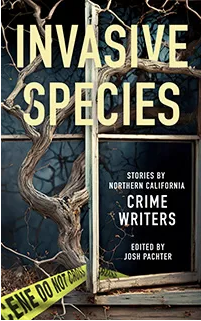
This weekend I’m in the Seattle area attending Left Coast Crime, a wonderful convention of mystery writers and readers. One of the highlights for me came on Thursday night, when the Northern California chapter of Sisters in Crime celebrated the official launch of its new anthology, Invasive Species. I’m thrilled that the book includes a story of mine. Called “Open House,” this tale recounts what happens two unwelcome visitors arrive at a showing of a home for sale.

So lately short stories have been on my mind, though not for the first time. I’ve always been fascinated by the power of stories and the joy of creating them. From the time I was very small, I thought of once upon a time as magic words with which to conjure a fascinating adventure. I started writing stories of my own when I was four.

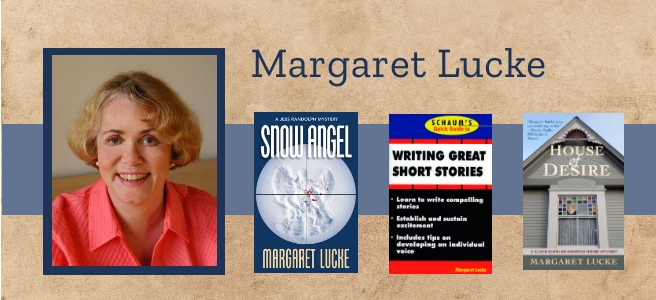
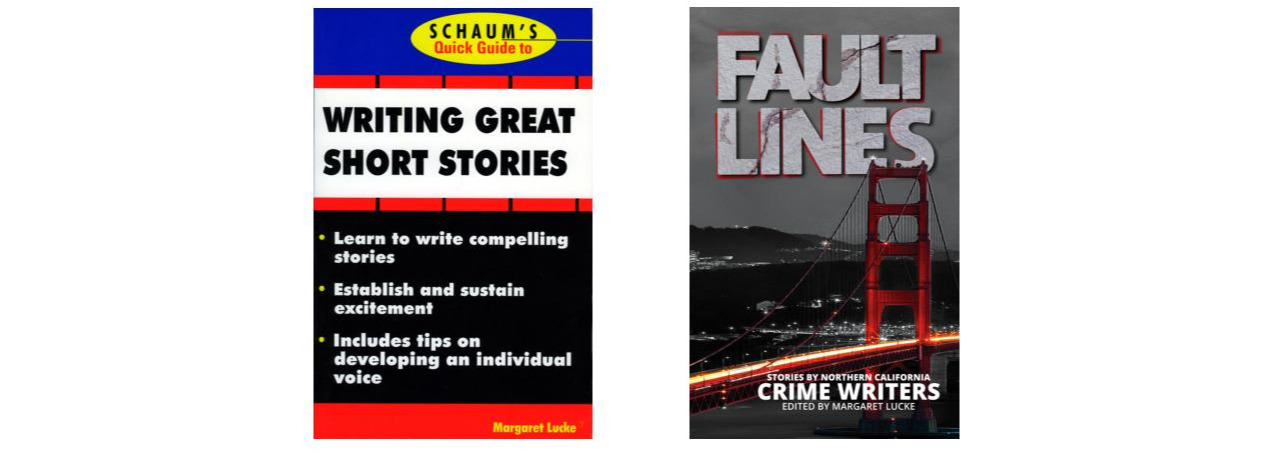
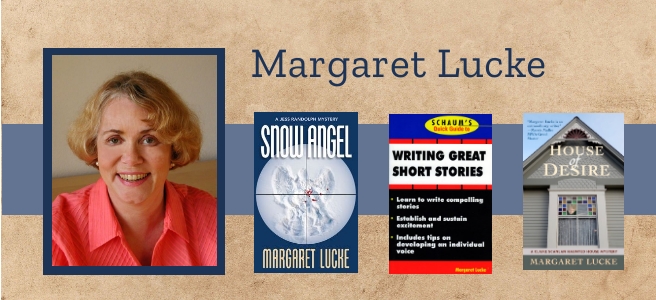
I teach fiction writing classes for the University of California-Berkeley’s Extension program. That gave rise to the opportunity to write a book for McGraw-Hill called Schaum’s Quick Guide to Writing Great Short Stories, which I’m told is a pretty good handbook for aspiring writers. I’ve edited story collections for a couple of authors, and a few years ago I had the privilege of being the editor for Sisters in Crime NorCal’s first anthology, Fault Lines.

What does it take to write a good short story? Writing a successful one takes less time than writing a novel, but in many ways it can present an equal challenge.

Not long ago, a local writers organization asked me to be the judge for their short story contest. A panel had narrowed the roster of entries to eight finalists, and my task was to choose which one would win first place.

It turned out not be an easy task. Too many of the entries were not, in fact, short stories. They were character sketches, anecdotes, or descriptions of random events. Some had no clear protagonist. In others, the narrative wandered around too long before settling into a plot. Several lacked tension. Too often, the narrative didn’t build to a logical ending, but simply stopped.

Since none of the stories stood out as the winner, I did a deep dive. After charting their strengths and weaknesses, I came up with a rating system, assigning scores to how well they handled characterization, plot, point of view, reader experience, language and style. When I totaled their points, the winner became clear.

When it comes to writing a short story, it helps to pay attention to two key words: short and story. That seems obvious, right? But it turns out that both words may be a little more complicated than they seem.

Let’s start with story, as this was something that several of the contest entrants didn’t seem to understand. In order to have a story, Something Happens to change a character’s life in some large or small way.

Here’s a definition I’ve found helpful:  A story is an account of the journey that a person takes as they move from one point in their life to another.

This might be a physical or geographical journey as the person moves from one spot on the map to another. The journey could cover a long distance, like a trip to a different city or a faraway planet, or a short one. Even getting out of bed in the morning can constitute a journey for some of us.

Or it might be mental or emotional journey, as the person gains new knowledge, new ideas, or a new understanding of themselves or others.

Early in the story, something happens that creates a challenge, a problem, or an opportunity for our person. So the person sets out on a path to meet the challenge, solve the problem or take advantage of the opportunity. Along the way, they encounter conflicts and obstacles that they must overcome if they are to succeed.

By the end of the story the person and their circumstances are different in some large or small way. Because of their accomplishment, or their failure, or the insights they’ve gained, nothing will ever quite be the same.

Change is the key—what is different for the person as a result of what happens? If there is no change there’s no story.

The protagonist in my short story “Open House” is a woman who, in midlife, is starting a new career in real estate. She is holding her first open house and has high hopes of having a buyer by the end of the day. That plan is derailed with the arrival of the two unsavory characters who are up to no good, but the encounter teaches her some valuable lessons about her own capabilities.

Then there’s short. Some sources define a short story as 10,000 words or fewer; others say 7,500. But it really depends on the market you’re aiming for. For Fault Lines we set a limit of 5,000 words, and I recently submitted a story to a different publication whose cap was 3,500.

But short means more than word count. It’s also a matter of focus. Compared to novels, short stories focus tightly on one event or sequence of events. They have fewer characters, cover a shorter timespan, and take place in a limited number of locales. They have room to raise and answer only one or two questions, to deal with only one or two themes. While a novel allows you delve into a complex series of events, relationships, backstories, and subplots, a short story requires you to make your point quickly and move on.

And while a novel might forgive you for meandering a bit, in a short story every single word has to pull its weight.  

Yet a short story also grants you a certain amount of freedom. You have the opportunity to to explore and experiment with language and form in ways that would be hard to sustain in a novel.

So go ahead and write your story in second person, tell it from the point of view of a giraffe in a zoo, and end it with an explosive twist. Have fun, and enjoy the challenge and creative reward that writing a short story provides.

Why I Read and Write Crime Fiction

By Margaret Lucke

Why is it that, when crime is so appalling, crime fiction is so appealing?

Both as a reader and a writer, I’ve always been drawn to mysteries and tales of suspense, and I suspect that most of my fellow Ladies of Mystery would agree. We’re not alone. Reliable stats are hard to come by, but I’ve from what I can find, mysteries and thrillers account for almost a third of all fiction sales. They’re entertaining to read and rewarding to write.

Here are some the reasons why I’m a fan and why I choose to write these kinds of tales.

1. Crime fiction offers great storytelling. I’m not a fan of fiction where a character, lost in thought, takes 200 pages to pour a cup of coffee. I want books where something happens, preferably something of significance to the characters involved. Crime novels satisfy because they have a plot and a purpose, a beginning, middle and end. They resonate with storytelling traditions that have captivated listeners and readers for thousands of years. What makes me happy is a good story well told. 

2. Crime fiction brings order from chaos. Mysteries comfort me with the illusion that there is order and logic in what is really a disorderly and confusing world. (As evidence of this, I offer you the year 2024.) Real life is filled with loose ends, unresolved problems, capricious twists of fate, and wrongs that go unrighted. In crime fiction I have the satisfaction of seeing order restored and justice prevail.  

3. Crime fiction answers the question: Why? One thing that distinguishes humans from other animals is the ability, and the compulsion, to ask why? Too often real life fails to provide the answers we crave, but as a fiction writer I must come up with explanations for what happens in my story. As I do, I sometimes gain insights that help me make better sense of the world and the people who share it with me.

4. Crime fiction imposes few boundaries. Crime fiction grabs people because it deals with life-and-death matters—the kinds of fundamental issues everyone must wrestle with. But life and death are such vast subjects that the genre offers an unlimited canvas. As a crime writer I can create intimate, personal stories or ones that are global in scope. I can examine the nature of people’s relationships with themselves, with each other, and with society. I can probe the depths of goodness and evil. I can set my stories against whatever background I choose and populate them with characters from any walk of life. Crime fiction is a framework that accommodates any theme, subject, or question a writer might want to explore.   

5. Crime fiction lets me taste the lives I’d like to lead. Who doesn’t sometimes long for a life that’s a little more exciting or colorful or adventurous than the one we actually lead? Through our heroes and heroines, crime writers get to experience those lives. When I’m writing, I can be a younger, thinner, braver person. I can travel to new locales, fall in love with ideal companions, and take revenge—on paper, of course—on the kid who snubbed me in junior high or the boss who fired me without cause. I can explore the dark side I normally keep hidden. I can take risks I never would in real life. I can rescue other people, maybe even save the world.

6. Crime fiction is challenging and fun. For me, mysteries and thrillers are reliably fun to read. But fun to write? Okay, not always—some days I’m blocked and frustrated, ready to tear out my hair. But I love the way writing crime fiction lets me be creative. It challenges my cleverness, wit, and problem-solving skills. Instead of solving a puzzle, I get construct ones that will, I hope, baffle readers. I dream up characters and have the thrill of watching them come to life on the page. I can’t think of anything I’d rather spend my days doing than write.

Those are my reasons. Why does reading or writing crime fiction appeal to you?

In Defense of Procrastination

By Margaret Lucke

“I used to just crastinate, but I got so good, I went pro.”
~ Seen on a T-shirt

My name is Margaret, and I am a procrastinator.

It’s 11:27 a.m. on Friday, and right now I am typing the first sentence of my post on time management for the Ladies of Mystery blog. The post is due to go live tonight at midnight. So I have twelve hours in which to get it written — and to accomplish all of the other items on my long to-do list for today.

It could be worse. If I had really perfected procrastination to a fine art, I’d be typing this at 11:27 p.m. on Friday instead of shortly before noon.

On the other hand, if I were any good at time management, I’d have written this post yesterday. Or last week. Or, hey, two months ago, like some of my fellow Ladies of Mystery, who are much more on top of their time than I am.

“Tomorrow is often the busiest day of the week.”
~ Spanish Proverb

Getting things done is simple, I’m told. You set priorities. You make lists. You break down a project into easily accomplished action steps. When I’ve tried doing that, I find it really works. As soon as I’ve finished my list, I make sure to take action on my next priority, which is to do a Sudoku puzzle, or take a walk in the fresh air, or make myself another cup of tea.  

“Never put off until tomorrow what you can do the day after tomorrow.”
~ Mark Twain

I used to feel bad about being a procrastinator. That’s because procrastination is usually talked about as if it’s a bad thing – a sure road to missed opportunities, a certain sign of laziness and sloth. Those annoying people who are on top of all of their tasks sneer at the rest of us with disdain and disgust. Their intent is to make us feel guilty and anxious, and too often they succeed.

But I think that when I’m confronted with an important project, it’s a good thing to take some time for mental preparation and to approach the work with judicious care. It saves me from slapdash results. And sometimes, if I procrastinate long enough, it saves me from having to do the work at all. The situation changes, and the need is no longer there.

Calvin:“You can’t just turn on creativity like a faucet. You have to be in the right mood.”
Hobbes:
“What mood is that?”
Calvin:
“Last-minute panic.”
~ Bill Watterson

I was gratified not long ago when I heard a radio interview with Berkeley psychologist Mary Lamia, about her book What Motivates Getting Things Done: Procrastination, Emotions, and Success. Lamia explains that there are two types of people: task-driven types who feel uneasy and anxious when pending work is going undone, and deadline-driven folks who are not motivated to act until they “feel the heart-pounding terror of an imminent deadline.” And she contends that both types are equally capable of doing quality work and achieving success.

So there.

“Procrastinate now. Don’t put it off.”
~ Ellen De Generes

In 2024, I Resolve To . . .

By Margaret Lucke

Here we are—halfway through January. Have you broken your New Year’s resolutions yet?

I recently came across this definition:

New Year’s resolutions = a to-do list for the first week of January

Maybe it’s true that most resolutions don’t last. In fact, a lot of people claim not to make them at all. But I sort of enjoy the annual ritual. If you’re like me, this is the year you’ve resolved to do things right—to break all your bad habits, finish all the projects you’ve been procrastinating on, and become that all-around perfect person you know you have it within you to be.

Most of my resolutions have to do with writing. It’s the same list I made last year, and the year before, and, well, probably every year since 2010.

If you’re a writer and you’ve neglected to make your own New Year’s resolutions, I hereby make you a gift of mine. I probably won’t keep them this year either, so someone else might as well put them to good use.

Note well: If carefully followed, these resolutions are guaranteed to lead to fame, fortune, and bestsellerdom. How do I know? Because they’re based on the never-fail counsel I’ve received over the years from how-to books, English teachers, and writers far wiser than I. Or is it than me?

That question leads me to:

Here are the rest of them:

3.  I will study the markets and never submit anything that is not tailored precisely to its intended home.
(I will also learn to read editors’ minds as well as their guidelines.)

4.  I will write about what I know.
(Hey, that puts me back to writing only once or twice during the whole year!)

5.  I will not try to second-guess market trends but will write only what speaks to my heart.
(Wait a minute—does anyone else detect a contradiction here? See Number Three.)

6.  I will keep pen and paper handy so that I can jot down ideas as they come to me.
(Especially those ideas that are so huge, so fabulous and solve so many plot problems that I could not possibly ever, ever forget them—until the next time I’m at my desk, when I will remember that I had this idea that was so huge, so fabulous … but I will have absolutely no recollection of what it was.)

7.  I will get organized.
(I’ve got a head start on this one. For New Year’s 2022 I bought myself a box of file folders. As soon as I find it, I’ll be all set to go.)

8.  I will eat right and exercise so that I will be in excellent shape for producing excellent work.
(That is, I will follow the Writer’s Diet Plan. It has been scientifically established that creativity is stimulated by the four basic food groups: caffeine, chocolate, wine, and nacho chips. And if getting up to refill your mug isn’t exercise, I don’t know what is.)

9.  I will quit procrastinating.
(Well, maybe I ought to wait until 2025 before committing myself to that one.)

10.  I will persevere, because writers with perseverance and no talent are more likely to succeed than writers with talent and no perseverance.
(All the books say so. Of course, it would be nice to have perseverance and talent both. Not to mention luck.)

11.  I will follow all the good advice I receive about my writing and ignore all the bad advice.
(And I will suddenly be blessed with the perspicacity to know which is which.)

12.  I will double-space my manuscripts when I submit them.
(Hey, I had to throw in one resolution that I might actually keep.)

So there you are—help yourself. Learn these lessons well, and let me know the minute these little gems make you rich and famous. And have a wonderful 2024!

The Holiday Season in Three Acts

Having you ever noticed that going through the holiday season is a lot like writing a novel?

Most writers of fiction are familiar with the three-act structure. While there are other models that can be used to construct a book, the three-act structure offers a handy method for building a plot. It works especially well for mysteries. It works like this:

Act 1–The Setup. In this act you introduce your Main Character, and then promptly make something happen that knocks your MC out of their comfort zone. Maybe they receive a mysterious letter, or a dead body shows up on their doorstep, or their kid is accused of a crime. This is called the inciting incident, and it creates a problem to solve, a challenge to meet, or an opportunity to take advantage of. The MC now has a goal.

Act 2–The Development. So the MC sets out to reach the goal, but it’s not easy. A lot of roadblocks, conflicts, and barriers are encountered along the way. The villain is elusive, red herrings steer the MC in the wrong direction, and a lot of questions evade answers. The plot twists and turns, tension tightens, and the suspense becomes unbearable. Will the MC succeed or fail? For a time, all seems to be lost.

Act 3–The Resolution. The big moment arrives. Everything has been building to this point. Now the MC’s ultimate success or failure will be determined. The villain will (hopefully) be vanquished, and all the questions will be answered. Reaching The End, the reader closes the book with a sigh of satisfaction and begins looking forward to the author’s next wonderful novel.

Right now you’re probably saying, “Sounds like a great story. I’d read that. But what does it have to with the holidays?”

Well, it occurred to me recently that the holiday season also unfolds in three acts.

Act 1–The Anticipation. We become aware that the holiday season is approaching. Or maybe it sneaks up on us; most years, that’s what happens to me.

This act can be fun, filled with hope and eagerness. This year, the holidays will go great. We make plans. We make lists. We ask questions: Will we celebrate at home or travel to visit loved ones? Who’s going to host the big dinner? What gift will please the picky nephew? What photo will we choose for the Christmas card? What do I want Santa to bring me? When will we find the time to accomplish everything on our to-do list?

Act 2–The Frenzy. Did I mention time? In this act, time becomes the villain. Too much to do, too little time. Now we’re in a frantic race to get it all done—shopping, decorating, wrapping, addressing, baking, searching for the missing gift tags, dashing from errands to parties to more errands. And all the while we have to keep up everything that makes up our daily lives during the other eleven months of the year. Our goal is to get it all accomplished in time to let us enjoy the rapidly approaching holiday. Will our juggling act succeed or fail?

Act 3–The Celebration. The big day arrives, or maybe it’s a stretch of big days. The frenzy of Act 2 is behind us. We can kick back, pour a cup or glass of our favorite festive beverage, and enjoy the twinkling lights and the smiling faces around us. It’s a joyous occasion, and just as we do when we finish a good book, we give a sigh of satisfaction.

Three acts to a book, three acts to a holiday season.

Whatever holiday you celebrate at this time of the year, may it be filled with joy, peace, and happiness for you and yours.