Recipes. Craft instructions. Math puzzles. Party planning tips. Some mysteries these days offer more than an entertaining read. They provide a gateway to a new, more creative lifestyle. Which is wonderful — so long as that recipe it’s inviting you to try doesn’t include arsenic as a main ingredient.
While my characters relish eating good food (as do I), none of my novels contain recipes, though occasionally I stir one into my author newsletter. You won’t find hobby hints or craft tips in my books either. I like to cook and enjoy dabbling at art, but first and foremost I’m a writer. That’s the main way that I express my creativity.
So what I really want is a recipe that I can put to practical use. Something that’s helpful as well as tasty. Like this:
MURDER MYSTERY BUNDT CAKE
Ingredients:
* 1 villain (or more) with the means, motive and opportunity for murder
* 1 victim (or more) who has the misfortune to be in the villain’s way or to have something the villain wants
* 1 clever and likable detective with a good reason to want to solve the crime
* A handful of the usual suspects, and maybe one or two unusual ones if you like that flavor
* Several tablespoons of clues and red herrings
* 2 or 3 cups of conflicts and obstacles
* A large measure of suspense
Instructions
1. Place the villain and victim in a large bowl and mix until the victim meets an untimely demise.
2. Add the detective to the mixture and blend until you have a thick, plot-like batter.
3. Whisk in clues and red herrings and beat until they are well hidden.
4. Stir in conflicts and obstacles. Note: There will be lumps.
5. Pour the suspense over the batter until it is completely saturated.
6. Transfer the mixture in a bundt pan and bake in the oven of your imagination until done. Baking time may vary from three or four months to several years.
7. Let cool but not too much.
8. Sprinkle with powdered sugar or drizzle on a chocolate glaze.
9. Cut, serve, and enjoy.
Try baking one of your own. I promise you it’ll be delicious.
Here’s a scene you’ll probably recognize. You’re at a cocktail party or a reception or some other event that involves standing around with a glass in your hand and making small talk with strangers. You’re chatting with someone you’ve just now met, and one of you says, “So, what do you do?”
The other one replies, “I’m a (fill in the blank). How about you?” After a brief exchange, you each nod politely and start looking around for someone else to talk to.
Some years ago, mystery novelist Linda Grant told me how she gave this standard, stilted conversation a new twist. Instead of mumbling, “Oh, how interesting,” when the other person named a profession, she would follow up with this: “Tell me, in your line of work who might you want to murder, and why? And how would you go about doing it? What weapons would you have at hand?”
The first response would be shocked silence. She could see the thought flickering in her companion’s eyes: What kind of nutcase are you?So she would smile and add, “Hypothetically of course. I’m looking for ideas for my next book.”
Then would come the sly grin. “You know, there’s this guy in the sales department . . . “
Almost everyone could come up with a person who would make a good murder victim, so long as it was only on paper. A backstabbing colleague, an overbearing boss, a customer who refused to pay a legitimate bill, a coworker who made everyone’s life hell by shirking responsibility or constantly cracking his knuckles. The types of victims and the motives for killing them seemed fairly universal.
What varied were the weapons—and it turns out that most of us have some at our disposal while we’re on the job. The car mechanic can tamper with the victim’s brakes. The clerk in the clothing store can wrap the silk sash from a dress around a person’s neck. The chef can chop a death cap mushroom into an omelet. The carpenter and the gardener can choose from several tools with sharp blades. The writer can bash someone over the head with a computer printer—and don’t think we’re not sometimes tempted.
At the time when Linda told me about her Cocktail Party Question, my husband and I owned a small printing business. The next day when I went to work I spent a few minutes doing a quick inventory of available tools for murder. We had cans of chemicals that were toxic or flammable, equipment that could be rigged to malfunction in ways that would cause its operator great bodily harm, a large paper cutter appropriately known as the guillotine. I found myself fingering the edge of the X-Acto knife blade. Very sharp, but too small to do the job? Maybe if it were pushed at just the right angle into just the right soft and vulnerable place on the body . . .
When I’ve taught mystery writing classes I’ve used the Cocktail Party Question as an icebreaker on the first day, pairing up students and having them ask and answer it for each other. At first all they can talk about is how weird the teacher is, but then they get into it, stretching their imaginations and beginning to see new possibilities for plots and characters.
Now it’s your turn. Choose your weapon as I pose the question to you: In your line of work, who might you want to murder, and why? And what weapons does your profession provide that could help you accomplish that dire deed?
Who knows, you now just might have the seed of a good mystery novel.
* * *
Speaking of mystery writing classes, I’m going to be teaching one of those this fall for UC Berkeley Extension. Ten Wednesday evenings from September 11 to November 13. It’s on Zoom so you can join from anywhere. If you’d like inspiration and information on crafting crime fiction, from cozies to thrillers, or feedback on your work in progress, this class could be for you. Check it out here: https://tinyurl.com/mysterywriting2024
Is it hot enough for you? Here where I live in Northern California, we’re sitting under a long-lasting heat dome—heat meaning 100° and more. And we’re not alone. Most of the country has been enduring extreme weather this summer—ultra high temperatures, severe thunderstorms, tornados, the season’s first destructive hurricane.
But at least we don’t have to endure oobleck.
Have you ever encountered oobleck? It’s green, sticky, relentless. It gummed up an entire kingdom and brought all activity to a halt.
As a little kid, I loved the stuff.
I discovered the green goo in a book in my kindergarten classroom: Bartholomew and the Oobleck, by Dr. Seuss.
Bartholomew is a lowly page boy serving the royal court of the Kingdom of Didd. The king has become bored with endless cycle of sunshine, rain, snow, and fog, and he summons his royal magicians from their secret cave and asks them to make something new come down from the sky. Bartholomew protests that this is a bad idea, but the king insists. The magicians oblige him by creating oobleck, and what results is a disaster of epic proportions. It’s up to the humble Bartholomew to save the day.
By the time I reached first grade, I’d read that book 1,247 times (approximately). I’ve been a big fan of weather in literature ever since. (If not always a fan of what’s going on when I step outside my house.)
Dr. Seuss violated the first of Elmore Leonard’s famous rules for writers, which is: “Never open a book with weather.” This book doesn’t just start with weather; it has weather on every page. Without weather, there would be no story at all.
And that’s very much in keeping with the reason Leonard gives for his directive. A description of weather may set a mood, but that’s not enough pull readers into a story. Readers want to meet the characters and jump into the action. They don’t care that it’s a dark and stormy night–at least, not until they see how the characters react to the storm and find out how it impedes the hero’s ability to solve the problem or meet the challenge set forth by the plot.
I’ve often heard it said that the purpose of fiction is to provide the reader with an emotional experience. Weather is one experience that everyone shares, and anyone whose heart has felt lighter on a sunny day or who has gripped the steering wheel tighter while driving on an ice-choked road knows that weather can evoke emotion.
When an author uses it well, a bit of weather can transport readers into the world of the story and help them relate to what the characters are going through. As E.L. Doctorow said, “Good writing is supposed to evoke sensation in the reader–not the fact that it’s raining but the feeling of being rained upon.”
Or being ooblecked upon. What a horrible mess that is! Excuse me while I try to scrape this green, sticky, gooey glop off my boots.
And whatever the weather is right now in your part of the world: Stay cool. Keep dry. Be safe.
The other day I received word that a short story I’ve written has been turned down by the publication I submitted it to. A disappointment for sure, but I like the story, and I’m confident I’ll find a home for it.
In the earliest days of my writing career, I read a biography of the iconic author F. Scott Fitzgerald. It mentioned that Fitzgerald received 287 rejections before he ever sold a word. He papered his bedroom walls with them. This may not be the exact figure, but it’s close, and it’s the number that sticks in my mind.
Let’s face it, rejection is a fact of life for writers. If we let it discourage us, pretty soon we’d be writing nothing but grocery lists.
Sometimes it’s hard to accept that no means no, straight and simple. When we receive a rejection letter, we try to read between the lines. Was my story rejected because it’s awful and I’m a terrible person who should never set my fingers on a pen or a keyboard again? Of course not, though with my first few rejections it was easy to read them this way. But there are lots of reasons why rejection can happen. Maybe the editor was rejecting everything on the day she read my story because a headache or a fight with her boyfriend had put her in a foul mood. Maybe my story was the twelfth one she’d read that week to feature a four-foot-high green-haired vampire as the detective and she was weary of concept by the time she got to mine.
Being on my way to assembling my own collection of rejection slips, I took heart from this. If a literary icon like Fitzgerald could be rejected that often, and persevere and succeed, then so could I.
I’ve discovered that there are hierarchies of rejection, and I’ve received them at every level. At the bottom of the list is silence. After you submit your work, you wait …and wait … and wait … for a reply, but you never receive one. Apparently the editor or agent you sent it to is too busy to say a simple no and assumes that if several months go by and you haven’t heard from them, you’ll figure out that they’re not interested. This is rude, in my opinion, but it has become all-too-common practice in today’s publishing world.
Next comes the basic form letter that says, “We regret that your submission does not meet our present needs.” Maybe that’s true, or maybe the publisher words it that way because it sounds slightly better than “Are you kidding? You were really thinking we’d ever publish something this terrible?”
Somewhat better is the form letter with the electronic equivalent of a handwritten scribble — the words “thank you” or, even better, a personal note.
At the fourth level is an invitation to submit something else “Try us again.”
If I’m really lucky I’ll achieve the fifth level, getting a comment that refers to details in the story so I know someone actually read it.
At the top of the pyramid is the personal letter so glowing and complimentary I have to read it twice to realize they’ve rejected me. Though I’ve never received one as flattering as this legendary rejection, purportedly sent to a would-be contributor by the China Economic Review:
“We have read your manuscript with boundless delight. If we were to publish your paper it would be impossible for us to publish any work of a lower standard. And, as it is unthinkable that, in the next thousand years, we shall see its equal, we are, to our regret, compelled to return your divine composition, and to beg you to overlook our short sight and timidity.”
At the other extreme, I’ve also never received rejections as chilling as these letters, cited by novelist Lawrence Block in one of his Writer’s Digest fiction-writing columns years ago. (Note: They weren’t addressed to him; they were examples provided by publishing industry sources.) The first was brief and to the point:
“I regret that I must return the enclosed shipment of paper as unsatisfactory. Someone has spoiled it by typing gibberish on every single sheet.”
The second provided detailed instructions to the writer, who had sent a literary agent a novel that was apparently a vicious racist screed:
“I suggest you take the following steps with regard to your manuscript. 1) Go out in the back yard and dig a hole several feet deep. 2) Place your manuscript at the bottom of the hole. 3) Fill in the hole and firm the soil in place. 4) Do not plant anything intended for human consumption in that portion of your garden for at least seven years.”
These make the standard form letter look good, don’t you think?
It’s time to send that turned-down tale of mine to the next market on my list.
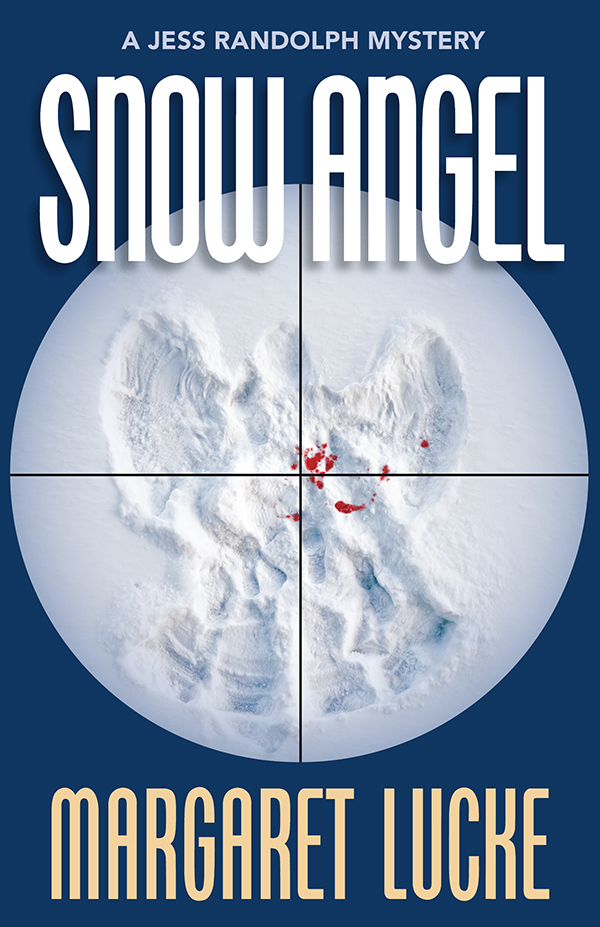
Jess Randolph, the star of my novels Snow Angel and A Relative Stranger as well as several short stories, is a private investigator and an artist, and she thinks of both of her twin professions as ways to search for the truth. Jess is following in the footsteps of a number of strong women who came before her, and I, as her creator, am doing that too. Some of our predecessors are well known, but these days others are too easily overlooked. So I thought I’d use this post to bring some of them to your attention.
Marcia Muller has been credited with launching the female private investigator in American mystery fiction in 1977 when she published the first Sharon McCone novel, Edwin of the Iron Shoes. Sara Paretsky (Indemnity Only, featuring V.I Warshawski) and Sue Grafton (A Is for Alibi, starring Kinsey Millhone) followed in her footsteps five years later. The three of them paved the way for many other mystery writers, including me.
No one can say these authors have been overlooked. They have many fans (including me), they’ve received high honors, and their series are landmarks in the mystery genre. All of them have been named Grand Masters by the Mystery Writers of America.
But what about their predecessors? It’s true that most fictional female sleuths prior to the 1980s were amateurs. Yet well before Muller, Paretsky, and Grafton published their first books, quite a few authors had written mysteries whose heroines worked as professional detectives — which was considered to be, as P.D. James pointed out in the title of her 1972 novel, An Unsuitable Job for a Woman. The woman in question was James’s character Cordelia Gray, who appeared again in The Skull Beneath the Skin.
Okay, P.D. James doesn’t qualify as an overlooked author either. However, consider these. How many have you read—or even heard about?
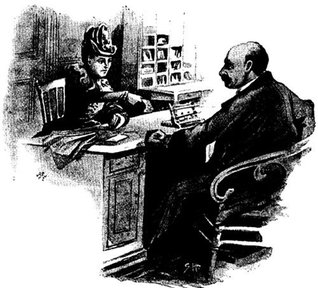
Catherine Louisa Pirkis, creator of Loveday Brooke (The Experiences of Loveday Brooke, Lady Detective, 1894). An unmarried woman from high society, Loveday has been forced by circumstances to earn her living. “Marketable accomplishments she had found she had none, so she had forthwith defied convention,” and signed on as an operative with a London detective agency. See her at left as she consults with a client.
Anna Katharine Green, creator of Violet Strange (The Golden Slipper and Other Problems for Violet Strange, 1914). A wealthy young debutante, Violet secretly works on occasion as a detective to earn money that her father doesn’t have to know about. She prefers cases “of subtlety without “of subtlety without crime, one to engage my powers without depressing my spirits.”
Jennette Lee, creator of Millicent Newberry (The Green Jacket, 1917, and two more). Middle-aged and middle class, Millicent starts her detective agency after working for another investigator. Interested in psychology, she is more interested in rehabilitating the wrongdoers she catches than in turning them over to the police.
Patricia Wentworth, creator of Maud Silver (Grey Mask, 1928, and 32 more books). A retired schoolteacher, Maud is a “private enquiry agent” who works with Scotland Yard. She uses her mild manner and appearance to her advantage, so that the villains in these cozy stories believe her to be harmless and unthreatening until it’s too late. Maud began as a secondary character and came into her own in The Case Is Closed, 1937.
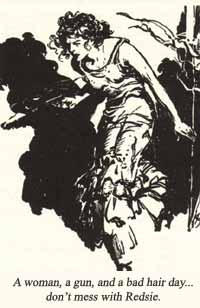
Roswell Brown, creator of Grace “Redsie” Culver (20 stories in The Shadow Magazine, 1934-1937). Despite being create by a man (Roswell Brown is a pen name of pulp writer Jean Francis Webb), Redsie is a gutsy, independent, no-nonsense woman. She works for Big Tim Noonan’s detective agency and has a penchant for fast action and chocolate sodas. She’s “nobody’s bimbo,” notes Thrilling Detective Web Site, “and an important figure in the development of female private eyes.”
Maxine O’Callaghan, creator of Delilah West (“A Change of Clients,” Alfred Hitchcock’s Mystery Magazine, 1974; Death Is Forever, 1980 and five more books). Delilah’s appearance in print predated the debuts of Muller, Paretsky and Grafton. In the first novel in the series, ex-cop Delilah goes after the man who murdered her husband, only to have the killer be murdered in turn and herself to be framed for the crime. You wouldn’t go wrong inviting Delilah to the same party as Sharon, V.I., and Kinsey. The Private Eye Writers of America honored Maxine with The Eye, their lifetime achievement award.
This isn’t an exhaustive list. Can you think of other forerunners to today’s female private eyes who have been overlooked and deserve recognition?






You must be logged in to post a comment.