What a Difference a Year Makes

by Janis Patterson

Ta-da! It’s really real! Finally!

As you probably know, one year ago (almost to this exact day!) The Husband and I went to Egypt to research a novel. My dear friend Dr. Dirk Huyge had invited us to come spend a few days at the El Kab dig house, which is formally known as Bayt Clarke. The house, built in 1906 by an English Egyptologist named Somers Clarke, is reputed to be haunted by his ghost. Unfortunately, Mr. Clarke did not make an appearance – though it wouldn’t have been difficult for him, as his grave is in the courtyard – but the rest of the trip was magical, from our time at the dig house to the flat we rented on the West Bank in Luxor that overlooked the Gurneh hills.

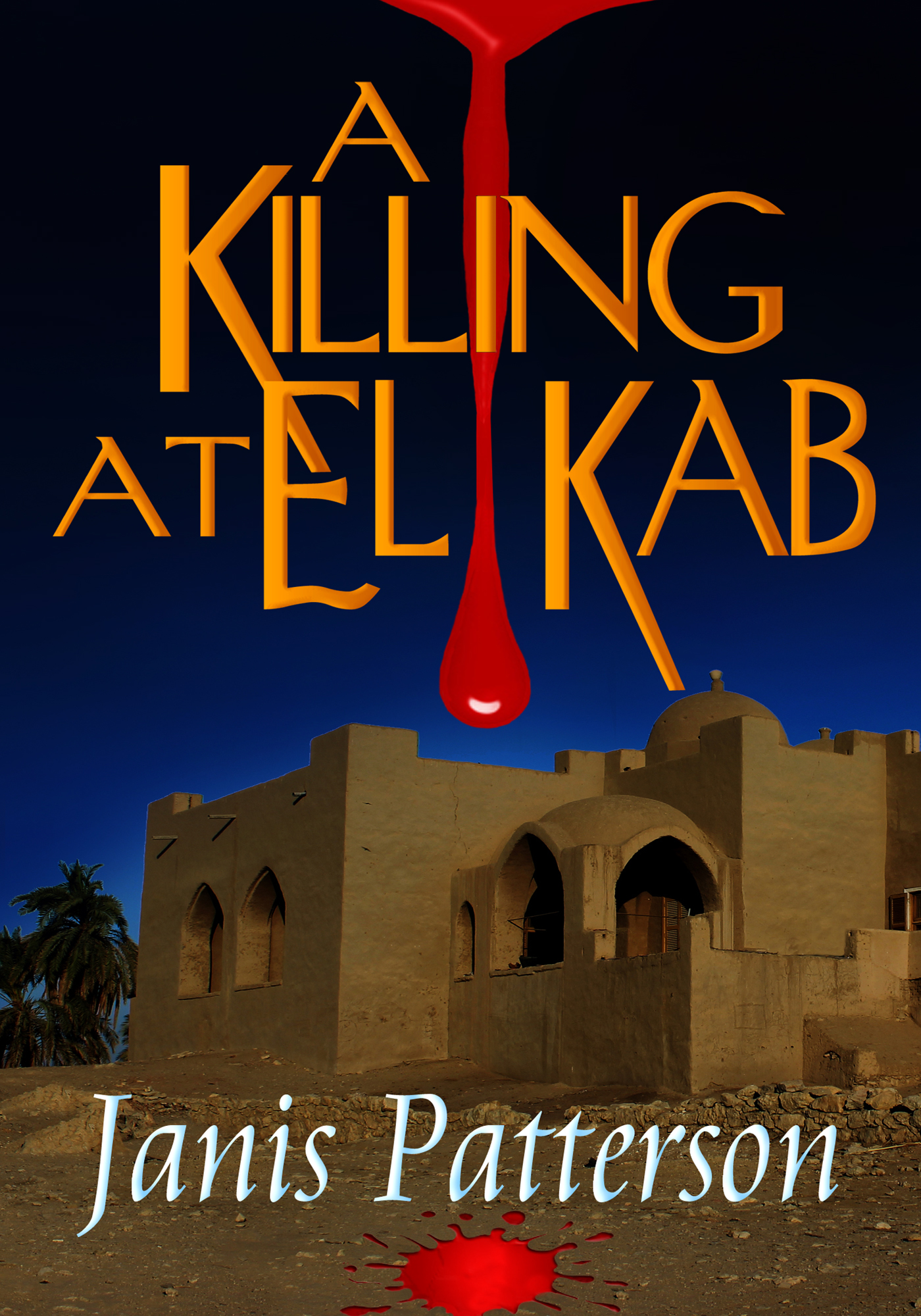
The result is my new book A KILLING AT EL KAB. It’s a straight murder mystery, but with the extra benefit of the reader being able to see an archaeological dig from the inside. Dirk was kind enough to be my advisor, reading the book in chunks as I wrote it so to be sure that it was as accurate as possible.

El Kab eBOOK COVER

I started the book while we were still at the dig house. I remember sitting very early one morning pretty much in the dark (pre-dawn) at the eating table on a most uncomfortable chair with a huge French door overlooking the Nile in front of me. I was typing furiously as the story danced through my brain faster than my fingers could move. One of my best memories of that trip is one afternoon (when the entire crew worked indoors after a long morning out at the excavation) I was sitting typing and could hear two of the crew members walking very slowly behind me. In tones of awe and wonder one whispered to the other, “She’s writing a novel while we watch!”

The official release date for A KILLING AT EL KAB is the 20th of March, chosen months ago because we were at the dig house on that date. I had hoped to have everything ready to release by then. Isn’t it true that when you really care about something everything that can will go wrong? Oh, the electronic versions of the book are great – the print version is apparently cursed.

So I made an executive decision. I took the electronic version and put it up as a pre-order on Amazon while I am wrestling with the malign cybergremlins who are playing with the paperback. This is a new thing for me – I’ve never done a pre-order before. After hearing some tales from other writers about the intricacy of putting up a book on pre-order, all I can say either I am an astounding genius (not!) or Amazon has made the pre-order process very easy (more likely). Anyway, it is available.

I made another executive decision – during the pre-order period the price is only $2.99 – it will go up to the regular price of $4.99 on the official release day.

The Husband laughs at my ‘executive decisions’ as I am terrible at making decisions – seeing me trying to choose from a menu is painful, as are my deliberations on what to wear to almost any function.

Some things just are ‘right,’ though, and A KILLING AT EL KAB is one of them. I am a very proud book mommy!

The Mystery of Romance – or is it the Romance of Mystery?

by Janis Patterson

Last weekend I was fortunate enough to be included on the panel at the public library sponsored Romance in Bonham, a nice county seat town a little over an hour away. The ladies of the library hold this event every other February, and it’s great fun. After the panel discussion and the book signing and everything is all over they provide the panelists and the family members they bring along a down-home potluck lunch. Always some of the best ‘lady food’ I’ve ever had! (Wish they’d do a cookbook…)

Although this is a romance-centric event, I brought several of my mysteries and was slightly astonished at the interest they generated. Apparently there is a growing interest for more mystery in romances – or more romance in mysteries. Both of which, I think, are a very good thing. For far too long readers and writers both have been pigeonholed into fairly rigid and unforgiving categories. Mystery was mystery. Romance was romance. Romantic suspense was a step in the right direction, but unfortunately it was soon codified into so much a percentage romance, so much a percentage mystery/adventure by most traditional publishers.

Now, almost in the manner of a superhero, self-publishing has started to break down the artificial barriers between genres, allowing them to become just stories with all kinds of elements. Want a mystery with lots of blood and danger and nary a kiss between characters? It’s out there. Want an exciting mystery where a couple falls in love while evading the bad guys/saving the world/whatever? It’s out there. Want a tender romance where a couple falls in love happily ever after while solving a usually gentle mystery? It’s out there. Want any combination of the above? Or just about anything else, including vampires, shapeshifters talking cats or kung-fu knitters? Even all at once? It’s out there.

I don’t know if the traditional publishers – the kind one finds on the shelves of your local bookstore, if there are many of those left – have twigged to how complete this revolution of thought is, but the virtual aisles of electronic/print on demand publishing are full of proof. You can find almost any permutation of any storyline now. Self and small publishing have opened up the world of stories, and readers/writers are no longer bound to restrict their desires to the small and rigid genres the trad publishers have decreed will make them the most money. True, in the days when traditional publishing reigned supreme and controlled not only content but distribution, print runs were enormous and had to be done ahead of release, then stored in gigantic warehouses. The publishers had to look to what would give the best return on their not-inconsiderable investment. Now, though, in the burgeoning world of electronic and print on demand self-publishing, such considerations are no longer the end-all and be-all of what’s available. Niche markets that were too small to interest the trad publishers are now flourishing and expanding.

And that’s all to the good. Choice is a good thing, and genre-blending is a good way to expand reader interest. If there is a downside, it’s that the freedom of self-publishing has opened the floodgates to an unbelievable amount of pure dreck. There are people who believe that not only putting down X number of words is writing a book, but that doing so will guarantee them fame and fortune. We can only hope that their number dies off quickly, because this wave of badly written, badly conceived and badly formatted messes is reflecting badly on self-published books as a whole. There are self-pubbed books (usually written by veterans – or perhaps we should say survivors – of the trad publishing industry) whose quality is unquestionably equal to or better than anything from the Big 5, but they are shadowed with the prevailing belief that all self-published books are rubbish. That’s a misconception that only time and persistence can alter. But it will, it surely will, and writers and readers the world over will benefit from it.


Dumb or Dumber

by Janis Patterson

I know when we write our villains we want them to be smart – smart enough, at least, to make our sleuth have to work to catch them, and look good when they do. If the villain isn’t a worthy opponent to our sleuth, the story is boring and not worthy of a book.

But is it like that in real life? Mostly, no. There are villains who lay complex plots with lots of red herrings and blind alleys or who skillfully cover their tracks, but they are – thankfully – rare. Let’s face it – most criminals are stupid, or they wouldn’t be criminals. There are even TV shows about how stupid some criminals are. Who hasn’t seen a film coverage of some burglar getting trapped in a chimney or a doggy door, or committing equal stupidities and having to be rescued by police?

Moving it up a level, murder/attempted murder/aggravated assault is a little different. Most burglars/thieves have to do some kind of pre-planning, however little and inadequate. Murder and its attendant variants can happen in the blink of an eye or be planned for a long time. The spur-of-the-moment murder is usually the easiest one to solve and in general is unworthy of our sleuths. If two guys are drinking and fighting and one of them ends up dead while the other is found still holding the gun… no book-worthy story there. On the other hand, the victim dead but seemingly asleep in a locked room… is it murder or is it natural death? If it’s murder, who among the victim’s many enemies did it? And how? That is a problem worthy of our sleuth!

So how do we do this in our writing? How do we make our villains into real people with hopes and dreams and desires? Remember everyone including villains is the hero of their own story – i.e., in their own mind. They have to have a reason for doing it, and never forget that whatever that reason is, it has to make sense to them. While killing someone because they wore purple on a Thursday seems absolutely mad to us, it must mean not only something but something very important to our villain. Remember those old super-hero cartoons of the 70s where the villain screams that he serves evil and does everything he does because it is evil? Doesn’t make much sense outside of a cartoon, unless the villain is a certified mental case, and I’m not sure even then the story is worthy of a book. Even the mad must have their logic, even if they are the only ones who can understand it.

Frankly I’m very glad that most criminals are stupid and therefore caught – in real life. In fiction, however, I love the crafty villain and the intrepid sleuth to be equally matched… at least, almost equally matched. I also like the sleuth and therefore justice to prevail. That makes a story worth reading.


Say What?

by Janis Patterson

I read… a lot. Lately, however, it hasn’t been as pleasant as it used to be and more than a few books have hit the (metaphorical) wall. Without exception it’s the fault of the authors. Nearly every one was a first time author – I did verify that, but it really wasn’t necessary. Their writing said it all.

One of the most common (and worst) errors is a misuse of words. Not quite as bad as the homophonic mayhem such as broach/brooch or affect/effect or grisly/grizzly and the like, which sadly are quite common even among multi-published professionals, but I’m talking about the more egregious mis-choice of language. I’ll explain; there are two kinds of word usage – dialogue and exposition. Dialogue is what the character actually says/thinks – what actually comes out of the character himself.. Exposition is telling what is done.

I believe that dialogue should be true to the character speaking. (And in ‘dialogue’ I include written communications by the character – letters, texts, etc. – anything that is ‘spoken’ by the character, such as interior thoughts.) Is the character a crusty old fisherman who hates people? A feisty young heroine-type who prances through life cooking, talking with her cat and showing off her shoes? A silent but heroic Navy Seal with a deep sense of patriotism and a distrust of women? A culture-vulture society woman with a drive to climb higher on the social ladder? All have the potential to be great characters, but they shouldn’t sound anything like each other. They all need their own voice.

Each character has (or should have!) their own history, their own background, their own socio-economic standing, their own individuality. That means they have their own character-specific language, their own vocabulary, their own rhythm of speaking whether exterior (speaking to other characters) or interior (thoughts, letters, etc.). You can get away with almost any kind of grammar/word choice in dialogue AS LONG AS it is congruent with the character speaking and the time/location frame of the story. For example, you would not have a Regency dowager or a 1850s Plains Indian saying “Fer sure” or “You’ve got to be kidding me.” If you do have a social doyenne speaking like a dockworker or vice versa, you’d better have a very good reason for it stated in the book.

Expository writing, however, is different. This is everything that is not dialogue. This should be written by grammatical rules with correct and perhaps neutral vocabulary. Even in deep third POV expository writing is the author, not the character, and should be correct both in grammar and word choices.

That said, remember first person works have their own problem, for there the expository writing is from the viewpoint character and should reflect his age, status, attitude and general personality.

Correct use of both dialogue and expository writing can give your characters a depth and life. Done correctly, the reader should be able to determine who said what by the language they use, even if you don’t add a dialogue tag. However – both using a dialogue tag and not using one are constructions which should not be overused.

Writing is always a balancing act, but it becomes easier for both the writer and the reader when the languages choices are correct to the character.

Catching Up


by Janis Patterson

This is going to be short, because – quite frankly – I’m tired. I was away from home more than half of September. A wedding in Boston; a wedding in Alabama; a family reunion in East Texas; the Novelists, Inc. conference in Florida. Whew! My luggage has never been fully unpacked this entire month and our beloved furbabies – two neurotic cats, one prissy little dog – probably thought we had abandoned them to the boarding kennel. They’re home now, and hopefully they’ll forgive us before long.

We got in late last night and this morning I went to pick up the furbabies. Had to do two trips – three carry cages in the car is just too much; besides, I don’t really like the odds of being outnumbered three to one. Got them all home, plugged in the cat pheromone tranquilizer (wonderful stuff!) and let them run. Big cat Chloe has taken over my lap, which makes typing difficult, prissy little dog Mindy Moo is lying right where my feet need to go, and oldest cat Squeaky Boots – a tiny thing of 6 lbs who rules the house with an iron paw and a single deadly little fang – has taken over our king-sized bed by sprawling in the exact center. Yes, life is back to what we laughingly call normal.

My work isn’t, though. Sigh. Wonderful month, saw lots of people and places and learned lots of things, but my writing this month has totally gone south. Barely ten pages all month. Lots of ideas, lots of plotting, even a nifty idea for a mystery series – which has garnered some interest, believe it or not – but two books that desperately need finishing and two more ready to be self-published, all  ignored.

Well, that will change tomorrow, just as soon as I hit the grocery store and lay in enough supplies to make sure that The Husband and I don’t starve to death. Though with all the wonderful meals out we’ve had in this month that eventuality is far from being a worry. I still say that whoever invented elastic waistbands deserves instant canonization.

If there is anything that I have learned in the last couple of decades of being a writer, it’s that you can’t plan. You can make all the business models you want, set up all the spreadsheets and project charts you like, but life can and will get in the way. I guess that’s true in any other field as well, but it seems to affect writers and artists more.

Like the NINC conference – without doubt the best conference for professional working writers on the planet. In three and a half very full and very long days I learned so much that my head is about to explode. Unfortunately, there was so much that I learned – stuff that really should be done NOW for the advancement of my business – that somehow the writing of new stuff gets shoved even further back. I did take my tablet and computer to Florida just so I could work in my down time, except there wasn’t any down time. When I wasn’t in workshops or exchanging information with other writers, I was trying to enjoy a little time with my adored Husband in a tropical paradise. Work? What’s that? Sleep? Who needs it?

Anyway, I have already made and paid for our reservations to next year’s conference, and will contact the hotel about rooms tomorrow or the next day. I’m already excited.

And tired. So – please forgive if this is a less than coherent post. My mind is going off in twenty different directions, and my body is going to bed. Night!