Narrative and Dialog by Heather Haven

Unlike the past, today’s mystery fiction has a lot more chit-chat between characters. There was a time when an author would write pages and pages of narrative describing the contents of a room, clothing, or the physicality of a character down to nose hairs. Oftentimes the narrator would describe how the characters were feeling rather than having them say the words for themselves. I’m thinking of Wilkie Collins’s The Woman in White, which may not be the first detective novel ever written, chronologically, but it certainly is one of the earliest. I can remember reading most of a chapter with nothing but descriptions of a room or an entering character before anyone actually spoke a word.

But even writing has its trends, and today the style for the most part, is to keep narrative to a minimum. It’s often described by instructors as, “Show. Don’t tell.” Speaking of trends, it has become incumbent upon the writer to use the word “that” only when absolutely necessary. No writing “I wish that I could go.” No, no. Today we write, “I wish I could go.” It may be cleaner, it may be neater, but sometimes I miss my “that.” 

But back to narrative writing. Today a description of something might go on for a paragraph or two, maybe three, and then it’s time to have somebody talk. Rarely are there rambling, run-on sentences about an overhead chandelier, unless, of course, it’s about to drop on somebody’s head and start our mystery going. Of course, there are exceptions to this rule (and YOU may be one of them). P.D. James, for instance, will turn over two, three, or four pages of a chapter to the victim’s study, even describing furniture in great detail. Carolyn Hart starts out the majority of her novels with elaborate details on the wants, needs, and secrets of every character who may be a potential suspect. And these ladies write one dang, fine mystery.

But for many of us, we like to keep the dialog rolling. That means we are extra careful with the words we choose for our characters to say. Every character speaks differently, has different word choices, and a unique rhythm or cadence. The dialog sets up who and what they are. It also helps to separate one character from another, without having to add “she said, he said.” The words in the sentence tell the reader who’s speaking. I have two distinctively different protagonists and the fact they are both women, roughly the same age, and private detectives means little. These two women are as different as a Schlitz Beer and a shaken, not stirred, extra-dry martini.

At 5’11” tall and 185 pounds, Persephone “Percy” Cole lives in lower Manhattan during the 1940s, is divorced, and has an eight-year-old son. World War II looms overhead. Percy is one of the groundbreaking women detectives of the time, lives in a man’s world, and faces that challenge readily. Whoops! Used the word “that.” Dang. Back to Percy. She is a savvy, street-smart woman, who takes boxing lessons and will sometimes punch out a criminal if they ask for it. And maybe if they don’t. She not only uses the colorful language of New York’s 1940s, she is a woman of few words and a lot of action. She uses phrases like, “Oh, yeah? Sez you.”

Enter Liana “Lee” Alvarez, the other protagonist. Lee sparkles in today’s  Palo Alto, California. She is 5’8″ with a dancer’s body, and a face reminiscent of Elizabeth Taylor in her glory days, should anyone be old enough to remember dear Liz. Lee’s now deceased father was a Mexican immigrant who made good, and her mother a blueblood from one of Palo Alto’s first families. Lee’s often torn between who she is, who she should be, and who she wants to be. But she is above all an ace private investigator, albeit in designer clothes, and a credit to the family-owned, Silicon Valley detective agency. Recently married, she has a blackbelt in Karate and can take care of herself. Lee utters things like, “Listen, I don’t mean to be rude, but if you’re going to wave a gun in my face, I’m going to take it personally.”

And then, of course, all the family members, side characters, and people I throw in and out, all have their own way of speaking and their own choice of words. From a one-liner to a major character. I can hear them in my head. Like an earworm.

What’s in a Title? by Heather Haven

A lot of times the story itself comes fairly easily to me, but the title often doesn’t. What to call my novel? How do I catch the reader’s eye and have them want to buy my book, just by reading that stellar title? How, how, how? Hmmmm.

And to make things worse, book titles seem to go through fads or phases. For instance, the word “girl” has been used in just about every best-selling book’s title in the last few years. While using that word may not have catapulted them to becoming a best-seller, the following books were best sellers: Girl Gone; The Girl on a Train; Girl, Interrupted; Girl with the Pearl Earring; The Other Boleyn Girl; and of course, Stieg Larsson’s trilogy, The Girl with the Dragon Tattoo; The Girl Who Played with Fire; and The Girl Who Kicked the Hornet’s Nest.  

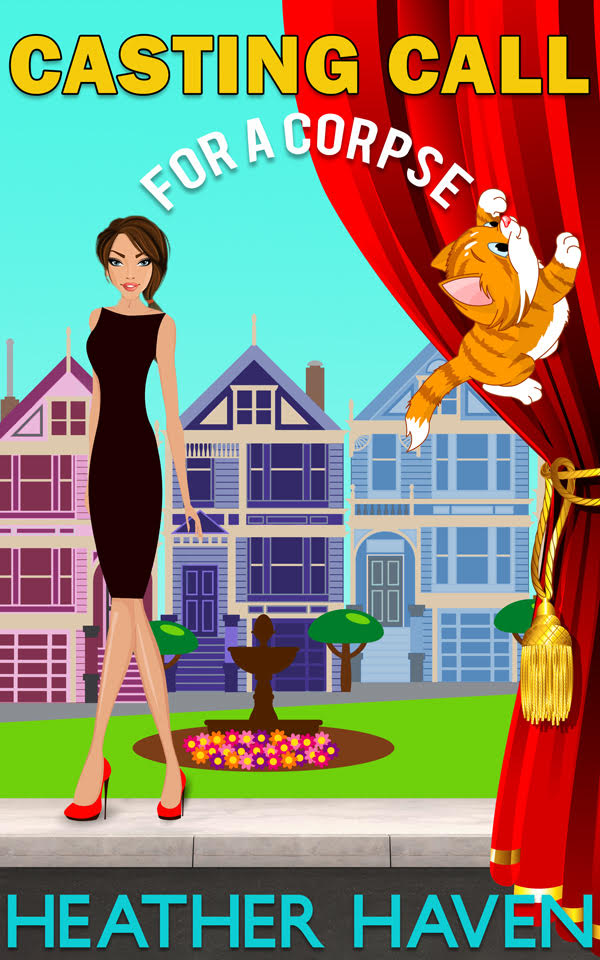
Hence, I decided to use the word “girl” in the title of a book and see what happens. I came up with Girl, Girl, Girl (see book cover). Amazingly, it didn’t sell. Maybe my heart wasn’t in it? Besides, I don’t think of human females as girls unless they’re under the age of 17. I’m not sure why that’s my cut-off age, but it is. I think once you’ve graduated from high school, you’re a young woman. Girl-kid, Woman-adult.

Often the title lets the reader know what kind of book they will be reading. I hope I’ve done that with my books. Whoops. The exception to this was the title of the very first book of the Alvarez Family Murder Mysteries, Murder is a Family Business. Looking back on it, I believe the title conveys a weightier book than mine. I had forgotten a famous crime syndicate called, Murder, Inc. was still in a lot of people’s minds. Guilt by association was my problem. Some readers, especially men, bought my book thinking it was going to be yet another exposé of the mob. Or possibly a written spin-off of the movie Murder, Inc, the film that launched Peter Falk’s career in his first major role as a contract killer.

Yikes. None of the above is anything like my book, a light-hearted romp through California’s Bay Area where not only is the murderer brought to justice but the shoes and handbags match. If I could, I would change the title, but the book has been hanging around for a certain amount of time, has had some small measure of success, and, besides, I can’t think of anything better. So, Murder is a Family Business it remains.

But since that goof with the first title, I tried to be careful in naming the rest. My latest book, a work in progress, has the working title, Bewitched, Bothered, and Beheaded. Hopefully, it conveys magic and murder. And if someone thinks of a guillotine, so much the better.

In closing, I should probably mention the title of an Elvis Presley movie, Girls, Girls, Girls. It has nothing to do with any of this, but I am a huge Elvis fan.

Bewitched, Bothered, and Befuddled Am I by Heather Haven

I’ve lost my mind. Again. I have begun a new novel on a subject about which I know absolutely nothing. Zip. Nada. I did it again. Did I not learn my lesson from the last Alvarez Family Mystery, The Drop-Dead Temple of Doom? Apparently not. But that’s a writer for ya. Or at least, that’s me for ya. I get an idea, I embrace it, I love it, it becomes mine, and I’m off and away.

It’s only when I plop myself down at the keyboard and have no idea how to start the first sentence do I realize I am in deep doo-doo. That’s what happened with Drop-Dead. My fingers hovered over the keyboard waiting for words to come to me. They didn’t. I had no idea what a Guatemalan jungle was like. I didn’t know the first thing about archeology. And, truth be told, an ancient Mayan could have risen from the dead, bit me on the knee, and I wouldn’t have had the first clue as to who, what, or why. I left my office and dove headfirst into a martini, the first of many. Ernest Hemingway may have said, “Write drunk, edit sober,” but you gotta know SOMETHING about a subject before you can write about it.

I have to do a little research for all my novels, but I had pushed the limits on this. A Guatemalan jungle? Even though I was born and raised in South Florida and have been to Parrot Jungle, it’s not the same. Archeology? Simply because I’ve streamed “Lost Cities With Albert Lin,” that didn’t mean I knew the first thing about digging anything up other than weeds. And the ancient Mayans? Ditto, ditto, and ditto.

But I had a fire in the belly. I wanted to tap into the real-life story of a young woman who is an Indiana Jones of today. I’ll call her Indiana Josie. She tromps around the jungles of Guatemala uncovering all kinds of wondrous things. And thanks to the development of LIDAR (Light Detection and Ranging), the exploration of ancient Mayan cultures has exploded. This is truly the golden age of discovery for this remarkable culture.

So began a crash course in not one, not two, but three subjects. As the world was in lockdown from Covid, even if I’d wanted to fly to the jungles of Guatemala for firsthand experience, I couldn’t have. Instead, I bled Indiana Josie dry of any knowledge she could give me. I watched every documentary on archeology, not merely as a spectator, but as a student. I read anything I could find on the ancient Mayan culture, gasping at pictures of their paintings, jewelry, and tombs. I marveled at what they had created, believing as many do, they rival the Egyptians in many ways. Eight months later, while not an expert on any of these subjects, I was able to sit down at the computer and write.

After completing the latest novel in my other series, Hotshot Shamus, Book 4 of the Persephone Cole Vintage Mysteries, I now return to the Alvarez series, with Bewitched, Bothered, and Beheaded as the next project. For whatever reason, I decided to write about a magic trick gone wrong, a dead magician, and the protagonist, Lee Alvarez, as the chief suspect. Belly fire returning. No antacids working.

Of course, I find I am in deep doo-doo again. I know nothing about the subject, nothing about magicians or their tricks. Leave it to me to have a misadventure with a guillotine trick front and center, basically starting the story off. Naturally, I can’t write a word until I investigate this. So it’s off to Vegas for a crash course in magic. I recently contacted David Copperfield for an interview. Start at the top, right? Maybe he’ll give me a few tips. If not, I’ll work my way down. I hear there’s a magician, Melvin the Magnificent, performing in a San Jose parking lot. Maybe he’ll talk to me.

Meanwhile, I need to face it. I just never learn.

On The Writing of Percy Cole, an Off-beat Heroine by Heather Haven

Bear with me if I’ve said this before, but The Persephone Cole Vintage Mysteries were born out of a challenge by my then-publisher to write a protagonist who looked and acted more like a real person, not a model. Could I do it? Did I even want to? Did I want a heroine who wasn’t typical of many a detective story? After I thought about it, the answer was yes! I wanted to write about a smart woman who wasn’t Mad Men classically feminine. And of course, I wanted it all. She should like herself and be comfortable in her own skin.

So along came Persephone (Percy) Cole. Percy is 35 years old and considered middle-aged by ’40s standards. She’s also a single mother, overweight, and at 5’11” is extremely tall. Sound like a winner? But Percy Cole is! Because as Winston Churchill said, “Attitude is a little thing that makes a big difference.” And Percy has attitude up the wazoo. She exudes self-confidence. She’s smart and savvy. She’s a no s–t lady. I just love her.

They say you don’t know what you’re writing until you’ve written it. Well, little did I know that by making Percy as large if not larger than many men of that era, she was able to compete in a man’s world in every way, including physical intimidation, a very ’40s-PI-Noir thing. Percy doesn’t use physical threats all the time, but she’s not above it. Her grabbing some lowlife by the scruff of the neck and hauling him off to jail is just plain fun to write about. And readers seem to like her fearlessness, her sense of self, of not compromising, which is all done with humor, style, and a touch of whimsy.

Yes, Percy’s tough to the core, but I do try to show a bit of softness through her dealings with her mother, father, kid sister, and in particular, in the raising of her eight-year-old son, Oliver, the child that gives her life meaning. Frankly, it is a rare woman who does not deal with family and family matters, no matter how tough they are. Even Wonder Woman (see linked article). Of course, Wonder Woman is a real hottie. But Percy has her moments; she has her moments. There are men who fall for this redheaded broad with her wicked sense of humor, who knows how to make her way in the world. All very enticing. All very Percy Cole.

Hotshot Shamus, book 4 of the Persephone Cole Vintage Mysteries, debuts on May 7th and at a preview price of $2.99. Yayyy!

The Waxing Moon and Me by Heather Haven

Occasionally, we writers write ourselves into a corner. In some ways, it can be fun. It can be a challenge. And being the inventive sort that writers are, we often come up with a pretty nifty bit of business to get out of these scrapes. The bonus is the story often improves, becoming more colorful and interesting.

However, you can’t do that sort of thing with Mother Nature. You have to stick with what is scientifically possible. Unless you’re writing fantasy or sci-fi, of course. Then you can have a green sky and 6 moons. But here on earth, we are stuck with one orbiting satellite, which tends to do its thing consistently. In fact, we have come to expect the moon to behave in a certain way. I happen to write cozy mysteries such as the one I’m doing now, Book 4 of The Persephone Cole Vintage Mysteries. They take place on earth, so I can only diddle around with the truth of it so much.

As I neared what I hoped was the final round of rewrites for Hotshot Shamus before sending it off to my editor, I realized I had several scenes and chapters taking place during two full moons. Unfortunately, these full moons occurred only 10 days apart within the story.

I am not a scientist but even I know there have never been two full moons in that short a space of time. Something catastrophic would have to take place for that to happen. Given the state of the world right now, I didn’t want to go there.

I tried not to panic. Maybe I could turn one of the full moons into a new moon? No, no, no. A new moon is just a full moon coming back within the same calendar month. And it usually happens 25 to 28 days apart.

Time to panic? I couldn’t leave it as it was and I couldn’t abandon the moon being a part of the prose, either. Like many writers, I often make the atmosphere a character in the story. So, it was with this stupid moon. A driving character, too. Did that mean I would be rewriting 4 to 6 chapters worth of story to correct this error?

If I had to, I had to. But I wouldn’t be happy.

After several pieces of chocolate washed down by a martini, I decided to research the moon in all its glory. Maybe the moon did something I didn’t know about that would bail me out. After all, it’s a good moon, a lovely moon, a romantic moon. I even look ten years younger in the moonlight. Moon, don’t fail me now.

Then I stumbled upon what is called a waxing­­­­ gibbous moon. Somehow that particular phase of the moon got by me. I’d never heard of it before. Waning, yes. That rang a bell. But waxing? No. Gibbous, excuse me?? Come to find out gibbous means marked by convexity or swelling of the moon or a planet. Well, I never. Maybe I was in Study Hall when that lesson took place.

Panic avoided. The beauty of a waxing gibbous moon is it turns into a full moon after about 8 days. That’s close enough for my needs. And bless its little heart, it can shine enough light the entire time to save my scenes and chapters. Just a tweak here and there and all became perfectly reasonable.

Ain’t Mother Nature wonderful?