
Everyone goes on about worldbuilding, but what if all you need is a town? Say a small town, population about 2,200, with an immigrant problem and burgeoning industry set at the very edge of the disappearing prairie, circa 1876. Or any town.
Design the Town You Need
It helps, of course, to have a plot line to build your town around, one that maintains historical context and is informed by the design of other small prairie towns. If this town is to be durable, say the focus of a series, you need to design it so that it can grow or shrink. Did the town spring up from a hell town (built during the laying of the railroads) or did it grow out of the land as people migrated west?
Define Its History
For instance, did it exist during the Black Hawk War? What happened when men, left wandering by the Civil War, who needed work, any work, were lured by the stockyards, coal vein, and wagonmakers to your town? Where do these men lodge? Does the town accept them, or must they camp or build somewhere else? Where? What other camp followers arrive?
Check out a Similar Small Town
Research a similar small town. If you’re lucky, you’ll discover an active historical society website. One with archival pictures and a town directory with business listings, goods and services available, and local surnames. Then picture your city center. What do the stores look like? Is there a boardwalk, or are the stores at street level? Are the streets paved? Is there a distinct residential area? A park? Schools? Do you see your town when you close your eyes?
Draw a Map
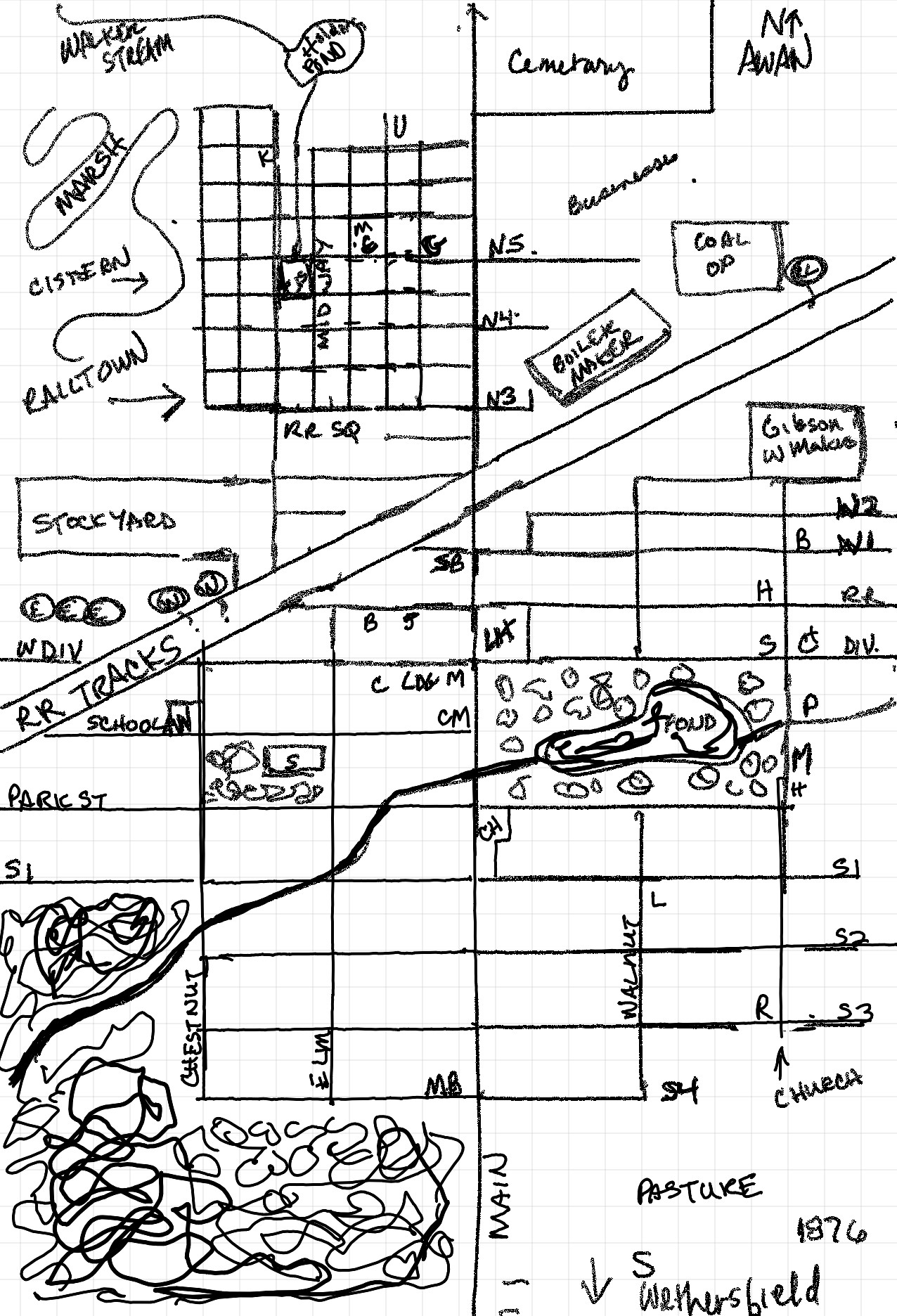
If so, sit down and draw a map. You’ll need it, whether for a series or a standalone, to maintain consistency across books and chapters as your characters interact in and with its spaces. Maybe the first map is a sketch, with subsequent maps providing more detail as the town grows or shrinks. The butcher shop needs to be in the same place each mention, until it burns to the ground.
Add Flora and Fauna
Now that you have your town, what trees grow there? Shagbark hickory, willow, chestnut, walnut? Check with the state agricultural organization to learn the native trees. Flowers? Bugs? Smells? Then study them until you can describe each accurately. Check the weather, too. Seasonal temperatures. Cycles of rain and drought.
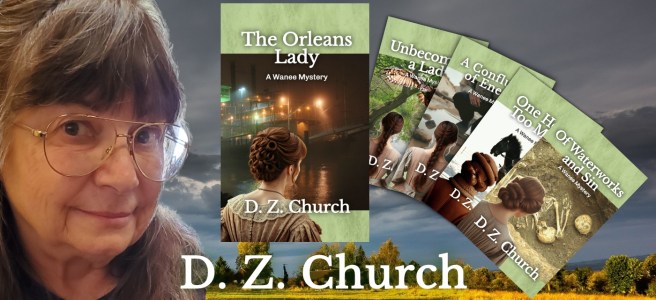
“In a normal year, the creek would be ten feet wide and several feet deep, with water lapping the banks. But this was no normal year. It hadn’t rained in Wanee since early June, leaving the creek narrowed with eddies of blue-green growth where fresh water had once flowed.” From “A Confluence of Enemies”.
Or blanketed in snow.
“The porch of the Presbyterian manse threw light across the glimmering lawn to the walkway, where it bounced off the dancing snowflakes accruing at their feet, enough that they left tracks etched in the thin layer of white as they strolled.” From “One Horse Too Many.”
Define the Town Folk’s Perspective
Finally, how forward-thinking are the citizens? The 1870s were a time of heavy migration and industrial change. As a rule, small rural towns didn’t have city water, central heating, or telephones. But if Lyon and Clinton, Iowa, had a telephone exchange in 1877, why can’t your little town? With the new boiler plant, wouldn’t central heating be available to those willing to pay? And if an artesian water source produced sufficient flow to fill a raised tank, why couldn’t your town have city water despite small-town water systems being rare until the1890s? After all, Chicago had city water in 1842.
Bring It to Life
It’s your town; now do with it as you please. Add characters, the good and the evil and let them roam its streets, finding bodies in trenches for the new water system, floating in the town pond or dead in a dry riverbed. But mostly have fun discovering the mysteries lurking within your town limits.
For more information about my books, check out https://dzchurch.com, where you can also sign up for my newsletter and learn some other cool stuff.


I use towns I know. I’m a visual writer so I have to be able too see my locations. Your idea of creating a map would be helpful.
LikeLike
Good post! I have maps of all my fictional towns. Otherwise, I get lost when my characters are chasing someone or looking for someone. 😉 I even made a map/floor plan of my fictional Spotted Pony Casino.
LikeLike
A wonderful and informative post. Many of my books use real locations, places I am familiar with. However, for The Sacrificial Daughter, I made up a town as well as a county. I didn’t draw a map but I seem to have one in my head.
LikeLike
This is a great plan, and a great course for writers. I have a terrible time with distances in the abstract, so I always write about a place I’ve been and know fairly well. The few times I’ve tried to make up an area for a story have been duds, and I’ve moved the plot elsewhere. I rename the real place, along with streets, etc., and put whatever I need (businesses, landmarks, etc.) where I need it. Your post is a great lesson for people like me.
LikeLike
Wow! Great post. I never actually drew a map of my make-believe town, Snow Lake, in the book Christmas Trifle. I always kept it mental. Now, five years later, I wouldn’t be able to find the characters’ home, their restaurant, or even remember the streets on which everything sits without rereading the novel. I do plan a sequel and this would be a good time to draw a map aforehand and see what I’ve got. Once I reread the novel. Thanks!
LikeLike
There’s a real Snow Lake in northern Manitoba, Canada. Maybe you can get some good ideas from having a look at it.
LikeLike
No kidding! And here I thought I was making it up. Of course, I put my Snow Lake in Northern Nevada. Thanks for letting me know.
LikeLiked by 1 person