
Finding the Ending
In some stories I know where the ending will be. I work toward it as I construct the plot, discover byways and digressions and facets of characters I hadn’t considered as the story takes shape. That’s one of the advantages of writing crime fiction—the writer has a pretty good idea of where she’s going to end up, still with room for surprises. But that isn’t always the case in some stories. One effort stands out in particular for me. For several weeks I worked on what had seemed to me a simple tale of a fisherman in India, “Tukku’s Dream.”
Tukku gave up fishing after losing a hand to a shark, a fairly common occurrence in that part of India. The reader follows him through a series of jobs as he tries to make sense of his new fear of the water. An unexpected call for help leads to more than anticipated. But I didn’t know how to end the story and kept writing—filling page after page with verbiage and still confused. I gave the story to a friend to read, and his response was terse. The story ended for me right here, he said, pointing to a page about half way through. And he was right. He found the ending after one reading when I couldn’t. I amputated the story at that point and sold it soon after.
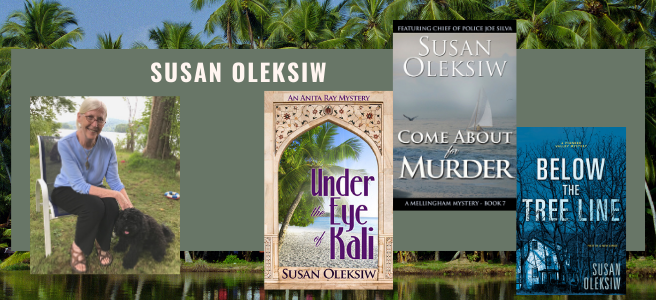
The Mellingham series featuring Chief of Police Joe Silva seemed a simple matter of giving Joe a series of crimes to investigate while I introduce the quirky, sometimes criminal inhabitants of his little town. I went along placidly, happily until I finished book number 7, Come About for Murder. And then nothing. Any ideas I had after that seemed more suited to short stories, and Joe found himself marginalized. Only then did I realize what had happened.
In book three, Joe meets Gwen McDuffy, who is guardian to two children. By the end of Family Album, love has blossomed and Joe’s chronic bachelorhood is coming to an end. In Last Call for Justice Joe visits his family and Gwen’s daughter, Jennie, plays a role, and the reader gets to know her and how she views their new family. In Come About for Murder, the focus shifts to Gwen’s son, Philip, who is presented as Joe’s stepson. By the end of the book it is clear that Joe is his father in every possible way, and the family devotion runs deep for them all.
What I had done in the Mellingham series without realizing it was follow the earlier principle that it took seven mystery novels to tell the story of the main character. This was an idea we avid mystery readers batted back and forth in the 1970s and 1980s, and then as many beloved series expanded to far more than seven books, the idea was mostly forgotten. But there is something to it.
The form of the mystery novel requires a lot of the writer (and the reader), so it’s not surprising that the additional theme of the series character’s personal life finds less scope in the 250 pages allotted for mystery novels back then. When the format and page length changed, the series focus did also, and we now have mystery novels over 500 pages and some over 1,000 pages, with attention shifting from the main character and family to formerly minor characters.
Writers have far more options now when it comes to length. Our preference is a personal choice, but I still look at my series as focused on one character and how she or he evolves through crises and challenges. I found the ending for the Mellingham series unless I want to shift attention from Joe onto someone else (and I don’t at the moment), but I haven’t found the ending for the Anita Ray series or the Felicity O’Brien series.
The so-far last book in the Anita Ray series, number five and titled In Sita’s Footsteps, opened doors I hadn’t expected and I’m playing around with some new ideas. Much as I love Anita and Auntie Meena, I see problems with future books because I’ve made them somewhat static though fun and charming. In the Sita mystery, I found areas in which they can grow and evolve. The question is now what to do about it, how to take the series into this new, unexpected direction.
I’ll figure it out eventually, and a new Anita Ray with a new and, I hope, interesting slant will appear. Right now I’m celebrating the long-lived life of the Mellingham series. Last Call for Justice, number six, will be out in paperback in August (and book club members in June). And I’m about to sign for Come About for Murder, number seven, which will appear within two years. Meanwhile I’ll think about Anita and Auntie Meena and Felicity.

 Ladies of Mystery
I agree that writing mysteries gives mystery writers a pretty good idea of what their ending will be. But most of the time, after I’ve made a suspect chart and have decided who the killer is, my mind takes the story off in a direction that ends up with someone else being the killer by the end. Which is the fun of writing mystery! I love it when I go back to make sure there are clues to that person and find that I had already left the proper crumbs without knowing it. That is the most fascinating thing about writing murder mysteries for me. Not just the plot and coming up with all the suspects and the victim, but also seeing how the story takes twists and turns to get to the end.
LikeLike