Guest Blogger ~ Carmen Amato

Writing the Only Woman in the Room

“Beat it,” Silvio said.

He shoved both Castro and Gomez aside and came into the office. He slammed the door and pressed his back against it.

“I never wanted a woman detective in here.” Silvio was a big man and if he wanted to make Emilia feel trapped, he was succeeding. “I’ll do everything I can to f**k you over until you quit.”

Emilia couldn’t help but laugh. “Tell me something I don’t know.”

Silvio gave a start, obviously not expecting her to say that.

When I wrote this dramatic moment in Cliff Diver, the first Detective Emilia Cruz thriller set in Acapulco, Silvio’s dialogue was already scripted.

I’d already been there and done that.

An identical conversation occurred when I worked for the Central Intelligence Agency. About five years into my career, I moved to a new office, recruited by a manager trying to breathe new life into a stodgy team of PhD analysts. All male, as was our manager.

“Pete” was assigned as my mentor. This gave him ample opportunities to sabotage my work. When I finally confronted him, he confessed that he’d never worked with a woman before, didn’t want to work with one now and would do everything he could to get me to leave.

He delivered his threat as if he expected to shock me. I couldn’t help but laugh and deliver  the same line that Detective Emilia Cruz would say years later in fiction.

Long since retired, I recently recalled the encounter when recording an episode of the Amato2Berrick Crime Conversations on YouTube with UK crime writer Jane Harvey-Berrick (Dead Water, Dead Reckoning) for our buddy read of The Trespasser by Tana French.

In The Trespasser, Antoinette Conway is the only female police detective on the Dublin Murder Squad. She’s convinced that all her male colleagues are out to get her.

Her point of view is a soul-eating combination of rage, paranoia and scorn. In every situation, Antoinette is looking for a fight, whether physical, verbal or emotional.

In contrast, Detective Emilia Cruz follows the pragmatic approach I took during my CIA career when I was the only woman in the room. A tiny minority of male co-workers acted like jerks and had to be dealt with, the faster the better. Like me, Emilia stands up for herself.

Although she grew up on Acapulco’s streets and knows how to use her fists, Emilia isn’t propelled by rage like Antoinette.

  In Barracuda Bay, the ninth and latest release in the series, the chief of police is the jerk who doesn’t want Emilia in the room.

In the series’ prequel, Made in Acapulco, he was loath to shake her hand at a badge ceremony. Fast forward a few fictional years and Emilia wants to get married. It’s the chief’s chance to boot her off the force.

Even worse, the chief recruits her former partner and current boss to help.

And who is the former partner and current boss? You guessed it. The very same Lieutenant Silvio who gave her such a rough time in the first book in the series, Cliff Diver.

In Barracuda Bay, the plot against Emilia unfolds after she finds a woman’s body in a derelict building. The murder case is explosive—the victim is the mayor’s sister, and election season is heating up.

Meanwhile, the crime scene holds secrets. The building once housed a covert government operation targeting a brutal drug lord that went sideways.

Before Emilia can zero in on her prime murder suspect, she’s dispatched to Washington, DC where she becomes a target of killers disguised as cops. Alone and desperate, Emilia is caught in a lethal web of corruption, betrayal, and political intrigue.

Barracuda Bay adds a heady dose of tension to Emilia’s situation as the only woman in the room. As one reviewer wrote: “The hits keep on coming as Detective Cruz is spun through a whirlwind that links cartels, crooks, and various government agencies.”

Before I sign off, you might be wondering what happened to “Pete.”

Six months after our confrontation, he left the CIA because his wife got a job in another state. He’d be a house husband until he found a job there.

Ironic, right? I couldn’t have written a better ending.

Barracuda Bay
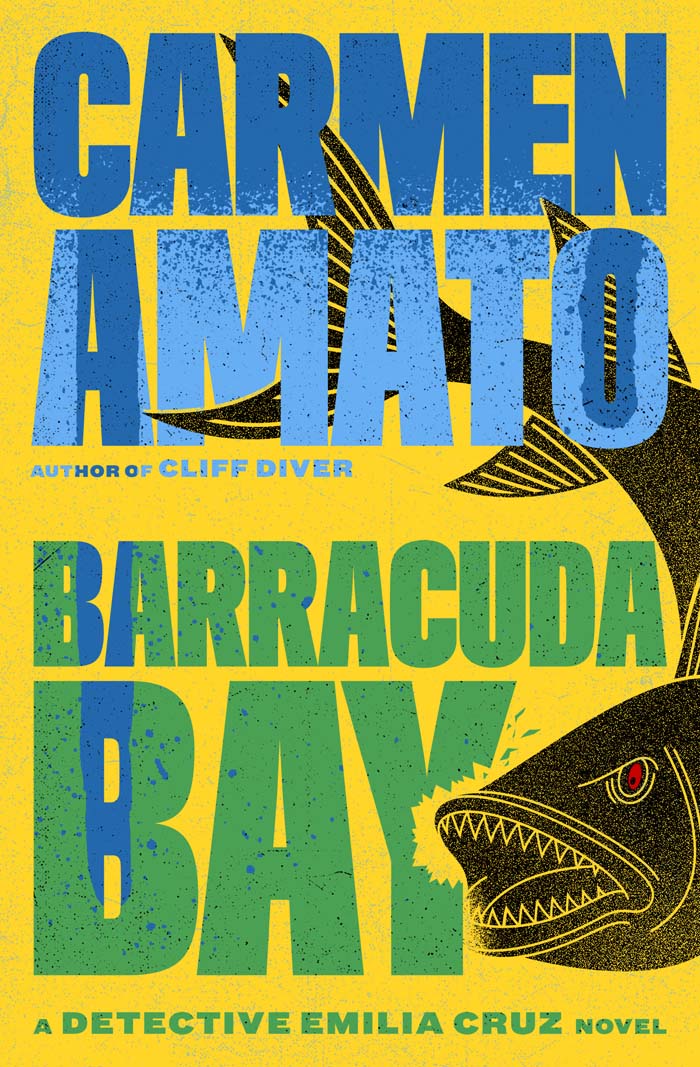
Political corruption turns Acapulco’s first female police detective into a fugitive on the run in Washington DC.

“A thrilling series” — National Public Radio

In a derelict building for sale, Acapulco police detective Emilia Cruz stumbles on the body of a woman brutally shot to death. Incredibly, the victim was the sister of Acapulco’s ambitious mayor, who is running for re-election against an opponent with deep pockets.

The victim’s ex-boyfriend has a suspiciously weak alibi but is the crime scene the key to finding the murderer? The building was once used for a secret Mexican government operation targeting a ruthless drug lord.

Meanwhile, there’s a conspiracy within the police department to force Emilia out.

Before Emilia can save her job or arrest her prime suspect, she’s sent on an errand of mercy to Washington, DC. There she becomes a fugitive hunted by killers masquerading as cops. Alone, desperate and on the run, Emilia turns for help to a human trafficker she once vowed to murder. Her brother.

From Acapulco’s beaches to the streets of Washington, DC, the stakes couldn’t be higher in this electrifying, page-turning thriller.

2019 and 2020 Poison Cup award, Outstanding Series – CrimeMasters of America

BUY:

Amazon: https://geni.us/barracuda2025

Barnes & Noble: https://www.barnesandnoble.com/w/barracuda-bay-carmen-amato/1146877496

Books-a-Million: https://www.booksamillion.com/p/Barracuda-Bay/Carmen-Amato/9798989140374

Carmen Amato is the award-winning author of 18 mysteries and thrillers, including the Detective Emilia Cruz mystery series pitting the first female police detective in Acapulco against Mexico’s cartels, corruption, and social inequality. Starting with Cliff Diver, the series is a back-to-back winner of the Poison Cup Award for Outstanding Series from CrimeMasters of America. Optioned for television, National Public Radio hailed it as “A thrilling series.”

Her Galliano Club historical fiction thrillers include Murder at the Galliano Club, which won the 2023 Silver Falchion Award for Best Historical.

Her standalone thrillers include The Hidden Light of Mexico City, which was longlisted for the 2020 Millennium Book Award.

A 30-year veteran of the CIA where she focused on technical collection and counterdrug issues, Carmen is a recipient of both the National Intelligence Award and the Career Intelligence Medal. A judge for the BookLife Prize and Killer Nashville’s Claymore Award, her essays have appeared in Criminal Element, Publishers Weekly, and other national publications. She writes the popular Mystery Ahead newsletter on Substack.

Originally from upstate New York, after years of globe-trotting she and her husband enjoy life in Tennessee.

Website: https://carmenamato.net/links

Substack: https://mysteryahead.substack.com

Facebook: https://facebook.com/authorcarmenamato

Instagram: https://instagram.com/authorcarmenamato

Amazon: https://www.amazon.com/stores/Carmen-Amato/author/B007UA1J8U

Goodreads: https://www.goodreads.com/author/show/6154479.Carmen_Amato

Email: carmen@carmenamato.net
HIDDEN GEMS

Hello, Ladies ~

When I was a kid, I loved playing the game of “Clue.” Piecing together the clues to decide if Miss Scarlett killed the victim with a candlestick in the conservatory was exhilarating.

And was there anything better than watching “Perry Mason,” “Matlock,” or “CSI?” I would settle in to watch these shows armed with a pen and pad, making notes of possible clues to help me solve the crime before the episode ended.

A few weeks ago, a writer friend and I were talking about writer’s block, something she’d been struggling with. When I said I never suffer from writer’s block, she raised an eyebrow.

I continued, sharing that my brain sort of takes over and directs my fingers across the keyboard, or guides the pen in my hand across a blank page.

“Can you give me an example?” she asked.

My response, then became my blog for this month …

While I don’t write mysteries per se, I do like to add a touch of mystery to my books. In my first novel, “Peril in Paradise,” I discovered that my writer’s brain had automatically planted clues about my crime and villain. In my series México Mayhem, the reader knows who the villain is from the beginning, but I still create a sense of mystery by adding perfect hidden gems to keep the reader guessing.

Two of my favorite additions were characters who weren’t meant to be in more than a couple of scenes. In “Peril in Paradise,” I created Billy Boyd, who becomes my villain Damian’s cellmate. I didn’t know when I created Billy, initially intending for him to add color to a few scenes with Damian, that he would become his own interesting character.

In “Malice in Mazatlan,” Alba’s only purpose was to paint a picture for the reader of how difficult my villain, Sarita Garcia, could be. But Alba ends up stealing a scene and becoming a perfect hidden gem.

As I reread the current WIP for my México Mayhem Series, “Vanished in Vallarta,” I realized I had added some hidden gems during the first draft that I could now use as clues for the Hero and Heroine as they try to tie a suspect to a murder. When I edited the Villain’s chapters, I discovered I’d done the same thing with her storyline.

Every time I find these intriguing nuggets, I’m in awe of how my brain has placed a little of this and a little of that in the right places of the storyline, which I can now turn into tantalizing tidbits for my readers. Another fabulous thing occurred, too. Without knowingly inserting this information, I created a storyline for my next book, “Lost in Loreto.”

In the first novel, “Redneck Ranch,” of my Stoneybrook Mysteries, I added stab wounds to my victim and placed her on the dirt floor of an old barn. But I didn’t know at the time the stab wounds would reveal Morse Code for a number or that the barn floor being void of blood would suggest a different crime scene for this victim.

I just finished a short story, “Jamboree Jealousy,” for an anthology, and when I did my read-through, I smiled at the hidden gems I’d already added to the story: A missing cowboy hat. A gold hoop earring. A few pages with lyrics for a song.

I hope there are many Hidden Gems in your writing endeavors, too! Happy Writing, Sisters!

Slow-growing Ideas

Several of my stories and mystery novels were worked out on paper before I began writing. I had blocks of story parts, notes on a particular character, and no sense of how the whole thing went together. As a pantser, I was willing to wait and then let it all come together when I started writing. This is an act of faith, and for some definitely reckless. But for me it feels like pulling a multicolored shawl around my shoulders, sinking into the warmth and richness of it, and letting the idea germinate. But these days the thinking part is taking longer and longer.

Some of my more recent stories are based on ideas or scenes that came to me years and years ago. Most often if an idea doesn’t take form within a month or so, I abandon it, or just as likely it abandons me. But some of these old snatches of a story I overheard, a piece of a scene that still flickers in my imagination, linger and don’t seem to change. When this happens I know there’s a story there, but I don’t seem to know how to get to it. 

This is where I can hear some of my fellow writers telling me to just sit down and write it out. There’s no mystery to it, as you know, Susan. It’s just a matter of doing the work. Most of the time I would agree. But there are some ideas that need more than an artificial structure composed for working them out on paper to be realized. These are the ones that hover in the back of my mind, like a dream that might be bad, might be good, but won’t fade. 

I’m not the only one who feels this way. A few years ago I was at a book event with other writers and found myself chatting with a writer I had met a number of times but didn’t really know. We talked about our work, what we were reading, and the days ahead. And then she said something that I recognized instantly.

“I think I’m ready for the next story. I can feel it growing. I’m ready to start writing.”

I knew exactly what she meant and how she felt. The story idea is there, gestating, growing, pushing through the reticence, the hesitation, the doubt, ready to emerge from the nib of my pen or the keys on the computer keyboard. At that moment I know I need one last step. Who is going to tell the story—that, for me, is the key to unlocking the whole thing. And once I know who the narrator is, the story unfolds before me, and it’s just a matter of me keeping up with the flow. The preparation time, if I can call it that, takes years. The writing takes a couple of days or fewer for a short story, a couple of months, writing full time, for a novel. The closer the story is to real life, a real event, the less rewriting, or fixing, is required. The characters act out according to their natures, their proclivities already established by where I found them in the basic idea. 

The hardest lesson in working on a story that arrives in this manner is to not tamper with it, to trust my own unconscious to deliver the narrative I can feel inside me. Sometimes I don’t know what the ending will be, but when I sense it coming, and understand what it probably has to be, I have to trust where I am and where I’m going and not tamper with it.

Not every story arrives in this way. I’ve constructed plenty from a simple What If beginning. But those that haunt my memory are different, and require a different writer response from me. From the few of these I’ve composed and published, I’ve learned discipline, trust that my writing brain knows what it’s doing, and faith that whatever is happening is something worthwhile. These stories tend not to have a happy ending, but they are realistic and honest. And for me that’s enough.

Five Things: Staying True in a Semi-Cozy Historical Mystery Series

I haven’t posted five things in a while. These five issues (plus the bonus) pertain to the promises I made to myself when I conceived the idea for the Wanee Mysteries. And how that all worked out.

  1. Main Character. When I think of the detectives (amateur and otherwise) that I love, they all have one thing in common. The detectives are not observers, but are affected and changed by what they see. They grow, they learn, they change. The secret, I think, is to create characters that are true to their own code, their education, and their upbringing, then allow them to grow with each outing, even if that means abandoning their basic precepts while bringing the reader along, knowingly or un. For instance, in “One Horse Too Many”, Doc Shaw, raised by abolitionists, discovers he is prejudiced.
  2. Aging. One of my pet peeves as a reader is a series where no one ages. Come on! Am I to believe all that death and mystery happened in one place in one year? When I planned the Wanee Mysteries, I intended that the main protagonist, Cora Countryman, would begin as a girl unwilling to lose her short skirt and braid and grow into a fearless woman. I set my sights on each book occurring a minimum of three months after the book before, since one of my other goals was to have my stories unfold in a booming 1870s prairie town. To demonstrate its growth and incorporate the changes, both human and industrial, time could not be static, nor could people’s ages. So far, I’ve stuck to this goal, for why it is so important, read on.
  3. Daily life. One of my goals was to have those who populate Wanee, Illinois, provide a backdrop, depth and fun to the mysteries. That means the characters, subcharacters, and even the Methodist owl have lives that include romance, marriage, babies, death, and everything in between. As a consequence, Wanee is rich in Cora’s lifelong friends, one pregnant, one attempting to forge a new life, a young doctor challenged daily, a man attempting to redefine himself, and old friends living their lives. Two of the above are suitors, only one of whom can win. Or maybe, none. I pray their lives help define the period, the mores, small town life, and Cora. A reviewer notes: “I love Cora and all the surrounding characters. The voice is so solid, and the details are so vivid that I am transported back to the small, Midwest town circa 1876 every time.”
  4. The canvas. I set out to build a town grappling with growth and change as the backdrop for my stories. When the mysteries start, Wanee is a pretty sleepy place, or so everyone thinks. Yet the 1870s were anything but. The railroad opened up the country, and towns built water systems, bringing indoor bathrooms and electricity to the bigger cities. Small telephone companies sprang up, coal-fired boiler furnaces appeared, and people roamed, including hobos who stopped long enough to make money before moving on. Politics were raw as people continued to deal with the fallout of the Civil War. One reviewer notes: “Church populates the town with an array of fascinating characters and shows the upheaval of a changing society, as well as the lingering trauma of the Civil War.” So, I guess I can give myself a star for number 4.
  5. Point of View. I envisioned that Cora Countryman would always tell the tale from her point of view. Frankly, I struggle with maintaining this. The reason is that I created three other characters who could easily carry any story and are often at the heart of big doings, leaving Cora to discover details from them. The decision to begin “A Confluence of Enemies” from Sebastian Kanady’s point of view broke my rule right out of the gate. But it was needed to make the book work. So, I guess the rule is, it’s Cora’s way unless it isn’t. I think in the future there may be more isn’t. But, then, again, it won’t be her story. Darn!
  6. Bonus: To dangle or not to dangle. Let this bit of wisdom be a warning to us all. A reviewer writes: “This could have been the beginning of a great new series (in my humble opinion) if not for that bomb on the last page. Does it all go down the drain for a few more cents in future sales?” The truly unfortunate part of this is, if the reader had scanned the first pages of the next book, he would have discovered that his presumption was wrong. I guess it is my fault for ending with a joke between friends that was never intended as a dangle. I could always eliminate the offending bits, maybe I should? Accepting all thoughts on this, so feel free to comment.

Read about me, find my books, and sign up for my newsletter at https://dzchurch.com.

Three yogis, two cops, and one damn cute dog

by donalee Moulton

Everything that happens in a yoga studio is not Zen. Sometimes it’s grand larceny. Three yogis, two cops, and one damn cute dog join forces to discover who’s stolen a Patek Philippe watch from what was supposed to be a secure locker.  Time is ticking.

Ten yogis are in various stretches, twists, meditations, and yawns when Kristi walks back into the studio. She forces a smile, and the smile spreads of its own accord into her muscles, her bones, her heart. This is her sanctuary. She is at home here. The rawness she feels is still there, but it has moved to the edges now.

cover of donalee Moulton's book Bind

Today’s bind is a yogi squat. One leg is extended; the other is bent. One arm goes under the bent leg; the other goes around the back until they meet. In theory. Lexie can’t wait until this month is over, and it’s only day three. Bhodi looks around the room to see if anyone else has completed the bind. Surprisingly, Honey seems to have easily maintained the squat and the bind. Bonnie begins the countdown until she can come out of the contortion, which for her is a little squat and a hint of a bind.

Kristi takes this opportunity to explain the benefits of binds. “These poses allow muscles to release, relax, and open. You can go deeper. You can also focus on alignment and flexibility while building strength.” She breathes in.

“Dear God,” thinks Lexie, “there’s more.”

“If you make her stop,” Bonnie says to her higher spirit, “I will give you my first born.”

Kristi continues to talk, and smile. “Remember to breathe when you’re in the bind. Don’t tighten. And come out of the bind if you feel any pain. Go to your edge, but no further.”

Archina isn’t sure where her edge is, but she fears she left it behind several minutes ago. Woo Woo unbinds. She believes in the mind, body, spirit philosophy of yoga, but enough of this shit.

If it’s one thing Kristi knows, it’s how to read a room full of yogis. The edge has been reached. She tells everyone to stand up, give themselves a hug, and as a special treat, this morning there will be an extended savasana that includes a meditation. (Kristi always has a guided meditation on her phone.) The room smiles, even Bhodi. Eleven bodies move from the vertical to the horizontal. Archina grabs a blanket; Lexie puts a bolster under her knees; Kevin, the newest member of the group, reaches for his socks.

The Dalai Lama is midway through his 13-minute meditation on the disturbed mind when the studio door opens. Twelve faces turn to look at the human who belongs to the shoes that just clomped into their zen-like state. All twelve agree, zen is overrated. Standing at the entranceway to the studio is a 6’2” man with ripped muscles, ebony skin, and a three-day stubble. “He can bind with me any time he wants,” Kevin thinks.

It takes the intruder less than a second to realize he has interrupted the class at an inopportune time. “I’m so sorry,” he says. “I thought class was over.”

“We’re running a little late,” says Kristi in a voice the class has not heard before.

“Please continue,” says Ripped. “I will come back.”

“Too late now,” says Bhodi. He gets the evil eye from most of the class.

“How can we help?” says Kristi introducing herself.

Ripped steps forward, hand extended. “My name is Michael …”

Before he can continue, Woo Woo interjects. “No, it isn’t. Your name is Lewis.”

The demi-god looks at her in surprise. He’s not alone. The whole class stares at Woo Woo.

“I’m so sorry,” Woo Woo says turning a deep magenta. “I don’t know why I said that.” But she does. Sometimes a thought, an image, a tickertape runs through Woo Woo’s mind. She knows it’s a message, and she usually tries to convey it. On this occasion, she wishes she hadn’t.

Michael turns back to Kristi, leader of the pack. “Terrell. Michael Terrell.”

“Did you want to join the class?” Bhodi asks. The snark is obvious.

“Please,” thinks Kevin. “Please join.”

Terrell smiles. “It’s on my bucket list, but today I’m here for a less pleasant reason. I’m a detective with the Halifax Police Department. I’m looking into a watch that seems to have gone missing from the gym.”

Kristi tries to control her breathing. No one else tries to control anything. Lexie’s eyes fly wide open. Charlene gasps. Bonnie recoils.

Honey farts.