
As a freelance journalist, writing to deadline is as natural as breathing. When editors assign a story, they provide three essential pieces of information: topic, word count, and delivery date. Miss your deadline and kiss the possibility of a second assignment goodbye.
This is not about editors flexing their weight. It’s about the reality of publishing. In the days before online everything, a story that didn’t arrive on time meant publications had a gaping hole in their magazine or newspaper. Gaping holes are filled when editors rush around like mad, cursing the name of the writer who missed their deadline.
When I started to do more fiction writing than reporting, I found deadlines are often self-imposed. I will finish my first chapter by the end of the week. I will write a thousand words of my short story every day for four days. I will edit the story by Monday. I also found self-imposed deadlines are often more wishful thinking than etched in stone.
I missed the rigor of deadlines I didn’t dream up. Then I discovered anthologies. Genre writing is rife with anthologies – and anthologies have deadlines. They also often have themes, the journalistic equivalent of topic. The path ahead is paved for you. Here’s what we’d like you to write about. Here’s when you have to get it to us.
I wrote my first mystery short story, “Swan Song,” in 2021 in response to a call from the Crime Writers of Canada. To celebrate its fortieth anniversary, the national association planned to publish an anthology, Cold Canadian Crime. There was a theme (“cold” in the broadest sense of the word). There was a deadline. Count me in.
Since then, I have written fourteen more short stories. Most of them have been published, mostly in anthologies. A few have been reprinted in anthologies. At least one has been reprinted in several anthologies.
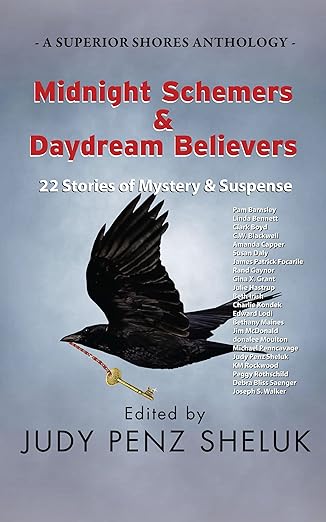
One of my recent anthology short stories is called “Maladaptive Anonymous.” In the story, the main character calls this group, somewhat disparagingly, Daydreamers Anonymous. The anthology, which will be out June 18th, is entitled: Midnight Schemers & Daydream Believers. Just as editors expect you to meet your deadline (or miss out on the opportunity), they also expect you to stick to the topic. You have lots of room to play, but the boundaries are there.
While every anthology editor has their own process, the process is usually rigorous. And appreciated. Judy Penz Sheluk, who edited Midnight Schemers, had three rounds of readers and after the first and third round we were provided with feedback – and helpful suggestions for improvements. There were also at least three rounds of proofreading. At some point, you think this is overkill until in the final proof you discover your main character has titled their head. In the published version, their head is now tilted.
As a short story writer, anthologies bring me back to familiar ground. I am given three essential pieces of information: topic, word count, and delivery date. This helps me to focus on a theme – and to go to wonderful and wacky places with plots I might otherwise not uncover and characters I might otherwise not create. And I go there by deadline.


I knew that title sounded familiar. https://kevintipplescorner.blogspot.com/2025/06/guest-post-anthology-advantage-by.html
LikeLike
Thanks for inspiring me to write this!
LikeLike
Thanks for writing this post, donalee!
LikeLike
I make my own deadlines for my writing on a big whiteboard. 😉 I also write one short story a year for an anthology published by the author co-op I belong to. They are fun ways to write snippets of my characters in my series. Good post!
LikeLike
I’m always trying to set deadlines. Sometimes I meet them. That’s a good day.
LikeLike