Prime the Pump and Take a Long Voyage

It’s an old phrase: priming the pump. Back in the 19th century, it meant pouring liquid into a pump to expel the air and make it work. Even now, an internet search will tell us that before any centrifugal pump can be operated, it must be primed. Priming is the process of replacing air in the intake lines and portions of the pump with water.

But our subject is books and writing. Priming the pump also means encouraging the growth or action of something. In this case, my work-in-progress.

It’s a historical novel. I have a large pile of words that will eventually become a coherent first draft. Where the hell I’m going? How am I going to get there? Will it make any sense? It probably will, to me. Will anyone else want to read it?

Thus I prime the pump. I’ve been seeking inspiration in one of my research books, taking lots of notes. I’m paying attention to the timeline of actual events, in order to integrate my fictional characters into the crowded parade of real people who were doing things in my setting in 1878 and 1879. As I do this, I write notes to myself, usually set apart in brackets, outlining things I want my protagonist to do. Or learn.

There’s a lot going on, but it’s impossible—and improbable—for me to place her physically at all the significant events, much as I would like her to be an eyewitness. I must pick and choose the most dramatic scenes and figure out a logical reason for her to be there. The rest, she’ll have to learn from others. Besides, the book already looks like it will be long. Some events need to be mentioned in passing rather than detail.
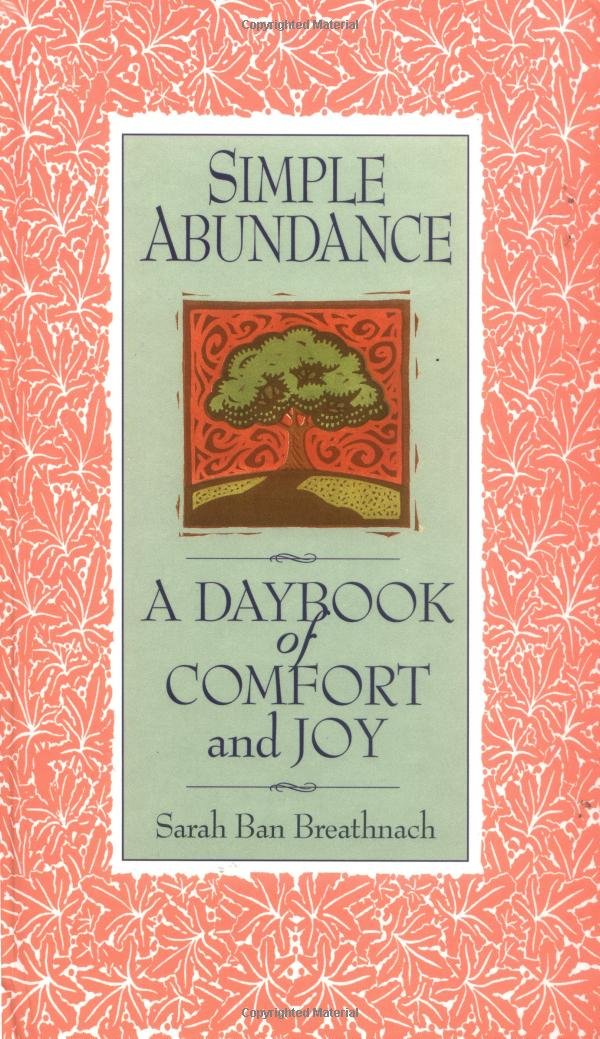
So, reading a book, in this case, a research book. Or another book. Like this one. Years ago, I was going through a bad patch that soured me on life and left me feeling perpetually grim, grumpy, and depressed. A friend tossed me a lifeline, a book. It’s Simple Abundance: A Daybook of Comfort and Joy, by Sarah Ban Breathnach.

I’m not one for touchy-feely, self-help books. Over the years, I’ve bought a few, gotten little from them, and quickly donated them, passing them on to other readers. But Simple Abundance spoke to me at a time when I needed it. It’s a collection of essays, one for each day of the year, looking at things like joy, gratitude, beauty, and so forth. I read one essay every morning. I’m always surprised and gratified when the essay for a particular day speaks to something that’s going on in my life. Such as the day my father died. That essay was exactly what I needed at the time.

One of the best takeaways is the gratitude journal. Each evening, I jot down three or more things that I’m grateful for—even if it just clean sheets on my bed, a quiet day at home, and especially a productive day of writing. I find that keeping the gratitude journal has changed the way I look at life. That helps immeasurably with my writing.
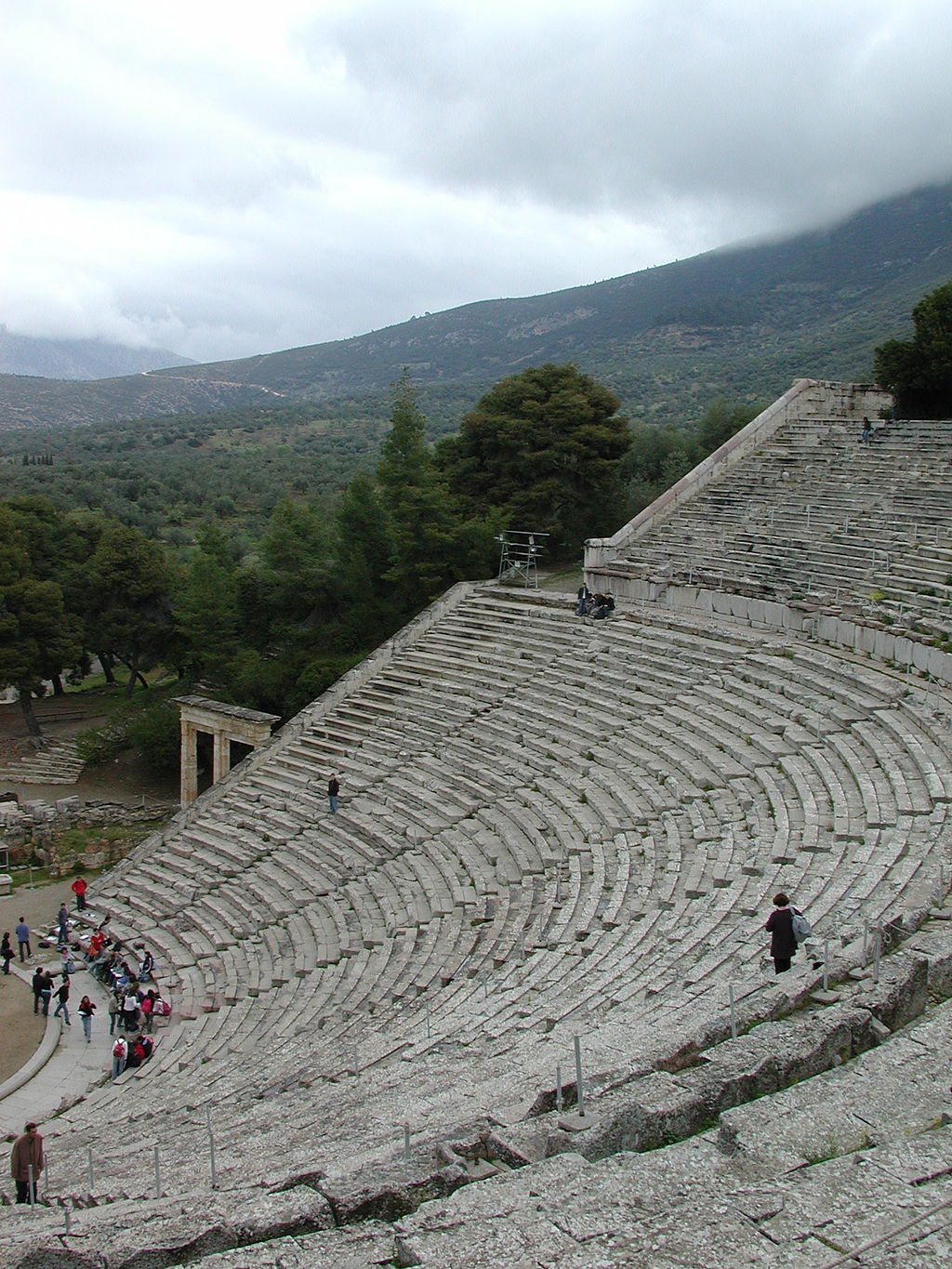
Simple Abundance also introduced me to the Greek poet Constantine Cavafy. On a date at the end of the year, the author quotes Cavafy’s poem Ithaka. During my trip to Greece in October 2023, my group visited the ancient theatre of Epidaurus, constructed in the late fourth century BCE. It’s considered the most perfect ancient Greet theatre with regard to acoustics and aesthetics. It is still used for the performances of ancient plays.

Our tour guide demonstrated the acoustics at Epidaurus by standing in the middle and reading a poem—Cavafy’s Ithaka. As we enter the new year, I leave you a few lines from the poem [translation by Edmund Keeley and Philip Sherrard, C. P. Cavafy/Collected Poems, Princeton University Press, 1992.]

As you set out for Ithaka

hope the voyage is a long one,

full of adventure, full of discovery.

. . . .

Keep Ithaka always in your mind.

Arriving there is what you are destined for.

But do not hurry the journey at all.

Better if it lasts for years . . .

May your voyage this year be long, full of adventure and discovery. And productive!

Guest Blogger ~ June Trop

Meet Miriam bat Isaac

            I’ve modeled my heroine, Miriam bat Isaac, on the woman known as Maria Hebrea, who probably lived in Roman-occupied Alexandria (Egypt) during the first century CE. I encountered her work when taking a course on the Historical Development of Concepts in Chemistry.

Ordinarily chemistry is taught from the perspective of what we know now without delving into how the concepts evolved over the millennia. So, when the professor assigned a paper on a historically significant concept, I had no idea of a topic. That is, until in desperation, I went to the university library to roam the stacks.

I don’t remember exactly how it happened—did I bump into a bookcase while looking to the heavens for inspiration?—but a moment later, a weighty tome fell on my toe and opened to a page about Maria Hebrea. And so, I began to wonder how a Jewish woman from Ancient Alexandria became the legendary founder of Western alchemy and held her place for 1500 years as the most celebrated woman of the Western World.

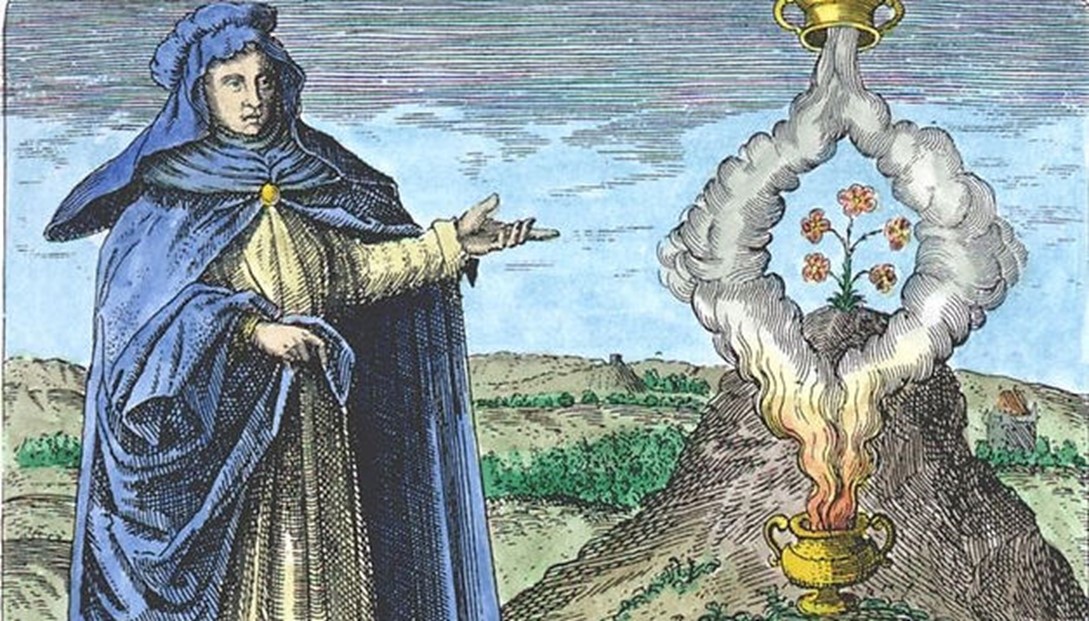
Sixteenth Century Depiction of Maria Hebrea

 In the alchemical literature, Maria Hebrea is also referred to as Mary the Jewess or Miriam the Prophetess, sister of Moses. Like her, all alchemists wrote under the name of a deity, prophet, or philosopher from an earlier time to enhance the authenticity of their claims or shield themselves from persecution. Although the tradition among all the crafts and mystical cults was to guard the secrecy of their work, persecution was a real risk for alchemists, who could be accused of and summarily executed for conspiring to debase the emperor’s currency.

Accordingly, Maria Hebrea worked anonymously. Hundreds of years later, however, another alchemist, Zozimos of Panopolis, celebrated her contributions. And so, with just a little tweaking, I had enough information to resurrect the once famous Maria Hebrea and create Miriam bat Isaac, my sleuth extraordinaire.

Miriam bat Isaac’s Adventures

Published in paperback and e-book by Level Best Books in February 2024

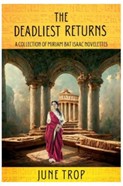
Miriam bat Isaac has recorded her nail-biting adventures in novels, novelettes, and short stories. Her most recent volume, The Deadliest Returns, is a book of three novelettes about returning, whether it means going back or giving back. In the first, “The Bodyguard”, Miriam’s brother, a renowned gladiator, returns from the dead to serve as a bodyguard back home when his employer retires Alexandria.

In the second, “The Beggar”, an old man disguised as a matronly beggar, returns to Alexandria to learn the fate of the lovechild he was forced to leave behind to escape the wrath of Roman law. And in the third, “The Black Pearl,” Miriam, having come into possession of the cache of jewels heisted from the Temple of Artemis, sails to Ephesus to return the treasure. The prized gem, however, a uniquely lustrous black pearl, disappears. With the power to heal the brokenhearted and restore the health of the one possessing it, could the pearl’s mystical properties be the motive for murder?

If, like Miriam, you thrive on uncovering the guilty longings, secrets, lies, and evil deeds of others, then as Miriam’s deputy, you will have ample opportunity to indulge your fancies. So, escape the monotony of everyday life and plunge into that rousing world of adventure in three of her most daring exploits.

To purchase The Deadliest Returns from Amazon

For the e-book, click here: https://www.amazon.com/dp/B0CV4TTX3T

For the paperback, click here: https://www.amazon.com/Deadliest-Returns-Collection-Miriam-Novelettes/dp/1685125859

As an award-winning middle school science teacher, June used storytelling to capture her students’ imagination and interest in scientific concepts. Years later as a professor of teacher education, she focused her research on the practical knowledge teachers construct and communicate through storytelling. Her first book, From Lesson Plans to Power Struggles (Corwin Press, 2009), is based on new teachers’ stories about their first classroom experiences. 

Now associate professor emerita at the State University of New York, June devotes her time to writing The Miriam bat Isaac Mystery Series. Consisting of short stories, novelettes, and several books, some have won modest recognition, such as being named a finalist for the Killer Nashville Silver Falchion Award. ​

June, an active member of the Mystery Writers of America, lives with her husband Paul Zuckerman, where she is breathlessly recording her plucky heroine’s next life-or-death exploit. She’d love a visit at www.JuneTrop.com or on her Facebook page, June Trop Author, https://www.facebook.com/profile.php?id=100044318365389, where she publishes a blog every Tuesday afternoon about writing, the history of science, or life in Roman Alexandria.

Writing is a Business … isn’t it? By Heather Haven

From the very beginning, I was taught that writing should be a business. Good in theory, not so much in reality. If I think about my salad days, I made about 5¢ an hour. When I got a real job writing humorous ad copy for No Soap Radio, I made $125 a week. Even in New York City’s late 1970s that wasn’t enough to pay your bills, so I worked backstage doing costumes on Broadway to supplement my income. I was in my early 20s then and doing two jobs I loved was no hardship at all, especially if one was in the theatre. I love the theatre. Lots of talented people inhabit the theatre. I am proud to say I’ve met friends I’ve kept throughout the years. Certainly worth more than 5¢ on the dollar.

As for writing ad copy for No Soap Radio, every morning in a round table sort of setting – literally – is where I learned it was my job to produce something, whether I felt like it or not. For decades after that’s how it went. Recently, however, I took on the luxury of writing when I felt like it. It’s only been for the past 4 months and hard though it is to admit, now writing feels more like a hobby than a job. It comes, it goes, and so what? This hobby approach to things is not my style. I’m a workhorse type of person. I need to feel useful and committed. And as John Adams said, one of our founding fathers and presidents, “There are only two creatures of value on the face of the earth: those with the commitment, and those who require the commitment of others.” I knew I liked the man.

I’ve discovered — or rediscovered — it’s not the money that spurs me on. It’s the commitment. True, this has been an important break after 40 years of daily writing no matter what was otherwise going on in my life. It’s been a test of what writing means to me. But this new thing, writing whenever the mood strikes me, just isn’t working. I need to get back to work, scheduled and at the forefront. I need to get up every morning and feel driven. I need to rekindle the fire in the belly. In short, pass me the matches.

I write because I love it. I write because I have to. I write because it’s me. So I greet 2025 most welcomingly. A new year and back to being me — a crazy, driven, committed writer — who puts her work above everything else except for maybe the occasional glazed donut. Well, come on. Let’s get real.

Happy New Year to all the other crazy, driven, committed writers in my life. 2025 is going to be great.