Guest Blogger ~ Claudia Riess

Choosing to write an art history mystery series came relatively late in my career, but the seed was planted very early in childhood, and was as much a part of the natural course of events as learning to read and being read to—Winnie the Pooh, Mary Poppins, Alice in Wonderland—and being told laugh-out-loud stories, ad-libbed by my father, about a little girl named Jeanie, clearly my alias, and her adventures with her anonymous daddy, clearly my own.  And like bedtime stories, my introduction to art—my association with art—was, and is, bound up with family, adventure, safe harbor. 

It began with outings to museums.  We lived in Brooklyn, and a couple of the great ones were a short subway ride away.  The Metropolitan, the Museum of Modern Art, the Frick, the Brooklyn Museum.  Typically, these outings were followed by take-out Chinese food and talks around the kitchen table about what we had seen that day.  We talked about the different ways painters saw the world; debated about which perspective better described the real world—and what the real world really was.  Color and light?  Shape and dimension?  And what about imagination? Created imagery.  Distorted reality.  Ideas about the relative nature of beauty and truth were woven into these conversations, and all the while we were savoring our chicken chow mein and fried rice with lobster sauce.

It stands to reason that my idea of the art world was a romanticized one, but by the time I’d written a few rom-com-like novels and murder mysteries and was considering writing an art suspense novel, I’d learned a lot more about its seamier side.  How the price of art is virtually uncontrolled, dependent on the whims of collectors and dealers and the transient tastes and fads of the times.  How art is ransomed, forged, used to launder money, stolen then sold on the black market.  In short, that the art world is where the most sublime of human instincts collide with its basest.  What a great amalgam for fiction!

I pitched the idea of my writing an art suspense novel to my brother, Jonathan, an art history professor at the University of Cincinnati, and he off-handedly suggested, “What about finding a lost study of Michelangelo’s Battle of Cascina?”  As he enlarged on the subject, a conversation I’d had years ago popped into mind.  It was my first week at Vassar College, and I was out of my social depth, trying to hold my own with one of my classmates, a seasoned debutant.  I suppose the incident remained etched in memory because our life experiences were so disparate.  Especially vivid was the story of how her father’s sugar plantation in Cuba had been confiscated by Fidel Castro’s government.  It was this historical nugget that instantly dovetailed with my brother’s suggestion.  In that moment, the American sugar plantation owner became an art collector, and as he and a freshly materialized plantation manager and a lovely cook’s assistant hid out in a basement storeroom, the art collection was being hauled off by a band of wannabe Castro rebels looking to raise money to buy arms.

The imagekicked off the prologue to Stolen Light, Book 1 of my art history mystery series.  I’m a stickler for historical accuracy, and as a rule I take off from it, filling the gap with events that conform to its character, and therefore might have been.  Then, in a butterfly-effect maneuver, I fast-forward to the present and drop a pair of resourceful lovers into the challenging set of circumstances that has developed—multiple murders included—and see if the sleuthing duo can sort it out. 

For example, the impetus for Knight Light, Book 3 in the series, came from two quotes.  From the painter Marcel Duchamp: “Not all artists are chess players, but all chess players are artists.”  From World Chess Champion, Alexander Alekhine: “Chess for me is not a game, but an art.”  From there, I discovered that the two had actually been team-mates on the French chess team in the 1933 Chess Olympiad.  And that furthermore, Alekhine’s death in 1946 has been considered a cold case to this day.  My fiction, integrated with the facts, took off from there.

Dying for Monet, Book 5 and the most recent in the series, is structured with the same criteria, except this time a crucial plot-twisting component hog-ties me to a bare-boned blurb.  I’ve never felt more in danger of giving away the spoiler.  I’m okay discussing Claude Monet and the Impressionists; Paul Ruand-Durell, the renowned art dealer based in Paris, carrying on in London during the Franco-Prussian War; the art museums in London; the disappearance of a still life painting; a brutal murder.  Even the End Notes, where I mention books that were part of the research phase, omits a critical one whose title would blow it.  Luckily, I’ve got my two sleuthing protagonists, Erika and Harrison, about whose ever-evolving love story I could go on forever.

Book 6, the last in the series, is in the works.  Its plot is powered by the subject of artificial intelligence, boon and curse of the art world, depending on your definition of art or stake in its profits.  My fascination was doubly sparked by an episode of CNN’s “The Whole Story with Anderson Cooper,” which focused on the Dead End Gallery in Amsterdam, the world’s first art gallery dealing solely in art generated by AI, and the Whitney Museum’s exhibition of Harold Cohen’s AARON, the world’s first AI program for art-making. These experiences raised questions regarding the genesis of inspiration, the act of creation, and the boundaries of ownership, all of which are potential harbingers of conflict, including the most deadly.

Dying for Monet
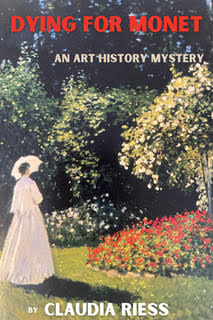
A gala evening auction at Laszlo’s, an upstart auction house in New York City, is in progress.  Without notice, a much sought-after Impressionist painting is withdrawn from the block.  Moments later, its broker is found dead at the foot of an imposing statue in Laszlo’s courtyard.

Amateur sleuths Erika Shawn, art magazine editor, and Harrison Wheatley, art history professor, are once again drawn into an investigation involving an art-related homicide, this time sharing an unnerving coincidence with violent crimes occurring abroad.

As Harrison searches for clues in the archives at the Ashmolean Museum in Oxford, Erika is on a stakeout in Brooklyn Heights gathering information on the owner of the hijacked still life.  After Harrison experiences a disastrous encounter in London, he returns home, where he and Erika, along with a few of their usual cohorts, find themselves ever more deeply at odds with the movers and shakers on the dark side of fine arts commerce.

https://www.amazon.com/Dying-Monet-Art-History-Mystery/dp/1685126545

Claudia Riess is an award-winning author who has worked in the editorial departments of The New Yorker and Holt, Rinehart and Winston, and has edited several art history monographs.  Stolen Light, the first book in her art history mystery series, was chosen by Vassar’s Latin American history professor for distribution to the college’s people-to-people trips to Cuba.  To Kingdom Come, the fourth, will be added to the syllabus of a survey course on West and Central African Art at a prominent Midwestern university.  Claudia has written articles for Mystery Readers Journal, Women’s National Book Association, the Sisters in Crime Bloodletter, and Mystery Scene magazine.  She has been featured on a variety of podcasts, blogs and Zoom events.
claudiariessbooks.com.

https://www.facebook.com/ClaudiaRiessBooks

ORNAMENTAL CHARACTERS

Happy New Year! I hope everyone had a lovely holiday season and the new year finds you busy writing, plotting, or selling books!

As I took my tree down a couple of weeks ago, I was reminded of a conversation I had when I attended a party hosted by one of my friend’s aunts. The aunt had a large, beautiful tree decorated in black and white. The decorations included black bows, a couple of very large white owls, and smaller blackbirds. Black and white ornaments were scattered amongst the branches and complimented by white icicles and white bells.

When I asked if she always has a black and white tree, she replied, “Oh, heavens no. I have decorations to do an all-teal tree, but my favorite tree is decorated in purple.”

My hostess was drawn into a conversation with another guest. I stood in front of the black-and-white tree, wondering if I could ever embrace this type of décor for my tree.

Decorating my tree is my favorite part of Christmas. When I open boxes of ornaments, I feel like I’m greeting old friends. Each decoration has a story, and I love remembering the ornament’s origins. I like grouping my Nutcracker ornaments together and keeping the handmade gifts from my kids and grandkids in the same area of the tree. I also like distributing my collection of Santa ornaments throughout the branches.

My nine-foot tree tells the colorful story of my life. Ornaments handed down from family members no longer here bring a smile to my lips as I remember past holidays. Each time I place my glass avocado next to the small plastic tequila bottle, I find myself longing for the beaches of México. And though my grandkids don’t visit at Christmas, I still hide the dill pickle ornament they gave me just in case they make a surprise appearance.

Recently, one of my readers asked me why I decided to write a series featuring repeating characters in the same setting. The question echoed in my mind this year when I returned my ornaments to their storage containers, and it occurred to me that my fondness for the characters in my novels is like the adoration I feel for the baubles that brighten my tree each year.

Luckily for me, I write two series. My suspense/thriller series, México Mayhem, has some repeating characters, but each book has a new heroine, hero, and villain. The locales change, too, since I move one or two minor characters from the previous book forward into a new story.

I can’t imagine never creating my very first heroine, Clara Marsh. When I wrote “Peril in Paradise” long ago, in 2008, I had no idea that I would suffer losing a child as Clara does. It stunned me the first time I reread the passages in the book after Clara’s daughter was murdered. How did I know her grief so well before I’d experienced it myself? And though Clara is a figment of my imagination, to me, she is real and a kindred spirit in my life.

My first hero took me by surprise, too. I’m a very independent woman, so when Jackson Brady wanted to protect Clara and rescue her from Damian, I found it hard to let her be rescued or trust Brady. Growing up, I never bought into the whole white knight coming to the damsel’s distress. But being part of Clara’s journey into Brady’s arms was a fabulous experience.

The only writing kudos I ever received when receiving countless rejection letters was: “You do write an excellent villain.”

Creating my villains is one of my favorite parts of crafting a story. I find it easy to heap on evil traits, but I also try to craft a backstory explaining their bad behavior. In “Peril in Paradise,” the reader eventually learns that Damian Garza thinks his stepmother killed his biological mother. Damian’s hatred for his stepmother causes him to mistreat women, but his ego eventually leads to his undoing.

In my mystery/suspense series, Stoneybrook Mysteries, I created a fictional town full of fabulous characters that starts the reader’s journey in “Redneck Ranch.” Every time I open a WIP for a Stoneybrook novel, I feel like I’m home. The chatter of patrons at the Babbling Brook Café fills my mind, and I can smell the bacon and eggs. When my heroine, Harley Harper, trudges to the barn to feed her animals, I’m reminded of my childhood on the family dairy. And though I’m lucky to have numerous friends, I never really bought into the “best friend” label. But I thoroughly enjoy writing about Busy and Harley’s “bestie” moments.

Sheriff Wyatt Stone is a culmination of all the incredible male role models in my life. Wyatt is diligent in his quest to protect the residents of Stoneybrook from harm. I don’t consider myself a romantic, but I enjoy the developing relationship between Wyatt and Harley. He exhibits quiet strength and endless patience, especially when interacting with his autistic cousin, Deputy Derrick Stone.

When I get to write a scene with Derrick, it takes me back in time, just like the ornaments on my tree. I love remembering our lunch dates after shopping at the local Goodwill. Derrick would always find some treasure he had to have, some of which I kept after his passing. Creating a fictional character to honor my son has been a soothing elixir.

The only rotating character in this series is the villain. And once again, what I lack in romantic tendencies, I make up for in crafting dark and twisty bad guys.

My Christmas tree ornaments have been stowed away for another year. The hustle and bustle of the holiday season has settled down, and the usual demands of everyday life await me each morning. I feel blessed to have these characters, recurring and newbies waiting in the wings, to greet me when I lift the lid of my laptop and place my fingers on the keys.

Just like decorating my tree, I enjoy greeting each character like an old friend or introducing myself to someone new, placing them exactly where they need to be in the book. Oh, what a journey each story promises to take me on… one ornamental word at a time.

Lists and More, Always More

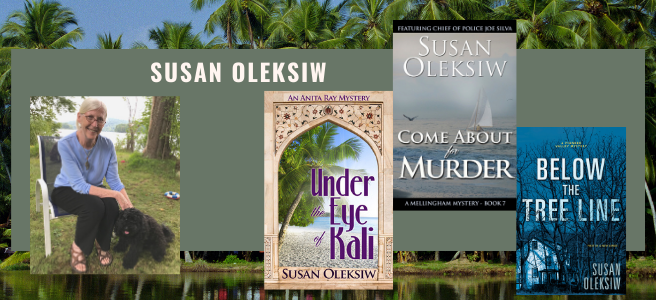
I belong to a chat list of people in my general geographical area, one or two counties north of Boston mostly along the water. Here we post requests for a carpenter or, right now, a snow shoveler. Members report on the remodeled bath and how well the job was done, or not done.

One man organized a picnic for anyone who wanted to come, and within days he had offers of side dishes, the loan of a grill, a small tent in case it rained while he was flipping burgers, a few tables and chairs, and a volunteer to track who was doing or bringing what. There are long discussions on what’s happening that has brought a helicopter and two police cars, and whether or not the city can or should do something about the homeless woman who has set up shop on a certain corner.

This is a community within a community, an ongoing exchange of good will, information, moral support, and occasionally humor. Lots of people are looking for small jobs, the kind that don’t attract construction companies. These are people willing to do just about any little chore—watch your elderly mother one afternoon a week, or your two pre-school children three days a week, or water your plants while you’re on vacation, or fix the front steps, or cut down a small tree that’s dying. There’s always someone who’ll help install a smoke detector, explain the restrictions on B&Bs in a specific town, or suggest a junk removal guy who is reasonable, quick, and neat. Small jobs but necessary ones.

I’ve had several jobs taken care of through this site, and occasionally I recognize another user, or another user recognizes me. The site is more efficient than asking at the local hardware store, another place I’ve come to know and love since my husband died. It’s also more informative. In almost any instance a person seeking a worker for anything will get two or three suggestions, with affirmations (or not) by other readers. 

The site is remarkably accurate as to skill, reliability, and pricing, perhaps because a failure in any one of these areas will lead to a disappointing post, at best, and complaints from others and a decline in business.

For a long time I thought of this as a useful site, but now I read the offers and requests, including occasionally my own, and I feel like I’m reading a novel or a short story as people report on life changes requiring a new home for a pet or a change in a second bedroom. This change in perspective is perhaps the result of how I see the world, or at least my corner of it. 

When I hear someone talking about an incident, or see a group of people engaged in something, within seconds my brain has constructed a narrative, just like what I did in the first paragraphs above. You read very few facts; instead you got a feel for how a group of people relate to each other, with holes where paranoia, suspicion, ill will could fold away from view.

When you’re a writer, wherever you look you find a story.

Constructing Writing

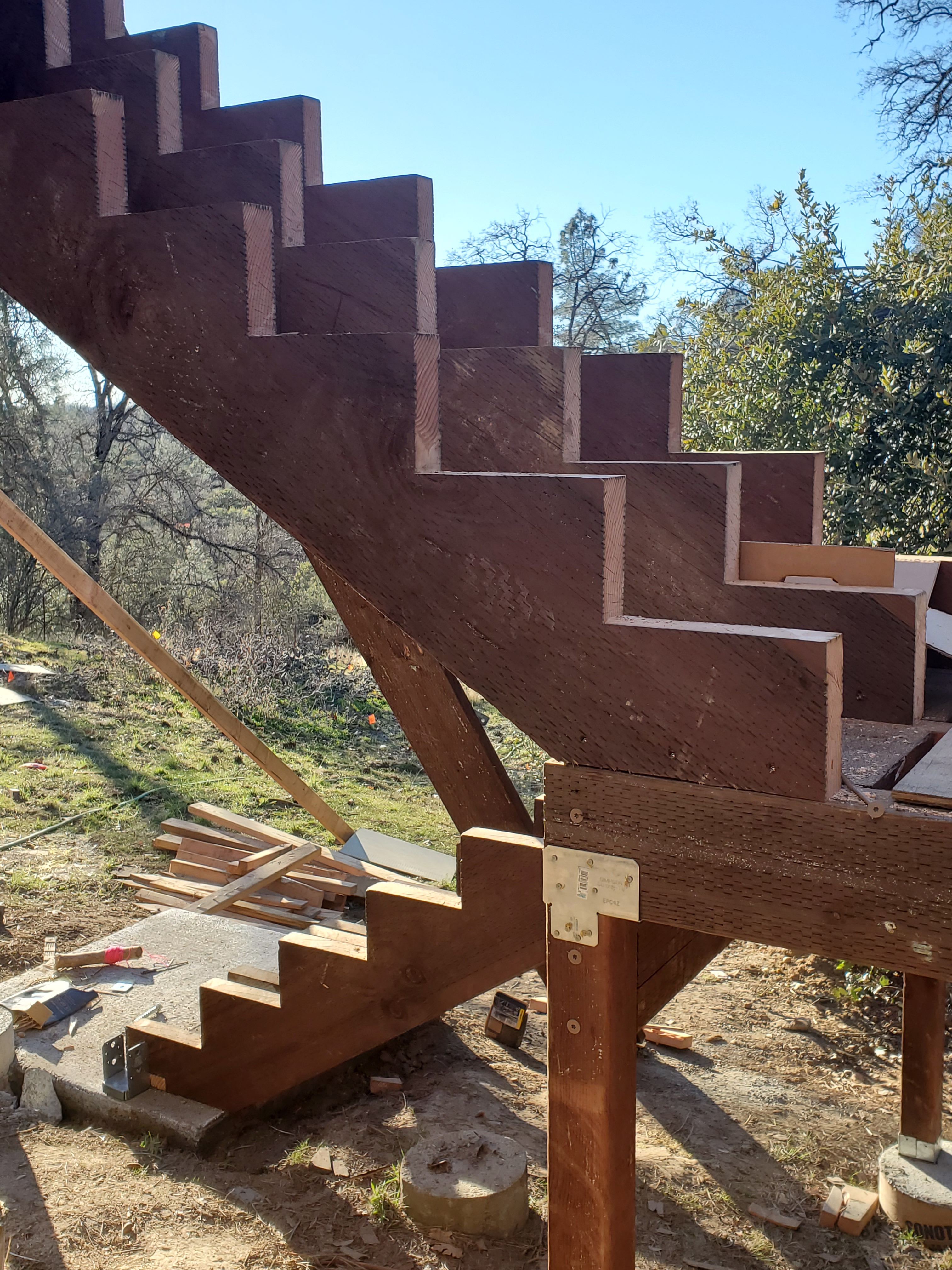
As I listen to my contractor pound nails, rip wood, and clamber about outside my cabin, I have come to newly appreciate the relationship between writing and construction.  Oh, we all know and acknowledge the concept of scaffolding, or how to eat an elephant one bite at a time. I’m not writing about that. This blog is about five steps in the construction process that parallel the writing process. The list does include, the need to show up every day on time at the building site with your tools strapped around your waist, i.e., sitting in your writing chair in your designated writing space and applying your skills to the work you do.

Step 1: Don’t go out to bid without knowing what your final product will be. In my case, we are updating the exterior of a cabin in the mountains driven by the ‘bleeping’ insurance companies. This requires, among other things, that to meet the insurance company’s timelines, the deck must be rebuilt using the same footings. Not unlike genre requirements, footings define the building parameters, including the number of support beams and joists. So the question becomes, do I want my deck to adhere perfectly to the existing footings or do I want the stairs to bend in the middle, as in stretch the genre (building) requirements to devise something more interesting without forcing the readers into a paroxysm of horror by reshaping the genre or the building inspector to require costly, time-consuming permits. Once this step is done, you have defined the genre or general scope of the work, be it a book or deck.

Step 2: Have a realistic plan for construction that estimates the materials and superstructure required. In short, outline your scope of work (by whatever method you use). Define your characters (joists). Define their relationships and how they support each other and the events (bridging). Who does what to whom, when, where and how. At least, know where your story starts and why and where it ends. And, if you write historical fiction, measure twice and cut once. Research, then double-check your research so that the time period unfolds seamlessly as you write. Fixing historical errors once they are embedded in the story can be like a trip to ‘the cold place’ and upend your plot.

Step 3: Anticipate change. Something always comes up that requires replacing, rewiring, or rethinking (materials plus 20%). Always. Don’t stress, go back to your plan. If the change doesn’t benefit the building or the plot – ditch it. If it enhances the final work for the reader, weave it in so that the warp and the woof are smooth cohesive and complementary. The story will benefit from the enhancement or twist.

Step 4: Have the construction inspected by an outsider. Building inspectors come to the site; reviewers don’t, but they are a must. I don’t mean the folks who write reviews for your web or social sites. I’m talking about a circle of readers, willing to tell you when something is off, when it isn’t, and what the story might need. Take them seriously, then …

Step 5: Ensure that work not only passes inspection but continues until it fully meets your expectations, including any changes required. Then read it, as in read it again, and again, and again. Try an AI grammar checker. Have someone else read it for grammar errors. If it is historical fiction, find someone who understands that word usage might be a tad different back then. Trust me, at least one embarrassing word or grammatical error will escape you.  You’ll find it lurking in the first chapter or whatever page your proof happens to open to as you relish your baby. Fix it. Get another proof. Then, take the next step.

Time for an open house! Or, rather, time to publish, send out for media review, advertise, market, and pray. And, if you need siding, have the cover done by professionals. Don’t worry you can still write all your own text, have AI write the cover text, or have the cover design group do the same.

What good is a great deck without new siding on the house?

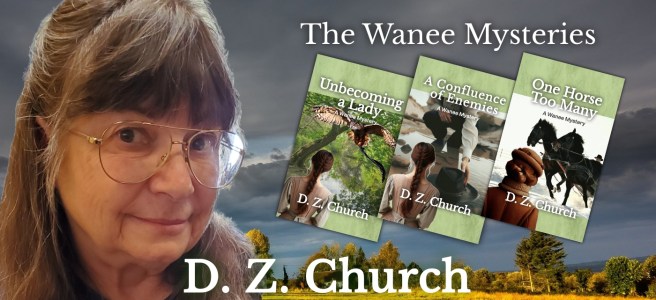
For more information about me or my books, check out https://dzchurch.com, or to buy my books, go to Amazon and search on D. Z. Church; they’ll all pop up.

Discovering the donair

Food seems to weave its way into my writing uninvited.

In my latest book, Conflagration!, food is the foundation for a friendship that springs up in 1734 between the main character Philippe Archambeau, a court clerk, and the jailer he befriends. Lunch becomes a means to extract information, then it becomes much more.

In my first book Hung Out to Die the main character, an American transplanted to Nova Scotia, discovers the delicious joy of the donair. Many people have never heard of this juicy, meat-filled, garlicky concoction, but it is the official food of Halifax. Popular history says the donair – spicy meat wrapped in a pita and embraced with lots of sweet sauce – was invented in Halifax in the 1970s where it rapidly became a must-have menu item for late-night partiers, snackers, and food aficionados.

As my main character, Riel Brava, discovers, the donair can be a little difficult to eat. There is an art to juggling a stuffed pita while licking sauce off your face and adjusting foil wrap to get more donair in your mouth.

The recipe below avoids that dilemma. It’s an appetizer compliments of the Dairy Farmers of Canada. I have adapted the recipe slightly.

Let me know how it tastes.

Donair Dip

Ingredients

  • 1lb (450g) lean ground beef
  • 1 tsp (5 ml) dried oregano
  • 1 block (250 g) cream cheese
  • 1 cup (250 ml) shredded old cheddar cheese (or cheese of your choice)
  • 2 tsp (10 ml) paprika
  • 2 tsp (10 ml) garlic powder
  • 2 tsp (10 ml) onion powder
  • 1/2 tsp (2,5 ml) salt
  • 1/2 tsp (2,5 ml) black pepper
  • 1 cup (250 ml) donair sauce (see below)
  • 1/2 diced tomato (optional)
  • 1/2 diced onion (optional)

Donair Sauce

  • 1 can (300 ml) sweetened condensed milk
  • 1/3 cup (80 ml) white vinegar
  • 1 tsp (5 ml) garlic powder

Preparation
1. Add all ingredients in a bowl and combine.
2. Preheat oven to 350 °F (180 °C).
3. Cook the ground beef and the spices together, mix well in a frying pan.
4. Drain off excess grease.
5. Mix the softened cream cheese, cheese and Donair sauce together.
6. Place ground beef mixture on the bottom of 9”x9” cooking dish (or equivalent).
7. Add the cheese and Donair sauce mixture on top of the ground beef mix.
8. Bake for 20 minutes.
9. Top with diced veggies after removing from oven (optional).
10. Serve hot or cold with tortilla chips or baked pita slices.
11. Enjoy!