
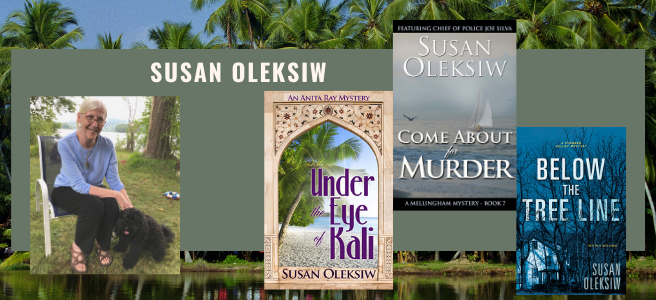
I’m in the middle of the sixth book in the Anita Ray series, which is set in a tourist hotel in a South Indian resort. Over the years the area has grown from a tiny fishing village with a few hotels just up the coast to one of the most popular destinations for Westerners eager for the sun and sand, not to mention the sunsets and the fishing boats bobbing on the horizon at night. I know the area well, having visited it for the first time in 1976 and several times in the 2000s.
The pathways laid out in the early years are now paved walkways through marsh with little pools covered with lily pads. The paths have been widened in some areas to allow shop owners to hang out rows of brightly colored silk saris and blouses. When I think there’s no more room for another restaurant or shop, I turn a corner and spot five square feet turned into an open-air cafe with the owner stirring a pot on a two-burner cooktop, ready to serve the foreigners sitting on stools before a board table. The food is good, the price is right, and the cook’s son works in one of the high-end hotels. Much of Kovalam has spread on what was once paddy fields that came down to a low berm fronting the beach. All those are gone, and only the rare private home remains, hidden away beneath tall palms.
A reader often tells me they know “exactly where I am” in an Anita Ray story, and that’s because I do too. I have a strong sense of direction in India (and elsewhere), a deep understanding of India (after years of graduate school), and a personal love of the region. All of that informs the Anita Ray stories. What I don’t have is a sense of place in any story if I haven’t been there, walked through a public park, found a typical cafe for the area, and visited a municipal building—perhaps a library or town hall. I can make up a lot of it, but I need to experience the “feel” of the place.
The Joe Silva series, in seven books, takes place in a small coastal New England town. I know these towns well, having grown up in one. The rocky coast speaks of the “flinty” Yankee, and the harsh winds call to mind the ever-present threat of hurricanes and other storms. Winters may be changing because of climate disruptions, but the birds still come, the land demands careful attention, and life for the fisherman is never easy.
One of the reasons I enjoy reading crime fiction is the other landscapes I get to explore. I’ve been through the Southwest and lived for a brief time in Tucson, so I appreciate any writer who can take me into that world of mountains and deserts, long straight roads, and small adobe houses with gravel yards. The openness of Montana and Wyoming brings out the best in some writers, and I look forward to their stories and landscapes.
Regardless of where we grew up or now live, we are creatures of our environment, and the best fiction uses that sense of place, what is distinctive and unique about one location, to propel the characters and their story. This, for me, is the reward of a reading a novel with a rich, fully developed setting. I come to understand both people and place, and know a part of the world I may never visit a little better.


Great post, Susan! I agree. I prefer to go to the places where I set stories. The only books I didn’t were my Isabella Mumphrey Action Adventure/Romantic Suspense. My husband wouldn’t let me travel to Guatemala or Mexico City. I was able to talk to people who had lived or traveled there to get a feel for the settings, and I had a woman who grew up in Guatemala as a beta reader for the first book. It is important to know the settings to convey what the characters see and hear accurately.
LikeLiked by 1 person
Thanks, Paty. I like the idea of a resident of the location serving as a Beta reader if you can’t travel. Because so much of my Anita Ray fiction involves the practices of specific castes, I relied on an anthropologist who had worked in the area to serve as a second reader. She caught lots of embarrassing slips, for which I’m forever grateful.
LikeLiked by 1 person
Karen, I too occasionally come across a mystery that reads like a story from another country because I can’t recognize anything in the setting or it plays such a small role that I end up feeling the story could be set anywhere. Not my favorite kind of book. We used to drive through the Finger Lakes back in the 1960s, a beautiful area.
LikeLike
I totally agree with you, Susan. There are nuances and feelings in each location, even smells. And with time, they often change. I remember walking down 10th Ave and 38th street, NYC, and smelling Italian cooking. Now it’s smells of car fumes and diesel fuel. But they all mark that location for me. I often use old pictures of an area when I write the Percy Cole Vintage Mysteries and try to combine them with what I remember. Not sure if I’m spot on, but I try! Great post!
LikeLiked by 1 person
Heather, yes, smells! In Tucson I could smell the heat, and in India I often smell cooking, and of course the buses. I came to love the small of diesel fuel and then the smell of certain cleaners. They weren’t wonderful smells but so evocative. I sometimes use my own photographs to help me work through the idea/feel of a story. Love photos.
LikeLike
I enjoy reading crime fiction for the same reason as it takes me to different place. Right now, I am reading about a crime taking place in Yosemite. It is fascinating when a writer can take you so clearly to places they have visited and understand. I will check out your books!
LikeLiked by 1 person
Thank you. I visited Yosemite once years ago, so perhaps it’s time to look for a mystery set there.
LikeLiked by 1 person
With my writing, I often use character traits of those I knew or grew up with. Sometimes I use a trait of my family member because I find my family interesting. That being said, sometimes I also use settings I have visited including the Middle East and Paris. I live in Florida which often leads to interesting story plots.
LikeLiked by 1 person
Nicely done, and I agree completely, Susan. Like you, I have visited and know well every place I write about in my own series. I’ve never been to India, but your descriptions entice me to do so.
LikeLiked by 1 person
Thanks, Karen. I suppose it’s obvious how much I love India, and love writing about it. But that’s true of all my mysteries—if I don’t have a feel for the setting, location, I can’t create anything that draws in the reader.
LikeLike
Susan, I recently read a book that was set in the Finger Lakes, where I live. The author had obviously never visited the wine country here. She called it The Valley ( her caps, not mine) which is not even remotely correct. She described spotting moose in the vineyards ( Adirondacks, not Finger Lakes), and the scenery as ” beautiful” without writing any description. She wrote that Buffalo was a short trip and Rochester far( Rochester IS in the Finger Lakes region of NY state) and that inexpensive, sweet wines were offered at five-star restaurants. She never researched or wrote about any of the award-winning wines. I typically do not write negative reviews, but this time I did.
LikeLiked by 1 person