

I don’t always write funny. In fact, some of my books aren’t funny at all. Oh, there might be something humorous said by a character now and then. But for the most part, it’s a straight mystery. However, my most popular series, The Alvarez Family Murder Mysteries, is definitely on the humorous side. My readers tell me they like the uniqueness of the family, a nice way of saying kookiness.
What they seem to also like is that Lee Alvarez, the protagonist, gets in over her head and is often involved in some funny situations. Of course, it doesn’t always have to be her. Sometimes it’s the characters surrounding her who have their lighter moments. However, the mystery itself, the whodunit part of the read, has to be there, regardless. In my humble opinion, the story cannot and should not be sacrificed for a laugh.
When I wrote comedy acts for performers that’s exactly what I did, though, write for laughs, laughs, laughs. But a mystery is a different animal and any humor added should be character-driven or situational. But I often walk a tightrope. How much humor is enough? How much is too much?
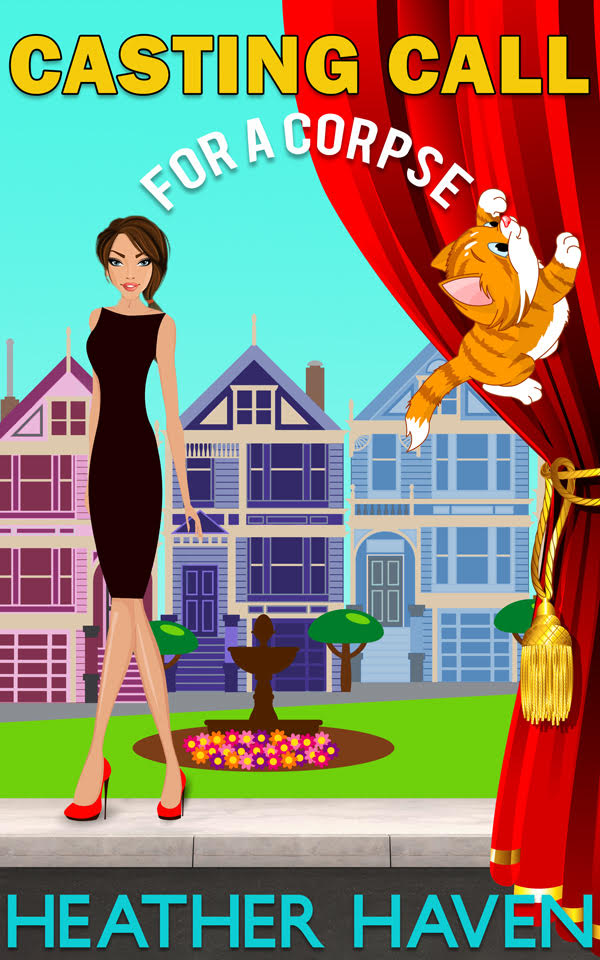
When I write a humorous scene, I try to give new insight into a character or add something to the story. When that happens I am off and away. One of my favorite examples comes from Casting Call for a Corpse, Book 7 of the series. It’s a scene involving a theatrical mishap, a not-too-well-trained horse, and Lee’s new husband, Gurn. Ordinarily, Gurn is a man in control, but at this juncture, he is undercover as a bit player in a new musical and is out of his comfort zone, which is often the key to humor.
Gurn entered from downstage right dressed in a French foot soldier’s uniform. A seemingly unconscious man, also wearing a French uniform, was slung over Gurn’s left shoulder. According to rehearsal, Gurn was supposed to cross to Gaby at center stage, say his lines, and then exit stage left. However, he halted awkwardly midway between stage right and center. When he tried to walk toward Gaby again, he simply couldn’t. Finally, he stood in one spot, looking more or less stupefied.
It didn’t take the audience long to figure out why he couldn’t move any farther. The wrist of the unconscious soldier had become entangled in one of the many pieces of gelatinous barbed wire jutting out from the fence. Whenever Gurn tried to move forward, the other man’s arm would be pulled as far as possible. It was clear the arm was insnared in the fake barbed wire. Any movement was impossible. I don’t think it was Newton’s law of physics, but something close. It became clear that unless Gurn dropped the man to the stage floor, he had to stay where he was.
Gaby, the star of the show and an old trooper, realized something was wrong. Changing her blocking, she walked over to Gurn who looked as if he would pass out at any moment. She fed him his line couched in a question.
“Tell me, soldier, were you going to ask me to please save your friend?”
Gurn opened his mouth, but no sound came forth. He may have seen many tours in Afghanistan as a soldier, but being onstage in front of eight hundred people was a new form of terror for him.
Gaby braved on. “I know if you could but speak,” she ad-libbed, “You would ask me to save your friend. So why don’t you bring him to the field hospital?”
She gestured to offstage. Gurn’s jaw worked back and forth several times. He looked out into the audience with rapidly blinking eyes. Still, he could utter nothing.
“It’s right over there. Go,” Gaby finally ordered, pointing to a spot offstage.
Gurn tried to walk in the direction indicated but, once again, had to stop when the other man’s arm was pulled to full extension. Also, the wire seemed to become more tightly wrapped around the “unconscious” actor’s wrist with each tug. The actor began to struggle, trying to get off Gurn’s shoulder. Panicked, Gurn reached behind himself and the man. He gave the offending, taut wire a mighty yank as only a former Navy SEAL can do, who is in really good shape. Which was really bad.
What happened next reminded me of the nursery rhyme, This Was the House That Jack Built:
This was the man
who yanked the wire
That jerked the fence
That pulled the scrim
That toppled the backdrop
That crashed to the floor
That spooked the horse
That hauled the wagon
That galloped onstage
Then raced to the exit
But not before pooping
Downwind of upstage
A bemused audience watched the entire set crash down upon itself behind onstage actors who stood frozen in place. Once the dust settled, Gurn realized he was free of the wire holding him and his companion captive onstage. Lines forgotten, Gurn made a sprint for the wings but not before running into one of Bob the Horse’s deposits. I am not well versed on the subject of horse manure, but from what I witnessed, it can be on the slippery side. Consequently, Gurn glided like an ice skater for a pace or two. Then both feet went out from under him.
Up in the air both men went. But what goes up must come down. So down they came landing squarely in another one of Bob’s farewell gifts. Dumbfounded, the two men sat, unmoving. There was the universal moment of sympathetic silence all human beings feel for any poor sap sitting in the middle of a horse patty. The feeling soon passed.
One or two audience members began to titter. Several broke out into loud guffaws. More laughter followed. Soon no one was holding back, including Gaby. She collapsed to the stage floor, wrapped her arms around herself, and rocked back and forth shaking with laughter.
The curtain rang down. The house lights came up.
There’s more, of course. We have characters reacting to what happened and so forth. I try to have one or two of these scenes in each story. But they can’t be there unless they do one of three things: show another facet of a character, move the story forward, or add relief and/or color.
Comedy writing can be very rewarding and a lot of fun. Seriously.

 Ladies of Mystery
Thank you, Paty, for your supportive words. Accident-prone is a great way to approach a scene!
LikeLike
Writing a scene like that is definitely its own reward. Loved it. You may think you’re being serious, but your posts are hilarious.
LikeLike
Susan, I’m so glad you like my humor. I often see the humor in everything, much to some people’s dismay. Thanks so much!
LikeLike
I actually took a writing humor workshop years ago and decided I can’t do it. But I did make a character accident-prone in one of my western romance books and it worked. I can do a one-liner here and there but as for flat-out humor, I applaud those who can do it. Fun post, Heather!
LikeLike