
Ancient Roman Forensics
As the author of the Miriam bat Isaac Mystery Series set in first-century CE Roman-occupied Alexandria, I regularly research the investigative techniques used in Roman times. In writing my latest book, The Deadliest Deceptions, a collection of short mysteries ranging from cozy to noir, I found myself focusing on Roman forensics. No, the Romans didn’t know about fingerprints and DNA, but in time, their courts accepted evidence based on blood spatters, dental characteristics, and pattern recognition.
Perhaps the most famous case based on blood spatters was “The Wall of Handprints”, in which a blind son was accused of killing his father for his inheritance. The prosecution argued that the father was asleep with his wife, his son’s stepmother, when his son stabbed him to death. Furthermore, the father died instantly without having awakened his wife, and the son left a trail of intermittent handprints and blood spatters on the wall from their room back to his own.
On the other hand, the defense attorney claimed that it was the stepmother who killed her husband. Upset that she would lose the inheritance, she framed her stepson. The lawyer successfully argued that the son, being blind, would not have left intermittent prints. Rather he would have dragged his hand along the wall. So, despite their lack of knowledge about the components of blood, the Romans used its prints and spatters to reconstruct the crime.
Julia Agrippina, a.k.a. Agrippina the Younger, used dental characteristics to confirm that Lollia Paulina was dead. Having ordered Paulina’s suicide, Agrippina confirmed her rival’s death by asking for Paulina’s head and inspecting the teeth herself. She must have been satisfied because she did not have anyone else killed for five more years.
Pattern recognition marks convinced the Roman emperor Tiberius that his praetor’s wife died by murder rather than suicide. He saw drag marks and other signs of a struggle to contradict the husband’s claim that his wife had jumped out the window while he was sound asleep. Tiberius referred the matter to the Senate, but alas, the praetor opened his veins instead.
Roman forensics may date back two thousand years, but even modern evidence from blood spatters, dental characteristics, and pattern recognition can be wrongfully interpreted. Just not in my stories. You can depend on Miriam bat Isaac and her assistants to look at wounds, loss of body heat, skeletal proportions, blood spatters, foot prints, and disturbed foliage to assess a crime correctly.
THE DEADLIEST DECEPTIONS
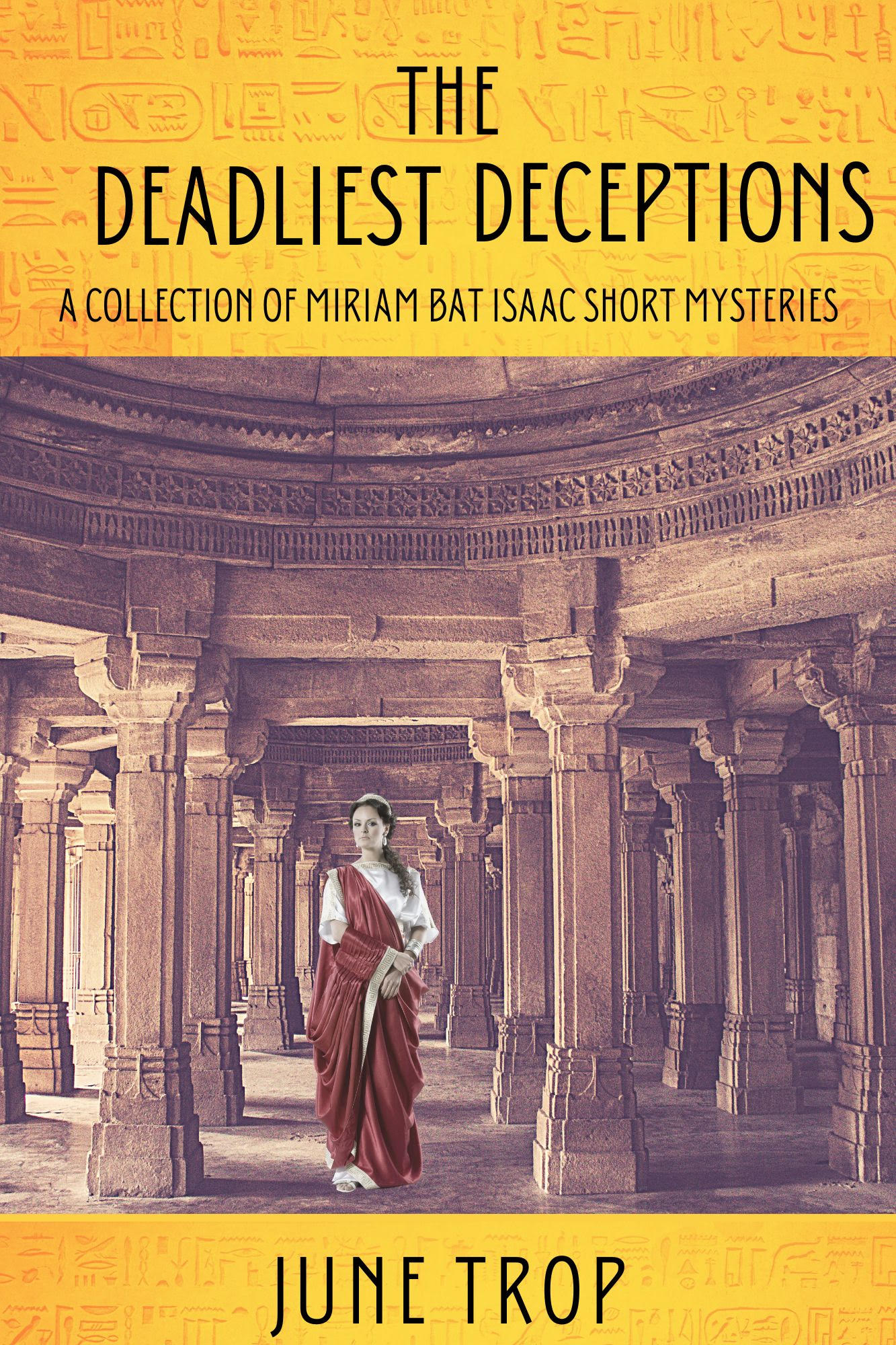
Enter the world of first-century CE Roman Alexandria and participate in the perilous adventures of Miriam bat Isaac, budding alchemist and sleuth extraordinaire. Join her and her deputy Phoebe as they struggle to solve nine of their most baffling cases beginning with the locked-room murder of a sailor in which Miriam is baffled by not just who killed the sailor but how he could have died and how the killer could have entered and escaped from the room.
But be careful as you accompany them into the city’s malignant underbelly. Whether or not you can help them solve the crimes, your blood will flow faster as you escape to that world of adventure we all long for.
BUY LINKS:
Amazon for Kindle https://www.amazon.com/Deadliest-Deceptions-Collection-Miriam-Mysteries-ebook/dp/B0BT3W7V1B
Amazon for Paperback https://www.amazon.com/Deadliest-Deceptions-Collection-Mysteries-Mystery/dp/1685122752
June Trop and her twin sister Gail wrote their first story, “The Steam Shavel [sic],” when they were six years old growing up in rural New Jersey. They sold it to their brother Everett for two cents.
“I don’t remember how I spent my share,” June says. “You could buy a fistful of candy for a penny in those days, but ever since then, I wanted to be a writer.”
As an award-winning middle school science teacher, June used storytelling to capture her students’ imagination and interest in scientific concepts. Years later as a professor of teacher education, she focused her research on the practical knowledge teachers construct and communicate through storytelling. Her first book, From Lesson Plans to Power Struggles (Corwin Press, 2009), is based on the stories new teachers told about their first classroom experiences.
Now associate professor emerita at the State University of New York, she devotes her time to writing The Miriam bat Isaac Mystery Series. Her heroine is based on the personage of Maria Hebrea, the legendary founder of Western alchemy, who developed the concepts and apparatus alchemists and chemists would use for 1500 years.

As an award-winning middle school science teacher, June Trop used storytelling to capture her students’ imagination and interest in scientific concepts. Years later as a professor of teacher education, she focused her research on the practical knowledge teachers construct and communicate through storytelling. Her first book, From Lesson Plans to Power Struggles (Corwin Press, 2009), is based on the stories new teachers told about their first classroom experiences.
Now associate professor emerita at the State University of New York, she devotes her time to writing The Miriam bat Isaac Mystery Series. Her heroine is based on the personage of Maria Hebrea, the legendary founder of Western alchemy, who developed the concepts and apparatus alchemists and chemists would use for 1500 years.
June, an active member of the Mystery Writers of America, lives with her husband Paul Zuckerman, where she is breathlessly recording her plucky heroine’s next life-or-death exploit.
Facebook https://www.facebook.com/profile.php?id=100044318365389
Website https://www.junetrop.com/

 Ladies of Mystery
This is a fascinating article. I look forward to reading your series.
LikeLike
June, this is all intriguing information. Congratulations on the second book in this series.
LikeLike