Sometimes a character will pop into my head just waiting to serve me. But I have to be honest. In reality, they have been stored in my mind, coming from an incident I may have seen while crossing a street, waiting in the supermarket line, or sitting in a restaurant. Speaking of restaurants, I remember years ago sitting in a large Chinese restaurant with my mother. As with most large, single rooms filled with people, the din was almost ear-splitting. But for one brief moment – you know how that goes – everyone stopped talking except for one lone couple. In the silence of that large room, we heard a woman’s voice ring out loud and clear. “It’s not the eggroll, Harry. It’s the past six years.” A titter ran through the room, then outright laughter. The hub-bub picked up again, but it was a moment I never forgot. The unexpected. The funny. The one or two words that spark an entire scenario.
That’s why it’s good to get out. You never know what you’ll see or hear. The out-of-the-blue inspiration for my imagination, the thing that gives me liftoff, could be anyone. It could be YOU. Never trust a writer.
As I writer, I tend to eavesdrop on life. I spy with my little eye. That sort of thing. But I don’t want any real details. I’m not a reporter. I am a fiction writer. I don’t want to know the couple I find so fascinating at the nearby table are not calling it quits after 15 years of marriage but are discussing a movie they saw. Or that the old duffer sitting at a table for one studying the menu again and again wasn’t thrown out of his house by his louse of a son but is merely waiting for someone, forgot to bring his reading glasses, and can’t see a word.
As I listen to them or see them oh, so briefly, I am creating a whole new world. I am adding to and subtracting from their traits, their virtues, their flaws. They have no idea they will be a major or minor part of my current story. Or my future story. They will become whoever and whatever I want them to be. It doesn’t matter who they really are, now they are mine. Bent to my will. I am their new creator. Oh, the power of it.
Today is the Fourth of July. I’ll spend a couple of hours this morning watching the local parade, which passes my condo complex, sitting in a camp chair and greeting neighbors. I’ll shut the windows to keep out the sound of those @#$%^&* illegal fireworks.
I’ll also watch a movie. That may seem like quite a segue, but I grew up at the movies. In years past, my mother’s family owned movie theaters, from the silent era on.
The movies also play a role in my novels. In my Jeri Howard book Bit Player, Jeri’s case takes readers back to Hollywood in the 1940s. My most recent Jill McLeod book, Death Above the Line, finds Zephyrette Jill taking a break from riding the rails, She winds up in the cast of a film noir. She also meets a former actress who was blacklisted.
The movies of choice for the Fourth of July are Yankee Doodle Dandy and 1776. In the first, Jimmy Cagney dances across the screen as that quintessential song and dance man George M. Cohan. And 1776 gets me every time, with William Daniels as John Adams. Benjamin Franklin is played by Howard Da Silva, who was blacklisted, for real.
So, watching these movies is a holiday tradition. It’s all good, right?
Yet lately, I’m bothered. There’s a blackface number in Yankee Doodle Dandy.
I know blackface is a theatrical tradition dating back to minstrelsy in the mid-19th century in the United States. In the 20th century, there are Al Jolson in The Jazz Singer and Bing Crosby in Holiday Inn. That’s why I can’t watch Holiday Inn, for all that many folks consider it such a classic. That blackface number in Holiday Inn is excruciating. And the one in Yankee Doodle Dandy makes me wince.
So, 1776. I’ve seen the musical on stage several times, and I have the DVD of the movie. The most difficult part, for me, is the battle and compromise over slavery. Just a movie, right? With terrific performances and wonderful songs? Well, it’s a movie with lots of undercurrents and lots to think about. Those founding fathers “twiddle, piddle and resolve,” according to the lyrics of one song, as they argue about whether to declare independence and then about the writing of the declaration. We’re still arguing about the constitution that followed, facing—or not—the consequences of those actions in Philadelphia all those years ago.
Flawed people, living in different times. Those founding fathers were white men of property who viewed the world through that lens, despite Abigail Adams’s admonition to her husband to “remember the ladies.” Unfortunately, that didn’t happen. And the slaves? Well, three-fifths of a person, a compromise at the constitutional convention that increased the power of slave-holding states.
For decades, from the 19th to the 20th century, many white performers and audiences didn’t see anything wrong with performing in blackface, though this 21st-century person finds it difficult to look at those stereotypes.
What does this have to do with writing? A lot, in my opinion. Flawed people. That’s what we’re dealing with when we write fiction. The characters I create wouldn’t be very interesting if they were perfect. In Witness to Evil, Jeri Howard’s case leads her into a confrontation with white supremacists. I wrote that book in the mid-1990s. I wish it wasn’t so relevant now.
In the Jill McLeod books Death Rides the Zephyr and Death Deals a Hand, readers glimpse how passengers aboard the trains in the early 1950s often treated African American porters with disdain and disrespect. And in the first book, a baseless accusation of theft. That’s the way things were back then and including that in the novels informs the picture I create of the times.
I make decisions when I write, determining how much, or how little, information about those flawed people goes into the book, and what it’s meant to convey.
We hold these flaws—a necessary part of the creative process.
Some of us are in critique groups, some would like to find one, and still others vow never to come near one. Maybe these resistant writers have a trusted editor at a big-name publisher or maybe they think they’re wonderful without feedback. I’m not that good, so when I moved to the Rogue Valley, Oregon, and gave up academic writing for fiction writing I was grateful to be introduced to my Monday Mayhem group.
I still remember my first meetings with the group. They praised my writing style but told me that I couldn’t wait a hundred pages before I introduced the murder. Although I reject such “rules,” they were right about Tour de Trace. The discovery of the murder in that novel now happens on page twenty.
I’ve now published seven novels with two more scheduled before the end of 2023. I couldn’t have achieved this without Monday Mayhem. The group works because it forces us to submit writing every two weeks. Not that we can’t take a pass now and again or that we can’t stray from writing mysteries that were the original impetus for the group. This isn’t a class where our grades depend on following an assignment and handing it in on time.
There are other reasons besides discipline that makes our group work. We stay on task, drinking water, not wine, and except for an occasional cookie being fed only the manuscripts we’re cooking up, even the cookies on hiatus when Covid drove us to Zoom. A two hour time period also keeps us focused on writing, not small talk. We’re not a stiff group, though. Sometimes we learn things about each other’s lives that surprise us. Who would have thought that one of the women drove race cars or that one of the men was admitted to his college’s Hall of Fame because of his acting career.
When I first joined this group, we were three men and two women. We welcomed a third woman, but when Tim, the group’s founder died, we returned to five members instead of six. Tim was the member who was most insistent about not delaying the murder in Tour de Trace. His criticism was never gentle so when I found a publisher for my short story “24/7” (The Fictional Café), I smiled to remember his rare praise for that story, “Don’t change a word.”
We’ve remained at five members because this seems to be an optimal number for giving full attention to what can amount to a hundred pages that we collectively submit on the Thursday before our Monday meeting. We all bring a different focus, a different strength, and, yes, a different weakness to our writing.
Carole’s work could be classified as regional fiction. All her novels are set in Oregon, often in the horse barns of ranches, and her sleuths are never professionals. I challenge her to omit extraneous detail and she challenges me to bring more emotional depth to my characters.
Clive’s region is as different from Carole’s as congested Los Angeles is to the range land of Oregon. His protagonist is a sometimes private investigator, sometimes actor. His novels are rich in Hollywood detail. I challenge him to eliminate his tendency to use passive voice, and he helps me get out of a clunky paragraph by suggesting that I use dialogue.
Jenn’s region is also Southern California and she writes with a strong comic voice. Michael’s setting in his thrillers is mostly international. He draws on his knowledge of politics honed from his years of teaching. Jenn inspires me to add a witticism or two to my writing and I challenge her to push on through her manuscript before she goes back to revise for consistency. Michael helps me whenever I get tangled in inaccurate technology and I remind him that even thrillers need to take a break now and again from an escape or a chase or a fight.
As helpful as critique groups can be, they also come with the hazard of someone going rogue. What do you do if a member consistently submits more than the allotted page count or spends valuable time resisting a suggestion? What if someone loses the big picture in favor of arguing about a comma or regularly crushes others with insults rather than constructive suggestions.
Monday Mayhem’s strength comes from our differences. Although our genres and writing styles differ, we have compatible writing skills. We aren’t teaching writing, we’re helping with revising. Neither too bad nor too good might be a mantra for a successful critique group. We can’t help someone with a tin ear any more than we can help a Beethoven.
Discipline, compatibility, variety. Three ingredients for a successful critique group. If you’re looking for one, watch for these qualities. If you are in one, ask yourself why it works or what it needs to work better.
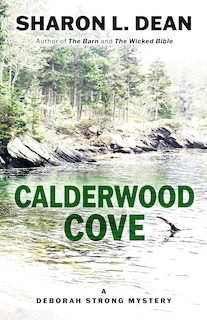
When Deborah Strong accepts an invitation for a reunion with high school friends who will all be turning fifty, she anticipates a lovely Fourth of July weekend in Maine. But soon a murder disturbs the quiet of the summer homes that dot the isolated cove. Deborah’s suspicions follow her like the Maine landscape–plenty of sunshine, plenty of fog, and plenty of evening mosquitoes that arrive like the sparks of fireworks. Where is Brenda’s husband? Where have her caretaker and cook gone? Who is the anorectic young man who keeps appearing? Is one of them a murderer? Or is it the old woman who lives across the street, her son who runs an oyster farm in the face of global warming, her poet-tenant who lives in her apartment? Deborah even suspects each of the friends she grew up with. By the time she finds the answer, she is ready to leave Calderwood Cove where an idyllic summer retreat turned as deadly as contaminated shellfish.
Sharon L. Dean grew up in Massachusetts where she was immersed in the literature of New England. She earned undergraduate and graduate degrees at the University of New Hampshire, a state she lived and taught in before moving to Oregon. Although she has given up writing scholarly books that require footnotes, she incorporates much of her academic research as background in her mysteries. She is the author of three Susan Warner mysteries and of a literary novel titled Leaving Freedom. Her Deborah Strong mysteries include The Barn, The Wicked Bible, and Calderwood Cove. Dean continues to write about New England while she is discovering the beauty of the West.




 Ladies of Mystery
You must be logged in to post a comment.