To Prologue or Not to Prologue (#2) by Karen Shughart

I promise this isn’t a duplication of Paty Jager’s blog from last Monday. Paty and I frequently seem to be on the same page when choosing topics for our monthly blogs, and when I read her title, I was terrified that my extremely rough draft had somehow made it’s way into scheduling instead of her very well-written and polished one. Fortunately, my fears were allayed when I saw her name as the author. Whew! And while our titles are the same, we’ve written from our own points of view.

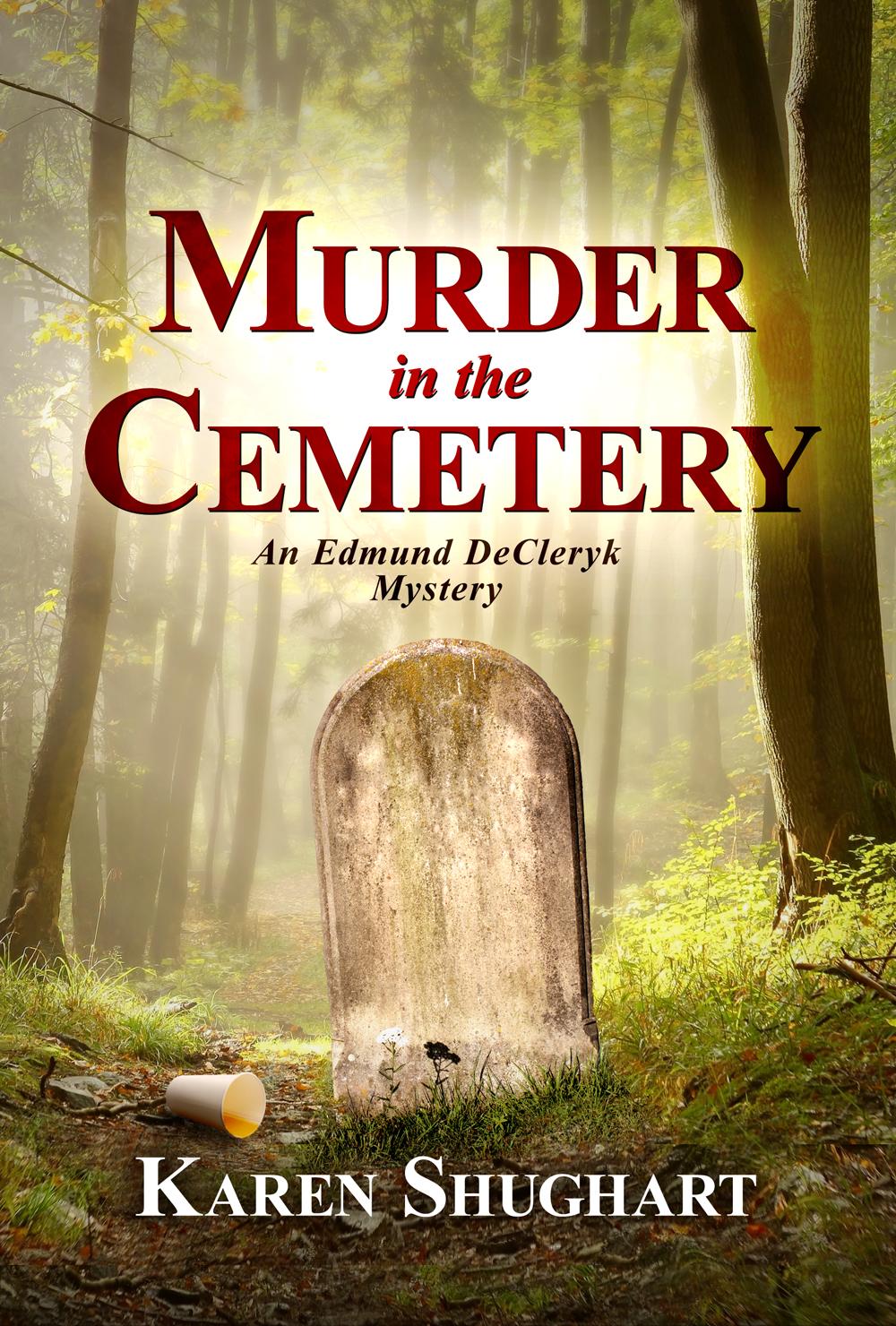
Each of the books in my Edmund DeCleryk Cozy mysteries has an historical backstory that’s related to the crime and provides clues to why the murder was committed. In book one, Murder in the Museum, the prologue introduced a character whose journal, written in 1845, was discovered at an archeological dig in Toronto, Canada. The prologue in book two, Murder in the Cemetery, ties the crime to a battle that occurred in Lighthouse Cove, NY during the War of 1812.

My creative juices really started flowing in book two, and I played around with writing two prologues: the first as described above; the other to introduce the setting, the month of May. You’ll have to read the book to learn why that’s important. My dilemma was which to keep and which to discard. I realized I was emotionally attached to both, so decided to get my publisher’s advice-few books are written with two prologues. Her quick response: “go for it,” and I did.

I’m heading down the home stretch with book three, Murder at Freedom Hill. Yet again, I’ve written two prologues: the first, the historical backstory – it takes place in 1859 in Lighthouse Cove during the abolition movement, when fleeing slaves boarded a schooner to transport them across Lake Ontario to Canada. The second is set in November, the month when the harvest is over, and the chill and frost of winter lurk just around the corner.  

What I love about writing this series is that I don’t have to follow all the rules. It doesn’t mean I am undisciplined; I certainly know how to craft a story from beginning to end, but I enjoy taking liberties with commonly accepted writing practices when it makes sense.

It’s up to us mystery writers to decide how our stories will be written. Some begin with the murder; others lead up to it, it can go either way. It’s the same for prologues. Sometimes a book needs no prologue, but at other times a prologue can set the scene and enhance the plot. And at times, two prologues are even better.

Guest Blogger ~ Kaye George

Where Did Enga Dancing Flower Come From?

I ask myself that sometimes! Her original name, in my mind, was Enga Yellow Flower. Her twin was Ung…some other color of flower. They were either abandoned by their own Neanderthal tribe, or the sole survivors of a catastrophe. However, as soon as I inserted Enga into the tribe who rescued them, in the very first book, DEATH IN THE TIME OF ICE, it became clear she was a dancer. The best dancer in the tribe. She wanted to keep the Flower in her name, hence, Enga Dancing Flower.

Maybe I should answer the larger question. Where did the Neanderthal tribe, who call themselves the Hamapa, come from? It is totally my fault that they find themselves in what is now North America. My life-long fascination with all things ancient compelled me to use that setting so I could include the wondrous mega-fauna from that time, about 35,000 years ago. I couldn’t resist the giant sloths, giant beavers, dire wolves, glyptodonts, saber tooth cats, mammoths of course, and many more. (The book, ICE AGE MAMMALS OF NORTH AMERICA: A Guide to the Big, the Hairy, and the Bizarre, helped to make them irresistible.)

Aside from residing where it’s probable that they never did (but it’s also possible, just barely!), this tribe and the others are drawn as faithfully to modern research as I can. It’s hard to keep up, though, because new discoveries are constantly being made, and new theories being posited. Just the other day, a baby wooly mammoth emerged from the permafrost in the Canadian Yukon, almost perfectly preserved!

Enga’s twin eventually became Ung Strong Arm when she turned out to be one of the best spear throwers. The Hamapa are matriarchal and the woman are the spear throwers since they are patient and accurate. The strong males are charged with hauling back the large pieces of the kills. Seems fair to me.

How about the names Enga and Ung? Believe me, everything had to be thought out for these books. I studied linguistics to learn what the easiest sounds are, the least complicated. It was thought, for some time, that Neanderthals had no speech capabilities, but that has been shot down for theories that they probably did. I took the middle ground. They can speak, but rarely do. And when they do, they use the sounds that young children and people with speech problems find easy to make.

That’s where Enga Dancing Flower came from. Where is she going? When the leader of the tribe is murdered in the first book, Enga is clever enough, with the help of a juvenile male named Jeek, to figure out who the murderer is. The tribe values her dancing as well as her problem-solving skills. You know, if you read mysteries, that more people will be murdered, and Enga and Jeek will have to uncover more clues, facts, and culprits.

The second book is DEATH ON THE TREK, and DEATH IN THE NEW LAND is the latest.

Enga Dancing Flower and her tribe have reached a place they can stay in safety. Or have they?

It’s clear the groups of other settlers in the area do not want more neighbors, and this is made even more evident when a male of Enga’s tribe is murdered, and a baby is kidnapped.

The future of the tribe is immediately put into question. Can Enga and her people find the killer and rescue the baby? Or will the security and bright future the tribe has dreamed of fall to pieces?

Buy links

Paperback from Untreed Reads (discounted here)

Ebook from Untreed Reads (discounted here, too)

Amazon

Barnes & Noble

Also available through Ingram

Kaye George, award-winning novelist and short-story writer, writes cozy and traditional mysteries and a prehistory series, which are both traditionally and self-published: two cozy series, Fat Cat and Vintage Sweets; two traditionals featuring Cressa Carraway and Imogene Duckworthy; and the People of the Wind prehistory Neanderthal mysteries,  Over 50 short stories have also appeared, mostly in anthologies and magazines. She reviews for Suspense Magazine and writes a column for Mysterical-E. She lives in Knoxville TN.

Social media links: (feel free to pick and choose)

CONNECTIONS

Here’s where you can connect with me if you haven’t already:

Emails: kayegeorge@gmail.com and janetcantrell01@gmail.com

My Facebook page: https://www.facebook.com/kaye.george

Goodreads page: https://www.goodreads.com/author/show/4037415.Kaye_George

Twitter: https://twitter.com/KGeorgeMystery/

Pinterest: http://pinterest.com/kayegeorge/

My Amazon page: http://www.amazon.com/-/e/B004CFRJ76

Book Bub: https://www.bookbub.com/authors/kaye-george

Authors Guild of Tennessee: https://authorsguildoftn.org/

My blog: http://travelswithkaye.blogspot.com/

PUBLIC FACEBOOK GROUPS:

Nose for Trouble Facebook group:  https://www.facebook.com/groups/NoseForTrouble/

Prehistory Writers and Readers Campfire: https://www.facebook.com/groups/1466936593554809/

Cozy Town Sleuths (on the 4th of the month) https://upload.facebook.com/groups/cozytownsleuths/

Smoking Guns E TN chapter of Sisters in Crime: https://www.facebook.com/groups/391058174841953/

Balancing Balls and Weather Machines – A Look at Setting


by Janis Patterson


The temperature has been in triple digits for the last week or so, but in the wee hours of the morning it does fall to the low 90s…


And here I am, wrapped in furs in the middle of a snowstorm. Sadly, it’s only in my mind, as I am working madly to meet the deadline for my Christmas anthology novella. It’s hard to keep one’s mind on snow and cold and greenery and holly berries and sleigh rides when in spite of air conditioning and skimpy sundresses there is sweat dripping from the tip of your nose.
However – I have been complimented about how real and evocative of time and place my previous Christmas novella anthologies have been, and they were written under similar unseasonable (for the work) circumstances, so I guess I’ve been doing something right.


But isn’t that the job of a writer? To create a world into which the reader can immerse themselves, feeling, seeing, knowing what the characters feel? To transport the reader into that world?
Writers are creators of worlds, whether that world is a snowbound country estate, a shack beside the cool orange seas of a distant planet, a year distant in either the past or the future, or even the here and now of our own home street. And it is our job to take the reader there.


So how does one do it? That varies; if it is a here-and-now story set in a pleasant American suburb, that is something to which most readers can relate without too much exposition or world building, even if they do not now nor have ever lived in one. On the other hand, if the story is set on a distant star, where gravity is minimal and the three orbiting suns insure that darkness is an unknown concept, the writer has to do more spadework in creating this world. Same if the story takes place in a great stone castle in the Dark Ages; most people have at least seen pictures of castles, but have little to no knowledge of the socio-political-religious attitudes/beliefs which not are only reflective of the time but which formed the society and belief systems of the time.


Another thing that writers must be aware of is that once they have created this world – be it tidy American suburb, distant star or long-past history – they must be true to it both in construction and action. For example, there is no way I could believably have the characters in my Christmas novella go out and sunbathe in between snow flurries. If my story were set in the distant future where the weather was controlled and there were strict time systems for each variety of weather, it could be perfectly believable that my characters could turn off the snow, set the sun to ‘melt’ and then go out for a nice long sunbath… as long as I had set this part of my world up correctly.
And the final thing to remember is once your world is built and works and you are sure you will have no trouble in maintaining this soap bubble of belief, you must craft a story – a good story – that will fit into the strictures of these parameters and profit from an interaction with them.


Taken like that, the prospect of writing a novel becomes both overwhelming and terrifying, all too often leaving the poor writer feeling like a trick seal who must balance eight or ten balls on its nose. It’s a wonder anyone ever writes.

To Prologue or Not to Prologue

I’m currently working on the next (#10) Gabriel Hawke Novel. It will be set up in the style of book #2. I have a person who saw a murder in the wilderness and my character Hawke will find them. Just like book #2, I’ll be starting it with a prologue where the character witnesses the killing and then runs in fear for their life.

To me it makes sense to start the book, with a prologue, showing the person watching the act happen and then fleeing, so that will need to be in their point of view. Then as the story progresses, there will be things Hawke (my main character) won’t know or see, but the reader needs to know through the fleeing person’s point of view so I will have the two points of view in the book.

Most of my Gabriel Hawke books are in my main character’s point of view unless there are scenes that the reader needs to see what my character can’t see. That’s when I use a second point of view.

This book, I’m still working on the title, has been brewing and stewing in my head for nearly 6 months. It came to me as I was writing book #9 that released the end of June. That’s how my brain works. While I am working on a current book in a series, my mind is already moving to the next book. It may be the villain creeping around in my brain, or a setting, or a premise. But as I typed the words to the work in progress, the other story is working in the background.

Back to prologues. There has been a book or two I’ve read where the prologue was flat or didn’t feel like it had anything to do with the story that followed. But there have also been books where the prologue drew me into the story, and I couldn’t wait to read more.

As with all writing, it is the execution of the timing, the words, the characters that makes a reader continue or stop. That and a good, as in a mystery book, whodunit. Something to keep the reader turning the pages and reading well past the time they should turn out the lights and sleep.

Unless you can pull them in at the beginning, with a good prologue, first sentence, first paragraph, first page, first chapter, you could possibly lose the reader. And that’s why I ponder the question: To prologue or not to prologue.

What do those of you reading this post think?

Here is info about my newest release: Owl’s Silent Strike

Book 9 in the Gabriel Hawke Novels

Unexpected snowstorm…

Unfortunate accident…

And a body…

What started out as a favor and a leisurely trip into the mountains, soon turns State Trooper Gabriel Hawke’s life upside down. The snowstorm they were trying to beat comes early, a horse accident breaks Dani Singer’s leg, and Hawke finds a body in the barn at Charlie’s Lodge.

Hawke sets Dani’s leg, then follows the bloody trail of a suspect trying to flee the snow-drifted mountains. Hawke is torn between getting the woman he loves medical care and knowing he can’t leave a possible killer on the mountain.

Before the killer is brought to justice, Dani and Hawke will put their relationship to the test and his job on the line.

https://books2read.com/u/bw19DG

Guest Blogger ~ Cherie Claire

A SCANCy series takes on Covid: Ghost Fever by Cherie Claire

            The last thing I wanted to rehash in my mystery writing was the virus that stole two years of my life. Of course, I’m exaggerating. I’m still here and am grateful my immediate family and friends are healthy and well. But write about Covid? Wasn’t high on my list.

            And yet, I had visited an outfitter in a rural area of the Florida Panhandle, just outside Pensacola, and it birthed an idea. Here was a place to zip line, kayak and relax in cabins on a piney woods property with an old schoolhouse from the 1920s and a creepy cemetery — yes, a cemetery! And it got better. Inside my cabin was a book about a rash of UFO sighting in the area in the 1970s. Nearby is a state park named for Ponce de Leon, the Spanish explorer who searched for the Fountain of Youth.

My imagination took off.

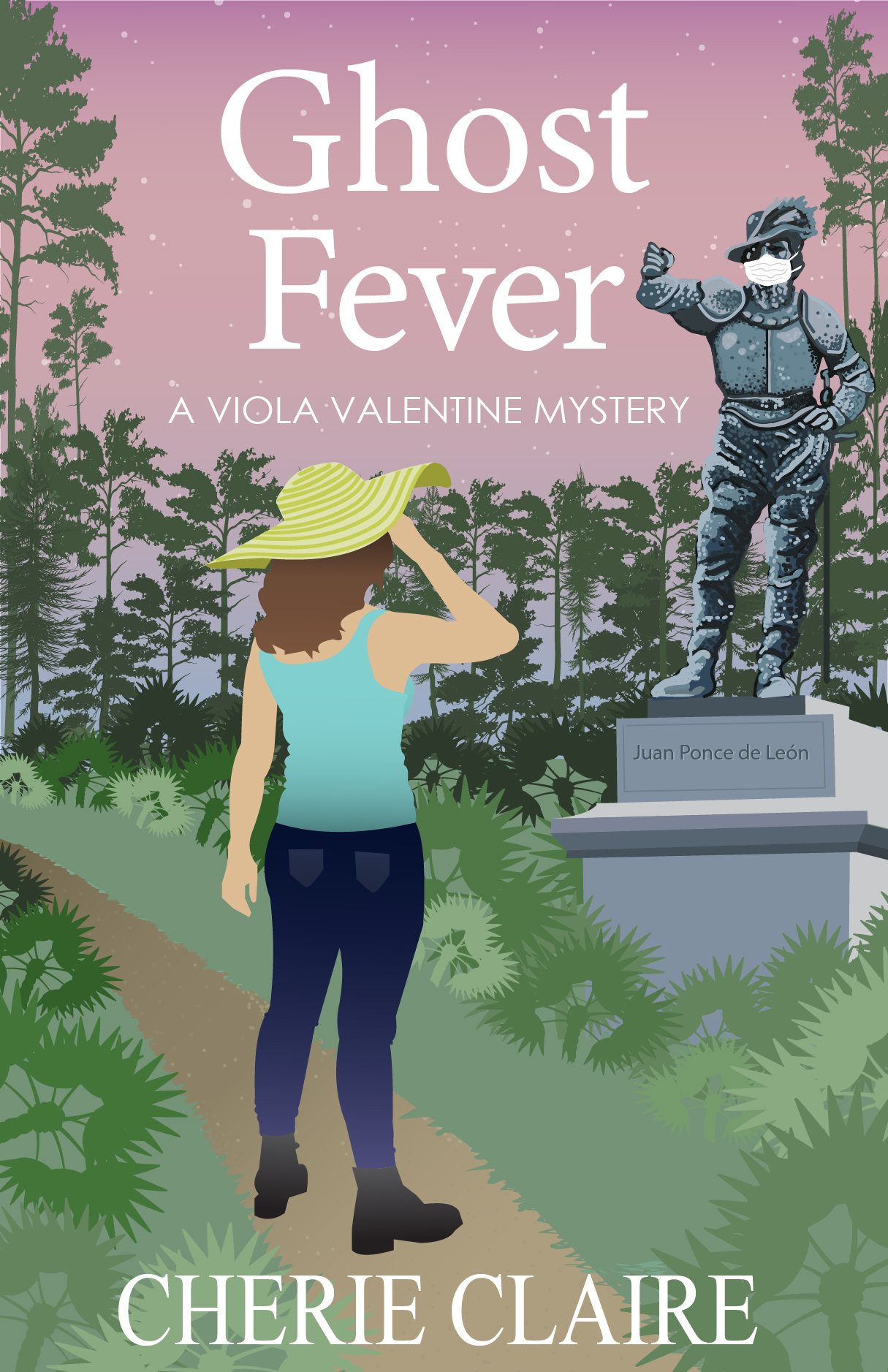
            The seventh book in my Viola Valentine paranormal mystery series combines all those elements, but adds time travel as well. What other pandemic had Americans been subjected to — the Spanish Influenza of 1918! That’s in the story as well.

            Ghost Fever may take place in 2021 amid the Covid scare but there’s a lot of adventure to enjoy.

The series features my main character, Viola Valentine of New Orleans. After a hurricane upends her life, Viola separates from a loveless marriage and becomes a travel writer, her dream profession. But the storm also blew open a psychic door. Now she sees ghosts who have died by water and mysteries to solve everywhere she goes.

            She’s what I call a SCANC. But it’s not what you think. SCANC stands for Specific Communication with Apparitions, Non-Entities and the Comatose. And Viola has seen all three!

The key word here is “specific.” Viola repressed her psychic abilities when she was young, tired of being chastised as having a vivid imagination when ghosts would appear. Children of the Paranormal TV show had yet to air so poor Vi had no support system, either. When my mystery series opens, Viola realizes that the trauma of the hurricane opened that door back up, but this time, the ghosts Vi sees are strictly related to water.

Along the way, that husband she tried to distance herself from won’t let her go. When I first started writing the series, I envisioned him a goofy distraction at best. He ended up stealing my heart and has become a colorful fun character throughout the series. He has some supernatural talents as well.

Do they get back together? You’ll have to read to find out.

Ghost Fever is the latest book in the Viola Valentine series, but the fun begins with A Ghost of a Chance, when Viola first discovers her ghostly talent. That ebook is free to download at all online bookstores. I also routinely give away copies of other books in the series through my newsletter. You can sign up and enter the contests at chereclaire.net.

Hopefully, Viola won’t have to experience another hurricane or pandemic, although being a New Orleans native she’s bound to see another storm or two. Vi has visited numerous Deep South locations and I’ll be sending my travel writing character to Southern destinations in future books, although an Alaska cruise is floating through my mind these days. Pun intended.

Regardless, there will be more Viola Valentine ghost stories to come.

Ghost Fever

The ghosts of the past never stop haunting.

Viola takes a job at her old summer camp in the Florida Panhandle, hoping for a peaceful place to work after months in Covid lockdown. But old traumas from her time at Camp Secret Spring resurface and Viola’s dream of a quiet getaway quickly turns into a nightmare.

Her best friend disappeared that summer, never to be found. Was it the camp’s mysterious water that Ponce de León searched for? Or can her friend’s vanishing be chalked up to the UFO sightings over the years? And just who were the Utopians who lived there before, many of whom died in the pandemic of 1918?

Book Seven in Cherie Claire’s Viola Valentine mystery series.

Book Links

Amazon: https://www.amazon.com/Ghost-Fever-Viola-Valentine-Mystery-ebook/dp/B09GMSDV1Q/

Apple: https://books.apple.com/us/book/ghost-fever/id1588475088

B&N: https://www.barnesandnoble.com/w/ghost-fever-cherie-claire/1140231054?ean=2940162354956

Google: https://play.google.com/store/books/details/Cherie_Claire_Ghost_Fever?id=guJFEAAAQBAJ

Smashwords: https://www.smashwords.com/books/view/1107922

Kobo: https://www.kobo.com/us/en/ebook/ghost-fever-2

Cherie Claire is the award-winning author of a mystery series and several Louisiana romances. New this year is Ghost Fever, part of a paranormal mystery series featuring New Orleans travel writer and ghost sleuth Viola Valentine. A native of New Orleans, Cherie now lives in Georgia where she works as a travel writer, but returns to her home state of Louisiana often. Visit her website at www.cherieclaire.net and follow her on social media.

Website: https://www.cherieclaire.net/

Amazon Author Page: https://www.amazon.com/Cherie-Claire/e/B000APFZ6E?ref=sr_ntt_srch_lnk_1&qid=1634567765&sr=8-1

Twitter: @Claire_Cherie, https://twitter.com/claire_cherie

Facebook: https://www.facebook.com/authorcherieclaire/

Instagram: https://www.instagram.com/cherecoen/

Pinterest: https://www.pinterest.com/cajunromances/_created/

BookBub: https://www.bookbub.com/profile/cherie-claire

TikTok: https://www.tiktok.com/@cherieclaire?lang=en