Hoping for the Best

Plans are being made starting in August for  book fairs and mystery and writers conferences. Do you think it will happen?

Not being able to see into the future, I have no idea, but I can assure you that I am really hoping it will.

I’ve really missed all the in-person events.

Book fairs are a great place to sell books because the attendees who come are folks who are readers and seeking new books. I’ve gone to many over the years. One in particular I’ve really enjoyed is held in Manteca CA, and they are planning one for this fall. Another group is planning one the same day in Elk Grove CA.

In the past, the Visalia Library (much closer to home) has hosted a book fair on their large front lawn. But the library has been closed all these many months because of Covid—and I’ve heard nothing about future plans for a book fair.

I know one of the bigger mystery conventions has plans to convene in August. I haven’t heard about many other mystery or writer conferences future plans.

I’ve missed them all. Writers conferences are great, a place to learn new things about writing and what’s going on in the profession and industry. Believe me, there are always changes.

Mystery cons are more of a showcase for writers and a place for them to meet other writers and mystery fans. For years I went to so many, that each occasion was a bit like a family reunion. I met so many writers and readers and it was a delight to see them again and catch up on their news.

Public Safety Writers Association’s writers’ conference is my favorite and they are shooting for the end of September. I like this conference because so many people in law enforcement and other fields of public safety are involved.

Whether or not this is the year we’ll  see the writers’ world return to normal, I have no idea. We can always hope, though can’t we.

Marilyn who also writes as F.M. Meredith

Latest Deputy Tempe Crabtree mystery, End of the Trail

Latest Rocky Bluff P.D. mystery, Not As We Knew It

Managing the Timeline

One of the features of a mystery that can be hard to pin down is the timeline. Right now I’m reading stories submitted for the first title of the new Best New England Crime Stories series to be published by Crime Spell Books, and one of the stories has a major problem in the timeline. I read through the story enjoying the characters, caught up in the setting, and satisfied with the end—until it dawned on me that the main clue happened after the important incident. The writer had muddled the sequence of events.

Most of us have heard the saying “Time is fluid,” and many of us have experienced the truth of that statement. Add to that the unreliability of memory, and you can see the problem. (This morning I thought it was Sunday and was shocked at how thin the Sunday paper was—a truly tragic shrinking of the Boston Globe.) A good story idea—strong characters, quick pace, good twists—can fall apart if the time line is not carefully worked out. It’s important to track the time.

The best advice may also be the most basic, so basic in fact that we sometimes forget to mention it. Let the reader know at the opening of every chapter and every scene exactly where she is. Does the opening signal a new day? Make it simple but precise: “The following morning, even though it was Saturday, Emily went to work as usual.” Is it a change in time of day? “After four hours at her desk staring at a screen, her eyes tearing up, Emily felt she was entitled to a lunch break—a long one.” Has a week passed? “The following Saturday things were no better, and Emily was still dragging herself into the office to keep up with the piles of busy-work her boss kept dropping on her desk—on his way out for a shortened work day. Emily was beginning to hate even the word golf.” 

Some writers can finesse this level of detail but when I reread their fiction I find they are clear in their own minds where they are and thus it is clear in the reader’s mind how things are progressing. It shows in the story development. You as writer have to know where the characters are or the reader won’t know.

When I’m working on a story long or short I keep track of important details on lined paper (you can use note cards or a spreadsheet or Scrivener—it doesn’t matter) of each chapter and scene. In the left-hand margin I note the time for each chapter or scene; then I note the activity of that scene. I need to know who said what to whom but just as importantly when. Introducing the back story has come to mean for me a new scene or chapter, but the change in time or setting has to be just as clear. “Emily hadn’t expected this level of drudgery when Hank hired her. She remembered that smile, and from the interview she expected a higher-level position. Had it only been three months?”

I may muddle these all together in a draft but as I revise I tease out each time change and make it explicit. When I can see the progression in time and place in my notes I have a better sense of how the story is developing. Do I need to add a twist? “Emily was warned by a co-worker not to complain—the last woman who did so had a terrible car accident and hasn’t worked since.” Have I spent too long on building up the conflict? “Emily remembered the first time Hank asked her to pick up his dry cleaning and the snide glances of the women who worked in the shop.” If the time moves forward in the backstory that needs to be marked also. “But the kicker, the proverbial straw, for Emily was when Hank asked her three weeks ago to pick up a gift at a women’s shop and rewrap it for him. She assumed it was for his wife. But in the box she was startled to find a negligee not in his wife’s size. That did it for Emily. It was time to take action.”

When I’m finished with the first draft I have a clear sense of pacing and direction. I can see easily if I’ve spent too long on moving forward instead of arriving at my destination. Crafting a clear timeline helps with character development (have I spent too much time or not enough on introducing someone?) and pacing (did I put Emily in enough danger, threatening her job security and her own safety before she chooses to act?), as well as keeping me clear on where I’ve been and when. 

A good, clear timeline will ensure I will end up where I want to be. And now, it’s all up to Emily.

A Little Exercise in Writing

I had the opportunity to join the Sisters in Crime crowd for a course in short story writing given by Art Taylor. It reminded me that I have a long-haul brain and a swift to explain psyche. It isn’t a terrific combination. I’m fighting both all of the time.

The writing of extremely short (700 words) stories was covered . . . a bit. I found the idea intriguing and liked the promised discipline of it. Really, how do you tell a good tale in seven-hundred words? I’m barely started by then. Heck, I can write seven-hundred words about the Canadian Shield lining Highway 14 in Ontario in seven minutes flat, fingers flying. But should I? Too often, I just want to tell everyone everything about everybody. I spill the beans right out of the can the minute the lid is off. It is a nasty habit.

It means that I spend days after the first draft is completed moving all of the spilled beans around to where they belong in the story. And sometimes, they don’t belong at all. And sometimes, they get left in when they shouldn’t, leaving a soggy bit of mess.

So, I suggested to my Bodie Blue Books partner that we each write a seven-hundred word short story for our upcoming newsletter. For me, it became the perfect exercise in combating my twin demons. Seven-hundred words are not many (heck, I’ve already used nearly a third of them). Like any book or short story, your seven-hundred-word tale needs a beginning, middle, and end, acts one through four, and a climax or conundrum. The enforced discipline of writing a super short story should be obvious by now.

For success, you need to question each word, its placement, purpose, and usefulness to the story right up to the hopefully satisfactory denouement. Each word should serve the purpose of the narrative. One word, one message, one point, one emotion, you can’t waste any of your allotted words, nor should you ever, no matter the length of your manuscript.

Let’s say your characters are awaiting an incoming storm of megalithic proportions. Do you describe the sky or their apprehension? Can you do both? Is it necessary to do both? Which has the most effect on the narrative? The mood?

My tale is a ghost story derived from an actual event in my life. I began writing it as it had occurred at our century-farmhouse packed as it was to the gills with the Uninvited. I felt the need to provide the provenance for the ghost. Then I realized his provenance was the mystery.  I had to walk back from my habit of spilling every character’s motivation and back-story, sometimes all at once like spewed pea soup. I worked, and honed, and edited, and . . . recalibrated a lot.

Frankly, the discipline of the limited word count drove me to rethink my writing and re-motivated me. Not a bad way to spend four frustrating days. And the exercise inspired this blog. All good, eh? (505 words)

So, suppose you decide to write an extra-short story? I suggest you limit yourself to precisely seven-hundred words to tell a tale you wouldn’t be ashamed to see in print. It will be time well spent. I leave you with that thought and 145 perfectly-good words to use anywhere needed.

Visit me at: dzchurch.com, facebook.com/mysteryhistorysuspense, or Amazon to check out my books

Guest Blogger – Avery Daniels

Resort to Murder series goes to New Mexico by Avery Daniels

One piece of writing advice I received early on was to write in whatever genre I read, and I read a lot of cozy and amateur sleuth books.  I like how justice is served; the villain is caught, and for a few hours I am on the trail of a killer.  The vicarious thrills in the safety of my locked home appeal to me, so of course I started writing a cozy mystery series.

I often hear the advice to write what you know.  I grew up in a town with a historic five-star resort.  On a sunny Sunday afternoon, I would go to the resort and walk around their man-made lake and feed the ducks.  I celebrated special occasions at their exquisite restaurant, my employers held holiday parties there, and I won tickets to and attended a LPGA golf tournament at the resort.  So it was easy to make the setting for my cozy series this resort with the idea to have every other book at a resort my sleuth is visiting.  I have also volunteered over the years and helped plan and facilitate events, from retirement luncheons to signature fund-raising events with silent auctions. I have worked with hotel staff from soup to nuts on events, so I knew a good bit of what goes into Julienne’s task in that vein of her job.

 After I settled on the resort as a backdrop, Julienne solidified as the lead character. Julienne is a young professional who skipped college for a manager-in-training program at the local five-star resort. Her dream is to manage resorts around the world to satisfy her wanderlust and desire to experience other cultures.

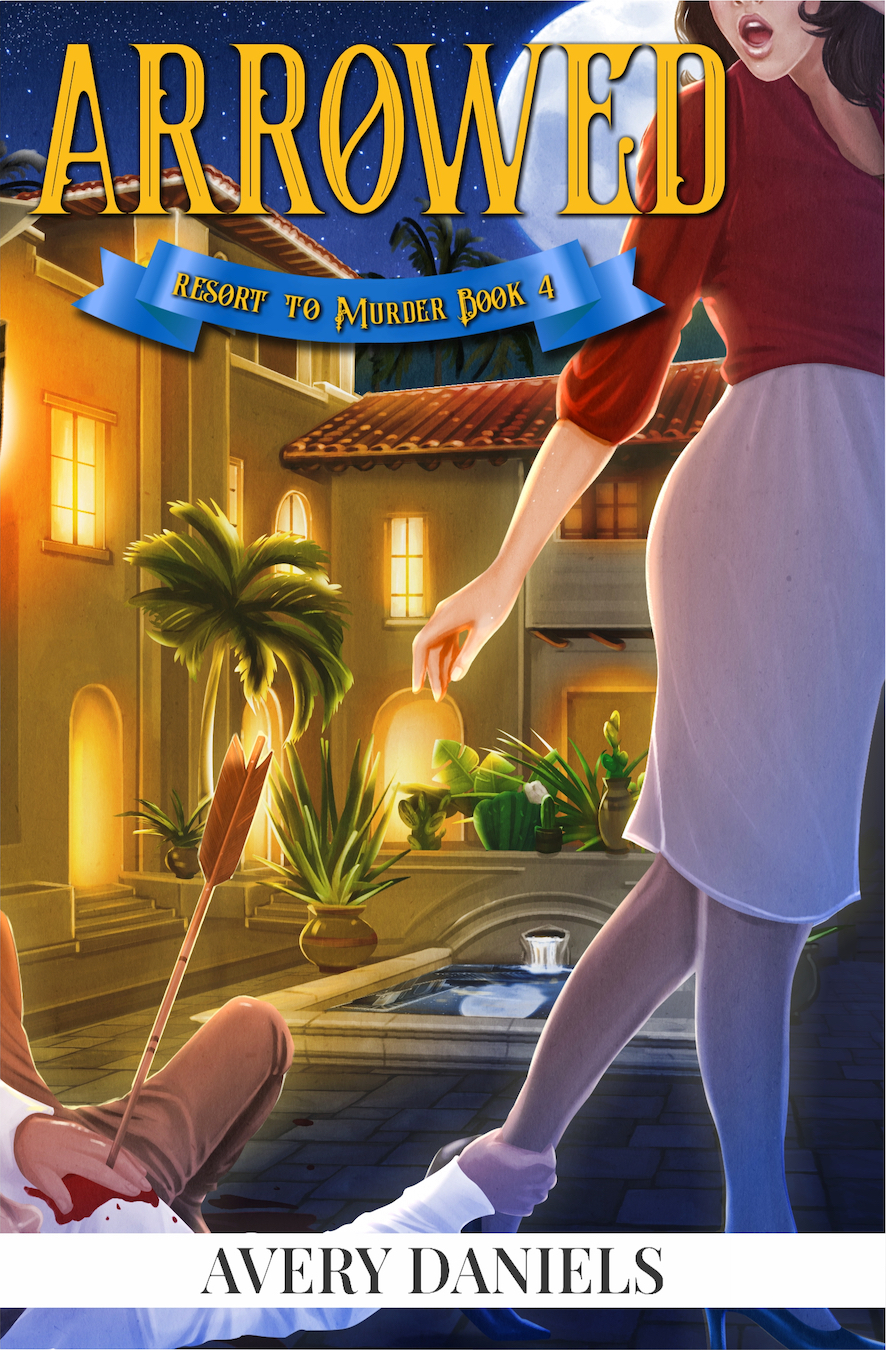
 In the first book Julienne finds her sleuthing legs when she is the prime suspect in the murder and we are in her historic “home” resort inspired by the Broadmoor.  For book two, Nailed, the resort was a luxury Bavarian themed ski resort in Vail, Colorado inspired by Sonnenalp.  The third book, Spiked, was back at Julienne’s home resort.  This fourth book, Arrowed, is the first to venture out of Colorado.

In Arrowed, a cutthroat venture capitalist grabs Julienne by the ankle and with his dying breath says “the curse got me.”  The Enchantment Canyon Resort, where this occurs, is entirely fictional.  It is a combination of resorts and ideas I merged for the story.  I wanted the feel of a Mexican villa merged with a world class health and wellness resort.  I love Santa Fe and its unique mixing of Mexican and Native American cultures and foods and thus I wanted a resort that reflected the rich cultural heritage. 

I had terrible timing on Arrowed, though.  Here I am writing a cozy mystery set in Santa Fe, only a five-hour drive for me (and one of my favorite places to visit), and Covid made it impossible to do any personal research.  Fortunately, I have been several times and have many fond memories to rely on and supplement with internet research.  Just a tip: any trip to Santa Fe means you should plan on eating and drinking some of the best food in your life.  The food is one highlight of any trip there for me, along with the Margarita Trail!

If you have been to Santa Fe, or New Mexico, what are your favorite memories?

It all began when a dying man with an arrow in his chest grabs her ankle.
     During a heat wave at a Santa Fe resort, Julienne has the resort owner pressuring her to solve the murder. The victim is a high profile business man who made enemies rather than friends, leaving Julienne with a roster of suspects. She was supposed to be training the staff and spending quality time with Mason rather than investigating a murder. The heat turns up when an old girlfriend of Mason’s checks in and is determined to get back together.
     Arrowed is the fourth book in Avery Daniel’s Resort to Murder series and is an exciting contemporary cozy mystery. If you like Cleo Coyle, Maddy Hunter, Duffy Brown, Lynn Cahoon, and Annette Dashofy, then you’ll love this series with a strong intelligent sleuth, lavish settings, and tantalizing mysteries.
     Buy this spunky clean cozy mystery and start enjoying Julienne’s adventures today!

Youtube book trailer:  https://www.youtube.com/watch?v=-svubHiLbDE

Purchase Links

Amazon: https://tinyurl.com/yoo3xfqw

B&N Nook: https://tinyurl.com/4rew7h83

B&N Print: https://tinyurl.com/2jbun5rt

Kobo: https://tinyurl.com/v4tpqebd

Apple: https://tinyurl.com/2a2vxa2b

Bookshop: https://tinyurl.com/14ecxyic

Avery Daniels was born and raised in Colorado, graduated from college with a degree in business administration and has worked in fortune 500 companies and Department of Defense her entire life. Her most eventful job was apartment management for 352 units. She still resides in Colorado with two brother black cats as her spirited companions. She volunteers for a cat shelter, enjoys scrapbooking and card making, photography, and painting in watercolor and acrylic. She inherited a love for reading from her mother and grandmother and grew up talking about books at the dinner table.

Website:  http://avery-daniels.com/

Newsletter:  https://tinyurl.com/2p952mcv

Goodreads:  https://www.goodreads.com/avery-daniels

Amazon Author Page:  https://www.amazon.com/Avery-Daniels/e/B0719JXY83/

Facebook:  https://www.facebook.com/AveryDanielsAuthor

Confessions of a Confused, Disorganized Writer

Does the drifter know anything?
     That’s what it says at the top of a page of writing notes (okay, scribbles) that I found a while ago in my desk drawer.
     I’d give anything to find out if the drifter knows anything. As a matter of fact, I’d give anything to know who the drifter is.
     The most troubling aspect of this question is that the note is definitely in my handwriting. Perhaps the query refers to my grandpa-may-have-been-a-serial-killer screenplay, since there are other cryptic notes on the same page such as Maybe Jessalyn was her mother, not her aunt, and I do have a deceased character named Jessalyn in that story. There’s also kind of a down-and-out handyman, but he’s always been part of the community; he’s not really a drifter.
     Then again, since there’s another scribble on the same page about designer sunglasses that I recognize as a reference to Undercurrents, my marine-biologist-dies-in-the-Galapagos mystery, maybe the question pertains to that novel. But while there’s a drifting corpse in the ocean, there’s not really a character that I would really call a drifter in that one, either.
     I search my memory banks. How about Call of the Jaguar, my find-the-other-lover-in-war torn-Guatemala novella? Endangered, my missing-kid-in-national-park mystery? Shaken, my earthquake/arson/is-our-heroine-committing-insurance-fraud romance? Nope. No drifters.
     Perhaps I was going to add a drifter somewhere? Or perhaps it belongs in a future story? I have another note about a mystery solved due to an error overlooked in digitally altered photographs, and that doesn’t match up with any story I’m currently working on.
     I haven’t always been this way. Who’s to blame for my current mental and physical confusion? I blame editors and agents.
     When I first decided to turn my writing talents from “how-to” manuals and books to fiction, I sat down and wrote Endangered, my first mystery novel, in about six months. Total focus. I sent out query letters.
Not taking new clients at this time.
Not distinctive enough to stand out in a crowded market.
     Not for us.
     Not right for us, but this is subjective; others may feel differently. Good luck.
    
The few agents who asked for samples hinted that the story seemed awfully close to Nevada Barr’s writing. I’d never heard of her at the time, but when I read some of her books, dang if they weren’t right, my protagonist (park ranger), setting (national monument), and story (was the missing child eaten by a cougar?) could have been written by her. The tone was even similar. I suspect Nevada is my long-lost twin.
     So, I changed the protagonist and the story slant substantially, and sent it out again.
My client list is full.
     Not distinctive enough to stand out in a crowded market.
     Well written, but I advise you to lose the technical stuff and focus on the outdoor adventure.
     Excellent writing, but add more technical stuff and lose some of the outdoor adventure and nature aspects.
     Not for us.

     Oh, I did get a contract in the mail from an agent who wanted money up front, which seemed a little suspicious. I called to get more information. When I asked about this person’s experience and publishing contacts, I discovered she was no more of a literary agent than I am.
     My novel did finally intrigue one agent from a reputable house sufficiently that she jotted down several very good suggestions for changes (bless her!) and agreed to see the novel after I made changes, along with samples of all my other work. Thank God, I thought, and applied myself to making the changes. Five months later (hey, I was working full-time in a software firm), I eagerly mailed my much smoother novel to her. I promptly received in reply a note from the head of the agency:
This agent has quit agenting. We shredded your manuscript.
    
If my four cats hadn’t kept reminding me of an imminent tuna crisis, I might never have scraped myself off the floor.
     I wrote a children’s book about a Kikuyu girl who wanted to save the hippos around her village in Kenya. It was a prizewinner in a local contest. A publisher was interested until she found out that I wasn’t African-American.
     I went to screenwriting school in an attempt to revive my sagging creative spirit. I wrote my first romantic adventure screenplay, sent it around.
Not taking new clients at this time.
     Client list’s full.

Not for us.
     I heard a romance editor talking up an outdoor adventure novel as ‘exactly what we’re looking for.’ After reading that book, I was a) confused, because in no way was it a romance (the protagonist’s lover is dead from the get-go) and b) enthused, because the book had a tone and theme similar to Endangered. I fired off a query to that editor, referencing the conference and the book she’d mentioned. No response.
     Meanwhile, having read that it’s much easier to publish mysteries if you’ve got a series, I worked on sequels to Endangered. (That series has five books now.)
     I finished a romance. I started to send out queries on it, while still trying to find a place for Endangered and its sequels Bear Bait and Undercurrents.
Not taking new clients.
     Got any non-fiction proposals?
     Not right for us, pardon the form letter.
     Agent deceased.
    
I did finally get a contract for three mysteries with Berkley Prime Crime. After the first one was published, my editor/champion moved to a nonfiction position, and no editor left in the original group was even mildly interested in marketing my mysteries. So, after two years of stagnation, I got the rights back and published them myself.
     Now I’ve got eight mystery novels, three romantic suspense novels, two drafts for children’s books, dozens of outlines, crowds of characters, hundreds of clever clues, and a score of half-baked plots romping through my head. “You must like banging your head against the wall,” my mother once remarked. (I’ve always had such a supportive family.)
     I’m a fast writer, and a good one, according to my fans. If I had only had honest feedback on what editors and agents wanted, or encouragement to run down any particular path, I would have galloped to the kill like a cheetah after a bushbuck. Instead, I still seem destined to become like the giant sunstars I see on my scuba expeditions; a creature with so many appendages that it’s a miracle it can move at all.
Does the drifter know anything?
    
I really hope so. And I hope he shows up soon to share it with me.