Something Bigger

My reading encompasses genres besides mystery, especially literary fiction, historical fiction, and nonfiction. Nonfiction educates me, and I’m delighted when the author presents information in a way that makes me want to know more. The same is true of well-researched historical fiction, with the bonus of plot and characters to keep me engaged. After pushing through several highly acclaimed recent literary novels, I had to ask myself why I found them such a struggle to read compared to the classics in the genre or to my other reading. My conclusion: self-absorbed protagonists with no goals beyond their egocentric concerns. In these books, I’ve admired but not enjoyed masterful portraits of unpleasant people and vivid descriptions so alive and detailed I was immersed in the locations with all my senses without ever wanting to be there. Appreciation for writing skill isn’t the same experience as getting wrapped up in a story. When I force my way through one of these frustrating novels, I feel the way I did as a kid eating lima beans. Mom cooked them and they’re supposed to be good for me, but do I have to finish?

The mystery genre appeals to me because the protagonists are involved in something bigger than themselves. The lead characters in mysteries have their personal problems, their relationship challenges, and sometimes their demons, but the pursuit of their goals demands caring and courage, often in spite of those private difficulties.  As a writer, I hope to give my readers the experience of empathy as well as an intriguing setting and the mental exercise of solving the puzzle. After all, that’s what draws me to the series I follow.

Getting the Details Right

GETTING THE DETAILS RIGHT

Recently I was asked to be a speaker at a writers’ conference—the topic being character and setting description. The chairperson titled it “Getting the Details Right.” Because I have messed up on the details in a few of my books, this is the perfect topic for me.

First off, two of the biggest mistakes I’ve made:

  1. Changing the type of car someone drives. In my first Deputy Tempe Crabtree mystery, the car changed from a Blazer to a Bronco several times.
  2. Names of people—giving new characters in a story more than one name.
  3. Leaving out an important day of the week in a book that moved day to day through the week. (I fixed that before it got published.)

What I’ve seen in other people’s books:

  1. Giving a Japanese character a Chinese last name.
  2. Putting in details about a real city that are totally wrong. (And this is why I created my own cities even though they have a resemblance to a real place.)
  3. Setting a story in a fictional mid-west town with the wrong kind of geography and kinds of trees.
  4. Having too much happen in a much too small amount of time.
  5. Changing an important piece of description of a main character such as eye color

Let’s start with setting. I love books that clearly describe the places where the action takes place inside and out and also includes the weather (because this can be an important part of the plot), and different smells (which also can be an important part of the plot, or merely a means to evoke another sense of what the setting is like).

With characters we don’t need to know every detail of a person’s look, but enough to create a picture of the person in the reader’s mind. Along with the outward appearance, the personality is even more important. What in the person’s background would make someone do certain actions? Think about triggers to behaviors and motivations.

All of this is important, but to make sure not to get things wrong as I and many other authors have done, some means of keeping track of all these details needs to be used. Authors do this in many different ways from simply keeping written notes or an elaborate computer system. This is even more important for those of us who write series.

Anyone want to share how they keep track of the details? Or a mistake you’ve found in a book you’ve read

Marilyn

P.S. Though it’s been fixed now, I mixed up some character’s names in my last Rocky Bluff P.D. mystery. No one noticed ahead of time–my critique group, the editor I sent it too first, or the publisher who thought it was my best book in the series.

tangledwebs

Yep, this is the one.


How Crime Novelists Come Up with Ideas by Richard Armstrong

Guest blogger banner

Where do writers come up with the ideas for crime and mystery novels?  It’s a bit of mystery itself, isn’t it!  I’m sure for some writers the crime section of the local newspaper is a rich source of inspiration.  Others may turn to history books and classical literature (like Macbeth) for ideas.  I even had an idea for a mystery novel come to me in a dream not long ago.  Unfortunately, the dream only gave me the title; I have to work out the rest myself.

It just so happens, however, that I remember the exact time and place when I got the idea for my new caper novel, THE DON CON.   My wife and I were in Rockport, Maine at a restaurant called “Shepherd’s Pie,” and we were having dinner with an old friend.  You may know him.  His name is Jonathan Frakes and he played Commander William T. Riker on Star Trek: The Next Generation.  I’ve known Jonathan for more than 40 years when we acted in a play together.

I asked Jonathan what he was doing nowadays and he told me he was directing a lot of network TV shows.  He also said that one of his sources of income was going to Star Trek conventions and signing autographs for money.  He regaled us with many funny stories about his experiences at these so-called “cons.”   At one of them, for example, he was annoyed to find a booth on the convention floor where they were selling Star Trek action figures.  A sign on the table said:

            “Buy any three action figures, and get one Commander Riker FREE!”

But the part of Jonathan’s story that really stuck with me was how much cash he was bringing home.   At $35 a pop for an autograph (more if you wanted a picture), Jonathan was leaving these conventions with his pockets, shirts, even his shoes stuffed with cash.  That’s when the idea occurred to me:

What if someone tried to steal all that money?

Not long afterwards, I began writing THE DON CON.  It’s a comedy thriller that tells the story of a washed-up actor who hit the high watermark of his career when he played a bit part as a gangster on The Sopranos.  Now he makes a living signing autographs at fan conventions.  One day, there’s a real gangster in his autograph line and he makes the actor an offer he can’t refuse: “You’re going to help me rob the celebrities at the next fan convention—or else.”

Jonathan was kind enough to write a blurb for THE DON CON, which will appear on the front cover when it’s released by Linden/Pace on April 1st.  Jonathan also invited me to join him at a small private dinner (during the Louisville “Supercon”) with William Shatner, Henry Winkler, and LeVar Burton.  Meeting Captain Kirk, Kunta Kinte, and The Fonz was like hitting the trifecta of iconic television stars, and it gave me some insight into what fan conventions are like from the celebrities’ point of view.

So how do mystery and crime writers come up with ideas for their novels?  The answer is to always ask yourself the “What if …” question.

But after that, it’s mostly a matter of sheer, dumb luck!

The Mafia comes to Comic-Con in a fast-paced suspense caper
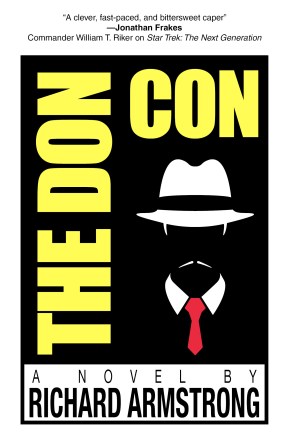
The Don Con CoverJoey Volpe hit the high watermark of his acting career when he played a small role as a mobster on The Sopranos. If you blinked, you missed it.
But now he’s unemployed, broke, and forced to make a living by signing autographs at pop-culture fan conventions, or “Fan-Cons,” for $35 a pop. His lack of income, along with his chronic womanizing, has put his marriage at risk, too.
Joey’s life gets even worse when real mobster Tony Rosetti shows up in the autograph line with a plan to rob the next Fan-Con –an offer Joey can’t refuse. When the heist goes awry, Joey is left with a beef with Rosetti and two long years to plan.
Partnered with a smooth-talking con man, Joey is using all his acting skills on new projects: Revenge. Money. And saving his marriage.
The Don Con is pure a pure-entertainment caper novel with all the intrigue of Ocean’s 11 and The Bank Job –as well as a smart, witty pop culture satire that riffs on The SopranosThe Godfather, Comic-Con, Star Trek, and The Sting.
Releasing in April 2019

#   #   #


Richard Armstrong is also the author of another crime novel “God Doesn’t Shoot Craps,” in addition to two non-fiction books published by William Morrow, a division of Harper Collins.  For more about Richard (and to get a free copy of his special report, HOW TO TALK ANYBODY INTO ANYTHING: Persuasion Secrets of the World’s Greatest Con Artists, please visit www.thedoncon.com


 

The Terrible, Necessary, Unavoidable Triumvirate

by Janis Patterson

In last month’s blog I talked about musery, and how the concept of a mythological goddess whispering ideas and words into a writer’s shell-like ear was a catch-all used to combine the rock-bottom basics of inspiration, imagination and skill. You see, to be a writer – a writer of any worth, a writer with any hopes of publishing – you need all three.

Inspiration is the beginning; this is the start of creating something from nothing. A ghost of an idea. An isolated incident that could be pampered and grown into something more. A starting place.

Imagination is what takes the ephemeral, insubstantial bud of an idea and feeds it, molds it, multiplies it into an acceptable storyline. Like a cook creating a recipe from the beginning idea of two ingredients, a writer will spin a complete storyline, adding in heroes and villains, buffoons and sages, problems and victories, and eventually bring it to a desired and logical conclusion.

Sounds simple, doesn’t it? Well, it will come to nothing if the writer does not possess the final part of the triad – skill.

In this context the simple word ‘skill’ has a labyrinth of meanings. The most basic form is what we used to call fifth-grade English – mastery of spelling, grammar, sentence structure and punctuation. In other words, the solid skeleton of language on which you can hang the gossamer flesh of your story.

Unfortunately, these days it seems that correct and standard usage of English is if not a dying at the very least a fading art. Typos and plain mistakes that would have been unthinkable a couple of generations ago are now not only tolerated, but hardly noticed. Where once a single typo in a published book was a point of shame, now it is regarded as a triumph.

But this post is not to rant about the relaxing of standards, it is to point out the need for plain old skill to use the language to create your world and your story. Everyone knows the example of ‘eats – shoots – and – leaves’ and its two very different meanings. ‘Eats, shoots and leaves’ is a very different sentence from ‘Eats shoots and leaves.’ A single comma changes the sentence from the reporting of a violent action to a descriptor of an herbivore’s diet.

It’s the same thing with ‘she took a peek’ (i.e., she snuck a quick look) to ‘she took a peak’ (she conquered a mountain top). Such mistakes can pull a reader out of the story in an instant, to say nothing of confusing the action. Doesn’t make the author look very good, either.

Our imaginations might be our stock in trade, but our command of language – and our skill in using it – are what makes it possible for us to communicate our stories to others. Inspiration, imagination and skill – the essential tools a writer must have.

Too Many Ideas Not Enough Time by Paty Jager

Lit Light BulbIf only I could write twice as fast! Ideas come at me like raindrops in a storm.  Some ideas seem like a great idea at the time and as I get closer to writing the story, decide it won’t work.

And then there are the ones that come when you least expect it and hold up the more you think about them and start researching.

In December, my husband and I spent a weekend at a nice casino in Reno. I’d won the weekend from the Silent Auction at the Left Coast Crime conference in Reno last February.  Part of the package I purchased was a spa package. I was excited to get a massage.

And the spa…on my! I’d never been anywhere that pampered and had such wonderful amenities.  I sat in a dimly lit room, watching big colorful fish in an aquarium, drinking lemon water, and waiting my time for a massage. Depositphotos_213681916_l-2015

The masseuse arrived and escorted me to the room. It was dimly lit, soft music playing. She showed me everything and headed to the door. “Take off your robe and get under the sheet, I’ll be right back.”

I did as instructed and as I laid there, face down, my arms dangling over each side of the table, my mind went to- “What if I were a dead body?” And of course my head began spinning with how to work it into one of my Shandra Higheagle books.

By the time my massage was over, I had the plot all figured out in my head. What I needed now was research.  While waiting for my hubby to come out of the men’s side of the spa, I started quizzing the people at the counter. I filled up the back side of two price sheets with answers to my questions about how a spa of that magnitude ran.

Then two weeks ago, I spent a week at the Oregon Coast writing. It was wonderful! What I especially like when I write at the beach are my walks on the beach.

On one walk, when the wind was blowing and cold enough I had my sweatshirt hood tied tight, I shared the beach with an older gentleman and a little boy of about six. I assumed the older gentleman was the grandfather. The the boy had on only a t-shirt and shorts. He had something in his hand. He came up to me and said, “Look! I found a mermaid scale!” It appeared to be a colorful piece of mollusk shell. But I agreed with him.

20190206_182452I went on my walk and noticed a boat bobbing in the ocean just the other side of the breaks. Thinking it would make a nice photo, I took several, then turned and headed back the way, I’d come.

The grandfather was near the water. The little boy was splashing in the waning waves sweeping up on the sand.  I passed them and glanced out at the waves. The boat was moving along the other side of the breaks in the same direction I was.

I thought I saw the head of a sea lion. I stared and took photos, trying to capture the creature. Walking briskly because the wind was getting colder, I headed to the hotel stairs two blocks from the house where I was staying. I looked back at the beach.

The man was there but I didn’t see the boy. And the boat was heading the other direction. Perhaps what I saw wasn’t a sea lion but a man in scuba gear?

As I walked to the house, I put together the kidnapping of a boy and the woman who captured it on her camera without knowing. It will be a story in a Gabriel Hawke book.

I love when ideas hit and I can see they will be a fun book to write.

HOME

https://writingintothesunset.com