
The Poetic Murderer, and me — How the Book Came to Be
Fear will learn to fear you.
Last winter I got the news: Lionel Ross wanted to publish my first novel. I was overjoyed and humbled beyond my ability to express myself. Then gradually I gained an understanding of what was happening. Engaging style. Humorous. Smiles. An unreliable narrator reveals himself as a lyrical mastermind known as … Of course! The book was scheduled to appear in January 2018. January came like a dream, and marvellous as it may seem, soon I held a copy of The Poetic Murderer in my hands.
I was a shy child with a “vivid imagination,” as my grandmother Liesel used to say. Then I was an anxious teenager who didn’t write at all because of a lack of confidence. In my late twenties, I moved to Copenhagen, where I was awarded a master’s degree in Environmental Economics and Natural Resource Management (A title that is killer like a whale to the attention.) Unsatisfied with the job prospects I attended the Creative Writing School at Cambridge University, where my passion for drawing stories from my imagination re-emerged. I was hooked. I decided that I wanted to write a book. Back then, my professor complimented the energy in my writing, but also suggested that I should write in my mother tongue German as it would be too far a stretch for me to write a novel in English. Challenge accepted!
I started with an image — a young, enigmatic, and successful detective, having to solve a mystical murder case on a quest of a dream and fulfilment of his own destiny, and that idea wouldn’t leave me alone. I wrote the first manuscript in a flash. After six weeks I was ready, and contacted my friend from Cambridge, who wanted to become an editor. I was very positive and awaited her response. Everything changed when she replied. The manuscript was full of inconsistencies, mistakes, and bizarre phrases. But nothing that couldn’t be fixed. I’m human. Humans make mistakes.
I worked on the story obsessively. I’d been a person who enjoyed to achieve his goals with ease, offhandedly. When the novel took over for the first time in my life I had the feeling that I was properly challenged really. I purchased a small notebook and scribbled notes like a maniac, no matter where I was. If I thought of something while cycling, I’d jump off as soon as the traffic permitted it, and put it to paper. It became second nature to me. It felt so real.
From the crazy rush at the beginning, soon my literary journey turned into a devoted drafting of each chapter, and then I’d send each revised version of the manuscript to my friend in England, whose opinion I feared and wait for her response. While all this editing was going on, I continued filling notebooks and drawing the story before the inner eye. I wrote far more than I ever did before. I also discovered that style is a continuous distillation. How can I be me? Honestly expressing myself. No lies. That became the bottom line of all my endeavours. The book slowly took shape, however, due to my inexperience, a fear of failure attended me and intensified.
The detective character was what kept me hooked. He’s my hero, mysterious, funny, impulsive, vulnerable, dreamy, and in love with his laissez-faire lifestyle. When Detective 00 Hansen has to deal with his disturbingly poetic case, much hate from the police force, and that his wife left him, he questions everything. A period of doubt studied me too, especially when friends and family had hard times understanding my yet fictitious ambitions. But I wouldn’t give up.
I worked on the novel through the year, and when I was sure I’d gotten the manuscript into shape, I contacted agents and publishers, and eventually was chosen as one among many talented writers. High times!
Well, that is what I would call a miracle, one that a shy child with a “vivid imagination,” wouldn’t have dreamt of or an honoured professor at Cambridge University wouldn’t have predicted.
Now will anyone buy the book, unravel the deeper meaning of it, smile when I’m acquainting them with a funny line, and feel inspired to follow their own dreams?
That remains to be seen. At least The Poetic Murderer made my own dream become true.
And as you shall see, fear will learn to fear you too.
 The Poetic Murderer
“Fear will learn to fear you.”
If you liked Paul Coelho’s The Alchemist, you will love The Poetic Murderer.
Detective 00 Hansen is an enigmatic dreamer in the streets of Copenhagen, riding a fast antelope, and living a slow life (not always to the delight of his wife)…
In The Poetic Murderer, Hansen and Don Cindy’s first mystery, the duo are informed by Denmark’s Queen Marmalade II and Prince Sandwich about an unimaginable murder at the supermarket. The body is marked by violence and the murder weapon an unhygienic rainbow trout.
The police are baffled by the mysterious poem at the crime scene. But when Detective 00 Hansen applies his vivid imagination to the problem he uncovers a tragic tale of unrequited love and ruthless ambition… Will he stop the poetic murderer on the quest of a dream and fulfilment of his own destiny?
An unaesthetic fear of the unknown haunts us, namely the unforeseen. A fear that shapes our lives. No human can unlearn to fear; we all have to learn how to deal with it. By picking up this novel, the reader travels a new route and learns to lead a fearless life by trusting in the own reality.
Buy links:
 Christoph Burmeister was born on the 16 April 1987 in Bad Oldesloe on the river Trave. That’s why he originally wanted to become a clown.
On school days he dreamed wholeheartedly. University was no hindrance to him; it was his hobby. He would carefully fashion his appearance as an eager student.
After graduation, the money bell rang, and he started working for a shipping company as a treasury manager. One day he took a glimpse into the mirror and did not recognise himself, so he left home and moved to Copenhagen.
All of a sudden: Hygge!
2015—Creative Writing at the University of Cambridge, then Improv theatre. Now his first novel: The Poetic Murderer.
Christoph likes Jazz and his simplistic life-style resonates with mystery and beauty. His right hand is the instrument of his daily writing practise.
Social Media:

 Do you pick a book by the title? Do you want the title to tell you the genre of the story or what the story will be about? How about a mystery? Do you want the title to be a clue to the mystery?


 Hey folks. What’s new with you?
 But when I write outside? I imagine my ideas multiplying and changing and growing limitlessly. I want to say they dance around on the breeze, like Julia Andrews in The Sound of Music but, in reality, I think it’s probably more like what happens to that alien in Evolution when they hit it with napalm. Only my ideas are much prettier. Maybe.
 I know people who write in coffee shops, but I just can’t be doing with all that noise and commotion. And, oh my days, there would be so many conversations to eavesdrop on I’d never get anything done!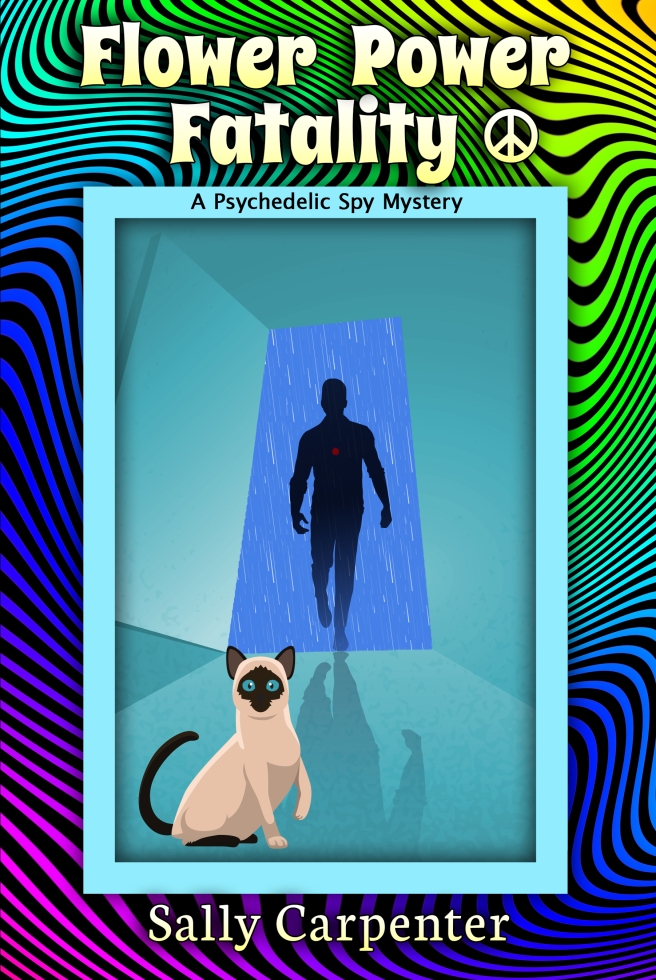
 Ladies of Mystery
You must be logged in to post a comment.