

Mystery and Mysticism by Paty Jager

paty shadow (1)My brother is an artist who creates his own bronze statues and patinas bronze work for other artists. When he told me about a specific piece he’d put the patina on and how it had a unique configuration, he had my attention. His words, “This would make a great murder weapon.”

That sentence stayed with me for several years.

And finally, when I decided to write a murder mystery series, I jumped at the idea of using a 300 lb bronze statue as the weapon. Only I had to come up with a plausible amateur sleuth and give her a profession. That is how Shandra Higheagle, a potter who is half Nez Perce Indian, came to be. I wanted her to have the Native American background to keep with my tag line, “Murder mystery and steamy western romance starring cowboys and Indians.”  And I wanted her to use her heritage to help solve the murders. That is where her Nez Perce grandmother came onto the scene.

Shandra’s Nez Perce father was a rodeo bronc rider who died in a rodeo accident when she was four. Her Caucasian mother and step-father kept her from her father’s family until Shandra rebelled as a teenager and spent a summer with her grandmother.  While Shandra still wasn’t allowed to let people know of her Indian heritage, she kept in touch with her grandmother. The first book opens with Shandra returning from her grandmother’s funeral and seven drum ceremony.

Where is this all going you ask?  When Shandra is suspected of killing a gallery owner and then the county sheriff’s detective turns his interest to her best friend, Shandra’s grandmother comes to Shandra in her dreams, guiding her to the evidence that will help them find the murderer.

Shandra has a hard time believing in these dreams, yet the detective believes. Her dreams cause her conflict with herself and allows her to let someone in after years of keeping herself closed off.

One of the most difficult and rewarding parts of writing these books is to come up with dreams for Shandra to have that reflect what is going on with the mystery without giving anything away.

The first three books of the Shandra Higheagle Mystery series are now in an ebook box set.

Here are the shortened blurbs for the first three books in the Shandra Higheagle Mystery Series.
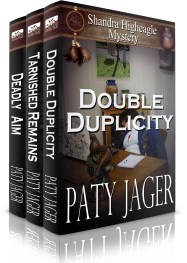
higheagle-1-3-box-2700px

Double Duplicity

Potter Shandra Higheagle’s Nez Perce grandmother visits her dreams, revealing clues that help Shandra uncover not only one murder but two.

Tarnished Remains

Digging up Crazy Lil’s past takes Shandra Higheagle down a road of greed, miscommunication, and deceit.

Deadly Aim

The dead body of an illicit neighbor and an old necklace sends potter Shandra Higheagle on a chase to find a murderer.

Windtree Press / Amazon / Nook / Apple / Kobo

Paty Jager is an award-winning author of 25+ novels and over a dozen novellas and short stories of murder mystery, western historical romance, and action adventure. She has a RomCon Reader’s Choice Award for her Action Adventure and received the EPPIE Award for Best Contemporary Romance. Her first mystery was a finalist in the Chanticleer Mayhem and Mystery Award and is a finalist in the RONE Award Mystery category.  This is what Mysteries Etc says about her Shandra Higheagle mystery series: “Mystery, romance, small town, and Native American heritage combine to make a compelling read.”

blog / websiteFacebook / Paty’s Posse / Goodreads / Twitter / Pinterest

patyjager logo

Who’s In Charge Here?

by Janis Patterson

Once someone asked me to do a workshop on creating characters. He had read several of my books and was impressed with how ‘real’ they all were. Could I, he asked, share my creation process?

I told him I couldn’t do such a workshop, and explained why, but somehow I don’t think he believed me. And I couldn’t blame him, because it’s pretty unbelievable.

You see, I’ve taken all the workshops. I’ve done character sheets and created questionnaires for them, some even to the extent of their favorite flavor of Jello. And every character so created died. Just faded away into cardboard flatness. I have never ‘just created’ a major or even secondary character. Minor characters and walk-ons, yes; but let’s be honest – one doesn’t have to go very deeply into a character who appears just a time or two and has only a couple of lines, if that.

So what do I do to have these apparently wonderfully realistic characters? The basic truth is, I stay out of the way.

You see, my characters come to me. They march into the story and tell me what they’re going to do. If I say the leading man has to have sooty black hair and he says he has a curly red mop, I have to go along. If I don’t, he’ll go sit in the corner with his back to me and not say a word. He won’t speak to me, he won’t do what I tell him to – he just lies there like a lump. Trying to bend him to my will is sort of like trying to make pantyhose out of an oak tree. Sooner or later – if I’m smart – I give in.

It’s the way I’ve worked all my life. I believe in character-driven stories (always have) and therefore by necessity have become a thorough pantser. Though I do have some vague idea of where the story is going, and usually a pretty good idea of where it’s going to end (though not always!) for me writing is simply hanging on for dear life until the characters are satisfied.

On one of my mystery novels I knew from the beginning who the murderer was going to be. There were several villains of one persuasion or another, but the murderer was going to be someone special. I wrote along happily, until about the last third of the book, when I had a sinking sensation in my stomach that the person I had always thought the murderer couldn’t have done it.

Urk.

Okay, I thought for a while and decided that another character just had to be the murderer. Except a chapter later I found he couldn’t have done it either. All in all, I changed the murderer’s identity five times in the last third of the book, and for one reason or another not one of them could have done it.

Double urk.

I was almost to the point of giving up when like a light from above the perfect solution came to me. It was a character I had never associated with the murder and for a reason that had never occurred to me, but everything fit together as if it had been planned from the beginning – means, motive and opportunity in one well-wrapped package. I finished the book with ease. But then – there was the problem of clues. The solution was perfect, but now I quailed at the thought of having to go back through the entire book and plant clues to the murderer. One should always play fair with the reader, after all…

Finally I girded myself for the task and plunged in… where I found to my utter amazement that they were already there. I did add one or two more, just so I’d have some feeling of being in control, but the story would have worked equally as well if I hadn’t. When I think of how many hours I spent worrying and how many scenes I wrote and then trashed…! It would have been so much simpler if I had just sat back and let the characters do the heavy lifting.

That was several years ago and that book is still selling well. It has also won more awards than any other of my books.

My current Work-In-Progress is a straight romance set in the Palo Duro Canyon kindle world of the fantastic Carolyn Brown (who is also a friend, I’m proud to say) and it is ticking along most pleasingly, which means the characters are behaving quite well. Jeri and Doug are total opposites – she’s a sophisticated globe trotting photographer, he’s a tall, strong and handsome rancher – and their mutual attraction is working just fine. I was about 10K into the book when all of a sudden her half-sister who is also her agent (and who I had no idea even existed) started banging about and now she’s worming her way into being a major part of the story… and perhaps the heroine of yet another book that I had never even thought of!

Years ago my late – and adored – mother, a supremely practical woman, listened to me talking about writing with something like despair. “They’re your imagination,” she said half angrily, half condescendingly, “they should do what you say.” Of course, very few living people ever defied my mother… When she tried to write a book on her own, though, she changed her tune. Apparently her characters were a strong-willed as mine. It was a pretty good book, too, but unfortunately she died before it was finished. I’ve been asked why I didn’t finish it for her (like I did her memoir THE LAND OF HEARTS DELIGHT) I can only say that her characters won’t speak to me and I have no idea of where she was going with it. It’s sad.

The Husband has no intention of ever writing anything except a technical report, but when I tried to describe my writing process to him, he thought for a moment, then said “Sounds like possession to me.” He might be right. I just know that I can only pretend to be in control.

Funerals and send-offs

By Sally Carpenter

 I recently read a blog post by a writer in his 70s who said he’s never seen a dead body. He’d never been to a funeral?

It could be the writer was referring to murder victims. But when I lived in the Midwest, viewing the deceased was a way of life.

Commemorating the dead in my rural hometown consisted of three parts: the viewing (called a “wake” in some circles), the funeral service and the graveside committal. The first two parts took place at a funeral home where the funeral director handled all the scheduling and arrangements. Clergy were asked to lead the services, but that was the extent of their participation or input.

 At the viewing, the embalmed body was placed in an open casket, flowers were set out and the public dropped by to sign the guest book, greet the family, and look at the deceased who bore little resemblance to the person in life. I think when I was a kid my mother took me to some viewings of people she know. I thought it was odd to stare at a dead person. Why not visit the person when they were alive and you could talk to them? I also didn’t like how funeral homes looked, too artificial and fussy. Not the place where I’d want to spend my last earthly moments.

At the brief funeral service, an organist played syrupy music and a minister gave a short talk. While the guests were still inside, the funeral home affixed little flags to the hoods of their cars to mark them as part of the processional. With the hearse carrying the casket and the limo with the family members leading the way, a long line of vehicles moved at a snail’s pace to the burial site. Since funeral processions had the right of way, many times I had to sit in traffic while an endless stream of these cars passed through an intersection.

 The committal service was even shorter, since people usually stood by the gravesite (except at my mother’s funeral, we sat in padded folding chairs beneath a canopy). Unlike what you see on TV/movies, the casket was never lowered into the ground and nobody threw dirt or flowers into the grave. The actuall internment took place after friends and family had left. Weeks or months later the gravestone was finally put in place.

 For one of my uncles, the internment consisted of his widow showing up at the family plot on her own, and placing his urn of ashes into a pre-dug hole. Other family members, including myself, happened to be there at the time (must have been around Memorial Day for our annual visit to the graves of mom’s parents).

 At my dad’s funeral service, my brother brought his young children. Even though they were not close to grandpa, they became hysterical when they saw the corpse and their mother took them out of the room for the service. I think their reaction was not grief over the loss but that their young minds had trouble processing a human death.

 Now I live on the West Coast and funerals seem to be done differently here. I’ve never seen a funeral processional, although during the day I’m at my day job. But with the heavy congestion on local streets, a long, slow-paced procession would not be practical.

Religious funerals are now taking place in churches rather than in funeral homes. I’ve attended two funerals at different churches. For me, the services more meaningful and longer and included congregational singing.

 “Home made” memorial services without the body present are replacing the traditional funeral. Family and friends, not processional morticians, plan and lead these informal services set in a home or a favorite bar or restaurant. Acquaintances share stories of the deceased and make toasts in their honor.

 I’ve attended two memorial services set in different community theaters where the deceased was an active participant. One of these funerals screened a video montage of the decease’ stage roles. At the other service, the deceased’s collection of Beanie Babies was set on the stage. Afterwards those present were invited to take a toy home as a memento (the cat I picked sits near my computer). And on my way into the building, I was asked to say a few words during the service. I’m not good at impromptu speaking, but I managed to sound intelligent and even (unintentionally) coax some laughter from the audience.

 How are funerals conducted in your town? What do you think is the best way to “send off” a loved one?