
by Janis Patterson
Writing a mystery means walking a very fine line.
You want to play fair with the reader and give him the chance to solve the mystery. Sort of.
Readers love to play along and see if they can match/beat your sleuth to the correct solution. In almost every case (so said because there is an exception to everything) nothing makes readers angrier than the solution just coming out of the blue with nothing leading up to it. Worse than that, it’s lazy writing.
So how do you do play fair and still mystify the reader?
Be sneaky.
Put your clues out there, but make them appear to be inconsequential, throw-away things that have no relation to the case. Also put out fake clues leading to a different conclusion (some call them red herrings, but I don’t like fish), but put them out in two ways – some as inconsequentials and some as great big whacking things that might as well have CLUE in blinking neon above them.
No one said you had to play completely fair, did they?
There’s also a traditional ploy called a MacGuffin. Sounds sort of like it should be some kind of fast food, but it’s real – trust me. The MacGuffin is a lovely tool of misdirection. That’s the word I’ve been looking for – misdirection! Just like a magician, you direct the reader’s attention in one direction with one hand while the other hand – in semi-plain view – is actually doing the trick, but no one is really looking at it.
Anyway, the MacGuffin is what everyone in the book seems to want – such as everyone believes the vicar was murdered in a foiled robbery attempt to steal an ancient chalice. All the characters go rushing around trying to figure out who wanted to steal the chalice and why, while the vicar was really murdered because his tulips were certain to win the annual flower show away from the Grande Dame of the village who dislikes losing. The chalice is only a MacGuffin. Now that’s an extremely simplistic example, but in reality the MacGuffin is one of the best tools in the mystery writer’s arsenal.
MacGuffins and misdirection – use them well, and you will keep your reader happily amused and hopefully confused. Or is it the other way around?
(For those with very good memories, you know I wrote this blog several years ago. I am reposting it now because (1) it is still true and relevant and (2) for several days before this appears and for several days after I am up to my earlobes in a very intense professional conference. It seemed better to share a ‘golden oldie’ than to just cobble together something or skip posting entirely. Hope you understand. Also, because I will not have my computer available, please forgive if I am not able to okay comments until this madness is over. I promise I will then!)
 I’ve had to research what type of revolver would be best for a woman to use for my murder mystery series. While Shandra knows how to handle a rifle from growing up on a large ranch, she’s never felt the need for a handgun for protection.
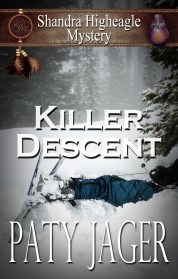 Killer Descent
 Award-winning author Paty Jager and her husband raise alfalfa hay in rural eastern Oregon.All Paty’s work has Western or Native American elements in them along with hints of humor and engaging characters. Her Shandra Higheagle Mystery series, set in a fictional ski resort in Idaho, is full of quirky characters, twists, turns, and a bit of mysticism.
 Ladies of Mystery
You must be logged in to post a comment.