Ripping out “Seems”

Amber in tree finalA few years ago I read a novel in which the characters “blew out a breath” so often, I started counting the times the phrase showed up. Needless to say, I was distracted from following the plot. That experience made me a little paranoid about over-used words and phrases. While revising each of my books, I’ve discovered a unique verbal habit for that manuscript. In my work in progress, I suddenly noticed that “seemed” cropped up too frequently. (I almost wrote, “I seemed to use seem too often.”) I did a search and found that forms of this word occurred an appalling ninety-seven times. My books are longer than the standard mystery, but even with over a hundred thousand words, this struck me as too many seems. Why was this word infesting my manuscript?

Characters seemed to have certain emotions. Avoiding head-hopping, staying in the point of view of one character, I slipped into this weak way of describing her perceptions. In revisions, I worked for more vivid and specific descriptions.

At other times, I used seemed when a more direct word would do. If my protagonist thinks a certain problem is recurring too often, she doesn’t have to think that it seems to happen too much. She’s Southern and raised to be polite, so she might careful in her spoken words, but I didn’t need evasive, roundabout wording in her thoughts. It made her sound indecisive or lacking confidence, and she’s not.

Sometimes, I needed to convey that an appearance or impression was uncertain. “He seemed honest, but was he?” I left some of those seems in place and replaced others with alternative words and phrases.

There are now only thirty-one seems and the story still holds together. (Pun intended.)

Fellow writers, what are some of those pesky words that you have to prune? Readers, do you ever get snagged on things like this is in a book?

*****

Amber Foxx is the author of the award-winning Mae Martin Psychic Mystery Series. The fifth book is in progress and seems to be is going well.


OFF TO LEFT COAST CRIME

copy

       Next week I’m going to Left Coast Crime, a convention sponsored by fans of mystery literature for fans of mystery literature. Officially it is the “Western North American Regional Mystery Conference”. “Western” is defined by the Mountain Time Zone and zones westward to Hawaii. The conference is held yearly in the first quarter of the calendar year and rotates north to south on an annual basis.
Last year was my first time at Left Coast Crime. It was held in Portland, and I went by myself, not knowing what to expect. It rained a lot, I guess because it was in Portland, and I never left the hotel, but I had a terrific time and met a lot of other mystery writers and mystery readers.

So I decided I’d go again this year. It’s being held in Phoenix, and it’s called The Great Cactus Caper. The American Guest of Honor is Gregg Hurwitz, and the International Guest of Honor is Ann Cleeves.
Last year I was on a panel with four other mystery writers, and we had a topic: “She Said, She Said: Writing the Female Protagonist”. It was a lot of fun, the moderator (Meg Gardiner) and the other panelists were great, and the pressure wasn’t all on me.

This year I have been assigned twenty minutes in a room by myself where I can doClimbing young adult at the top of summit

anything I want (within reason, of course). I’ve chosen as my topic “It’s Never Too Late.” As a writer who only began publishing really late in life, I plan to talk about becoming a writer and writing seriously after retirement. I just hope that I’m not talking only to myself!

Now I need to spend some time planning what I’m going to say. If, indeed, there’s anyone there to say it to. I hope that some of the participants, both fans and writers, will want to hear what I have to say.

Wish me luck!

A Time to be Bold

thumb_IMG_1225_1024

Romance is in the air. We celebrated Valentine’s Day yesterday, a day for lovers to be together, for friends to celebrate friendship, for admirers to share their feelings. For many, this is a day to be bold. Romance requires a certain amount of boldness.

In the best romantic stories, the hero(ine) must fight for his or her love. Whether overcoming insurmountable obstacles to be with the one they love or fighting for the heart of the one they love, the heroes and heroines of classic romance understand the need to be brave. The need to be bold. Romance is not for the weak of heart.
Knight

Characters in a classic murder mystery have a similar need. A need to be brave, a need to be bold. The detective must determine not only who has the means and the opportunity, but also who has the motive, boldly digging into lives that the suspects would prefer to keep private.

Each character in a mystery must be bold, to face the inevitable confrontation with the detective, to face the other suspects without succumbing to fear, and to deal with the secrets that always lurk just below the surface of their own lives.

And of course the killer must be bold. Bold enough to hide the truth, to lie and to misdirect. Bold enough to be a worthy opponent of the detective.

I’ve hit that point in my work-in-progress when it’s time for me, as an author, to be bold. I’m putting the finishing touches on the last draft of What She Fears, book 4 in the Adam Kaminski mystery series.

It’s the last draft for now. I’m sending it off to my editor and it will come back with pages of notes, changes, revisions, additions, deletions. Some minor. Some that will require rewriting a significant portion of the text. As a writer, I dread this step. Not because of the suggestions — those will no doubt improve the work.

NJ Summer

No, my fear is in sending this text, a text that up to now has only been seen by my eyes, out to be read by someone else. Someone out there. Someone whose interest lies not in complimenting me or praising me, but in tearing my work apart, exposing its weaknesses and highlighting its flaws.

I’m not alone in this, and I gain strength from knowing that everyone who has written their heart and soul onto a page understands this feeling. With every new draft I share, every new book I release, I swallow my fear, tuck my doubts out of sight, and bravely go where every author has gone before. It is a time to be bold.

IMG_2039 (1)


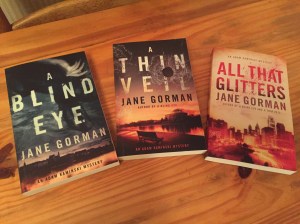
Visit janegorman.com for information on all of Jane Gorman’s books.

Writing About Something I Know Little About

This is something that I often do. I’m working on my next Deputy Tempe Crabtree mystery and it has a lot to do with wild fires. I’m not a firefighter, except for one retired fireman married to my cousin, I have none in my family. (Cousin’s hubby wouldn’t be helpful because he fought city fires.)

Fortunately, I have a friend who is also in my critque group who has been a volunteer fireman for years and often works on the big forest fires around the state. Believe me, I’ve truly picked his brain.

I’m good at this because of course, I’ve never been a resident deputy sheriff either. Living where I do, we’ve had several I’ve become acquainted with over the years. In fact, I wrote an article for the newspaper about the woman who inspired me to write about a female deputy sheriff. As for the real-life deputies who came after her, the first was a layed-back guy who had some traits that I borrowed for Tempe. Even the more gung-ho type we have now was kind enough to let me see inside his truck so I’d know what one looked like.

And for all of us writing about murder–I doubt that many of us have known a murderer personally or what really makes one do what the or she has done. But it hasn’t stopped any of us from writing about murderers and the acts they commit.

What I think that says for all of us is that we’re good at researching what we want to know and have incredibly lively imaginations. And of course, we’re counting on our readers to be transported to the world that we’ve created.

What else can you think of that helps you to write about people and subjects you really don’t know much about?

Marilyn who also writes as F.M. Meredith


The Mystery of Romance – or is it the Romance of Mystery?

by Janis Patterson

Last weekend I was fortunate enough to be included on the panel at the public library sponsored Romance in Bonham, a nice county seat town a little over an hour away. The ladies of the library hold this event every other February, and it’s great fun. After the panel discussion and the book signing and everything is all over they provide the panelists and the family members they bring along a down-home potluck lunch. Always some of the best ‘lady food’ I’ve ever had! (Wish they’d do a cookbook…)

Although this is a romance-centric event, I brought several of my mysteries and was slightly astonished at the interest they generated. Apparently there is a growing interest for more mystery in romances – or more romance in mysteries. Both of which, I think, are a very good thing. For far too long readers and writers both have been pigeonholed into fairly rigid and unforgiving categories. Mystery was mystery. Romance was romance. Romantic suspense was a step in the right direction, but unfortunately it was soon codified into so much a percentage romance, so much a percentage mystery/adventure by most traditional publishers.

Now, almost in the manner of a superhero, self-publishing has started to break down the artificial barriers between genres, allowing them to become just stories with all kinds of elements. Want a mystery with lots of blood and danger and nary a kiss between characters? It’s out there. Want an exciting mystery where a couple falls in love while evading the bad guys/saving the world/whatever? It’s out there. Want a tender romance where a couple falls in love happily ever after while solving a usually gentle mystery? It’s out there. Want any combination of the above? Or just about anything else, including vampires, shapeshifters talking cats or kung-fu knitters? Even all at once? It’s out there.

I don’t know if the traditional publishers – the kind one finds on the shelves of your local bookstore, if there are many of those left – have twigged to how complete this revolution of thought is, but the virtual aisles of electronic/print on demand publishing are full of proof. You can find almost any permutation of any storyline now. Self and small publishing have opened up the world of stories, and readers/writers are no longer bound to restrict their desires to the small and rigid genres the trad publishers have decreed will make them the most money. True, in the days when traditional publishing reigned supreme and controlled not only content but distribution, print runs were enormous and had to be done ahead of release, then stored in gigantic warehouses. The publishers had to look to what would give the best return on their not-inconsiderable investment. Now, though, in the burgeoning world of electronic and print on demand self-publishing, such considerations are no longer the end-all and be-all of what’s available. Niche markets that were too small to interest the trad publishers are now flourishing and expanding.

And that’s all to the good. Choice is a good thing, and genre-blending is a good way to expand reader interest. If there is a downside, it’s that the freedom of self-publishing has opened the floodgates to an unbelievable amount of pure dreck. There are people who believe that not only putting down X number of words is writing a book, but that doing so will guarantee them fame and fortune. We can only hope that their number dies off quickly, because this wave of badly written, badly conceived and badly formatted messes is reflecting badly on self-published books as a whole. There are self-pubbed books (usually written by veterans – or perhaps we should say survivors – of the trad publishing industry) whose quality is unquestionably equal to or better than anything from the Big 5, but they are shadowed with the prevailing belief that all self-published books are rubbish. That’s a misconception that only time and persistence can alter. But it will, it surely will, and writers and readers the world over will benefit from it.