
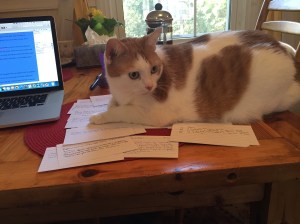
I’m about to give my work in progress, the fifth Mae Martin Psychic Mystery, its most ruthless examination. My first critique partner has read it, I’ve revised it with her input, including discarding an end that she wisely recognized as weak, and I rewrote the last five chapters in their entirety. Now, having reviewed key ideas in Jack Bickham’s Scene and Structure, I am about to go through a printed-out copy of my manuscript with my analytical mind, not my creative one, examining every scene and sequel as well as the overall arc.
Bickham suggests using color-codes, not words, for this process. I’ve done it for all my books so far and I can see why. It keeps me from going into perfectionistic small-picture mode, editing each line, and makes me look at the big picture. I’ll use yellow for the point-of view character’s scene goal, hot pink for conflict, and purple for the disaster at the end of the scene—the setback that actually moves the plot forward. Due to a lack of choices when shopping for highlighters, the same color code will have to work for the sequels, too, indicating the characters’ emotions, thoughts and decisions. For some reason I’ve always used orange to highlight what needs revision, and I mark it with an up arrow for increased pace and tension, a down arrow for slowing down to give more depth, a C for possible cuts, and question mark material that may need clarification. I’ll also mark the pages with abbreviations for the themes that come from the main characters’ story goals, other abbreviations for the superstructure signposts, and for acts I, II and II. I’ll take notes on any loose ends and on details I need to research more thoroughly.
Some of my reminders to myself include looking for the main characters’ vulnerability, can’t-turn-away commitment to the story goal, and agency in the events.
When I put the printout in a binder, my book gave me a paper cut. Omen of painful things to come? No doubt. I’ll be killing a few darlings as well as fine-tuning every scene. But like all the hard work in crafting a novel, it’s satisfying.




 Ladies of Mystery
You must be logged in to post a comment.