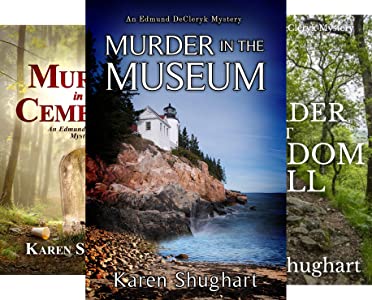
An Early Spring by Karen Shughart

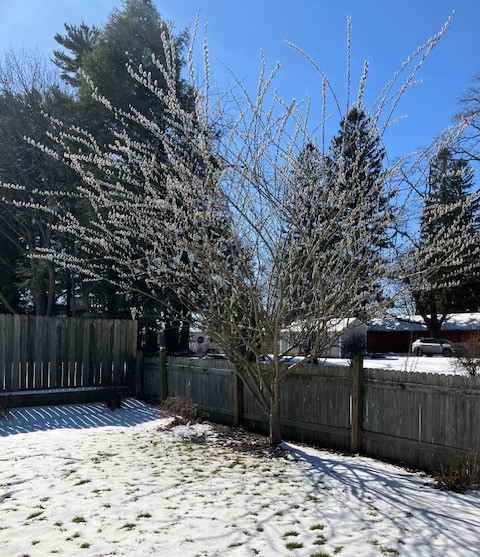
Here on the south shore of Lake Ontario we had a mild winter, and now we’re having an early spring. In February that rascally groundhog didn’t see his shadow, so he probably wasn’t surprised when our daffodils started peeking up from the ground, that green leaves emerged on our hydrangea bushes, or that lush catkins swelled the branches of our pussy willow tree. Robins began hopping about in search of worms, and we awakened to the cooing of mourning doves much sooner than expected. Geese obviously know things we don’t, we spied multiple V-shaped processions flying high in the sky, heading north to Canada, about a month early.

February was also a wild roller coaster ride – a day or two of sub-freezing temperatures with power outages, the result of vicious wind and driving rain or blowing snow — followed by a day or two of sweater weather, bright sun with temperatures in the 50s, 60s and on some days, 70s, Repeat, and repeat. Thank goodness we have a generator.

Now it’s March, the month that in our neck of the woods we call Mud Season. The reason for the name is that the several feet of snow we typically get each winter melts in a rush in a day or two, flooding our streets and making for swampy grass and a mucky beach. This year it never happened, we hardly had any snow. It’s odd, but then again, we’re not complaining.  I’m still clipping sprigs from the rosemary plant I grow in a pot on our deck, usually by now it’s turned brittle and yellow.

In the past I’ve never really loved March, we often travel south for warmth and sun, but this year we decided to stay home and put a positive spin on it. March, like its cousins June, September and December, spans two seasons, with winter ending earlier than expected and signs of an early spring everywhere.

The air smells softer, a sweet perfume of ripening earth, and instead of washed-out blue, the sky is now the color of a robin’s egg. The lake, more often than not, is cobalt with frothy waves of white instead of pewter and silver. The days are longer; and we often awaken to a coral-pink sunrise and cheerful birdsong. Instead of heavy coats and boots, we don sweatshirts or sweaters and sneakers for our daily walk.

This year, it’s as though a switch has been flipped weeks earlier than we expected. We’re enjoying it and the opportunity to spend more time outdoors as we anticipate the slow and steady movement towards the vibrant days of summer.

Karen Shughart is the author of the award-winning Edmund DeCleryk cozy mystery series, published by Cozy Cat Press. All books are available in Kindle, Kindle Unlimited, paperback, and Audible and at independent and chain bookstores and gift shops. She is a member of Crime Writers Association of the UK, North America chapter; F.L.A.R.E. ( Finger Lakes Authors and Readers Experience) and AllAuthor.

Hook, Line and Sinker – The Problem with First Lines

by Janis Patterson

Unfortunately we live in a sound bite age – if you don’t get their attention in X amount of seconds you don’t get it. Time was when authors were advised that you had the first chapter to hook the reader (agent, editor or customer). Then it went down to the first five pages. Then the first page. Then the first paragraph. Now people are leaning toward the first line. Logic would dictate that it would stop there, but in this crazy publishing world I wouldn’t bet on it. With a sad fatalism I’m waiting for a list of sure-fire attention-getting first words. Where things will go after that I don’t even dare speculate.

So what do you do? You grab their attention from the first. Now I’m generous, so I personally work under the three sentence rule. You have three sentences to intrigue them enough to read on. Almost every classic novel violates this rule… some of them adhere to the old ‘first couple of chapters’ convention, which means many if not all would never make it to the shelf today. Of course, novels, conventions and writing styles have changed over the years; what was loved and lionized years – decades – centuries – ago is dead weight today. After all, how many modern people read really old books today for pleasure? (I know some do, and good on them, but we’re talking about modern, short-attentioned modern genre readers.)

So what is it about first lines? People say, you have your cover blurb – why won’t that make them read the book? Well, sometimes it will. It and the cover will usually get the reader to look and pick up the book, but the first sentence(s) will make them want to read the rest. (And like all other things in this more than slightly mad business, this is a generalization. Nothing is ever absolutely certain!)

How? is usually the first question. What do you do to hook the reader? What formula is there to make sure that first line makes them want to continue reading?

The first thing you do not do is start off boring. Don’t talk about the weather, or the pretty scenery, or how much you like your new red dress… unless of course, this is so strange or so much of a clue or whatever that it almost turns out to be the turning point/crux of the story. That’s an individual story call.

Some people just start writing and eventually go back to edit; others end up cutting the first thousand or so words to get a good beginning. Every writer at one time or another has been told “Your story starts in the middle of the second chapter – cut everything before that and lard the information into the story later on.” Other writers can craft a winning first line almost from the get-go. Still other writers come up with a sterling first sentence and then create a story to support it. Even other writers… well, you get the idea. Writing is a highly individualistic enterprise and everyone’s process is different. There are requirements about the finished product, but the process is up to the individual writer.

Back to first lines. Do start off in the middle of something exciting. The hero is caught in the middle of a wildfire or is being stalked by a hungry tiger or is hiding from a gunman – or is being made love to by the most beautiful woman in the world whom he has never seen before. Make his emotions your own. Make the reader wonder (1) how did he get into such a situation and (2) how is he going to get out so much that he has to keep reading.

Once the reader is engaged you can tell the rest of the story – either from that point on or going back to the beginning to tell how he got there or whatever timeline the story demands.

Let’s face it – it doesn’t matter how good and outstanding your story is, or how you present it, the reader is not going to read it unless you hook their interest, and one of the primary tools for that is the first line.

GOOGLE IT!

Eons ago, when I wrote my first book, I actually had to go to the library to research untraceable poisons, fast acting poisons, skin absorption poisons. Yes, I was poisoning someone and yes, I’m that old!

I loved going to the library, I mean after all it is filled with books! But as a single mom at the time, with two young boys, my opportunities to languish in a palace of books were limited.

Also, during my early writing days, there were no TV shows like Criminal Minds or CSI. Though I have a dark and twisty mind, I didn’t know anything about “behavioral analysis” or “DNA” or “national criminal databases.”

In my next WIP, my villain convinced another inmate to kill himself while posing as the villain. The villain would then assume the dead inmate’s laundry job and smuggle himself out of the prison in a laundry truck. My weapon of choice was a lightbulb gasoline bomb, an idea I stole from “The Longest Yard.” So, I was back in the library researching how to make such a bomb. When I found no such information, I resorted to asking my electrician uncle who said he’d remember not to make me mad.

Then, when I wanted to know what type of firearm an FBI Agent carried, I emailed the FBI. Instead of receiving an email reply, the FBI called me. Evidently, at the time, they kept this information secret, and I was told I’d be placed on a list as an author in case I emailed them again.

A side note about lack of technology when I wrote this book, it was written longhand on countless sheets of a legal pad. Then I would spend hours carefully typing the novel on a non-autocorrect typewriter. Good times!

Imagine my delight when the World Wide Web was created, along with my ability to own a desktop computer! And, of course, my creative brain couldn’t get enough of shows like CSI and Criminal Minds.

By the time I wrote my next novel, it was 2004. My husband and I were finally empty nesters, and I was blessed with the opportunity to work from a home office.

I have an overactive imagination, which isn’t always accurate. Now when I need to verify an action one of my characters might take. Or the consequences for a specific crime if my villain is caught. Maybe I just need to know what the times are for sunrise/sunset in a specific month. Whatever the question, Google is at my fingertips!

I love that I can get instant information from several sources and within minutes to hours, I have my answer. Generally, I copy and paste my newfound knowledge and store the Word file in a folder for my current WIP. Another great tool is the ability to search my Word program for a specific item, but if I failed to save the nugget of info, I can always Google it again!

Googling does have its pitfalls. When I researched how to smuggle drugs in an RV (think gas tank) I received a phone call from Homeland Security. At first, I thought I was being pranked and the following conversation ensued:

“Hello, Mrs. Setzer,” a baritone voice filled my ear, “this is Agent Michaels from Homeland Security. I’m calling regarding your recent research on how to smuggle drugs into the United States from México.”

Okay,” I laughed, “who is this really?”

“Agent Michaels from Homeland Security.”

“How’d you get my cell number?”

“We’re Home Lane Security, ma’am.” Agent Michaels sounded annoyed. “Please answer the question.”

“I’m an author and just doing research for a book.”

“Understood. You will be placed on a list as an author, but you may want to be careful in the future with regard to your Google searches.”

Oh, good, I’m on another list!

Recently, I was struggling to settle on titles for two new WIPs. One book centers around a character’s survival while stranded on a ledge after a fall. The second WIP is about a serial killer who places bodies into a river. These two books will be part of a series that has two-word titles, which are my favorite. As I had my hair cut and colored, my stylist, Larry, and I tried out different word combinations. We landed on “Ravine”, which I really liked, but needed a lead word beginning with R.

You guessed it, we turned to Google! During my two-hour visit, Google sparked our imaginations with words like rescue and remote. We had fun trying different words with “Ravine.” Given a ravine is generally in the woods, our search led us to rattlesnake dens located on rocky ledges. We finally settled on “Rattlesnake Ravine.” Not only do I love the title, but our brainstorming created another threat for my Hero. And if you hate snakes as much as I do, researching and writing about their behavior was creepy!

This series already has “Redneck Ranch”, “Whispering Willows”, and “Willow’s Woods.” And though the titles are perfect for their novels, I really wanted to use a different consonant. So, on another recent visit to Larry, we repeated our title Googling session, finally landing on “Fatal Falls.”

Now, in an era of instant information, I am in awe of the tools available to me. From acquiring specific knowledge to checking facts to looking for inspiration, I can use Google, Bing, Wikipedia, and more.

While I love being able to use technology with my writing projects, I’m not planning to go down the AI rabbit hole. My mind is already dark and twisty without the benefit, or detriment, of Artificial Intelligence.

I very rarely visit a library these days to do research, but I do still write longhand on a legal pad. My favorite writing spot is a noisy bar where I get lost in the cacophony of sound. And when I need a tidbit to round out a character, to verify the average temperature in Oregon in October, or fact check how a rural Sheriff’s Department would handle a crime scene … I just Google it!!!

Happy Googling, Ladies!!!

Merging Fact With Fiction by Karen Shughart

I’ve been a contributing blogger for Ladies of Mystery for roughly five years, and initially, at the beginning of each year, I made a list of the topics I wanted to write about for each month. But a year or two ago I decided to be a bit more flexible and instead of sticking to the script, so to speak, to write about what motivated me at the time.

When I began to think about what to write for this month’s blog, at first I came up with a blank–some months are easier than others–and after that I considered writing something about Valentine’s Day or Presidents’ Day. Somehow neither felt right, and I couldn’t think of anything original to say about the topics. Then I decided that because February is also Black History Month I’d write about the third book in my Edmund DeCleryk cozy mystery series, Murder at Freedom Hill, which is about the murder of the beloved, biracial mayor of the fictional village of Lighthouse Cove, NY, whose body is found on the path leading to the beach at a historical site called Freedom Hill on the south shore of Lake Ontario

Freedom Hill is a real historic site a short drive from our house where before and during the Civil War, through an intricate, dynamic and well-developed Underground Railroad system, escaping slaves fled down a path to boats that would transport them across the lake to freedom in Canada. At that same time Maxwell Settlement, upon which the fictional Macyville in the book is loosely based, was a thriving community of freed people of color who worked along side abolitionists to help those slaves escape.

In the book, when criminal consultant, Ed, is hired to investigate the mayor’s murder he wonders if the crime might be racially motivated and related to an exhibit the mayor had been working on with Ed’s wife, Annie, head of the local historical society and museum. The exhibit’s focus is on Macyville and the mayor’s ancestors, both Black and White, who lived there, but a critical piece of information the mayor had promised to provide is missing.

The historical society, with help from the mayor, has also obtained a grant from the National Trust for Historic Preservation to restore Macyville, which had fallen into disrepair after its residents left for better opportunities after the Civil War, and a fire destroyed it in the 1920s (the real settlement remains in ruins, but there’s a historic marker designating the site). Annie is working with contractors to assure the project will be completed in time for July 4th weekend festivities, but she suspects that someone is trying to stop it from moving forward. Is the mayor’s death related, or is something else afoot?

I enjoyed doing the research for this book and merging fact with fiction- as I do with all the books in my series- but for some reason this particular period of history has always fascinated me. It was gratifying to learn how so many of our residents played a critical role in helping to shelter fleeing slaves from capture before transporting them to freedom.

Karen Shughart is the author of the Edmund DeCleryk cozy mystery series, published by Cozy Cat Press, including the award-winning book three, Murder at Freedom Hill.  All books are available in Kindle, Kindle Unlimited, paperback, and Audible. She is a member of CWA ( Crime Writers Association of the UK-North America Chapter) and F.L.A.R.E ( Finger Lakes Authors and Readers Experience).

Noise Levels and Other Considerations

by Janis Patterson

This is a noisy world. There are sirens and neighbors and families and appliances… and not even noise-cancelling headphones can guarantee total silence. At least, not at my home with a house reconstruction going on to the west and the neighbor to the east – though a wonderful man in many ways – owning every gasoline-powered piece of lawn equipment ever made. His lawn is beautiful, though.

Now all writers are different. Some like lots of noise, claiming it is a stimulant, while others like pure silence as they say it frees their creativity. Depending on the time and our mood of the moment I daresay most of us fall somewhere in between.

Some writers swear by writing in different places – cafes, car parks, just about any place you can think of. Now when we have to be someplace besides our office, a writer can work almost anywhere, especially a writer under deadline. Have to take your child to ballet practice? Need to get the car worked on? Have a lunch hour at work? You can take a laptop or one of those keyboards that feeds  into your phone (I keep meaning to get one of these, just as soon as I get a phone which can handle it), or even a humble pen and paper, then make use of the time to up your word count.

Other writers believe in total silence – or as total as one can achieve short of moving to an uninhabited mountaintop in some third world country. Noise-cancelling headphones help, as sometimes does a white noise machine, but nothing can truly drown out the noise of the modern world.

As I usually do, I stand firmly in both camps. There are times I write happily in front of the blaring television while listening to The Husband tell me about his day, and other times I have on my headphones, my office drapes drawn and a sign on the door threatening a dire fate to anyone who disturbs me.

So what is the best way to write? I can only speak for myself, but as always my practice varies. If I had to choose just one atmosphere, it would be classical music (either full orchestra or piano only – no screechy strings, please) playing softly in the background, preferably of an emotion and tempo appropriate to whatever I was working on at the moment. After that, as pure a silence as could be achieved. Of course, I would – and have – made do with whatever had to be undergone at the moment.

By contrast, I have a friend – an excellent writer – who is addicted to writing in cafés. Now I admit there are advantages to writing in a café, foremost of all being to command endless cappuccinos by the mere raising of a hand! On the other hand, there is a constant swirl of people and babble of conversation, to say nothing of being the object of curiosity by the customers (“They’re real writers? And they’re working on books?”) for all as if we were some sort of exhibit in a raree show. I am no shrinking violet when it comes to being in the public eye – far from it – but not while I’m trying to concentrate on work.

However – being a fair individual and willing to experiment, I have joined my friend on occasion, and yes, despite being interrupted by spectators telling me about how they have always wanted to write a book, or have a sure-fire idea for a best seller, both broadly implying that I should stop and either teach or co-write with them (grrr) I managed to get a fair amount of writing done. Unfortunately, it wasn’t really writing – just lots of typing that, on a cool-headed reading the next day, was barely one baby step away from garbage. I didn’t try to save any of it, but I did go put on some Chopin, close the drapes and the door and try to salvage the underlying idea.

By contrast, my friend actually wrote a short story that same afternoon, one when it was polished, she sold.

How boring life would be if we all worked exactly alike!