So long, farewell, auf wiedersehen… by Karen Shughart

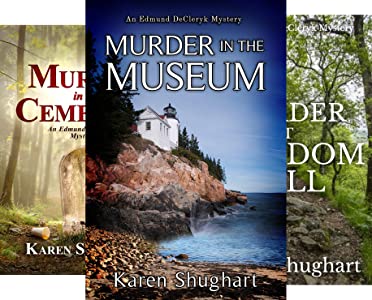
The song from The Sound of Music kept popping up in my head as I struggled to choose a title for this blog, which will be my last for Ladies of Mystery.  I started writing these shortly after the first book in my Edmund DeCleryk mystery series, Murder in the Museum, was published in early spring, 2018, and other than missing one a while back, I’ve managed to write every month for the past six years.

You’ve read not only about my books, investigative procedures and writing processes, but also what it’s like to live in the northern Finger Lakes region of New York, our travel experiences and family gatherings, and even eulogies for those I’ve loved. I’ve enjoyed every minute of it and feel gratified by how many wonderful and positive comments I’ve received as a result, and friends I’ve made along the way.

The decision has not been easy, it’s taken me weeks to feel comfortable with it. As I’ve grown older (and by most standards I’m in the elderly category), simplifying my life and deciding what takes priority seems tantamount to residing in a world that’s become far too complex for me as of late. Family always takes precedence, we’ve committed to spending more time with our children and siblings; also with friends whom we hold dear to our hearts. Some live hours and sometimes a plane trip away.

When I wrote the first book, my publisher asked for a series, and that’s what she got. I’m now working on book four, Murder at Chimney Bluffs, which, like the others, includes a historical backstory that provides clues to why the murder occurred, this time Prohibition and rumrunning. There was much activity between Canada and our side of Lake Ontario during that period of time, with contraband liquor unloaded onto a beach beneath Chimney Bluffs, drumlins that were created from icebergs millions of years ago.

Authoring books is a time-consuming process and one that I integrate into the other facets of my life, which include writing a monthly blog for Life in the Finger Lakes magazine, serving on the board of directors at our local library, and occasionally volunteering for other organizations here. An active social life and attendance at a multitude of cultural events are included in the colorful tapestry of our lives.

I truly appreciate that I, as a newly published author of mysteries, was given the opportunity to show off my writing skills here. Thanks so much, Paty Jager, for your unwavering support along the way and for understanding my decision at this juncture of my life, and to the rest of you who have steadfastly been with me throughout this journey.

 So, for now, so long, good-bye, auf wiedersehen, good night, and may peace and love follow you everywhere you go.

Karen Shughart is the author of the Edmund DeCleryk cozy mystery series, published by Cozy Cat Press and set in the Finger Lakes. She has also co-written two mysteries with Cozy Cat authors, two non-fiction books, and pens a monthly blog for Life in the Finger Lakes magazine https://www.lifeinthefingerlakes.com/.  A member of CWA, North America Chapter, and F.LARE (Finger Lakes Authors and Readers Experience), she lives with her husband, Lyle, in Sodus Point, NY.  Her books are available at local gift shops and bookstores and in multiple formats at  amazon.com

Anatomy of a Villain

by Janis Patterson

Everyone agrees that every genre story has to have a hero/protagonist, which means that it also needs a villain/antagonist. Both are needed to create conflict, which is what the story is about. One thing most people do not admit is that while the hero pretty much has to be human or at least act in a fashion that humans would find sympathetic, the villain/antagonist does not have to be human or sympathetic. It only has to be someone/something that prevents the protagonist from attaining his goal. Plus, just to make it easy for writers (not!), the villain has to have his own agenda and goal. And, need I add, not the cartoonish ‘evil for the sake of evil.’

No character – or person, for that matter – is ever all evil or all good. There are heroes who are selfish and cold on certain subjects. There are villainous people who, after killing or ruining several people, will put himself in danger to rescue a kitten. Also, as difficult as it might be to understand – and more so to write – the hero and the villain might be the same except in their goals. What is good and what is evil is decided by the character and the story.

All right, I see your looks of doubt. Try this – One character is an ecologist, who wants to maintain a certain field in a natural state where children can play, animals can graze and the plants hold on to the rainfall, preventing landslides. Another character wants to build an office building on that same piece of land, employ both builders and later employees in the nearby – and economically depressed – town, landscape the property to maximize its beauty and usefulness. Both men believe passionately in their vision and will do anything to see it come to fruition.

Which is the villain?

As with so many things, it depends. What is the thrust, the ethos of the story? Preserving pastoral paradise? Creating an economic bonanza for a dying town? That is your choice. Just make sure the villain – whichever he is – is passionate about his desires. Give him and the hero both something to want. And a hint – no matter how good their goals might be or whatever other good qualities they might have villains are usually less honorable and honest than heroes.

Of course, all that above doesn’t mean anything if the villain has no sense of honor or justice – if he is truly bad, if he deliberately destroys things or kills people to further his goals, whatever values he might have are totally overshadowed.

The trick is, he has to truly believe his actions in pursuit of his goals are not only necessary but righteous – no matter what he feels he has to do. It makes no difference if no one else can understand what he does (what kind of a man sacrifices turtles for a love spell or burns down an orphanage to save a rare plant?) the important thing is that it makes sense to him and to him it is not only necessary but right.

One of the pitfalls of writing a well-crafted villain is that they are often so much more interesting than the hero. I think that accounts for the popularity of the ‘bad-boy’ hero – the usually scruffy, usually somewhat tough and morally ambiguous man who turns up trumps at the end. I have never seen the attraction to an unshaven, grotesquely muscled semi-lout with little to no sophistication, but the trope is very popular. Unfortunately, the kind of character to which I resonate – urbane, in suit, shirt and tie, successful and sophisticated – is normally cast as a villain of the deepest dye. In so many books these days once you see a successful, sophisticated, well-dressed man you know immediately he will probably turn out to be some sort of bad guy… sad. Using success as an indicator of villainy makes no sense whatsoever.

A villain has to have a goal, an agenda in which he believes that will get him what he wants, otherwise he becomes little more than a cardboard marionette jumping to the writer’s whim, and no one wants that. A villain has to be a real person, perhaps with less moral fibre than a protagonist, but with some good qualities. No one is ever all one thing or another.

Remember, a well-crafted villain is always the hero of his own story who is just doing what he has to do in order to triumph.

Three Hydrangeas

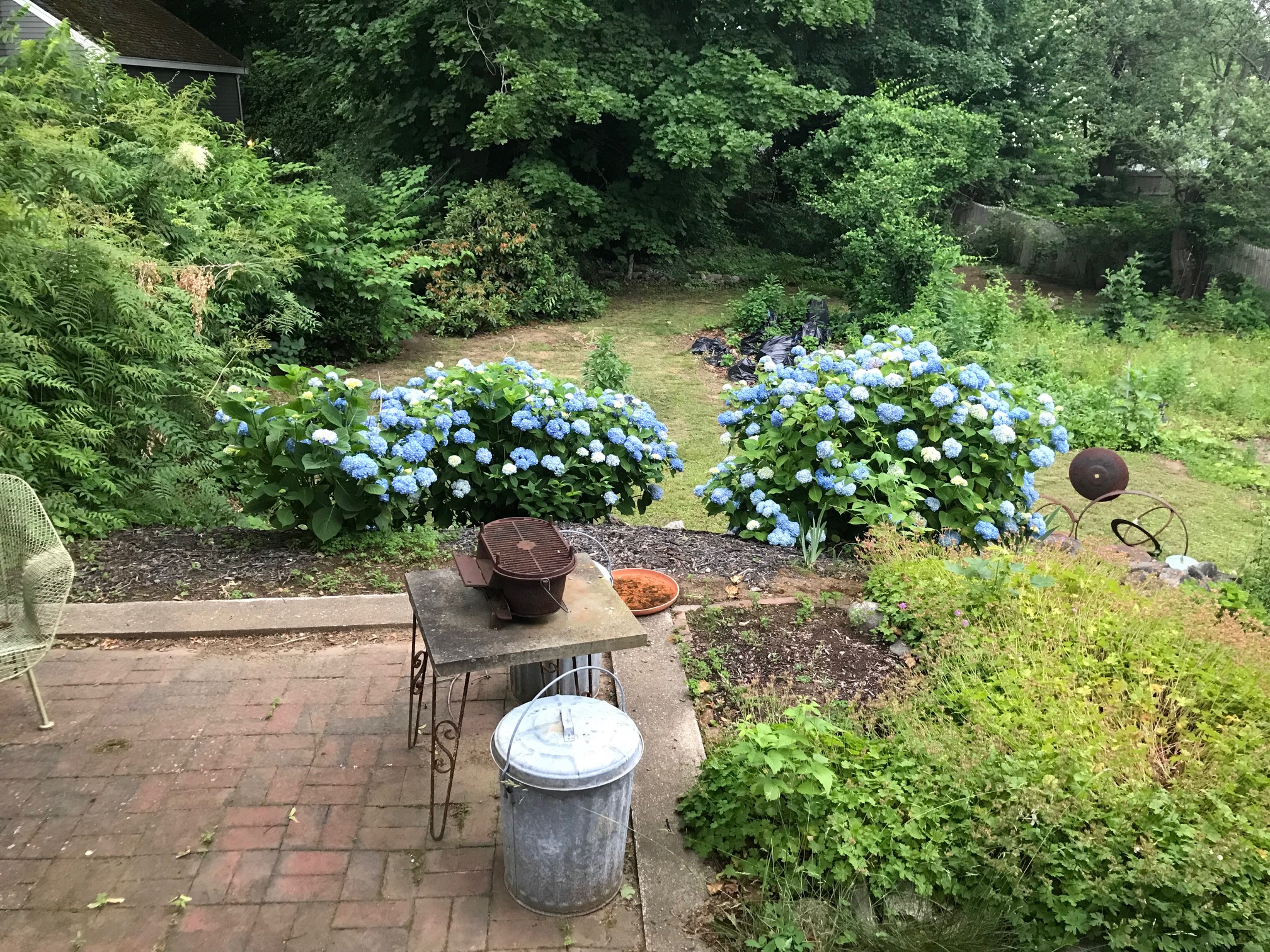
I’ve been reading up on hydrangeas—where to plant, when to bloom, what to feed. I planted three on a gentle slope in the back yard, just off the small patio, several years ago. This area gets lots of morning sun, midday sun, and some afternoon sun. I never feed them, never prune though I do remove old stems that are woody and falling off. And, like many other plants in New England, these three no longer wait for the traditional August blooming. They begin in mid June. 

All three plants have been productive since I planted them perhaps fifteen years ago, and two have reached their full height, over three feet. The third grew more slowly, and two years ago, as I was weeding out whatever had crept up through the mulch, I found an invasive plant had twined itself around the third plant. I rooted it out, and hoped the hydrangea would survive and do better now.

Last year the runt of the trio bloomed nicely, and I congratulated myself for planting it a little higher than the other two, thinking now it gets more sun instead of being somewhat sheltered between two other plants and a fast-growing false spirea, which is another object of my (unfriendly) attentions.

As the spring drifted into June, I admired the first two hydrangeas, which were getting larger and larger, with more and more blooms. I pondered the third plant, which has now arrived at the top of the slope and is only a few inches from the patio. How did it get there? 

It’s been two years since my husband died, and while I thought my life was continuing on its established trajectory, I’m beginning to see that it’s not. A few weeks after Michael died, a mutual friend, also a widow, asked me if I was now reinventing myself. The question surprised me because we’d known each other for years both as writers and as neighbors. My first reaction was, no, of course not. I’m who I have always been. But in the intervening months I have noticed that interests I didn’t pay much attention to are coming to the fore, or I’m taking them more seriously. Some of them involve fixing things myself instead of asking Michael, who loved broken things for the chance to tinker, or hiring someone. 

I’m doing a lot more photography, and looking back on four solo shows and wondering why I didn’t take the work more seriously. My newest project involves lace and exploring experimental photography, which involves poking into analogue work. I don’t feel like I’m reinventing myself so much as sprawling over boundaries established arbitrarily and no longer useful. 

So now when I look at the hydrangea working its way up the slope and getting ready to grow as large as the other two, I don’t wonder how it got here or why. It’s where it needs to be.

Adventures in Anthology-Land


by Janis Patterson


I like the anthology format – a short (ca 20K words) length which is appealing to today’s sound-bite sensibilities, several authors, which means several different stories, several different viewpoints, several different styles even if written around the same theme. This broadens the target audience and exposes every one of the contributors to readers they might not otherwise have reached.


On top of my standalone releases I do two Regency-set romance anthologies every year – one with a summer theme and one set at Christmas. Great experience, great publisher, good financial returns – everything needed to give me a totally overblown opinion of my own knowledge and powers.


At an informal gathering of some long-time (multiple decades) writer friends (all working professionals) we were talking about the market and what we could do to improve our sales. Suddenly struck with an attack of the stupids, I suggested “Why don’t we do an anthology ourselves? A mystery anthology?” (Yes, I have seen all the Mickey Rooney/Judy Garland movies where someone always cries, “Hey! We’ve got a barn… why don’t we put on a show?”)


After a lot of chatter and very little good sense, we decided to peg our anthology to underserved holidays. I mean, who needs another Christmas or Valentine’s Day anthology? Who has even seen a Labor Day or Memorial Day or St. Swithin’s Day anthology? It’s practically a virgin field.


We decided to start with July Fourth, each of us writing a story about our choice of the various wars that have defended our freedoms. I – for some unknown and unfathomable reason – chose World War I, about which I knew next to nothing. Now I know a lot, much more than is needed for a 20,000 word novella, but that’s the way things go.


Fortunately, as all of us are long-time professionals, all skilled in the mystery genre, coming up with the ideas and actually writing the stories were not difficult at all. What drew us all up short was the non-writing stuff.
Who is going to do the formatting? We all have different formatters, or do it ourselves. What about covers? Same thing. But those were small problems, easily handled.


It was the business side that drew us up short. Now we have all self-published with varying degrees of success, so the mechanical part didn’t faze us, but the financial part did. The vendors only take one name and social security number, so whomever we used would get stuck with the tax bill. There are ways around that, with a portion of the buy-in to be set aside to recompense that person, but it seemed dreadfully complicated. None of us are particular mathematical geniuses (genii?) so through the kind generosity of several other writers we got names of a couple of companies that did fee-splitting, which relieved our minds immensely. The only sad thing is, by the time we got this far it is much too late to get the July Fourth book release on track for a proper pre-release. The only choices we had were to rush it through and sell a less-than-ideal product or put it off a year so we could give it the professional send off – and offer our readers a professional product.


So what did we do? Of course none of us could face putting out a less-than-professional product, so it should be ready for pre-order next June. You expected something different? Of course, that left the question of what to do between now and then… go back to our individual projects after making a release schedule for the July Fourth anthology? Take a much-needed break from writing at all?


Hey, people, we’re writers. What on earth would make you think we would do anything so sensible?
The new anthology is titled Bloody New Year! and is centered on New Year’s Eve/Day. It will be ready for pre-order 15 November. Don’t forget to get your copy!

In Praise of Envelopes

Scattered around the house, until I finally gathered them in one place, were a number of pretty, well-decorated pads of paper in various colors. Some are aqua with little sprigs of white flowers in one corner; others are yellow, or pink, or off white with cute titles such as To Do, or Not To Do, with a row of colorful books at the bottom, below the hand-drawn lines. Some only say Notes in florid fonts. Some have bouquets in the corners and others have snowflakes along the borders. My favorite is the collection of library book cards that used to be found, stamped, in the back of every book. I never use any of these.

I also have a stack of journals I received as gifts. They come with nice covers and silk bookmarks, and beautiful pages, some lined, some not. I don’t use these either. When I travel, I take a plain black Moleskine journal, the small size, and it’s just the right tool for a short vacation, about a month or less.

For taking notes, keeping track of my to-do list, I use envelopes, plain white, usually used envelopes. I can’t break myself of the habit. When I get the mail the first thing I do is examine the envelopes, hoping for one that isn’t stamped or printed on the back, torn or stained. The envelope might end up with coffee spots on it, or smears of butter from a morning pastry break, but I don’t want it to begin that way. I want pristine, a pure white envelope calling me to list all the goals I have for the day, the list of things I believe, in my arrogance or delusion, that I will get done in the next ten hours. I can be very ambitious, and with small handwriting to accommodate the space, I can list a month’s worth of tasks on the back of a No. 10 envelope.

When I think about it, I admire my smarts in choosing this disposable vehicle for my ultimately disposable thoughts. The item is plain, it fits neatly into my hand, and there’s room on the back for additional notes and clarification. Because the No. 10 envelope, a standard size, is 4 1/8 in by 9 1/2 in, it is roomy enough for a clear statement of the task but not so roomy that I’m tempted to get wordy. There’s no point in a to-do list if it reads like a lecture or an essay. In addition, it folds neatly to fit into a pocket, and slides into my purse easily.

This week I cleaned my desk and found no less than seven (that’s seven) envelopes packed with things to do, books to read, household chores to get to, handymen to keep in mind for various repair jobs (I live in an old house), and writing ideas so terse I had no hope of ever figuring out what I had intended. That’s okay. I always tell myself if it’s a good idea, it’ll come back—several times—until I either get to it or discard it. I’d crossed out much of the items on each envelope, and as I read through the remainder I smiled at my plans, and was glad to let them go. I have new ones now.

There’s another reason I like envelopes, one that I rarely admit to myself. You can probably guess what it is, or who I’m going to refer to. In my quiet writerly life, I’ll never rise to the level of him, the great one, nor will I ever write anything so perfect as to be quoted decades or centuries after I wrote it. But here I sit, with my stack of envelopes honored by having its own desk drawer, thinking of what is possible with a simple envelope. The great man’s example is simple and can be summarized by anyone, and is always worth remembering and thinking on. Be direct, be honest, be brief. This is good advice for the writer, no matter what she writes on. Thanks, Abe.