My Desk is a Mess by Karen Shughart

This is the stage when I’m writing a mystery that if you visited my office, you’d gasp in horror. I’m usually very organized, but at this stage, my desk is a mess.

On the right are the first two books in my Edmund DeCleryk Cozy series, Murder in the Museum and Murder in the Cemetery. I use them as a reference for book three, Murder at Freedom Hill, because there are recurring characters: a newborn baby in the last book can’t be in elementary school two years later.

A thesaurus, usually on a shelf, claims space on my left. I’m forever scrambling to find synonyms for words I tend to overuse. It’s a weighty tome but a necessary tool, although the good news is that I recently had an aha! moment when I realized that with a couple of keystrokes and the click of the mouse, hello Google, goodbye Roget’s.  How easy is that?

That thesaurus, by the way, was published in 1962. My Webster’s dictionary in 1982. If you think that dates me, it does, think about how many words there are now that none of us who were alive 50 years ago could have imagined: truthiness; snowflake (not the one that falls from the sky); bestie; twerk. Not that I’d ever include those words in my books, none of my main characters is young enough to use them. Wait a minute, did I say 50 years? Has it really taken me that long to follow my bliss?

Photo by Pixabay on Pexels.com

But I digress.  Piles of paper surround me: bills I’ve received from vendors who still, after all these years, won’t send them electronically but that I, a modern woman, have  paid online; recipes I printed from The New York Times when I could have simply opened my phone or computer when preparing them; print-outs of outdated passwords; a receipt for our dog’s latest checkup; a flyer from the local carwash announcing its wash and wax specials.

I don’t like wasting paper. “Waste not, want not” –phrase origin 1576 or 1772 — depending on your source, is my motto. I write notes to myself on the blank sides to advance the story line, a timeline I never follow, names of new characters to remember, thoughts and ideas that come to me at 3 a.m., questions I have about historical details that are always part of the backstory and the reason for the murder.

There’s a system here, a method to my madness, and it works for me. Once I make sure my historical facts are mostly correct, change the timeline yet again, check for inconsistencies, discard ideas I had at 3 a.m. — what was I thinking — I cross the items off the list, rip the paper into shreds, and toss it into the recycling bin. Then the cycle begins again. Until I reach the point when the manuscript is sent off to my publisher, my desk will remain a mess.


The Sounds of Christmas

When I noticed that my post was due on Christmas morning, my first reaction was to cringe and wonder, What on earth could I talk about that wouldn’t seem banal on such a morning? Not sure what to do, I do what I always do. I put the worry aside and took the dog for a walk. 

The various churches in our area often play recorded music. There is little live bell ringing in churches today, which is a loss. As a former bell-ringer, I miss the sound of bell music. When I was barely twelve years old, I was part of a group from my school that performed for the mayor of Boston (in a public concert) during the holiday season as well as for my community. When I hear bell ringing now I actually listen as though I understand what I’m hearing—the different bells, the timing, the way a ringer has to pitch and snap the bell forward, etc. 

On my walk I heard the recorded music from a small nondenominational church nearby, and let my mind drift. In the distance a dog barked and I knew another dog walker was out and about. Briefly a car with the bass ramped up sped by, crushing the bells and the dog. I registered all this and more as I waited for the world to fall quiet so I could enjoy the bells again.

This was one of those moments when a writer recognizes the obvious. In my recent work I’d forgotten the sensation of sound—the music that alters how I feel, the pain of shouting voices, the laughter that starts me smiling and makes me curious, the chorus of dogs barking in response to each other, and the snatch of conversation from two people walking past. The world is one long musical composition of which we hear only bits and pieces. But what if we listen?

The morning of a holy day is a good time to begin to listen well and carefully, to set aside the urge to add a comment or tell a story. Now is the time to listen to the world around us, the sounds we screen out instead of embracing as part of the fullness of life. There is a rhythm to movement and the noise it creates, and if we listen carefully and long enough we’ll see people walking up the steps in time to the beat of a car coming around the corner, or the landing of birds while a tree branch bends. If we listen we can hear the rhythm that holds us in sync with each other, each sound a grace note of life. 

May your holiday be rich in all the best ways.

The Darkest Hour is Just Before Dawn by Karen Shughart

One of my favorite songs of the 60’s and 70s is “Dedicated to the One I Love,” which was performed by multiple groups, my two favorites the ones sung by The Mamas and the Papas and The Shirelles. The last line in the first stanza ends with the words, “And the darkest hour is just before dawn.”

The line in that song has both a literal meaning-the darkest hour is just before dawn-but also a metaphorical one. During our personal struggles and darkest emotional hours, when doom and gloom seem to permeate our lives, sometimes light and happiness are truly just around the corner, if we can hold on long enough to wait until that happens. If we’re patient, and sometimes we must pay attention before we are aware of it, dawn comes.

The song has meaning to me in another way.  Living here in the north, on the south shore of Lake Ontario, the days are short and the nights long this time of year. But it’s not as depressing as it sounds, because if you’re willing to rouse yourself in the middle of one of these nights, you can sometimes view a breathtaking display of Northern Lights over the lake.

Light is a theme in our village, especially from Thanksgiving through Christmas. Our tiny visitors’ center is decorated to look like a gingerbread cottage, trimmed with bright, colorful lights and surrounded by decorated, brightly lit trees.  A tree-lighting ceremony in the park brings villagers out to sing carols, enjoy hot beverages and snacks and warm themselves around brightly burning fire pits.

Photo by cottonbro on Pexels.com

You’ll notice telephone poles wrapped with garlands of evergreens twinkling with white lights and topped with red bows. Lights glimmer on bushes, are wrapped around trees and woven through fences. Candle-lit luminaria line walks, and fairy lights peek through holiday wreaths and garlands.

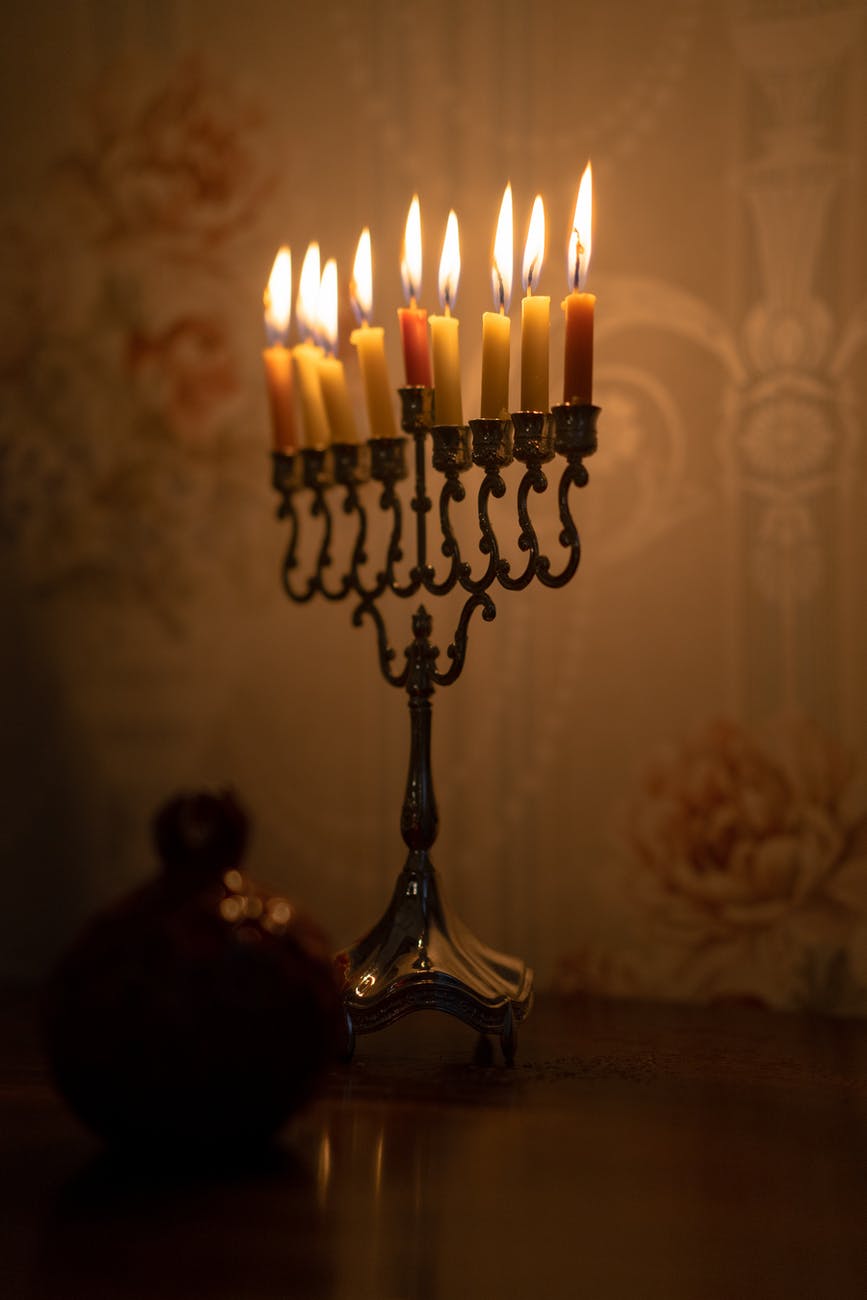
It’s not by accident, I think, that so many cultures celebrate holidays and festivals from late fall into winter that revolve around light. In many communities you’ll see Menorahs in windows, candles burning brightly, to celebrate the Jewish holiday of Chanukah which commemorates a miracle that happened thousands of years ago. 

Candles also burn in Kinaras as Black families celebrate Kwanzaa, to remember their cultural heritage and traditional family values. Hindu families decorate with lights in-and-outside their homes for Diwali, a festival in remembrance of a period in their history when good triumphed over evil. I expect there are others, too.

So, when the days are short and the nights long, how comforting it is to know that many cultures celebrate holidays and festivals that bring light into their lives and homes to brighten those darkest hours just before dawn.

The Season of Gratitude

This time of year publications on and off line are full of essays on gratitude, each writer searching for a unique expression that would set the writer apart. Having said this, I too am offering one of those essays. 

Some years ago I listened to a speaker on meditation talk about online meditations on various topics including gratitude, and how it changed his thinking. That sounded promising for someone who is often grateful for finding a parking space in Boston or catching the last train out or something else equally pedestrian. I decided to give the meditation on gratitude a try.

The instructions began with a sitting meditation of about ten minutes. After that we were instructed to begin listing the things for which we were grateful, and to keep going for another ten minutes. You might think ten minutes isn’t very long, but it is in fact a very long time, especially when you think you should be able to answer the question and then get on with it. (Obviously I hadn’t yet benefited from the practice of meditation.)

I began the list of gratitudes with the usual–my family, my health, my friends, the colleagues who read the first draft of my first mystery and didn’t tell me to get a day job. Then I scrounged around for things like our garden, the gifts from my family, the quiet streets of my neighborhood, and the like. I kept on going, even though I was feeling a little desperate and telling myself no one would know or care if I quit right then–at the three-minute mark. I passed through gratitudes for having a nice home, enough money to pay the bills, a husband who loved me (he got listed several times in different categories). 

The pressure was mounting. I still had several minutes to go. Without thinking (which is actually the same as thoughtlessly minus the emotional baggage), I began free associating. We had a dog, so I thanked him for bringing me close to broken bones every time he leapt to play with another dog. I thanked the person I offered to help when I saw him struggling with a bureau trying to get it into a truck, and he told me what a handsome dog I had. I was thankful for the mailman who came every day without complaint about our old porch stairs. 

By the end of the ten minutes I was ready to go for another as I thought about all the people I met and spoke with or somehow interacted with, and the feelings they’d left me with. I was grateful for the human qualities that are so often the source of pain and shame and disappointment. And even those qualities and others like them I was grateful for because they reminded me that I was human, and that was glorious.

Recently I read an explanation of why we have fantasies, daydreams, and the rest of it. The reason is, in that particular person’s view, a way to escape ourselves, that we humans will do almost anything to avoid spending time in true communion with our true selves. I don’t know if that’s true or not. But I do know that if you want to really know who you are, try a ten-minute meditation on gratitude. The discoveries are definitely worth the initial discomfort and awkwardness. Skepticism dissolves and something close to identity emerges.

Counting Our Blessings by Karen Shughart

Sometimes life sends us lemons, lots of them, maybe more than a bumper crop. We can make lemonade, lemon meringue pie, lemon sorbet… but still, sometimes there are too many bitter lemons to use them all up.

Without going into a ton of detail, this past year has been a tough one for me and my family. We’ve had several non-Covid-related deaths; some serious, life-threatening illnesses; surgeries; and other family challenges that at times seem unending. It’s been exhausting, emotionally draining and downright frightening. Then there’s been the pandemic, the terrifying weather events, and the general unrest on so many levels in our society and the world. I expect we are not alone.

How does one survive? Lately, when the stressful occurrences seem to be relentless, it’s been hard to think that any of it will get better. At times over the past many months, I’ll admit I’ve been depressed and angry and more than a little sad.

But then I take a couple big breaths, close my eyes, and remember to count my blessings. It’s a platitude, I know, but I tell myself we’ll get through it; we have the strength.

Photo by Jill Wellington on Pexels.com

I am married to a loving, caring man. We have wonderful children. We enjoy an incredible support system of family members and family of the heart, dear friends who’ve also been there to cheer us up as we’ve needed it. We live in a stunningly beautiful maritime village where we have a roof over our heads, our home is warm in winter and cool in summer. It’s a safe place to live, too, where we’re not scared to walk freely for fear of violence.  It could be so much worse.

 We have plenty of food, transportation to get us where we want to go and medical care. We may not be rich, but we have an abundance of what we need.  So many people don’t. Sometimes it’s easy to lose sight of that.

We adopted a Beagle during the earlier days of the pandemic. She had multiple health issues. With excellent medical care and lots of love, she’s fine now; a happy and healthy little dog who makes us laugh and gives us an immeasurable amount of joy. That’s too, is a blessing.

So, during the month when we are supposed to give thanks, I will. Sometimes it’s easy to lose perspective and dwell on all that’s going wrong, all that’s contriving to decenter us. I’m making a concerted effort to remember what I have and how much worse my life could be. We actually do have enough lemons to make tasty drinks and desserts and even enough to share with others during the darkest days.