Foreshadowing

I read a lot about craft issues—writing the perfect opening sentence, creating a cliff-hanger ending to a chapter, character description that reveals something more than height and taste in clothes, and the like. One area I’m working on now is foreshadowing. 

When I begin a story I rarely know exactly where the characters are going, but I follow them faithfully through the mine fields of their lives until I reach what seems to be the end. It isn’t until I’m working on the third or fourth draft that I realize instead of foreshadowing an approaching development I’ve anticipated it in a truncated scene. 

There’s a big difference between foreshadowing and getting ahead of myself, revealing too much too soon. In foreshadowing properly done, the reader doesn’t know what’s going to happen, only that something will. A character joking about her horoscope on the train into work is a hint that the unexpected is on the horizon, but her report of what the horoscope promised would be getting ahead of the story.

Foreshadowing is a device for increasing or maintaining tension, directing the reader’s attention to a particular issue or relationship, for example, hinting at where danger lies. Anticipating too much too soon or too clearly does the opposite of creating tension; it undermines the climax or twist to come. It takes the air out of the balloon.

This would seem to be an easy technique to master but in my first drafts I often slide right past what I’ve done. It’s not until a much later draft that I notice that I’ve told the reader almost exactly what’s coming, and to make the narrative work effectively I have to cut that part and rewrite. The danger, of course, is that I’ll miss it and be shocked when a Beta reader finds it. (Love my beta readers.)

Someone who has published ten mysteries with three publishers and a few self-published also could be assumed to know all the basic techniques of crafting a novel, but that would be naive. I always find something more to learn. Right now I’m focused on foreshadowing, but next month I could be focusing on dialogue. In some stories the characters emerge clearly in dialogue and I don’t doubt what I’ve written. In others I can’t seem to get them to say a single line that isn’t forced or awkward. But that’s another problem for another post. 

Eating Locavore by Karen Shughart

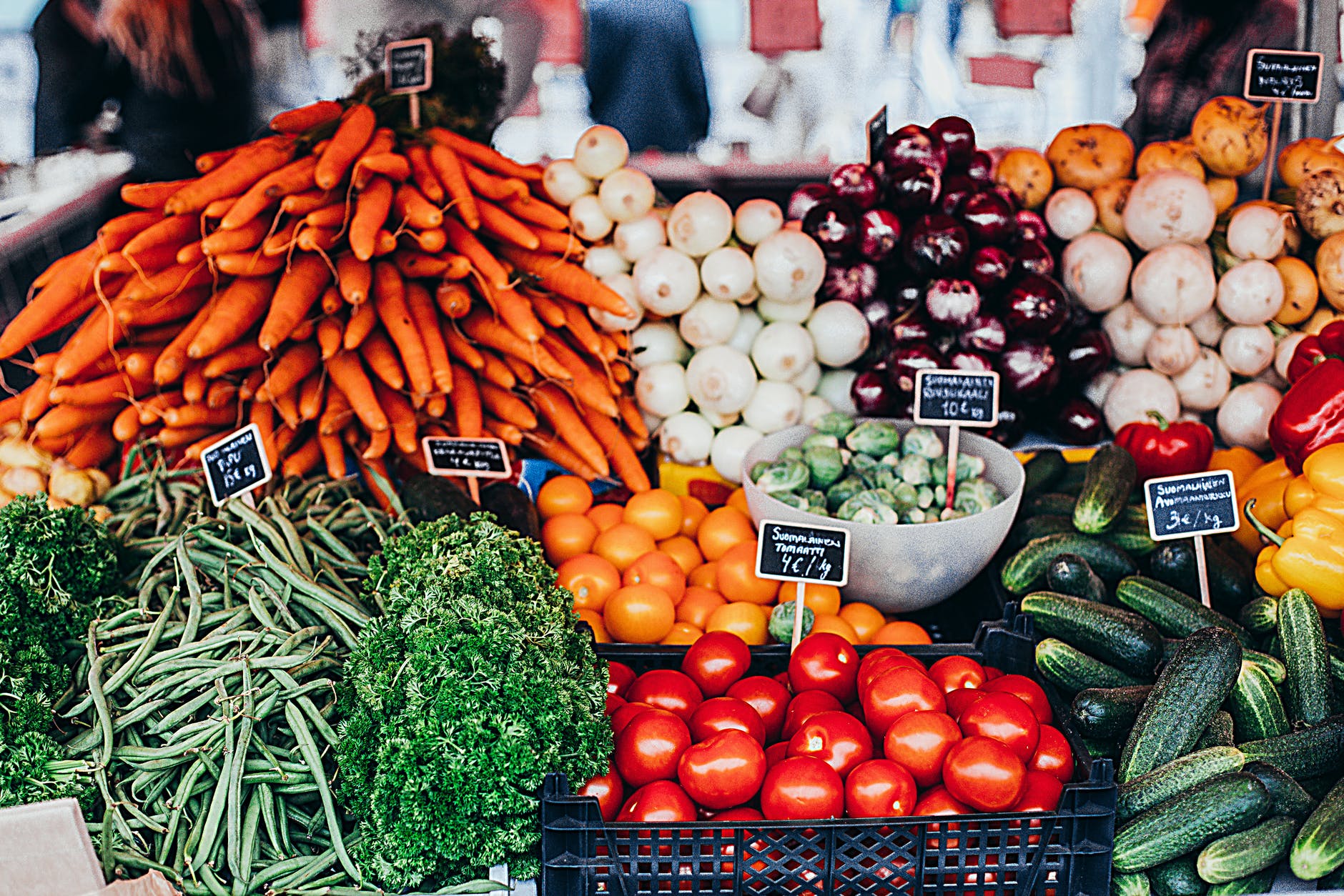
We live in the Finger Lakes region of New York on the south shore of Lake Ontario. It’s a beautiful area with lovely scenery, and defined seasons. I love all the seasons here, but summer is the most bountiful. We’re surrounded by orchards and vineyards, cideries and apiaries, and farms offering up a cornucopia of fruits and vegetables, dairy products, or cattle and chickens sustainably and humanely raised.

This year I made a concerted effort to buy local as much as possible. It’s decreased the number of trips to the grocery store, the food tastes better because it’s so fresh, and the shelf-life is longer. It’s also much less expensive. We joined a CSA (Community Supported Agriculture) from an organic farm that delivers items of our choosing every two weeks, and I shop weekly at a farm stand for fresh-picked produce, grass-fed beef, organic eggs from free range chickens, home baked bread, local honey, preserves and cheese. I grow my own herbs.

Photo by Daria Shevtsova on Pexels.com

For me, buying locally is exciting and challenging. I love concocting menus based on what’s available during any given week. If I can’t get spinach, I use kale and romaine. If strawberries are out of season, I buy berries or stone fruit. I’ll substitute Swiss chard for beet greens and when I can’t get cherry tomatoes, I buy the large, beefy ones that were so common during my childhood.

 I’ve learned to be creative with green beans, cruciferous vegetables, cucumbers, fresh garlic, zucchini, and blueberries, which are plentiful throughout most of the summer. Committing to buying locally and for the most part only eating what’s grown here and is in season also means we won’t be eating corn until early August, apples and pears until September, and winter squashes and root vegetables from early to late fall. When I’ve bought more than we can consume in a week or two, I make soups and stews to freeze for cold winter nights, and there’s always a large pitcher of homemade gazpacho in our refrigerator.

We don’t eat many sweets, but occasionally, especially on hot summer days, it’s nice to have a cold treat. I make homemade ice cream using an ice cream maker, cheating a bit with coconut or almond milk for the lactose intolerant among us, but also using milk from local dairies and fruit from local farms. A wine and spirits store in our village carries Finger Lakes wine; a shop up the road, locally made hard ciders and spirits.

I’ll do this again next year, it’s worked for us. We like knowing we’re supporting our local agricultural community and that everything we eat is fresh and healthy and supplied to us by our neighbors and friends..

Life and Other Troubles

by Janis Patterson

I almost forgot this blog post. Then when I remembered it was due I almost blew it off. Almost. Such an action was tempting but having been trained in professional journalist ethics by my father totally impossible. One simply does not do something like that – he would have risen from his grave and gibbered at me. I was taught early (like around nine or ten, when I first started working in the family agency) that there was just one acceptable excuse for missing a deadline. Death. Yours.

I’ve probably told you that before, and since it is such an integral part of my blood, bone and genetics, will probably tell you again in the future.

However, that does not mean life does not get in the way. After returning from a very intense conference held across the country from us, wrestling with the Book That Will Not Die (and which is due 1 September), working to get my new newsletter set up, working with my producer to get new episodes in the can and revivify my unfortunately moribund YouTube channel (which will probably debut in late October), dealing with the most exhausting illness a wife can have to deal with in her husband (the dreaded Man Cold), trying to get at least half a dozen books ready for release/re-release (yes, I’ve been disgracefully lazy) and prepping for a Very Big Trip it’s small wonder that this column is somewhat disjointed.

I would really rather talk about our Very Big Trip, but for various reasons can’t at the moment. Suffice it to say that it is a working trip for me (research for a new book, and probably more than one), multi-continental and probably very physically taxing. Sadly, I am now of an age when physically taxing is much more of a problem than it was in previous decades.

So even though I can’t tell you about our Very Big Trip now, I will be making detailed notes every day (even got a new travel computer – a used MacAir – to take with me just for that purpose) and promise to tell all in the first edition of my new newsletter. You can subscribe either by going to my website or by going to https://bit.ly/jsmnews – either way I’ll give you your choice of a mystery short story or a short romance novella – and you’ll get the entire story of our Very Big Trip as well as a schedule for new releases.

So now I must either return to the fray with The Book That Will Not Die or keep going through my closet to see if I can assemble a wardrobe suitable for the trip without having to go shopping. Unfortunately, I do have to go look for good hiking boots. My old ones are sadly indestructible, but too heavy for all-day comfortable wear. I did order some pink ones, but while they are cute I’m beginning to think they just aren’t right for the trip. Decisions, decisions…

I have decided that for the moment I will work on The Book That Will Not Die. The characters are behaving very badly and not doing anything I tell them. I can deal with a sick husband, and an upcoming Very Big Trip, and a superannuated dishwasher which is on the cusp of having a breakdown (if it doesn’t give me one first!), but my father’s child cannot take the insult of misbehaving characters. Authority must be maintained!

I will let you know what happens.

Discovering the Story

This post is both an apology and a discovery. I went off this morning thinking I had attended to everything that needed attending to, and then came home to realize I was wrong. So, late but here is my post along with my apologies.

When I began working on the Anita Ray mystery series I knew there would be a wedding in the story arc, and I assumed I knew who the bride would be. After two entries in the series I zeroed in on the prospective bridegroom. But after another two novels I found I was wrong. The character who was the obvious candidate wasn’t all that obvious anymore for reasons not known at first. I don’t want to give away what happened to him, but he lived to appear in a later story.

I continued with the fifth book in the series, In Sita’s Shadow. Each mystery is named for an Indian deity whose temperament matches one aspect of the story. Sita is the wife of Lord Rama, and is considered the quintessential wife, the spouse deified, her perfection unmatched in this world or any other. 

The choice of this figure for the title was meant to underscore the character of one of the main figures in the plot, but then the story got out of hand, and all of a sudden I had a love story in my lap.

Many Indian weddings, if not most, are still traditional, which means they can take hours. Every step in the ritual must be exact—the roles of the relatives are strictly prescribed, the recitations must be exact (no stumbling over the lines), and the families must meet all the requirements.

I thought it would be fun to write about a traditional Malayali wedding adapted to modern requirements, and it was. The first ritual is the presentation of the dowry. Among the Nayars in Kerala, the groom is required to provide the dowry; his “gifts” must be exactly what was agreed to. The gifts are inspected by the father of the bride and his agent before the ritual can begin. There’s something about watching two men with their agents calculating the pile of gold sovereigns, jewelry, saris with gold borders, and keys to cars or motorcycles, and more.

The guests watch it all. Women sit on one side of the room, men on the other, and we check out what the groom provided. I once made the mistake of saying, “So is that what the groom offered to give?” And the father of the bridge pounced and said, “Must give!” He was adamant, even fierce. Marriage is serious business in India.

The wedding in In Sita’s Shadow is adapted to the needs of a Westerner and an Indian woman, and figuring out how this would work required creativity as well as consulting with an anthropologist, but we figured it out, and it’s now one of my favorite scenes of all I’ve written about India. Auntie Meena, originally a skeptic of this relationship and the marriage rites between them, is won over. I hope the readers will be too.

Coming in August, In Sita’s Shadow: An Anita Ray Mystery.

To Prologue or Not to Prologue (#2) by Karen Shughart

I promise this isn’t a duplication of Paty Jager’s blog from last Monday. Paty and I frequently seem to be on the same page when choosing topics for our monthly blogs, and when I read her title, I was terrified that my extremely rough draft had somehow made it’s way into scheduling instead of her very well-written and polished one. Fortunately, my fears were allayed when I saw her name as the author. Whew! And while our titles are the same, we’ve written from our own points of view.

Each of the books in my Edmund DeCleryk Cozy mysteries has an historical backstory that’s related to the crime and provides clues to why the murder was committed. In book one, Murder in the Museum, the prologue introduced a character whose journal, written in 1845, was discovered at an archeological dig in Toronto, Canada. The prologue in book two, Murder in the Cemetery, ties the crime to a battle that occurred in Lighthouse Cove, NY during the War of 1812.

My creative juices really started flowing in book two, and I played around with writing two prologues: the first as described above; the other to introduce the setting, the month of May. You’ll have to read the book to learn why that’s important. My dilemma was which to keep and which to discard. I realized I was emotionally attached to both, so decided to get my publisher’s advice-few books are written with two prologues. Her quick response: “go for it,” and I did.

I’m heading down the home stretch with book three, Murder at Freedom Hill. Yet again, I’ve written two prologues: the first, the historical backstory – it takes place in 1859 in Lighthouse Cove during the abolition movement, when fleeing slaves boarded a schooner to transport them across Lake Ontario to Canada. The second is set in November, the month when the harvest is over, and the chill and frost of winter lurk just around the corner.  

What I love about writing this series is that I don’t have to follow all the rules. It doesn’t mean I am undisciplined; I certainly know how to craft a story from beginning to end, but I enjoy taking liberties with commonly accepted writing practices when it makes sense.

It’s up to us mystery writers to decide how our stories will be written. Some begin with the murder; others lead up to it, it can go either way. It’s the same for prologues. Sometimes a book needs no prologue, but at other times a prologue can set the scene and enhance the plot. And at times, two prologues are even better.