My window into other worlds

I don’t know how many of you get giddy when you can visit or see the settings from books you’ve read. But as a reader, I have always enjoyed being taken to settings or worlds I haven’t been and may never be able to see. Books have always been my window into other worlds.

A few weeks ago, my hubby and I made a trip from SE Oregon to Killeen, TX to see his sister and her husband and deliver boxes of belongings to our oldest granddaughter now living in Arkansas. On the way over we drove through the four corners and the towns of Flagstaff, Tuba City, Windowrock, and Gallup. The settings of author Tony Hillerman’s novels.

My husband just shook his head as I said the names of places that I’d read about in those novels. I could envision Leaphorn, Chee, and Bernie Manuelito driving around on the dirt roads I saw from the freeway.  Seeing First Mesa on Hopi land and the hogans on the Navajo land… It stalled my breath to see places and things I’d envisioned as I read or listened to Mr. Hillerman’s books but had used my imagination at what it would look like.

In case you haven’t figured it out already, I have been a huge fan of Tony Hillerman’s books since reading the first one. While he has more Native American life, traditions, and legends in his stories than I have in mine, he was my inspiration to have a Native American character as the main protagonist in my three mystery series. 

He lived on or near the four corners area where the Hopi, Navajo, and Pueblo tribes live. He had many contacts among these tribes to help him show more of the culture than I’ve been able to cultivate living a distance from the reservations and tribes I write about in my Gabriel Hawke novels, Shandra Higheagle Mysteries, and Spotted Pony Casino Mysteries.

I aspire to write as intriguing and thrilling reads even though they aren’t as steeped in the culture and lives of the people.

The next Gabriel Hawke book, I’m having Hawke and Dani, his significant other, attend Tamkaliks. A powwow held every July in Wallowa, Oregon. I attended it this past year for the third time and am now feeling confident I can give my two Nez Perce characters the experience they would undergo having been away from their culture for decades due to their careers and trying to fit into a culture other than their own.

However, with the return of Hawke’s sister to his life, she is showing him how good their culture is for their wellbeing. That will be a subplot in the book to his investigation into a decades-old body he discovers while patrolling the Snake River in the Hells Canyon.

I‘m hoping my contact within the Nez Perce community and the Fish and Wildlife Trooper helping me with the patrol of the river will give my story more realism.

Speaking of realism, I took a trip to the Oregon Coast last Spring to research for my newest release, The Pinch, book 5 in the Spotted Pony Casino Mystery series. In this book Dela Alvaro, head of security for the Spotted Pony Casino is at a tribal-run casino on the Oregon Coast helping them beef up their security. While there a child is kidnapped and she runs into an old friend.

The Pinch

Dela Alvaro, head of security for the Spotted Pony Casino, is asked to do a security check of a casino on the Oregon Coast. She no sooner starts her rounds at the casino and a child of a dubious couple is kidnapped. Special Agent Quinn Pierce of the FBI has been out to get the father for some time.

One of Dela’s best friends from the Army is also at the casino and they catch up. The next morning, Dela finds her friend strangled. As Dela struggles with the violent death of yet another best friend, Tribal Officer Heath Seaver arrives and the two begin untangling the lies, kidnapping, and murder.

As Heath carries the kidnapped child to safety, Dela must face a cunning killer alone.

Pre-order now, releases on February 22nd. https://books2read.com/u/38Y787

I hope you enjoy this latest book and follow my books to learn more about the Nez Perce, Umatilla, and Cayuse tribes as my characters, Hawke and Dela begin to, in Hawke’s case become reacquainted with his roots and Dela is just beginning to learn she may have a Umatilla heritage.
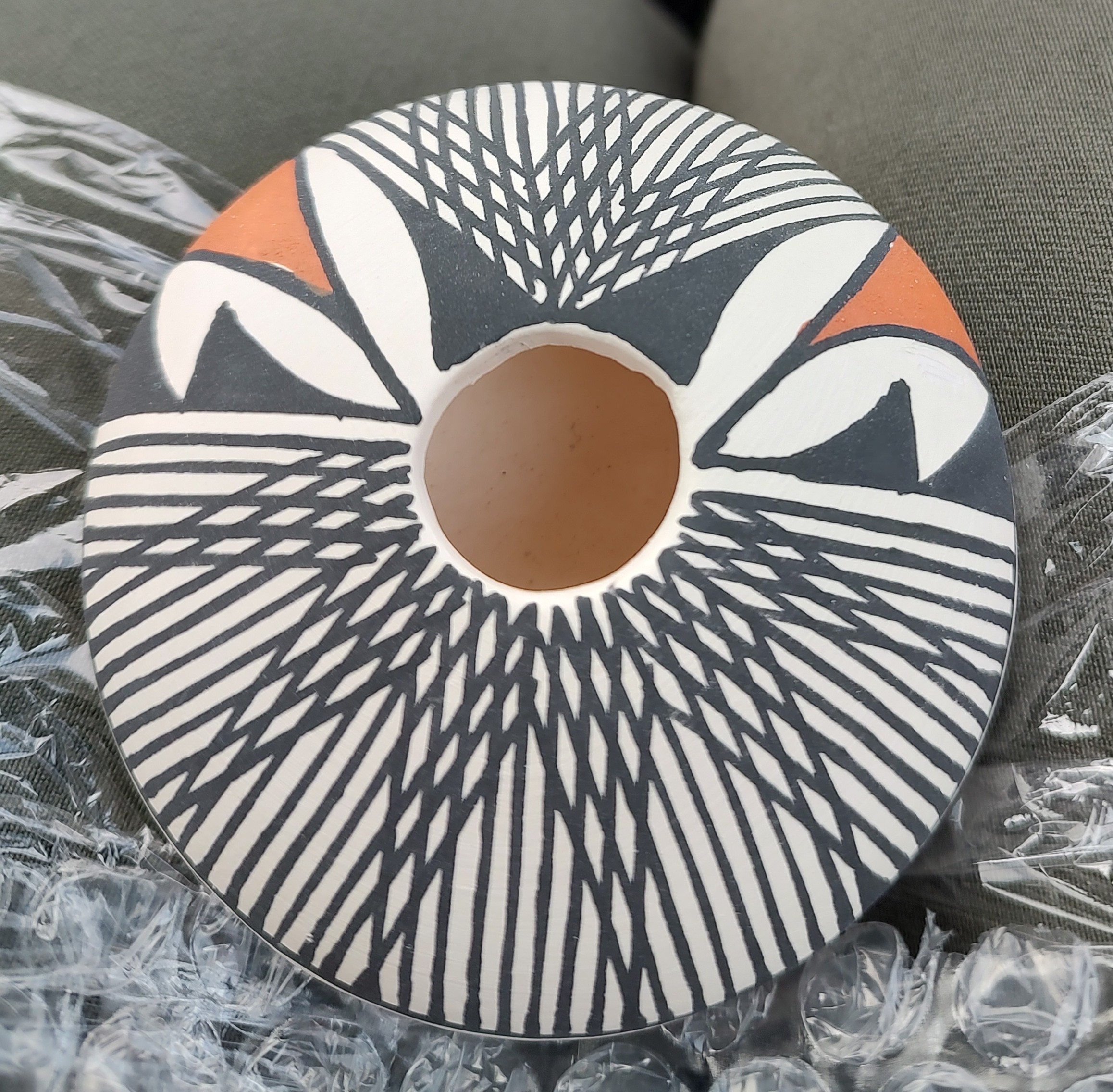
I purchased this seed holder pot from a Pueblo woman in front of a market on the reservation. She told me she was Acoma (Ah-kuh-muh) Pueblo with the Bear Clan. She showed me her name and a bear paw on the bottom of the pot. She then told me the solid black on the pot represents mountains and land, the orange sun, and the thin lines rain. I enjoyed my visit with her.

That is the thing I love most about reading, writing, and traveling. I learn new things and broaden my horizons.  
Openings, Closings, Cliff Hangers, Hooks, and Dribbles

In early drafts, I fall into a habit of beginning and ending chapters in similar ways. Because of this, one of the stages I’ve added to my revision routine is the focused examination of chapter-opening and chapter-closing paragraphs to make sure they are not only effective but varied.

Openings

A chapter has to start with a sense of purpose and direction, or a reader will be confused or lose interest, and it’s not just the writer’s goal for the scene that matters—it’s the character’s. Furthermore, it has to be a goal the reader will care about, a goal that arouses empathy, curiosity, suspense, or dread. Although some chapters can begin effectively with an overt statement of a character’s goal, it would be tedious if they all did. How many other ways can I indicate that goal?

  • It can be forced on the protagonist by another’s character’s goal, either in conflict or through teamwork. (But not too often, or the lead character can seem passive and reactive.)
  • Some goals are made so obvious by the action that opens the chapter that they need not be stated directly.
  • Occasionally, a chapter can open with a sequel or reaction scene relating to the previous chapter, a paragraph or two of the character’s inner work which leads to a decision that becomes the goal.
  • Minor goals can set a character in motion only to be swept aside by a more urgent goal.
  • There’s immediate energy in a goal stated in conversation or implied by the subtext of the dialogue.

Though I won’t keep listing them, I’m sure you can think of other variations on this essential feature of the chapter (and scene) openings.

Closings

If a chapter ends with a nice, tight feeling of closure, the reader can easily put down the book. I doubt any of us has ever read a chapter ending like that in a mystery. At least, I hope not. The last lines have to keep the momentum going. I’m not a fan of the “if only she had known what was coming next” sort of hook. It’s possible to use to it sparingly in the first person, or in a truly omniscient point of view where there is a narrator’s voice, but not in close third person, which is the only point of view I use. Sometimes I want to create that portentous feeling, though.

To do so, I can end with a character having a sense of something bad about to happen, and if I do it once or twice in the book—probably once—that’s enough. Another way to get the hint of forthcoming doom or disaster is a chapter with a happy ending to that’s too good to last, or a character turning down a task that he’ll eventually have to face. There’s also the classic cliff-hanger that leaves a character on the precipice of a life-changing decision or a dangerous confrontation, but it can’t be overused without losing its power. Sometimes the hook can be as simple as going through a door, if the reader wants to know what will happen on the other side.

I took a class in which we were cautioned not to let our scenes dribble—not to keep going after they have ended—and it’s good advice, but once in a while I’ve seen some excellent writers do this at the end of a chapter. There is a page-turning plot event at the end, but it’s followed by a few humorous lines of dialogue that add depth to the characters and their relationships without smothering the impact of the “real” ending. It’s a dribble, but it’s a skilled dribble, used judiciously like a dribble of hot sauce that’s only good in small quantities.

For this post, I studied how one of my favorite writers, Tony Hillerman, began and ended chapters, examining his Sacred Clowns. The chapter openings vary from setting a scene and introducing characters along with their goals to dialogue lines that jump into the next stage of the plot, and from inner reflections to moments that progress the romantic subplots. The goals are clear but sometimes implied, not always stated in narration or dialogue. His endings range from surprises to warnings to humorous dialogue following up a more serious event (the well-crafted dribble). One chapter ends with a character’s recognition of an important pattern in the mystery plot, another with an informant’s hint that he can help, and another with a comic setback in a romantic subplot. There are endings where the characters are stumped or struggling, but he never uses an outright cliffhanger in this book. Once in a while, he even ends with character getting what he wants—for the moment.

There’s some wonderful symmetry in Hillerman’s chapter structures. One begins with Joe Leaphorn dealing with paperwork and ends with Jim Chee dealing with paperwork, paperwork to be exchanged with each other. It’s humorous and insightful, tells much about their working relationship, and it moves the plot. Another chapter ends with someone warning Jim Chee that a certain investigation is none of his business, while the following one begins with a different character giving Chee the same caution. The book is a page-turner, without the author doing anything clichéd to make the reader turn the page.

One of my go-to writing books is Jack Bickham’s Scene and Structure, and I expect many of my fellow writers are familiar with it. Bickham’s basic scene structure advice is: goal, conflict, disaster. He gives creative ways to work with that structure, including starting in the middle of the conflict and then revealing the goal later, ending short of a full disaster, and more.

Can you share any other “tricks of the trade” for keeping readers up at night?