
Reading Old Work

For the last few weeks I’ve been thinking about the old mss left unfinished. Some are in my computer. Some of them are on paper, stacked in a closet, shoved into the back where I can’t see them. That’s probably a good thing because if they were visible I’d pull them out and litter my desk with them.

There’s nothing wrong with any one of them, and several came very close to a sale. But there is something not quite right. Every writer knows what I’m talking about—the story we loved and worked on and with a gasp of hope sent off to an editor or an agent. And then it sat there, on someone’s computer or desk, gathering dust of being pushed lower and lower on the list of titles in the TBR file. The question becomes, what do we do with them? Do we reread and rework them? That’s a definite possibility. The more I learn, the more I rethink what I’ve done and recognize where I could have improved the story by changing the setting, developing the villain more, heightening the tension, or removing the extra secondary characters. But I don’t do these things in a novel. I might do some in a short story, but not in a longer work. And I think I know why.

Some years ago I was an avid fan of Margery Allingham’s Albert Campion mysteries. The first one appeared in 1929, The Crime at Black Dudley, and others followed fairly regularly into the 1960s. I don’t know if many people read her work anymore, but she was considered one of the great British mystery writers of her time. After reading through her entire list including a couple of novellas, I came across her first mystery, The White Cottage Mystery, published in 1928. This is only a year before her first Albert Campion story. And I was startled at the difference between the two., and the extent of her growth and development as a writer between her first and her second book. It’s an experience I have always remembered. 

We grow and change as writers. If our work sounds the same year after year, we’re not growing and it’s time to stop and ask why. I don’t want to write the same book year after year. There has to be something different, some sign of a new perspective, a new challenge. I can see this same ambition in some of the writers I read, but not in others. 

When I pulled out some of my old mss and had the passing thought of rewriting and updating them, I was frozen, and here I think I was so for a good reason. Whoever I was back then I am not her now. To bring one of those old mss up to the level I would want to write today would be to dismantle and basically erase it. Each line, each feeling and action would have to be different because I’m different. The story was good for its time and in some instances that’s twenty or more years ago. I was different and the world was different.

I’m in a long phase of decluttering the house I’ve lived in for over forty years, but I doubt I’ll toss out those mss, not just yet. Each one tells me something about writing, finding a voice, developing a voice through time, challenging ideas and creating new ones. I liked some of those stories more than others, and the failure of some weighed on me more than others, but like any other experience that comes to an end, I let those novels go and moved on.

The one important thing I remember is that even though they didn’t sell, they made me the writer I am today, with their lessons and discoveries, their pitfalls and graces. For that alone I will probably keep them for a while longer.
Discovering the Setting

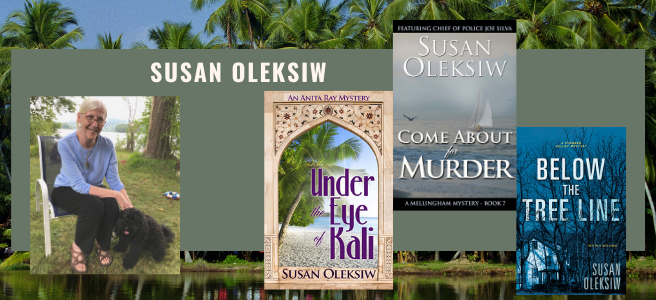
I’m in the middle of the sixth book in the Anita Ray series, which is set in a tourist hotel in a South Indian resort. Over the years the area has grown from a tiny fishing village with a few hotels just up the coast to one of the most popular destinations for Westerners eager for the sun and sand, not to mention the sunsets and the fishing boats bobbing on the horizon at night. I know the area well, having visited it for the first time in 1976 and several times in the 2000s. 

The pathways laid out in the early years are now paved walkways through marsh with little pools covered with lily pads. The paths have been widened in some areas to allow shop owners to hang out rows of brightly colored silk saris and blouses. When I think there’s no more room for another restaurant or shop, I turn a corner and spot five square feet turned into an open-air cafe with the owner stirring a pot on a two-burner cooktop, ready to serve the foreigners sitting on stools before a board table. The food is good, the price is right, and the cook’s son works in one of the high-end hotels. Much of Kovalam has spread on what was once paddy fields that came down to a low berm fronting the beach. All those are gone, and only the rare private home remains, hidden away beneath tall palms.

A reader often tells me they know “exactly where I am” in an Anita Ray story, and that’s because I do too. I have a strong sense of direction in India (and elsewhere), a deep understanding of India (after years of graduate school), and a personal love of the region. All of that informs the Anita Ray stories. What I don’t have is a sense of place in any story if I haven’t been there, walked through a public park, found a typical cafe for the area, and visited a municipal building—perhaps a library or town hall. I can make up a lot of it, but I need to experience the “feel” of the place. 

The Joe Silva series, in seven books, takes place in a small coastal New England town. I know these towns well, having grown up in one. The rocky coast speaks of the “flinty” Yankee, and the harsh winds call to mind the ever-present threat of hurricanes and other storms. Winters may be changing because of climate disruptions, but the birds still come, the land demands careful attention, and life for the fisherman is never easy.

One of the reasons I enjoy reading crime fiction is the other landscapes I get to explore. I’ve been through the Southwest and lived for a brief time in Tucson, so I appreciate any writer who can take me into that world of mountains and deserts, long straight roads, and small adobe houses with gravel yards. The openness of Montana and Wyoming brings out the best in some writers, and I look forward to their stories and landscapes.

Regardless of where we grew up or now live, we are creatures of our environment, and the best fiction uses that sense of place, what is distinctive and unique about one location, to propel the characters and their story. This, for me, is the reward of a reading a novel with a rich, fully developed setting. I come to understand both people and place, and know a part of the world I may never visit a little better.

Settings and Seasons

This morning when I went out to walk the dog, the temperature was 12 degrees. When the breeze came along, it cut. But it’s also dry. When I think about winter I prefer cold and dry to warmer and wet (think snow and ice).

During my walk I often compose sentences to add to whatever I’m working on when I get back to the house, or just because I feel like writing a sentence in my head. This morning the cold held my attention, and I began thinking about how this degree of cold would affect an amateur sleuth hot on someone’s trail. Snowy and cold would make the situation even worse.

Since I live in New England, famous for its winters, most of my mysteries, long or short, are set in pleasant, or at least tolerable, weather—in spring, summer, or fall. Winter poses challenges that my characters don’t have to face, challenges that could change the plot, the direction of the story, the success of the sleuth and the authorities. Perhaps the sleuth has only a few minutes to reach a location to rescue someone, but it’s snowing, the roads are icy, the stop lights not working because of a power failure, the streets impassable in some places. The weather certainly ratchets up the suspense. (Sounds like my drive home from work years ago.)

In a city the sleuth could travel faster and more safely by subway, but at least in my area (Boston), that means a different kind of problem—subway car breakdowns. (To be fair, in Boston subway cars break down in every season.) Or, this could be the start of a story—the subway car stuck in a tunnel. When the car starts up again and makes it to the station, the riders trip over a dead body blocking the exit. Is the killer still on the car, or did that person somehow get off and escape through the tunnel? Will he or she survive in subzero weather underground?

I will admit that when I go about choosing the setting in a warmish season, I’m really thinking about myself—how easy it is to get around, to get things done, to get anywhere I want to go. Winter is a chore for me. And on cold days, though I don’t actually mind them, having grown up in New England, I’m aware of how much effort it takes to make the transition to outdoors—scarf, hat, coat, boots or heavy shoes, mittens, sometimes even a hand warmer for a long walk. But now that I’ve thought up a number of scenarios relying on cold weather, perhaps I’ll make a change.

The weather is going to remain well below freezing for the next day or two, and then warm up. That gives me plenty of time to work out the basic plot of a story set in bitter cold weather, with all the worries and challenges that come with that setting. And I get to write the story while I’m warm inside.

As we head into Christmas, I hope all of you reading this are warm inside with your families and friends, good food, and a pet if you have one, enjoying the season and the freedom to write whatever you want.

Balancing Balls and Weather Machines – A Look at Setting


by Janis Patterson


The temperature has been in triple digits for the last week or so, but in the wee hours of the morning it does fall to the low 90s…


And here I am, wrapped in furs in the middle of a snowstorm. Sadly, it’s only in my mind, as I am working madly to meet the deadline for my Christmas anthology novella. It’s hard to keep one’s mind on snow and cold and greenery and holly berries and sleigh rides when in spite of air conditioning and skimpy sundresses there is sweat dripping from the tip of your nose.
However – I have been complimented about how real and evocative of time and place my previous Christmas novella anthologies have been, and they were written under similar unseasonable (for the work) circumstances, so I guess I’ve been doing something right.


But isn’t that the job of a writer? To create a world into which the reader can immerse themselves, feeling, seeing, knowing what the characters feel? To transport the reader into that world?
Writers are creators of worlds, whether that world is a snowbound country estate, a shack beside the cool orange seas of a distant planet, a year distant in either the past or the future, or even the here and now of our own home street. And it is our job to take the reader there.


So how does one do it? That varies; if it is a here-and-now story set in a pleasant American suburb, that is something to which most readers can relate without too much exposition or world building, even if they do not now nor have ever lived in one. On the other hand, if the story is set on a distant star, where gravity is minimal and the three orbiting suns insure that darkness is an unknown concept, the writer has to do more spadework in creating this world. Same if the story takes place in a great stone castle in the Dark Ages; most people have at least seen pictures of castles, but have little to no knowledge of the socio-political-religious attitudes/beliefs which not are only reflective of the time but which formed the society and belief systems of the time.


Another thing that writers must be aware of is that once they have created this world – be it tidy American suburb, distant star or long-past history – they must be true to it both in construction and action. For example, there is no way I could believably have the characters in my Christmas novella go out and sunbathe in between snow flurries. If my story were set in the distant future where the weather was controlled and there were strict time systems for each variety of weather, it could be perfectly believable that my characters could turn off the snow, set the sun to ‘melt’ and then go out for a nice long sunbath… as long as I had set this part of my world up correctly.
And the final thing to remember is once your world is built and works and you are sure you will have no trouble in maintaining this soap bubble of belief, you must craft a story – a good story – that will fit into the strictures of these parameters and profit from an interaction with them.


Taken like that, the prospect of writing a novel becomes both overwhelming and terrifying, all too often leaving the poor writer feeling like a trick seal who must balance eight or ten balls on its nose. It’s a wonder anyone ever writes.