Following Through

by Janis Patterson

There is not much about writing in this post. Actually, not much about anything. Remember last month when I posted about the necessity and occasional dangers of researching? Well, I put my money (and lots of it this time!) where my mouth is.

As you read this I am – if our somewhat fluid itinerary is accurate – bouncing along in a jeep somewhere in the desert between St. Catherine’s Monastery in Sinai and Petra in Jordan. Am I researching a new book? Probably, though that was not the intent of the trip. However, I can do research on a book with a trip to the grocery store, so that’s not surprising.

No, my husband and I have decided to spend as much time as we can traveling – while we can afford it and are still physically able. I know it’s a luxury, but we’ve both worked hard all our lives and it’s something we want. And we don’t want to miss a chance to fulfill our dreams just because we got lazy.

We started a few days early in Cairo, to visit both a few of our favorite spots and to see old friends, then joined the small group of pilgrims to go on to the Dead Sea. I’ve been there before, and it is still as much of a moonscape as I remember. Then to the fabled St. Catherine’s… ah, but I’m telling too much. Next month I’ll talk a little about my trip and show a few pix. There will be more of both on my website, though, if you want to see more!

And – just a bit of writing news. I’m part of a new anthology called July 4th Murders – where every story takes place on July 4th, but each in a different time period. It’s a fascinating concept and one of which I am proud to be a part. I’ll let you know the exact date it goes up for pre-order.

After we get back from Petra, though. That’s been on my bucket list for years, and I intend to enjoy every second of it!

Research, or the Lure of the Rabbit Hole

by Janis Patterson

There’s nothing more frustrating than a novel which mangles history. Unless, of course, it is alternative history (at best a bastard genre) and clearly labeled as such. What raises my ire is when someone writes what is purported to be historical fiction but has such factual clangers in it as to stop the reader cold. My favorite example of this is from a contest I judged when a Regency hero – handsome, wealthy, arrogant as all of them are – pulls a fountain pen from his pocket to sign some important document.


Really? A fountain pen?


The bladder fountain pen that we all know wasn’t invented for at least fifty years after the Regency. Even the steel-tipped dip pen wasn’t invented until after the end of the Regency. Before that, writing was done with feather quills, usually goose.


Of course I dinged the writer severely for not doing proper research, and sent a rather kindly note of explanation of her low score, hoping to raise her consciousness about the necessity of research. Instead she attacked me viciously, not only in a private letter but on social media, ranting that it was an old-fashioned pen and who would know the difference anyway.


And there is the crux of the matter. Far too many people get their ideas of history from novels (and movies, and TV) and therefore as writers we owe them the honesty of real facts.


Such a high-minded ideal is not without its dangers to us, though. I was working on a fairly early Victorian Gothic where my librarian heroine had to make some ink. Now I knew she couldn’t just pop off to the allsorts shop in the village for a bottle, so I went online and looked up how to make ink.


Who knew there were so many ways to make ink? And there are so many people making it today? Well, it was a plethora of information and I started reading happily. Only thing was, I realized that some of the recipes used items to which my early-Victorian-working-in-remote-Scotland heroine would have no access. But I had to make sure of what was available, which took me to botanical sites and shopping sites and each of them led to other sites, most of which had little to nothing to do with Scotland, libraries or ink, and before I knew it hours later I was deep into the intricacies of making Scottish country cheese. Still don’t know quite how I got there, but it was fascinating.


Now I don’t know if I’ll ever need any minutiae about the making of country cheese in Victorian Scotland, but it did give me a deeper insight into the Scottish rural people of the time, their lives, their chores, their way of living. Besides, I believe that everything is useful in some way, some time, some how. Who knows when some snippet of rural Victorian Scottish life/mores/cheesemaking – or something influenced by them – will show up in a totally unrelated story? It’s one of the dangers and the magic of writing!


Doubtless by now you have figured out that I like research. And, having an inquiring (some say nosy) mind, I must admit I do. It’s one of the most fascinating things in the world. And one of the most dangerous. It can take hold of a story, turn it every way from up, then hand it back to you in a form totally different from the way you originally envisioned it. Or, if you are strongminded enough to corral your story to its original form, those little snippets of research are still there, adding depth and shading – and an occasional surprise – to your story.


A prime rule of good writing is Do Your Research. Another rule of good writing is Do Not Let Your Research Take Over. Usually I manage both, but it’s most definitely a delicate balancing act.

Experience vs Research


by Janis Patterson

I’ll admit it – I’m a travel junkie. So is The Husband. We love to fill our bags, I grab my travel computer (an aged MacBookAir) and then we head off. I’ve gotten several books from my various trips and many more ideas than I can ever use. (Plus, to be honest, a lot of fun and a few downright scary moments…) Being older, we’re trying to squeeze in as much travel as we can afford before it becomes physically unfeasible. Travel is one of the greatest gifts life can offer. It is not a guaranteed gateway to a career.


I really did think everyone sort of thought the same way, but not long ago someone whom up until then I had thought intelligent gave me a rather unpleasant shock. Now you know because I have written again and again I believe there are ideas everywhere – you can get more workable ideas in a couple of days than a dozen writers could work up in a dozen lifetimes. I still believe that, which is why I was absolutely gobsmacked when this person said they really planned on becoming a novelist but they couldn’t start until they had more money to travel with.


This happened at a speaking venue where – among other things – I talked about the research value of travel. After my presentation was over there was a reception, and this person came to talk to me and dropped his bomb about not being able to write until he could afford to travel. Of course I questioned the idea that one had to travel to write novels. He became very defensive and said he didn’t want to be limited to writing only about what he knew, because all he knew was domestic and boring and in his opinion not worthy of his time, talent or effort. He didn’t think it was fair that established writers should have such a prejudicial leg up.


Sorry to burst anyone’s bubble, but I am not always sweet and well-mannered, especially when I am irritated and this person’s somewhat belligerently skewed vision definitely irritated me.


So, I asked, if you haven’t been to a place you can’t write about it? (Now I am not stupid; there are innumerable advantages to actually having been to a place – I just don’t believe it is an absolute requirement.)


He said yes.


I then asked how he thought people wrote historical novels, as time travel machines are pretty rare on the ground. Or sci-fi. Or high fantasy, since I hadn’t seen any dragons zipping around lately either.


Now he was getting angry, saying I was just clouding the issue and trying to discourage him and, he accused, like other multi-published professional writers keep the market for myself. He was an adventure writer, he declared, one who wrote about exotic places and cultures – not a ‘kitchen sink’ drone. He was special and he’d prove it once he could get started.


The rest of the conversation, I am somewhat sad to say, was too intense and impolite for recording here. However, it did make me think… and grieve for those who agree with him. I have always and will always say that research is essential; you have to write about what you know, and if you don’t know about it when you start you should know a great deal about it before you finish – whatever ‘it’ is. However, that does not mean you have to personally experience it! Sometimes that is indeed preferable, sometimes it is just pleasurable, sometimes it is impossible. (At least until they start tourist runs to 1860 or Alpha Centauri.)


If personal, on-the-spot research is impossible and there are no research facts are available, what’s a writer to do? My answer is logical extrapolation. If you’re writing about a space colony with a mixed alien population, you should think about physical makeup, reactions to varying gravitational pulls, breathing (oxygen or methane, for example), eating (fat/carbohydrate vs silicon/mineral sustenance) and the like. Now I know this is far from the world of terrestrial, ‘normal’ mysteries, about which there is thankfully an abundance of research available, but the principle is the same.


You have to know what you’re writing about whether you already know it, research it, create it, experience it or learn it. You are creating a world and in some worlds what you say goes – but once you have said it, it must stay the same for the length of time you are in that world. Even ‘playing God’ as writers do albeit on a limited basis, there are still rules.
In a nutshell, research is necessary; personal experience is not.


I don’t know what happened to that deluded young would-be writer; I do hope he absorbed and accepted what I told him – though I fear not, at least not now. Perhaps the writing-fairy lightning will strike him and he will have his beliefs validated – doubtful, but it does happen very very very rarely.


All I know is that we made a deposit on a great trip the other day and I’m already thinking about what to take and make sure my traveling computer is up to date and ready to go. Even though it’s early, I’ll start as soon as I finish the current project, which is set in ‘today’ and just down the street. No travel needed.

And… just in case you’re interested, all four volumes of my newest release – 50 BLOGS ON WRITING AND THE WRITING LIFE – are available at Amazon for just $.99 each!

Research for a Setting

In fiction I like a strong sense of place, where the environment has shaped people and their problems. Before I begin a story, I want to have a clear idea of the real place where I’m locating my characters. I may change the name, add buildings and roads, but I begin with something real.

For the stories set in central Massachusetts, I chose the town and surrounding area where my family lived for many years. This was a farm community that had once had an industrial base at the end of the nineteenth century. The mills, small compared to some in other area cities and towns, were small, and the empty brick buildings prone to decay, as well as fires. The village where my family lived is at the northern end of the town. I know the community fairly well, since I visited my family often, but I wanted a better sense of its history, the kind that comes from having grown up there. I listened to people’s stories, looked over historical maps, but the absolute best resource was something I came across by accident.

In 1923, the local Reunion Association authorized the publication of a history of the town, which appeared either in 1924 or soon thereafter, in a sturdy cloth-bound book. The history is interesting, but more interesting from my perspective are the notes. Someone took pen in hand and added names and comments on several of the homes and what happened to them. She (and I think it was a woman) added a few historical notes as well. There was apparently a toll on the road through the hamlet, and she’s marked that page and added dates.

Several buildings marked and annotated are no longer there, but the notes give me a good idea of what kind of tiny hamlet it was—more than homes and a church. The shoemaker’s shop is gone, but I know where it was, and the post office and store are also gone. A chapel was replaced by a library, and a small school disappeared. Not included in the book is the last business in town, a second-hand bookstore that closed down probably in the 1990s. The house is noted in the book, and I visited the bookstore, but now it is only a home.

The former bookstore was also the toll house. According to the writer, “The position of toll-taker was not free from danger, as some persons denied the right of the corporation to tax persons for the use of the highways and at times insisted on passing the barrier without payment of the customary toll. This led to bodily encounters which sometimes ended with the shedding of blood.”

The history is not without its odd characters. “Uncle” Calvin Mayo “insisted that Tully mountain was at one time located where the Lily pond now is, but that some great force of nature took it from there, turned it over and gave it its present location.” The note in the margin says “Can you beat this?” Another story concerns an old cannon that was hauled up a mountain to help the miners, and brought a quick end to their work and part of the mountain.

This little book is giving me more than I had expected. First is the history, some of which is obscure; second is the tone of the writer, Mrs. Ward, who graduated from the Salem Normal School and taught in Lynn, MA. And third is the writer or writers who added details on when a house was auctioned, and who lived in it more recently. One writer made several more personal notes, such as “We lived on this road.”

I’m not sure how much of this history will make it into the next Felicity O’Brien book, but it’s already giving me ideas for a few more stories. It also has me thinking about writing an historical mystery—with lots of humor.

My Desk is a Mess by Karen Shughart

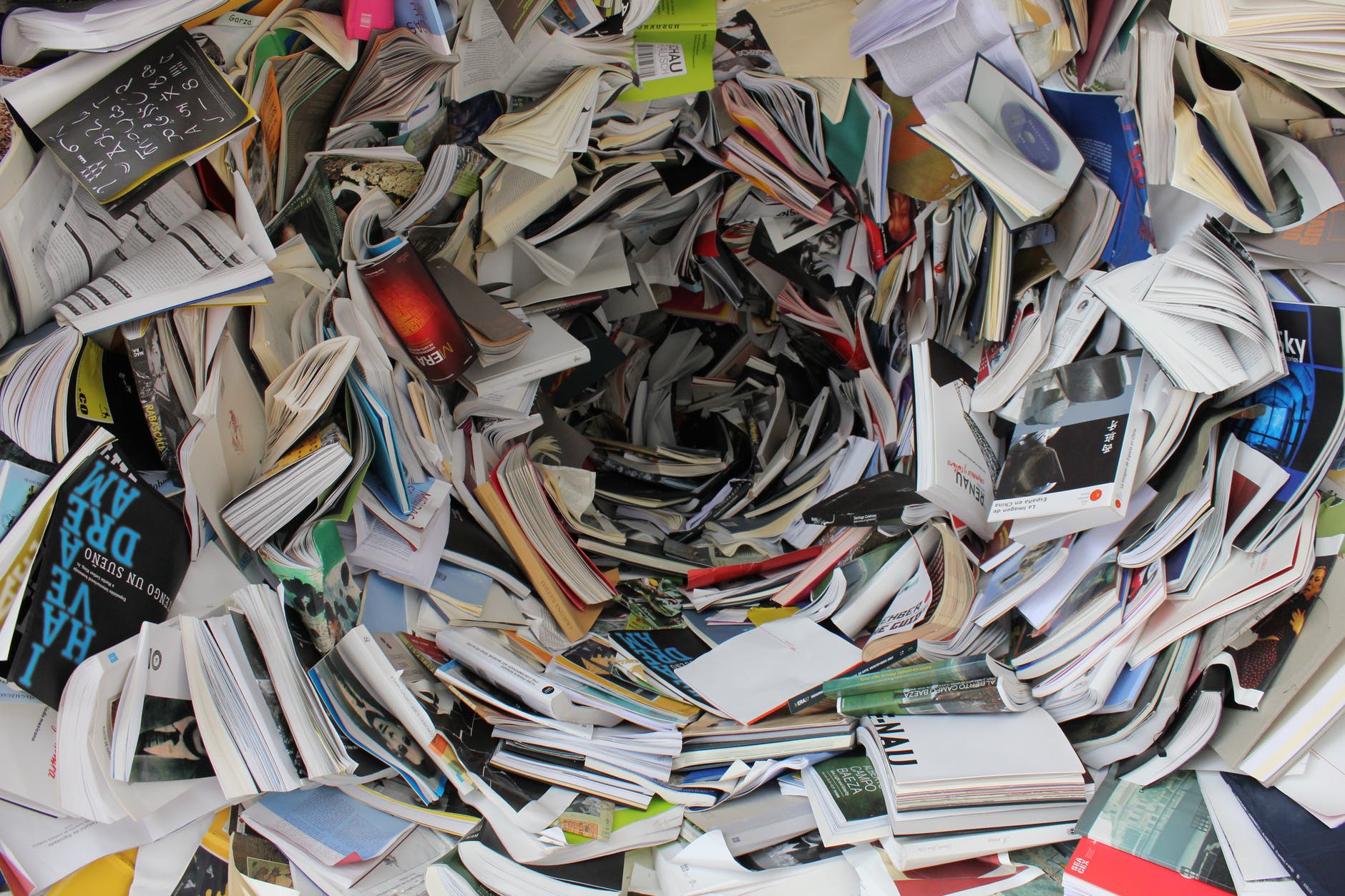
This is the stage when I’m writing a mystery that if you visited my office, you’d gasp in horror. I’m usually very organized, but at this stage, my desk is a mess.

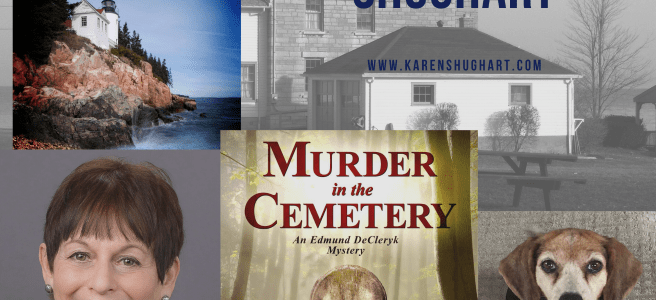
On the right are the first two books in my Edmund DeCleryk Cozy series, Murder in the Museum and Murder in the Cemetery. I use them as a reference for book three, Murder at Freedom Hill, because there are recurring characters: a newborn baby in the last book can’t be in elementary school two years later.

A thesaurus, usually on a shelf, claims space on my left. I’m forever scrambling to find synonyms for words I tend to overuse. It’s a weighty tome but a necessary tool, although the good news is that I recently had an aha! moment when I realized that with a couple of keystrokes and the click of the mouse, hello Google, goodbye Roget’s.  How easy is that?

That thesaurus, by the way, was published in 1962. My Webster’s dictionary in 1982. If you think that dates me, it does, think about how many words there are now that none of us who were alive 50 years ago could have imagined: truthiness; snowflake (not the one that falls from the sky); bestie; twerk. Not that I’d ever include those words in my books, none of my main characters is young enough to use them. Wait a minute, did I say 50 years? Has it really taken me that long to follow my bliss?

Photo by Pixabay on Pexels.com

But I digress.  Piles of paper surround me: bills I’ve received from vendors who still, after all these years, won’t send them electronically but that I, a modern woman, have  paid online; recipes I printed from The New York Times when I could have simply opened my phone or computer when preparing them; print-outs of outdated passwords; a receipt for our dog’s latest checkup; a flyer from the local carwash announcing its wash and wax specials.

I don’t like wasting paper. “Waste not, want not” –phrase origin 1576 or 1772 — depending on your source, is my motto. I write notes to myself on the blank sides to advance the story line, a timeline I never follow, names of new characters to remember, thoughts and ideas that come to me at 3 a.m., questions I have about historical details that are always part of the backstory and the reason for the murder.

There’s a system here, a method to my madness, and it works for me. Once I make sure my historical facts are mostly correct, change the timeline yet again, check for inconsistencies, discard ideas I had at 3 a.m. — what was I thinking — I cross the items off the list, rip the paper into shreds, and toss it into the recycling bin. Then the cycle begins again. Until I reach the point when the manuscript is sent off to my publisher, my desk will remain a mess.