Guest Blogger ~ M. E. Proctor

Making a Scene

By M.E. Proctor

One of the questions most frequently asked to a writer (on par with where do you get your ideas?) is if they know the entire story from the get go or if they figure it out on the fly—the planners versus the improvisers conversation.

I’m a hybrid. I put together a rough outline and then inevitably veer away from it as I start writing. This happens because I love to work individual scenes. What happens here and now tends to take my attention away from the high level perspective of the complete narrative.

Here’s an example from the new Declan Shaw detective novel, The Way You Say My Name.

In Chapter 4, Declan meets Sam, the local vet. He waits for her in her small office, intending to ask her about an incident with a dog. It’s a critical scene that will set in motion a succession of dramatic events. Declan is attracted to Sam and her reaction is ambiguous. She could put a firm end to his flirting attempts but she doesn’t, leaving him wondering why she’s aloof and what she isn’t telling him.

I must have imagined, pictured, and acted this scene over a dozen times in my head. I moved my actors around and changed their lines of dialogue endlessly until the interaction sounded and felt right. I didn’t sit at the keyboard to write until I was sure I’d nailed it down. This is how I built the book, scene after scene. In editing, with the full story laid out, I reworked parts to smoothen the flow.

I’m a ‘visual’ writer. I need to see the scene to be able to write it. And I need to hear it too. A storyboard with speech bubbles won’t do the trick. Like the movies, maybe closer to stage work. Two characters, face to face. They react to each other, there’s tension, and the story happens.

Here’s a small part of that scene, can you picture it?

“Please take a seat. You’re a detective who wants to talk to me about an injured dog, what’s the catch?”

“Senator Spencer hired me to find his daughter, Amanda. Have you heard about the incident?”

“Vaguely. There was a search and it was called off? Senator Spencer is the closest we have to a celebrity around here.” She sat on the corner of the desk, denim-clad legs swinging. “What does it have to do with the dog?”

They were very close. There was barely any room. If she tipped forward, she would drop in his lap. Declan hoped she would tip and drop, so he could catch her. The office door was open, which alleviated the claustrophobic feeling. Sam Chandler smelled of soap and something medicinal, like a freshly opened jar of multivitamins. It should have put Declan’s thoughts on an antiseptic track, and it did the exact opposite. He pictured her scratching the reception cat under the chin, and his head tilted back in an unconscious reflex. She sat higher than he did, and he had to look up to her, so his neck stretch wasn’t completely ridiculous.

I rolled these lines in my head so many times, I could swear I was in the room with them. The scene is told from Declan’s perspective, but I’m Sam’s head too.

So I am more a plotter than an improviser after all. I’m a compulsive nitpicker who needs to have every detail just so. The kicker is that I do it at the scene level, not knowing in Chapter 4 how it will go to hell in Chapter 6. Not until I get there. I have the general direction: Sam is in serious trouble and Declan will be dragged into it, they’ll be running from people who wish them harm, there will be a painful climax and illusions will be shattered …

But the scenes, ah, the scenes! They take shape in my mind one by one, and I ruminate over them, night after night. The guy holding the clapperboard shouts: Scene 25, Take 6 … 7 … 8 … 32 … until I get it just right.
Isn’t it wonderful that writers have no budget to worry about, and no unionized crew members who need breaks to eat and sleep?

The Way You Say My Name
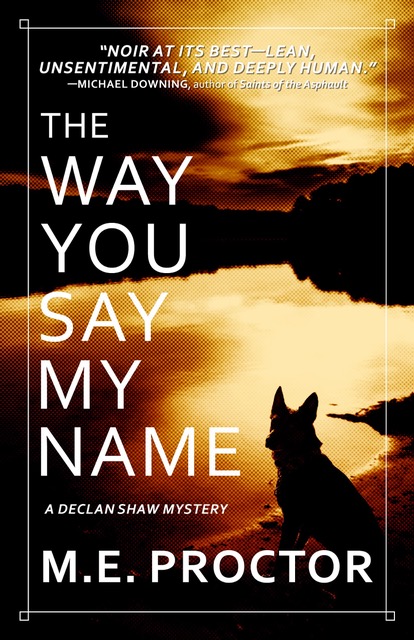
A Declan Shaw Mystery

A short blurb …
On New Year’s day, P.I. Declan Shaw is hired to investigate a disappearance. Amanda Spencer, a young mother of two, slipped away from a Christmas concert without leaving a clue. What made her run and who is she running from?

While digging up shreds of info from Amanda’s parents and friends, Declan meets Sam Chandler. She’s the kind of woman who stops him in his tracks. Sexy, smart, and complicated. And skilled at keeping secrets. So skilled Declan questions his abilities as a detective. What began as an intriguing missing person case soon shifts into a cross-country pursuit with Sam’s life in the balance.

For once, Declan isn’t the searcher, he’s the one who cannot afford to be found.

“This time Proctor does something remarkable. She pulls back the curtain on Declan Shaw’s past, revealing the trauma that helped shape the man readers have come to know. This is a version of Declan that feels unexpectedly vulnerable, stripping away any illusion of invincibility and replacing it with something infinitely more compelling. His evolution across this series is exceptional, and understanding his history makes his compassion, restraint, and fierce loyalty all the more meaningful. Proctor doesn’t simply give readers another mystery to solve. She gives them a character worth investing in, a man whose imperfections make him impossible not to champion.”

—Teresa Brock for Best Thriller Books

Buy Links:

The Way You say My Name is available in eBook and paperback.

All formats on Shotgun Honey website.

M.E. Proctor was born in Brussels and lives in Texas. She’s the author of the Declan Shaw detective mysteries: Love You Till Tuesday, Catch Me on a Blue Day, The Way You Say My Name. She’s the author of two short story collections, Family and Other Ailments and A Book to Live By, and the co-author of the retro-noirs, Bop City Swing and Kansas City Breakdown. Her fiction has appeared in various magazines and anthologies. She’s a Shamus and Derringer awards short story nominee. Catch Me on a Blue Day was recently nominated for a Shamus Award in the Best Original Paperback P.I. Novel category.

Social Links

Author Website: www.shawmystery.com

On Substack: https://meproctor.substack.com

Facebook: https://www.facebook.com/martine.proctor

Twitter: https://twitter.com/MEProctor3

BlueSky: https://bsky.app/profile/meproctor.bsky.social

Instagram: https://www.instagram.com/proctormartine/
Guest Blogger ~ M.E. Proctor

The Detective Comes Calling

When I start working on a short story I never know much about the characters. I might have a place in mind—a bar on a beach, a path in the forest, an iced-over parking lot—or a line of text I woke up with, like this one that I used recently, curious to see where it would take me: Innocence doesn’t do it for me. Spoiler alert: somebody dies.

Most of my pieces unspool that way. Characters walk on stage, I get to know them, and things happen. Or nothing happens and the story goes asleep on my laptop, for a while or forever. That loose process works well for me, for short fiction.

A book is a very different animal.

If you write yourself in a corner in a short story the damage is minimal. You can shelve the draft, revisit it later and either find a solution or scrap it entirely. It’s disappointing but at worst you’ve only lost a few weeks. On the other hand, if you’re fifty thousand words into a book and hit a wall or run out of juice, it really hurts. The investment in time and the emotional commitment are substantial. Of course you can try to rescue the project. As Chandler said: In doubt, send in a guy with a gun. Sometimes it works, other times … Raise your hand if like me you’ve read books that feel like they’re limping to the finish line.

The pitfalls of winging it were very much in the back of my mind when I decided to sink my teeth into a crime novel. The problem is that I’m not a plotter. Detailing every beat of a story before sitting down to write it feels too much like a straitjacket. It sucks all the fun out of the project. Why bother to write it if I know everything, no surprises, from the get go? Still, I wanted to be better organized than usual. Start with an idea and develop a rough outline that could go the distance.

It was an excellent resolution.

It didn’t happen.

Because Declan Shaw threw me for a spin.

I was on the back porch, engaged in the creative exercise known as woolgathering, when a name popped into my head. Out of nowhere. Insistent. I’d never written anything, book or short story, that used the name of a character as a prompt. I was intrigued. Who the hell was this guy pitching a tent in my subconscious?

Names aren’t neutral. In life, we’re passive recipients—a gift from our parents. In fiction, the writers are in control. They can play with the mental images a name creates (Dickens mastered it). What does the name suggest about the character’s past, family, or cultural background? Smith evokes 1984 or The Matrix, Cadogan-Smith comes with horses and country estates, Smith-Underfoot might be a familyliving in Hobbiton.

Declan Shaw. What does it bring to mind? Irish heritage. He probably drinks whiskey and can tell a tale. Yes, I know, it’s a cliché. But seriously, with a name like that, what does he do for a living? I love antiheroes but I didn’t feel like spending an entire book with a hitman, Ken Follett did it so well in The Day of the Jackal, and, more recently, Rob Hart in Assassins Anonymous. So what? Reporter. I could see the byline, front page, above the fold. Then an insidious voice in my head whispered: Can you build a series around a journalist, how many cases can he cover, without stretching credibility? A series? The inner voice had to be kidding, there was no book #1 yet. It was ludicrous. But, but … I could smell the possibilities.

And that‘s how, right there, on my porch, Declan Shaw became a private detective.

The first scene I wrote had nothing to do with investigating. I pictured him as an eleven-year-old boy, standing at the bottom of a flight of stairs, looking up at his intimidating grandmother. She was a black-clad villain straight out of a comic book. I imagined the events that brought the kid to her place and the disastrous consequences that ensued. Readers won’t find any of that in Love You Till Tuesday, the first book in the series. Declan’s back story is in my back pocket and won’t come out until the time is right.

I forgot my resolution to outline and gave myself permission to improvise. The plan was to learn who my character was by writing him. It took a lot longer than I expected, three years, three manuscripts, a thousand pages, multiple false starts. None of that work made it into the book, but the effort was worth it. I knew Declan inside out. We were both ready to tackle Love You Till Tuesday. In some sort of orderly fashion.

My plot document looked like the output from a chaotic brainstorming session, a jumble of character sketches, a rough timeline, cryptic notes, dead ends and side stories. It was an unstructured and messy pseudo synopsis, with plenty of freedom between the lines to change almost everything. As I typed away, things changed indeed, and changed again after input from editors and beta readers, cuts and tightening up, but the original bones of the story remained. Until finally Declan Shaw made his official debut with his cigarillos, his cowboy boots, his good and flawed impulses, and his ironic take on the world. He’s good company. I’m keeping him.

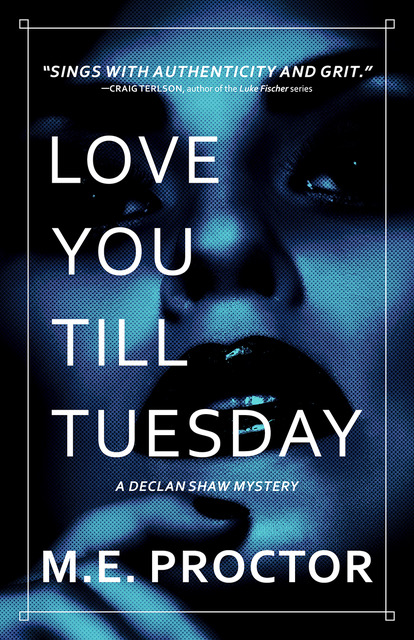
Love You Till Tuesday – A Declan Shaw Mystery

The murder of jazz singer April Easton makes no sense, and yet she appears to have been targeted. Who ordered the hit and why? Steve Robledo, the Houston cop in charge of the investigation, has nothing to work with. Local P.I. Declan Shaw who spent the night with April has little to contribute. He’d just met her and she was asleep when he left.

The case seems doomed to remain unsolved, forever open, and quickly erased from the headlines. And it would be if Declan’s accidental connection with the murder didn’t have unexpected consequences.

The men responsible for April’s death are worried. Declan is known to be stubborn and resourceful. He must be watched. He might have to be stopped. He’s a risk the killers cannot afford. The stakes are high: a major trial with the death penalty written all over it.

Buy Links:

Love You Till Tuesday is available in eBook and paperback.

Barnes & Noble, Bookshop.org, and Amazon at https://www.amazon.com/Love-You-Till-Tuesday-Proctor/dp/1956957707

From reviews:

If you think the crime fiction market has enough PIs, think again. Declan Shaw is the kind of PI this genre has been waiting for. Declan is a well-developed, complex and nuanced character, wrestling with his own internal conflicts as he investigates the murder of April Easton. Sharp, witty dialogue and a fast-pace make Love You Till Tuesday an engaging read—one of those books you can’t put down and keep reading late into the night. It is a fun, intense read from beginning to end and M.E. Proctor displays her incredible talent at creating a well-written and beautifully crafted book.

M.E. Proctor was born in Brussels and lives in Texas. The first book in her Declan Shaw PI series, Love You Till Tuesday, is out from Shotgun Honey with a follow up scheduled for 2025. She’s the author of a short story collection, Family and Other Ailments. Her fiction has appeared in various crime anthologies and magazines like Vautrin, Bristol Noir, Mystery Tribune, Shotgun Honey, Reckon Review, and Black Cat Weekly.

Social Links

Author Website: www.shawmystery.com

On Substack: https://meproctor.substack.com

Facebook: https://www.facebook.com/martine.proctor

Twitter: https://twitter.com/MEProctor3 BlueSky: https://bsky.app/profile/meproctor.bsky.social