
Mystery and Mysticism by Paty Jager

paty shadow (1)My brother is an artist who creates his own bronze statues and patinas bronze work for other artists. When he told me about a specific piece he’d put the patina on and how it had a unique configuration, he had my attention. His words, “This would make a great murder weapon.”

That sentence stayed with me for several years.

And finally, when I decided to write a murder mystery series, I jumped at the idea of using a 300 lb bronze statue as the weapon. Only I had to come up with a plausible amateur sleuth and give her a profession. That is how Shandra Higheagle, a potter who is half Nez Perce Indian, came to be. I wanted her to have the Native American background to keep with my tag line, “Murder mystery and steamy western romance starring cowboys and Indians.”  And I wanted her to use her heritage to help solve the murders. That is where her Nez Perce grandmother came onto the scene.

Shandra’s Nez Perce father was a rodeo bronc rider who died in a rodeo accident when she was four. Her Caucasian mother and step-father kept her from her father’s family until Shandra rebelled as a teenager and spent a summer with her grandmother.  While Shandra still wasn’t allowed to let people know of her Indian heritage, she kept in touch with her grandmother. The first book opens with Shandra returning from her grandmother’s funeral and seven drum ceremony.

Where is this all going you ask?  When Shandra is suspected of killing a gallery owner and then the county sheriff’s detective turns his interest to her best friend, Shandra’s grandmother comes to Shandra in her dreams, guiding her to the evidence that will help them find the murderer.

Shandra has a hard time believing in these dreams, yet the detective believes. Her dreams cause her conflict with herself and allows her to let someone in after years of keeping herself closed off.

One of the most difficult and rewarding parts of writing these books is to come up with dreams for Shandra to have that reflect what is going on with the mystery without giving anything away.

The first three books of the Shandra Higheagle Mystery series are now in an ebook box set.

Here are the shortened blurbs for the first three books in the Shandra Higheagle Mystery Series.

higheagle-1-3-box-2700px

Double Duplicity

Potter Shandra Higheagle’s Nez Perce grandmother visits her dreams, revealing clues that help Shandra uncover not only one murder but two.

Tarnished Remains

Digging up Crazy Lil’s past takes Shandra Higheagle down a road of greed, miscommunication, and deceit.

Deadly Aim

The dead body of an illicit neighbor and an old necklace sends potter Shandra Higheagle on a chase to find a murderer.

Windtree Press / Amazon / Nook / Apple / Kobo

Paty Jager is an award-winning author of 25+ novels and over a dozen novellas and short stories of murder mystery, western historical romance, and action adventure. She has a RomCon Reader’s Choice Award for her Action Adventure and received the EPPIE Award for Best Contemporary Romance. Her first mystery was a finalist in the Chanticleer Mayhem and Mystery Award and is a finalist in the RONE Award Mystery category.  This is what Mysteries Etc says about her Shandra Higheagle mystery series: “Mystery, romance, small town, and Native American heritage combine to make a compelling read.”

blog / websiteFacebook / Paty’s Posse / Goodreads / Twitter / Pinterest

patyjager logo

What do Jessica Fletcher, Shania Twain, and Sarah Winnemucca have in common? by #Paty Jager

canstockphoto26040640I was asked this question for a blog interview I did: Describe your protagonist as a mash-up of three famous people or characters.

These are the people/characters I picked and the reasoning behind choosing them.

The first is a character: Jessica Fletcher of the TV series Murder She Wrote. Jessica is always finding herself in the middle of murders and so is Shandra Higheagle my protagonist in the Shandra Higheagle Mystery series. They are both amateur sleuths and they both have creative minds. Shandra is a potter who sells her sought-after vases as art pieces.

DanPost_DP3544_15The second person is real: Shania Twain, the country singer. Her artistic nature and panache reminds me of Shandra. My character buys a new pair of fancy cowgirl boots every time she sells a vase. She likes the flashy, fancy ones with embroidery and cut-outs. And while she dresses with flair and adds special touches to her vases, she loves to ride her horse, snuggle with her dog, and dig in the clay that she uses for her art.
The third person is also real and a part of history: Sarah Winnemucca, a Paiute woman who was an activist and educator from 1844-1891. Shandra has been kept from her father’s Nez Perce family while growing up. Now that is an adult, she is exploring her heritage. The more she travels to the reservation to get to know her family, she is determined to help her people and family through her art and educate the masses. I have a post here about some other fascinating Paiute women.

When this question was first put to me, I had to think about it a bit. But once I started connecting the people with my character it became clear who she was and how she related to each of these women I picked.

I’m currently working on the 6th book in the Shandra Higheagle series, Reservation Revenge. This book is all set on the Colville Indian Reservation. The home of the Chief Joseph band of Nez Perce and 11 other tribes. It has been a learning experience writing this book. Both culturally and as I try to make it twist and turn.

If you want to learn more about Shandra Higheagle you can go here.

You can get the first book of the series for free:

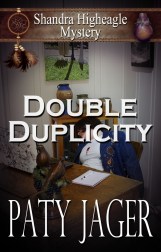
Double Duplicity (652x1024)Book one of the Shandra Higheagle Native American Mystery Series


Dreams…Visions…Murder
On the eve of the biggest art event at Huckleberry Mountain Resort, potter Shandra Higheagle finds herself in the middle of a murder investigation. She’s ruled out as a suspect, but now it’s up to her to prove the friend she witnessed fleeing the scene was just as innocent.

With help from her recently deceased Nez Perce grandmother, Shandra becomes more confused than ever but just as determined to discover the truth. While Shandra is hesitant to trust her dreams, Detective Ryan Greer believes in them and believes in her.
Can the pair uncover enough clues for Ryan to make an arrest before one of them becomes the next victim?

BUY LINKS

Amazon / Kobo / Nook / Apple / Windtree Press

Paty Jager is an award-winning author of 25+ novels and over a dozen novellas and short stories of murder mystery, western historical romance, and action adventure. She has a RomCon Reader’s Choice Award for her Action Adventure and received the EPPIE Award for Best Contemporary Romance. Her first mystery was a finalist in the Chanticleer Mayhem and Mystery Award and is a finalist in the RONE Award Mystery category. This is what Mysteries Etc says about her Shandra Higheagle mystery series: “Mystery, romance, small town, and Native American heritage combine to make a compelling read.”

All her work has Western or Native American elements in them along with hints of humor and engaging characters. Paty and her husband raise alfalfa hay in rural eastern Oregon. Riding horses and battling rattlesnakes, she not only writes the western lifestyle, she lives it.

blog / websiteFacebook / Paty’s Posse / Goodreads / Twitter

patyjager logo


 photo source: © Can Stock Photo Inc. / dizanna

Inside the modern jail

By Sally Carpenter

This post first appeared some time ago on Writers Who Kill. The information is good for any writer who sets a story inside a modern jail. The picture of jails as long rows of cells with men clanging cups against iron bars just isn’t true nowadays. This description is from the 1980s but I’m sure it’s still relevant. Jails are moving away from “cells” to “pods.” Read on

If you write crime novels, you might set a scene inside a jail. Do you know what a modern jail looks like or how it functions?

Jails are intended for short-term housing of up to one year only. Prisons are constructed for long-term housing of many years so they are larger and have more amenities. Juveniles are housed in other facilities designed for that population.

For about eight months in the mid 1990s while I was finishing my seminary studies, I was the jail chaplain intern at the DuPage County Jail in Wheaton, Ill. At the time the jail had just finished constructing new cells with better security that allowed women civilians on the floors.

The new cells were in a tower. The basement level housed the solitary confinement cells and the upper floors had the male general population (I’ll discuss the female inmates later). The top floor was for illegal immigrants.

Security cameras monitored the hallways and the elevators. A person approaching the elevator had to wait for the deputy watching on the camera to open the door by remote control.

On each floor the cells were arranged in “pods,” now the industry standard for new jails. A few years ago I visited the Ventura County (Calif.) Main Jail as part of a Citizens’ Academy program and that facility also used “pods.” This format provides deputies greater visibility and control over the inmates.

The center of the pod was the control room encased in bulletproof glass. A deputy sat inside and watched the inmates at all times. While on duty deputies were not allowed to do anything that would distract them such as reading or watching TV (nowadays I assume that prohibition includes texting and using a cellphone).

The cells, also made of glass, were in a row racing the pod center. Each cell had a bed, sink, toilet and shower for one man. The inmates used the toilet in full view and the small shower doors provided only a minimal amount of privacy. The deputy could see every action of each inmate. A speaker system allowed the deputy to listen in as well.

Inside the pod center was a panel where the deputy could open and close the cell doors. The deputy controlled access at all times. If a fight broke out, the deputy inside the control room would remain safe as he or she summoned help.

The cells opened into a recreation room that housed a TV high on the wall as well as tables and benches that were permanently bolted to the floor. During the daytime inmates, who were not confined to their cells, could go into the rec room if they choose. The deputy watched the activity inside this room as well. At night all inmates were “locked” inside their individual cells.

The only “windows” were small glassed-in slits just under the ceilings that let in a tiny amount of sunlight. The inmates couldn’t see anything outside the building.

A glass-walled meeting room, with a table and benches, was attached to the rec room. Again, the deputy controlled access to and from this room. Once a week I came to the room to lead a Bible study for the inmates. The deputy could see inside this room although I never had any trouble from the inmates. Some inmates came to the group just to break the daily monotony but most were genuinely interested in bettering themselves.

The inmates never left the floor except to go to court or as a group to the gym (the men lined up and moved through the hallway in a line with several deputies escorting them).

Meals were prepared in the kitchen, placed in individual covered trays, and then delivered to the floors on a wheeled cart. The inmates ate in the rec room or their cells. After eating the dishes were collected and returned to the kitchen for washing.

Inmates called trustees did meal preparation and cleaning. Doing trustee work gave the men points to reduce their sentences. Many of the trustees enjoyed the job as they could get out of their cells, move around, and perform a useful task.

The deputies did not carry weapons. My supervisor suggested that I not carry my purse into the jail, so I locked my handbag in the trunk of my car. I was also told to never bring anything from the outside to give to an inmate, and never take anything from them.

A deputy told me that most of the men were in jail for one of two reasons: drugs or lack of education. The jail had a small library where the inmates could not only do legal research but also work on GED classes.

The female population was far smaller and was housed on two floors in the older section of the jail that did not have “pods.” These were the traditional-type dorm cells with bunk beds. The cell doors had steel bars, not glass. The interesting thing about the women is that they complained about their living conditions far more than the men did.

One thing I learned from this experience is how much we take our freedoms and privacy for granted. At the end of the workday I could leave the jail and drive home. The inmates didn’t have that luxury.

The chaplain program was run by the nonprofit organization JUST (justice, understanding, service, teaching) of DuPage that provided free Bibles and Qur’ans for inmates as well as worship services and educational programs. For more information, visit www.justofdupage.org.


Guest Blogger -D.J. Williams

I sat across from Michael Connelly’s agent and wondered how I ended up there. To say that Connelly was an influence in my pursuit to be a storyteller would be an understatement. Along with Grisham and Patterson, he is in the top three of my favorite authors. Connelly’s agent had read my first novel, The Disillusioned, or at least enough of it to request a meeting. I listened as he shared how they had built Connelly’s career culminating with finalizing the Amazon deal for Bosch. I shared with him a story idea that had been resonating for a few years and knew from his response that I had something unique.
When I left his office I knew that The Disillusioned was only the first novel in the Guardian series. But what was next? As I thought about my story idea and my conversation with Connelly’s agent, I had a moment of inspiration. To move the series ahead, a story from the 1920’s would become an underlying mystery revealed throughout the series. It wasn’t enough on it’s own. The challenge was to bridge the gap between these two eras. Eight months later I had a first draft of Waking Lazarus, an epic global adventure filled with riveting characters and page turning twists and turns. While I had written a first draft of Waking Lazarus in less than a year, it took months of rewriting and editing to cross the finish line.
I write in this genre because I love mysteries filled with suspense. I love the rush of diving into a scene and seeing what happens next. And I love writing stories that go beyond entertainment. As you’ll find in the first two novels of the Guardian series there are key themes of light versus darkness, religion versus faith, and power versus innocence that drives the characters forward. You’ll also find that there are strong female characters and colorful settings throughout to keep readers on edge.
One month ago, Waking Lazarus was released worldwide. Once again I’ve been humbled to capture the attention of industry veterans including Peter Anderson, Oscar Winner/Cinematographer, who has endorsed this latest adventure, “Waking Lazarus is a captivating visual story with a colorful narrative. Once I started reading, it was hard to put down.”
I will always remember those few hours being taught a master class in how to build a series that could potentially go the distance. Thank you Michael Connelly’s agent for imparting your words of wisdom!
Lazarus
Waking Lazarus
by D.J. Williams
Jake Harris’ life hasn’t turned out the way he planned. Battling his addictions, and the shattered pieces of his family, he is hired to ghostwrite a memoir. From the 1920’s story of a controversial evangelist, to the present day mystery of a former District Attorney, everything changes when his search for the truth leads to an atrocity hidden from history. With a past he can’t remember, he begins to discover that he is not the person he believed himself to be. Rather, he is a threat to a secret society that has remained in the shadows for nearly a century. Jake is drawn deep inside a world he never knew existed that brings him closer to his own extraordinary destiny.
 

guardiancomboad

Guest Blogger – Susan Breen

Sometimes You Have to Jump

I wouldn’t consider myself a bold person. I slow down at yellow lights. Occasionally at green ones. I look both ways, twice. So I startled myself when I decided the protagonist of my first mystery would be a Sunday School teacher.

This was not at all the safe choice.

Sunday School teachers are not generally considered exciting. In movies they are the ones with buttoned-up shirts. They’re no fun. They quote scripture and sing hymns. At best, they’re considered prudish, at worst fanatics. Why would you want to spend 300 pages with one?

I thought about that a lot. I also worried there would be people who would simply not want to go near a book with a Sunday School teacher as a protagonist. Would I be considered one of those raving people who launch themselves at you at street corners? (I like to sit and write in Bryant Park in Manhattan and quite often people come up and try to convert me to one thing or another.)

However, beyond the fact of being fairly stubborn and wanting to write about what I wanted to write, there were several compelling reasons why I thought a Sunday School teacher would make an interesting detective.

Sunday School teachers, and people of faith in general, see the world as organized by a set of rules. There is a reason why things happen. So when things go wrong, when people are murdered, when your neighbor shows up dead on your front lawn, it’s all the more disturbing. Not only does it upset the protagonist, it upsets the natural order of things. In this case, Maggie Dove is forced to confront what she believes. It raises the stakes.

So that was one reason.

The other reason was that it would bring Maggie Dove into contact with people of all different ages. Maggie Dove is 62 years old (that was my other bold choice.) But as a Sunday School teacher she comes into contact with young people, such as her favorite student, 6-year-old Edgar Blake, and older people, such as his 39-year-old mother. And then, of course, Maggie’s not confined to the world of the church. She’s active in her village and comes into contact with a variety of people. I like stories about communities.

Then there’s the fact that I have spent about 300 years teaching Sunday School. I know the ins and outs. I know that if you decide to cook pretzels with your students, for example, you may set off the alarm in the kitchen. which will require the entire church to evacuate during the minister’s sermon. I felt I could flesh the novel out with that sort of detail. It’s a world that I know, and a world that I love.

So, am I happy with my choice?

Absolutely! And for my next novel, my protagonist is going to be a vampire. (Not.)

Maggie Dove coverSusan Breen introduces a charming new series heroine in this poignant and absorbing cozy mystery with a bite. Maggie Dove thinks everyone in her small Westchester County community knows everyone else’s secrets. Then murder comes to town.

When Sunday School teacher Maggie Dove finds her hateful next-door neighbor Marcus Bender lying dead under her beloved oak tree—the one he demanded she cut down—she figures the man dropped dead of a mean heart. But Marcus was murdered, and the prime suspect is a young man Maggie loves like a son. Peter Nelson was the worst of Maggie’s Sunday School students; he was also her late daughter’s fiancé, and he’s been a devoted friend to Maggie in the years since her daughter’s death.

Maggie can’t lose Peter, too. So she sets out to find the real murderer. To do that, she must move past the grief that has immobilized her all these years. She must probe the hidden corners of her little village on the Hudson River. And, when another death strikes even closer to home, Maggie must find the courage to defend the people and the town she loves—even if it kills her.

Buy links:
Bio:
Susan Breen’s first mystery, Maggie Dove, was just published by a digital imprint of Penguin Random House. The sequel, Maggie Dove’s Detective Agency, will be published on October. 18, 2016. Susan’s short stories and essays have been published by a number of magazines, among them Ellery Queen Mystery Magazine, American Literary Review and anderbo.com. Susan teaches creative writing at Gotham Writers in Manhattan. She’s also on the faculty of the New York Pitch Conference and New York Writers Workshop. She lives in a small village in the Hudson Valley with her husband, two dogs (cockapoos) and a cat. Her three grown children are flourishing elsewhere.


Social media links: