
Hobbies and Homicide

by Janis Patterson

Hobbies (and crafts, though for brevity’s sake I will use ‘hobbies’ to cover both) serve several but very disparate purposes in cozy fiction, all in a kind of situational shorthand.

Although a surface read of the cozy genre seems to indicate that the protagonist/sleuth’s hobby is solving murders, there is more to the inclusion of a sleuth’s avocation. Often having a hobby gives the sleuth a sort of ‘leg-up’ on the modus operandi and eventual solution of the crime that the police do not necessarily have.

For example, a hobbyist needleworker might notice that the knots tying the victim are unique to a certain form of embroidery… or the same could be said of a model ship builder who sees the esoteric knots as being nautical.

A baker or cook or even a nurse or pharmacist might notice certain ingredients laid out that have no place in the recipe the decedent was baking at the time of death… or notice the distinctive scent of an obscure ingredient in a finished product that, combined with another ingredient, could cause an allergic reaction in some people, which of course the victim is one.

A hobbyist jeweler might notice that the garotte was made of a rare form of tiger tail (a coated wire often used in stringing heavy necklaces) instead of the common guitar string the police mistakenly believe it to be.

The use of this special, hobby-related know-how is a quick and believable way of giving the amateur sleuth a depth and breadth of knowledge that would be cumbersome and difficult to explain otherwise. However, this is a trope which can be easily overused. I mean, wouldn’t you quickly tire of mysteries where the same sleuth is always an expert regarding the widely varying ways and means of the way a murder was committed? Or that multiple murders by multiple murderers are serendipitously committed using the same unusual means?

To continue the above examples, it is unacceptable that bakers/cooks can solve only baking/cooking related mysteries or needleworkers needlework mysteries or… you get the idea. To say the least such narrow specialization would be pretty much unbelievable for an amateur sleuth cozy mystery, as well as totally destroying the idea of a series featuring the same sleuth. How many people can you believably expect to be murdered using needlework techniques? Excepting, of course, an obsessed serial killer, which is a totally different genre and therefore is another topic of discussion altogether.

Back to specialization. If there is a series where the sleuth has a useful and universal-ish hobby, as the more general the hobby the more believable multiple solutions become. For example, if the sleuth is an expert in 15th century Swabian poetry, how many mysteries can logically (or even semi-logically) be created to fit in such a narrow framework? On the other hand, a sleuth whose hobby is making ship’s models, the world of potentially solvable crimes expands. There can be mysteries about full size ships, doll house miniatures, history of both (and more)… all of which are basically related and could be easily lumped into one general hobby-related knowledge base.

Aside from the story uses of hobbies, avocational pastimes are wonderful as character revealers. When creating a character writers have to be careful to make each one an individual, a person you should be able to recognize if you met them on the street. Nothing can kill a book (no pun intended) faster than a cast of characters with all the depth and believability of paper dolls.

Real people are not so easy to pigeonhole. That sweet gentle man down the street whose garden is a dream was also a bad-ass Army Ranger in his youth. The doting mama who makes glorious ceramics in her garage kiln used to sing grand opera in Europe. That cherubic young man who builds model airplanes and helps elderly neighbors carry their groceries inside also sets fires for amusement. Humans are not single-note creatures, and neither should our characters be. Hobbies – even those which do not help solve the mystery – are a useful tool in creating believable characters.

And not just sleuths/protagonists/sympathetic characters. Remember, villains need to be well-rounded people too, perhaps even more than heroes. The mustache-twirling villain who does evil for the pure sake of doing evil belongs in bad cartoons, not in cozy mystery fiction. Sleuth, victim or villain, everyone is the hero of their own story. Although it might make no sense to us that the villain cultivates a lovely garden of poisonous plants so he can wipe out those who want to make a parking lot where a field of wildflowers bloom, we have to be able to see why he believes his actions are necessary. Even though we don’t believe in what he is doing we have to be able to see why he is doing it in order for our sleuth to obtain enough proof to solve the case.

Just remember that the hobby-related clues – like all clues – should not be obvious from the first. If a victim is killed by a salad containing some of the nightshade grown by the grumpy old woman down the street and she is the actual poisoner, that is not much of a mystery. On the other hand, if the killer is the sweet grandmotherly lady at the other end of the block who is always baking treats for her neighbors is using the grumpy one’s nightshade to get rid of those whom she doesn’t think are worthy of living in her neighborhood while trying to cast suspicion on her grumpy arch-enemy, that is a mystery. Or perhaps there is a third player, the man who amuses himself by drawing pictures of plants and hopes to get rid of both old ladies so he can buy their houses and….

You see? The possibilities are endless. Just make sure that when you create your characters – both sleuths and villains – that their reasons are valid to them even if not to us, that they are believable and (this is important!) accurate. If your character has a hobby, it doesn’t have to be yours – you just have to know enough about it to get it right. Otherwise those who do know about it will descend on you with righteous criticism and both your book and your sales will suffer for it.

(P.S. – for those of you who are following my republishing blitz, I am happy to report that it is going perfectly according to schedule – a book, freshly edited, freshly edited and as often as not with a new cover – released every other Wednesday since the middle of January! TIMELESS INNOCENTS (#14) released the 5th of July, and THE EARL AND THE BLUESTOCKING (#15) will go live on 19 July. Plus – drum roll here – my second audio book A KILLING AT EL KAB and my third CURSE OF THE EXILE are now available at Amazon and Audible!)

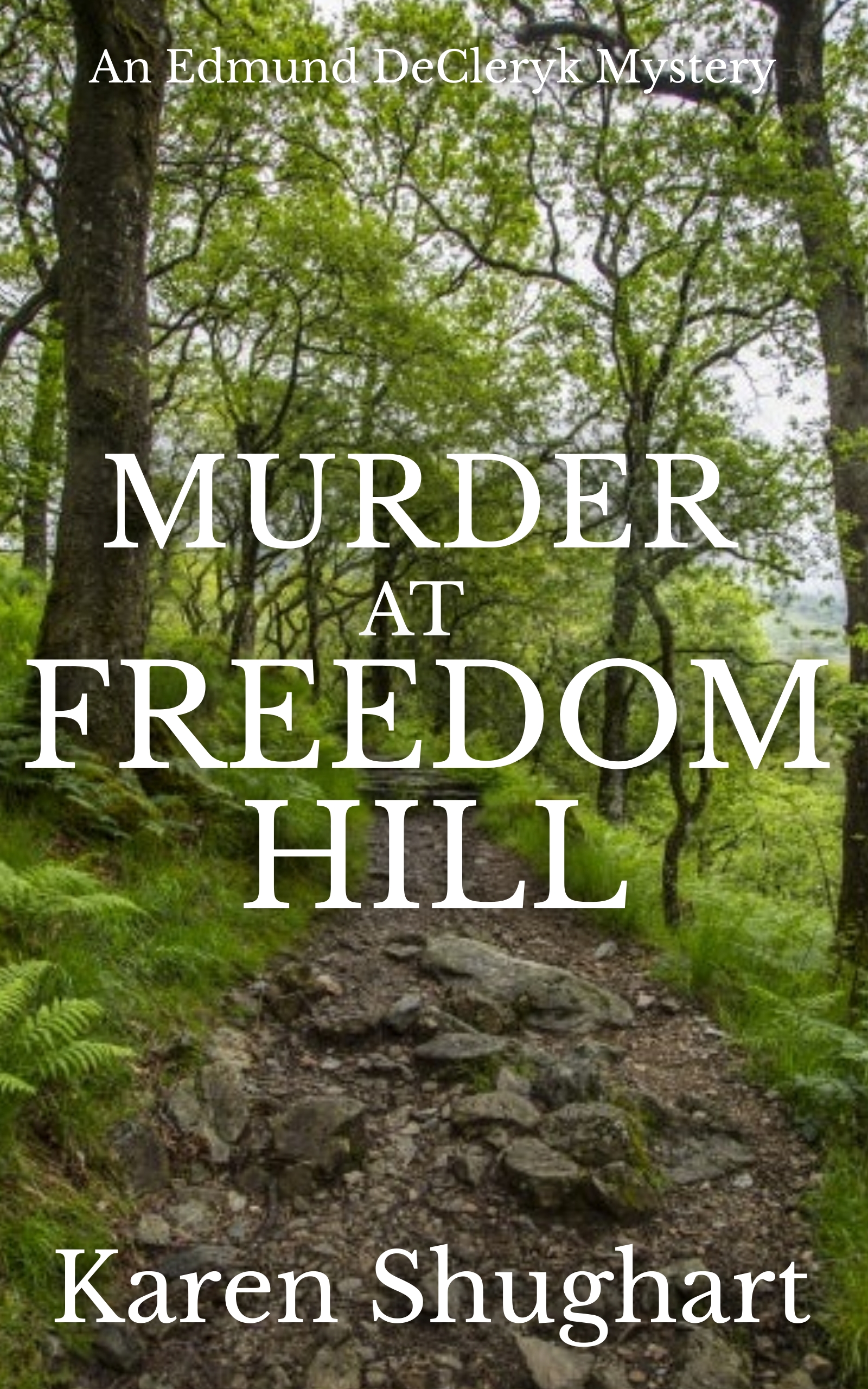
November: A Prologue by Karen Shughart

After my first Edmund DeCleryk Cozy mystery, Murder in the Museum, was published, I decided to play around with the concept of having two prologues for subsequent books and contacted my publisher to see what she thought. She basically told me to ” go for it”, and in book two, Murder in the Cemetery, that’s what I did: the first to set the historical back story that alerts readers to why the murder may have been committed, and the second to describe the seasonal tone for the crime.

In book two I described the month of May in Lighthouse Cove, with its profusion of flowers and abundance of sun, a fitting backdrop to the crime that’s about to occur. In Murder at Freedom Hill, the third book in the series (now on sale in paperback and Kindle versions at Amazon and other book outlets) the second prologue is entitled “November”. I thought it was appropriate for this month’s blog, so here goes:

  For residents of Lighthouse Cove, NY, November was always a month of mixed emotions.  

There was a yearning for the blazing colors of October, the cool, crisp nights, starlit skies, bright days. For a low-hanging sun that could still warm the bones and ease the joints.  For the farm stands, now shuttered until spring, that had offered up a bounty of ripe produce, local honey, homemade baked goods and jams, fresh herbs.  For the hayrides and bonfires and deer spotting among the apple orchards. For the unbridled joy of chattering, costumed children extending small hands for treats as their parents kept a watchful eye; glowing lights illuminating their way.

There was also the peace that comes with tourists gone for another year and the ease of getting about.  The sound of waves, ambling onto the beach like lazy sloths. The geese and swans gliding effortlessly around the bay, no longer competing for space with boats and bathers, and the eagles soaring silently above on currents of wind. The rumbling and grumbling of street noises now muffled by a thick carpet of brown, fallen leaves.

 There was excitement and anticipation, too, in November.  For a day, later in the month, when families would gather to give thanks and then soon after, start to prepare for the hustle and bustle of the upcoming holiday season. For the hunters who had been looking forward all year to donning their camo, retrieving their guns, and stalking their prey in fields and woods, hoping to bestow upon their loved ones a largess befitting of their labors.

For some, November was also the month of grieving. A month of decay that precedes death.  Where what was past was past and would be no more, and what lay ahead was the chill and dark of winter.

On A Writer’s Responsibility…


by Janis Patterson


The other night The Husband and I were out to dinner with some of his friends whom I knew very slightly. The wives were nattering on about something so totally mind-numbing that I was half-way listening to the men. They are all sport rocketry enthusiasts – something I know very little about and personally find watching paint dry much more interesting – and were taking about the various propellants used in rocket engines.


One of them laughed about a particular one and said if they weren’t careful they could make a pretty nifty bomb using XYZ. Perhaps unwisely, I said yes, they could, but it would be foolish, as XYZ was disproportionate in explosive value versus weight/size besides being so basically unstable that it was very dangerous to use in the quantity needed to do any significant damage. Plus, it would need a special detonator that would be very easy for the police to trace.


Startled, they all looked at me as if I had lifted my sweater to reveal a suicide vest. The Husband was quick to enlighten them, saying that I was a novelist and that he had helped me research explosives for a work in progress. Obviously intrigued, they peppered me with questions about various fuels and propellants and their non-rocket related destructive capabilities, then became rather petulant when I refused to answer them as completely as they wished.


I probably could have answered all their questions sufficiently to give them a great deal of destructive knowledge, but even though these were all decent and law-abiding men, I didn’t. Why take the risk if I were wrong? Besides, I never tell everything I know, either in print or in person.
Why? Because I write novels, which should be momentary escapes for ordinary people – not technical manuals. I long ago decided that I should never put anything in a story that someone can use to hurt someone else. The idea, yes, or I wouldn’t have a story. Enough facts to have a feeling of verisimilitude, yes. A blueprint, no. There’s no way I can stop people bent on destruction from seeking out all the information they need about any kind of killing tool – and it is out there if they’re determined – but I don’t have to help them.


For example, years ago at an NRA convention I met a salesman who, on finding I was a mystery novelist, delighted in telling me how to get a ballistically clean and therefore untraceable bullet – i.e., how to kill someone with a bullet that had no rifling, no striations, no markings at all. He seemed so proud of himself and then asked me when I put that in a novel would I mention his name. Horrified, I told him NO most definitely, then begged him not to tell anyone else.


I write about crime. I want to entertain, and entertain only. I don’t want to teach or make it easy for some demented person to eliminate another without leaving clues. Sadly, that made the third way I have found to have a ballistically clean bullet. Those who want to can find the information if they search assiduously enough, but I don’t have to help them.


I believe it is the writer’s responsibility to entertain, and perhaps maybe even teach some (hopefully benign) facts. It is not our responsibility to become an instructor – and therefore, in spirit at least, an accessory.


So – I imitate my betters by using selective censorship and obfuscation. Some of my characters do horrible things, but while readers are given enough facts to know what is happening, none are able to recreate the crime. At least, not from what I write. Not everyone out there – especially on the internet – is so responsible. And that is sad.

Who? When?

by Janis Patterson

If there’s one thing in the writing world you learn very quickly it’s that no matter what you do you cannot please everyone. Sometimes it seems almost impossible to please anyone! Another thing you learn is that the ‘rules’ change almost as quickly as the weather.

Well, I don’t believe in ‘rules’ – other than the hard and fast ones like good grammar and spelling and a cohesive, interesting book, of course. What I dislike are the God-like pronouncements of how a story should be structured. Such as in romance, for example, say you have to have a ‘cute meet’ between the hero and heroine in the first three pages or (in certain kinds of romance) a hot sexual encounter no later than the second chapter. A corollary in mystery is that the body has to appear early in the book – ideally in the first three pages.

Well, being by nature a dedicated contrarian, I find such ‘rules’ to be inimical to the integrity of a story. They smack of ‘writing by pattern’ and while each genre has certain expectations like as a happy ending and justice done such arbitrary ‘rules’ are the antithesis of creativity… and all too often good storytelling.

That said, I have written – sometimes at the ‘behest’ (i.e., orders) of a publisher or out of pure mischief –  some stories that follow these ‘rules’ and some which most delightfully turned them on their heads. One example is a Regency Romance (written as Janis Susan May) where the hero and heroine, though lovers a decade or so before, do not meet in the here-and-now present of the novel until the last chapter. This particular book has won a couple of awards… and been used as an example of how not to write a romance.

On a different note, I once wrote a mystery where the body appeared as demanded in the second or third paragraph, and that was a very hard book to write. Murder is by definition a violent crime, no matter how delicately it is committed, and one should feel outraged that someone – anyone – should have their life taken from them. However, there is almost a prerequisite that to feel sympathy for a character you have to know them, and that’s almost impossible when said character first appears as a lifeless lump on someone’s rug.

How do you create empathy for a character about whom no one knows anything and feels less? This victim, this human, this person, is perforce little more than a stage prop who elicits very little feeling or sympathy. I gave him a name, simply because it was more convenient than calling him ‘the body’ or ‘the decedent’ or ‘the dead guy,’ but although he had the requisite number of arms and legs he never really became a real person – merely a humanoid construct.

I have been dinged and called down because in my mysteries (save that one) the murder doesn’t happen until one-third or one-half through the book. I feel by giving the reader such a delay it creates two mysteries instead of one. The first is, who is going to be murdered? while the second is, who is going to be the murder?

When I write a murder I want the reader to be outraged at the deliberate taking of a human life, no matter how much that person deserved to be offed – and believe me, in my mysteries there are several characters who deserve it. Don’t know why bad people are so interesting, but they are, so I always have several of them… just like in real life.

A murder victim – whether in a book or in real life – deserves to be more than a stage prop.

The Murder Person Redux

by Janis Patterson

We’ve talked a lot about the myriad murder weapons present in the average home, and a little about what deadly things a murderer can carry on his person, on which I intend to expand a little after this warning.

If your murderer is going to use something clever (i.e., more than a rock or a gun or a knife) that he carries on his person he not only needs to be extremely smart but very careful. especially if the murder method results in instantaneous death. Then everyone who was with the victim is likely to be carefully scrutinized. We cannot rely on the police overlooking anything suspicious.

So with that caveat in mind, let’s talk about the actual killing. If your villain is going to be gone before death occurs there’s a lot more leeway in method.


How will your murderer handle such risk of exposure? Usually it will involve some specialized equipment,  barring the expected – and lamentably common – belts and scarves, etc. Here is where the ingenuity – and the sneakiness – of the murderer becomes paramount. If specialized equipment is necessary and the murderer can’t manufacture it himself, he must find a safe and secret way of obtaining it. Remember, the more people who know a secret the less of a secret it becomes and the more of a risk exists for the murderer.

If your killer is a woman, jewelry is a good choice. An earring with an edge sharpened so fine it can slice arteries. A garotte wire woven through a chunky metal necklace, though with this method you must be sure that it leaves no identifiable imprint in flesh as chain patterns are very recognizable. There is also the question of disposability. You don’t want to be caught wearing the murder weapon.

One way of murder requires a very daring and brave – if not downright foolhardy – killer. This would not work where there is a possibility of a body search of witnesses and would probably work best in a crowded venue. The murderer secretes a thin needle to the inside of a finger, with thin surgical tubing running up his arm to a bladder secreted somewhere on his person. Under the clothes under the arm to a pocket where it could be manipulated with the free hand would be the best choices. Fill the bladder with the poison of choice – a very fast acting one would be my preference, as you don’t want your victim to remember he felt a sharp prick or that your murderer was standing very close by at the time!

Personally, my choice would be curare, the South American neurotoxin. Fill the bladder, grasp the hand or arm or neck of your victim, make sure the needle enters the skin, squeeze the bladder… almost instantaneous death. And most likely untraceable if you did your sourcing cleverly, as one of the benefits of curare is that it dissipates almost instantly and leaves no trace in the body, which makes finding ‘cause of death’ almost impossible. Of course, your murderer would need superb neuromuscular skills in order to make sure he didn’t jab himself. I’m too much of a klutz to even think of trying this method. I would probably end up being my first victim! And if you worry about supply sourcing, you can order curare over the internet. It’s amazing what you can find out there if you just search creatively.

So – if you want a memorable murder, if you want something different, just let your imagination roam. While it’s terrifying, it’s also true that almost every object in this world can be used as a murder weapon in the hands of a clever villain. Your murderer is limited only by your imagination… and his conscience.