

The Friend I Left Behind
Late night–no, was already morning. I read through an email when my gaze snagged on a name. I stared at it, incredulous. After forty years, I had found Zenia.
Zenia is not her real name. I’ve changed it to protect her privacy. When I was fifteen, I met her on her first day at school. A year older than me, she was a tall, statuesque teen with a well-developed figure and, as I discovered, a wild imagination. She was a “boarder”—a residential student; I was a day-student whose mother was also a teacher.
From almost the first minute, we became close friends. She was lovely, with long wavy hair. Plump and vivacious, she had travelled, and boy, could she talk. Her tales of dangerous train journeys enthralled me. Then, gradually details emerged. Some were shared in long, private conversations—I usually stayed after school to chat, and often rushed home an hour or two late.
As a teen, Zenia was full of imaginative stories. She dreamed. And she narrated those dreams in long, vivid tales of descriptions that would today be called ‘drone shots’. In turn I made up ghost stories to entertain her. We had our in-jokes too; we once disagreed about how to pronounce the word ‘obviously.’ She skipped the B entirely, while I stressed it! So, when one of us made a pronouncement, the other replied, “OVIOUSLY!” whereupon we dissolved into giggles.
She said her father had worked at Tata’s (a huge, respectable conglomerate) but that he had been unfairly accused of embezzlement. My father also worked in a subsidiary of the Tata Corporation. He said that Zenia’s father had been fired from his position. There was a protracted lawsuit, the outcome of which I never did learn.
Sighing, he also said that Zenia’s mother had committed suicide.
Separately Zenia revealed that she walked in on her parents one day while their legal issues were at their height. She must have been eight or nine years old. She said, “A bottle of pills was on the table between them. They were holding hands. They looked at me when I came in, and my mother said, ‘That’s why you have to stay.’” That phrase haunted Zenia. She repeated it over and over.
On our school’s parents’ day, I met Zenia’s father, a handsome, charming man with a boisterous manner. And I met Connie, an old, trusted friend who loved Zenia dearly. Connie had been close to Zenia’s parents for decades. A year later, she married Zenia’s father.
Then, in tenth grade (a crucial exam year in India), we broke up. I’d brought home a poor grade, and my mother was astonished. It hadn’t happened before. That night, she came to my room, sat by me on my bed, and asked me to stop spending so much time with Zenia.
I did; my grades skyrocketed. When Zenia asked why I didn’t stay late anymore, I begged off with excuses of homework. She got the message. I was sorry, but no harsh words were spoken and we both dived into exam prep.
Years after I’d migrated to the States, my mother mentioned that Zenia’s father had passed away. She must have had some common friend or acquaintance to know this.
Decades later I looked for Zenia on Facebook and Instagram. She would have enjoyed these forums, full of color and variety. But I couldn’t find her. I checked LinkedIn; no sign of her there either. I assumed she had changed her name after marriage.
Now I know why she wasn’t on social media. That email said she had stage-2 respiratory failure. And Rheumatoid Arthritis, morbid obesity and a slew of other conditions. It was a community appeal to help with Zenia’s medical bills. She’d never married. Her stepmother Connie was caring for her.
That notice brought back a waterfall of memories. I wept for the girl with the big imagination, the gorgeous singing voice, who’d played a funny, eccentric Petruccio to my Katherina in our wacky adaptation of Taming of the Shrew. That girl had such big dreams, wanted an erudite, playful husband, and had plans to work in theatre. In the decade after school, I completed a master’s degree in economics, travelled to the States on a scholarship, married and had children. After my corporate career, I began to write novels about the wide spaces and colorful people of India, crime stories based on immigrants, and history.
Forty years ago, we were both at the starting point of our journeys. Then Zenia fell sick. Meanwhile, I was flying without the terrible weight she carried, the tragedies that had already shaped her at seventeen.
She was longwinded because she had no one else to talk with. She was loud, argumentative, because she imagined that other students were whispering behind her back. Now I wonder whether she was lonely because of a self-imposed exile from the other boarders.
And I wonder if they were cruel to her because she was so unlike them. Most boarders came from orthodox families in small villages and had rarely traveled beyond their own towns. Zenia had been abroad, read widely, loved Shakespeare and Mills and Boon novels. We shared so many interests, not least a penchant for short stories and poetry. What a writer she would have made!
These splinters of memory come alive as I write my novels. Faces from long ago return, embedding themselves into my chapters. Perhaps I’m trying to hold on to them, understand them, preserve the essence of who they were. In Murder in Old Bombay I built the Framji family based on people I’d known, and lost. Each book that follows contains fragments of me too.
Now regret escapes my eyelids, dropping wetly on my keyboard. Regret that I did not reconnect with Zenia when we were younger. Why didn’t I try to find her phone number? It didn’t occur to me. Youth can be stunningly self-absorbed. In the quiet past midnight, I mourn the friend I left behind.
The Spanish Diplomat’s Secret
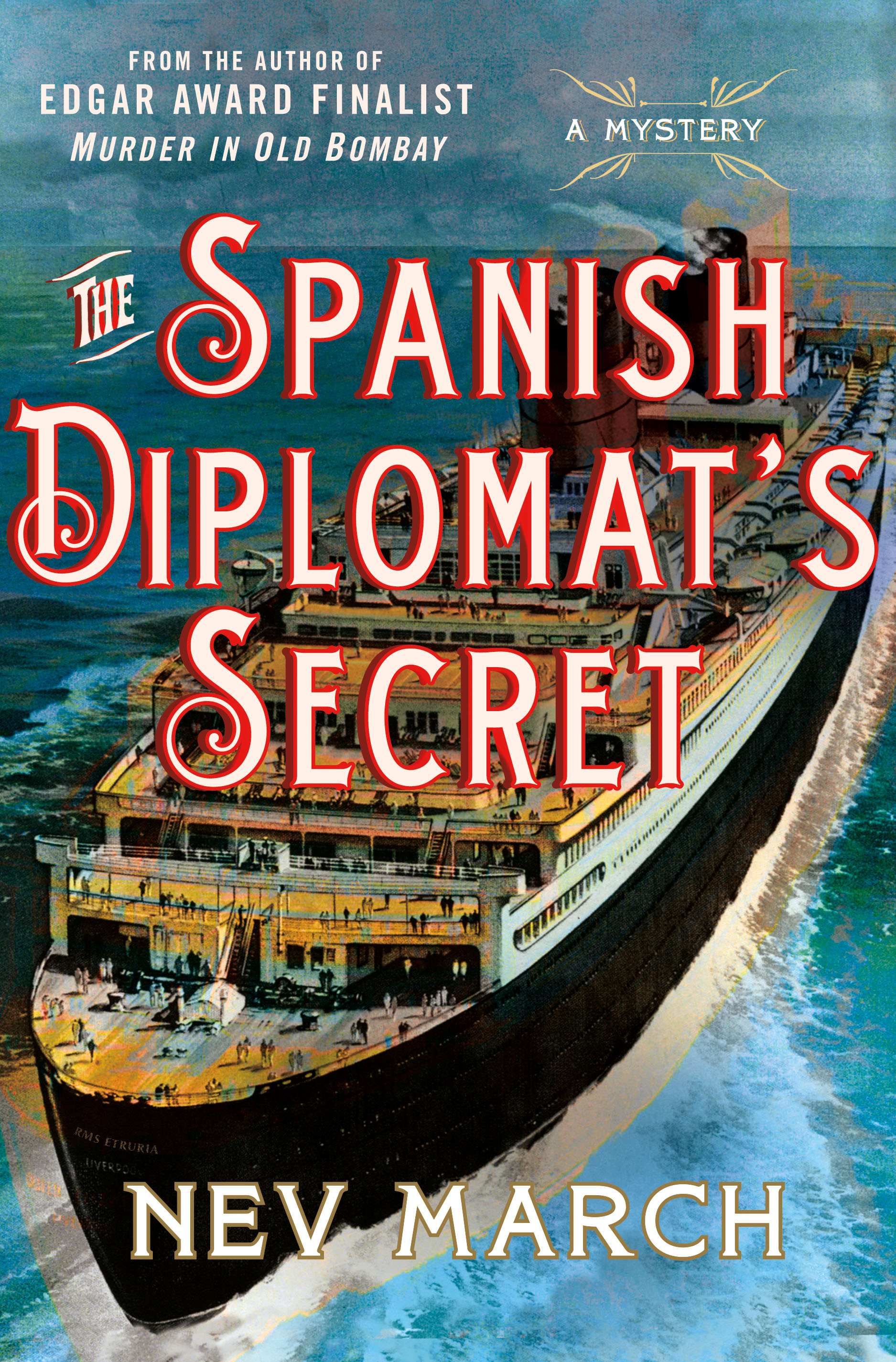
In The Spanish Diplomat’s Secret, award-winning author Nev March explores the vivid nineteenth-century world of the transatlantic voyage, one passenger’s secret at a time.
Captain Jim Agnihotri and his wife Lady Diana Framji are embarking to England in the summer of 1894. Jim is hopeful the cruise will help Diana open up to him. Something is troubling her, and Jim is concerned.
On their first evening, Jim meets an intriguing Spaniard, a fellow soldier with whom he finds an instant kinship. But within twenty-four hours, Don Juan Nepomuceno is murdered, his body discovered shortly after he asks rather urgently to see Jim.
When the captain discovers that Jim is an investigator, he pleads with Jim to find the killer before they dock in Liverpool in six days, or there could be international consequences. Aboard the beleaguered luxury liner are a thousand suspects, but no witnesses to the locked-cabin crime. Jim would prefer to keep Diana safely out of his investigation, but he’s doubled over, seasick. Plus, Jim knows Diana can navigate the high society world of the ship’s first-class passengers in ways he cannot.
Together, using the tricks gleaned from their favorite fictional sleuth, Sherlock Holmes, Jim and Diana must learn why one man’s life came to a murderous end.
Buy links:

The Spanish Diplomat’s Secret she explores revenge for a real-world unresolved crime in the years before the Spanish American war over Cuba. Nev is presently working on book 4 of her Captain Jim and Lady Diana series. Her books deal with issues of identity, race and moral boundaries.
Join my newsletter

 Ladies of Mystery
You must be logged in to post a comment.