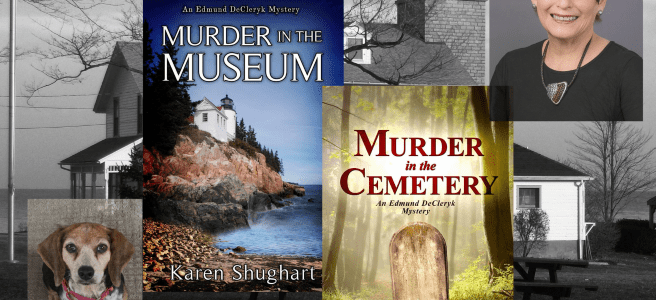
Let There Be Light by Karen Shughart

My husband and I live in a charming maritime village on the south shore of Lake Ontario in New York, the prototype for Lighthouse Cove, the village where my Edmund DeCleryk cozies are set. This time of year in our village activities surrounding the holidays abound, and there truly is something to do for people of all ages: festivals; tree lightings; parades; caroling; shopping and dining opportunities, and a judged competition for the best outside holiday decorations.

 I especially like writing about the seasons in my books. In my third, Murder at Freedom Hill, the crime occurs just before Thanksgiving with the investigation continuing through the entire holiday season. I enjoy describing how the folks living in Lighthouse Cove celebrate, with light-filled activities that juxtapose the dark, horrific murder that has occurred.

Ed, a retired Navy SEAL and former police chief, now works as a criminal consultant who is hired by the current police chief to solve the crime. His wife, Annie, head of the local historical society and museum, curates exhibits, organizes special events, and because of the historical backstories that frame each crime, often becomes involved in the investigation.

One of these special events occurs early in December, when the days are short and darkness prevails. A Festival of Lights, held on the grounds of the museum, provides diverse groups with an opportunity to showcase the ways in which light plays an important role in their cultures during this time of year:
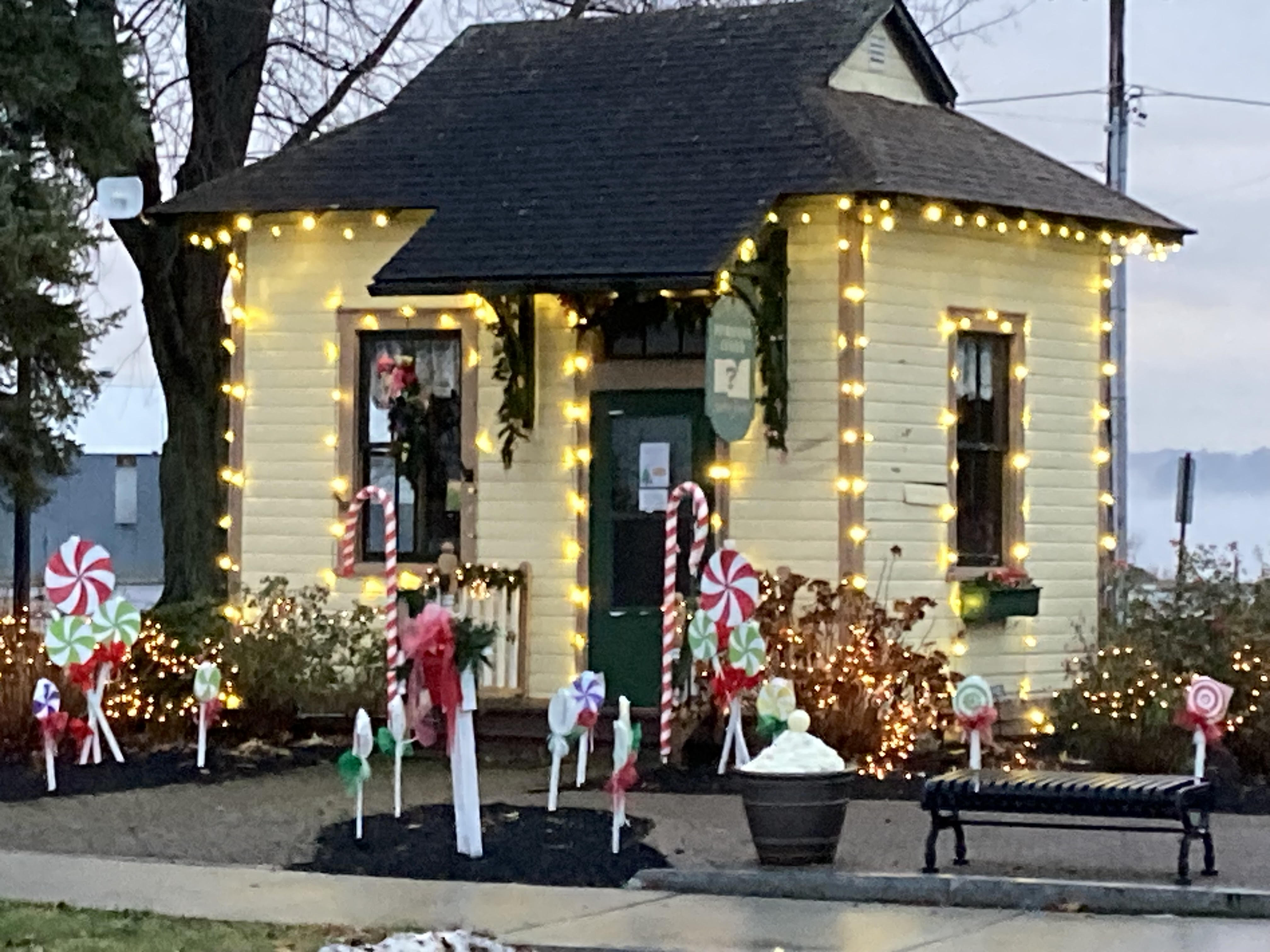
Photo courtesy of Lyle Shughart

“The Holiday Festival of Lights was held in the park next to the museum the following Saturday evening and started at dusk. Tall stadium field lights provided illumination, and the museum staff and volunteers had strung multi-colored holiday lights on bushes and around tree trunks. Several portable fire pits had been placed at strategic spots near park benches to provide warmth.

The Neighborhood Association maintained a booth that offered free hot chocolate and cookies. Other booths, with representatives from local Christian, Jewish, Muslim, and Hindu congregations, offered information about their holiday customs including the significance of light, and samples of traditional holiday food.

Santa ambled through the crowd passing out wrapped red and white candy. A group from near Tug Hill brought live reindeer, tame enough to pet. Children hopped on the back of a fire truck, a huge wreath on its hood, for a ride around the block, speakers blaring seasonal winter songs.

A large evergreen tree located in the middle of the park was festooned with multi-colored lights; a Chanukah menorah, Kwanzaa kinara, and clay diyas—oil lamps representing the Hindu holiday of Diwali—flanked the tree on large tables on either side.

Towards the end of the evening, the high school student chorus handed out sheets for a sing-along and led the community in a diverse selection of melodies representing all the groups at the festival.”

A definition of the symbolism of light from the National Gallery of the UK states: “Across cultures, light is an ancient symbol of understanding and intellectual thought: it is the opposite of ignorance, or darkness. Almost universally, the dark is …frightening and sinister, associated with things we cannot understand. Light is said to conquer darkness and to bring order out of chaos.”

We all need a little light in our lives this time of year, so, let there be light!
The Darkest Hour is Just Before Dawn by Karen Shughart

One of my favorite songs of the 60’s and 70s is “Dedicated to the One I Love,” which was performed by multiple groups, my two favorites the ones sung by The Mamas and the Papas and The Shirelles. The last line in the first stanza ends with the words, “And the darkest hour is just before dawn.”

The line in that song has both a literal meaning-the darkest hour is just before dawn-but also a metaphorical one. During our personal struggles and darkest emotional hours, when doom and gloom seem to permeate our lives, sometimes light and happiness are truly just around the corner, if we can hold on long enough to wait until that happens. If we’re patient, and sometimes we must pay attention before we are aware of it, dawn comes.

The song has meaning to me in another way.  Living here in the north, on the south shore of Lake Ontario, the days are short and the nights long this time of year. But it’s not as depressing as it sounds, because if you’re willing to rouse yourself in the middle of one of these nights, you can sometimes view a breathtaking display of Northern Lights over the lake.

Light is a theme in our village, especially from Thanksgiving through Christmas. Our tiny visitors’ center is decorated to look like a gingerbread cottage, trimmed with bright, colorful lights and surrounded by decorated, brightly lit trees.  A tree-lighting ceremony in the park brings villagers out to sing carols, enjoy hot beverages and snacks and warm themselves around brightly burning fire pits.

Photo by cottonbro on Pexels.com

You’ll notice telephone poles wrapped with garlands of evergreens twinkling with white lights and topped with red bows. Lights glimmer on bushes, are wrapped around trees and woven through fences. Candle-lit luminaria line walks, and fairy lights peek through holiday wreaths and garlands.

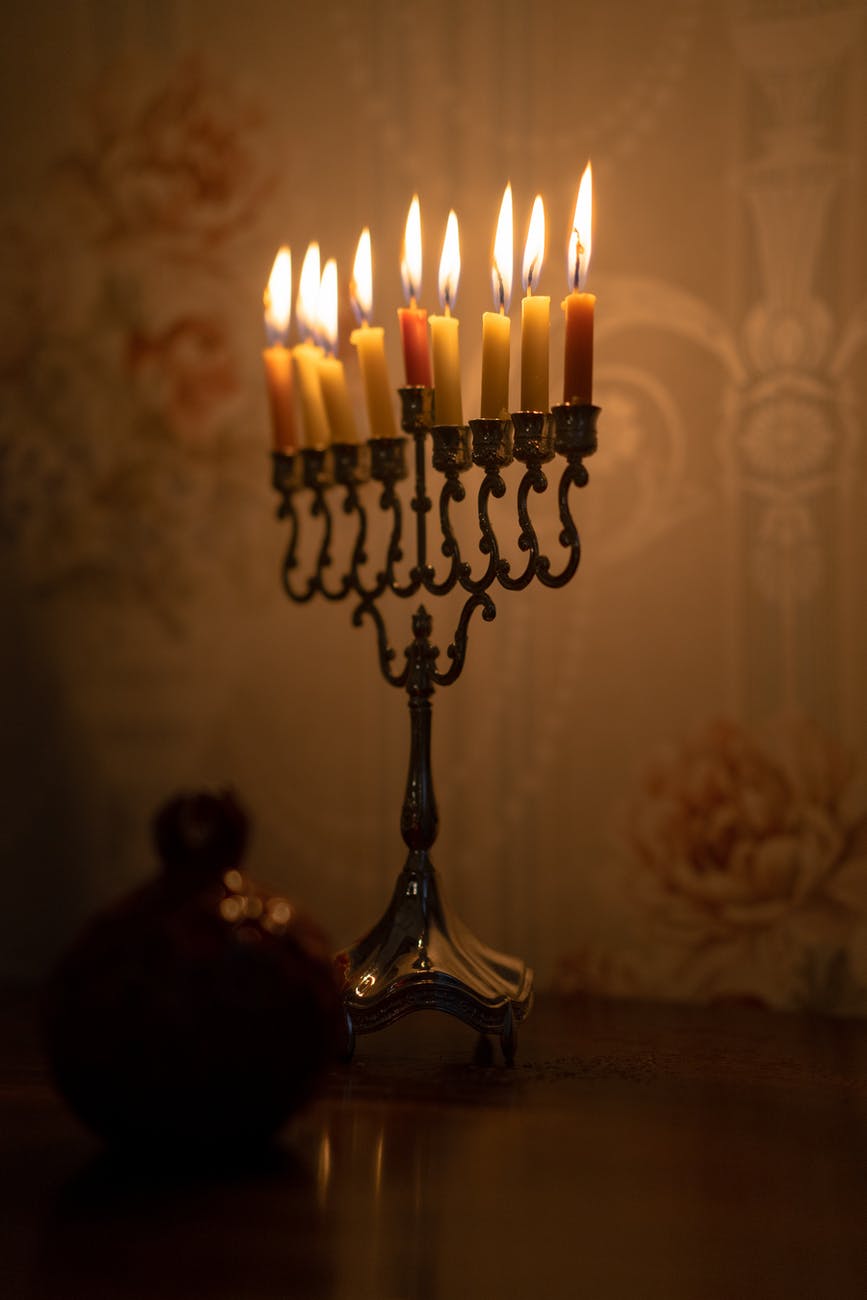
It’s not by accident, I think, that so many cultures celebrate holidays and festivals from late fall into winter that revolve around light. In many communities you’ll see Menorahs in windows, candles burning brightly, to celebrate the Jewish holiday of Chanukah which commemorates a miracle that happened thousands of years ago. 

Candles also burn in Kinaras as Black families celebrate Kwanzaa, to remember their cultural heritage and traditional family values. Hindu families decorate with lights in-and-outside their homes for Diwali, a festival in remembrance of a period in their history when good triumphed over evil. I expect there are others, too.

So, when the days are short and the nights long, how comforting it is to know that many cultures celebrate holidays and festivals that bring light into their lives and homes to brighten those darkest hours just before dawn.

A Love Story by Karen Shughart

“He alone is great who turns the voice of the wind into a song made sweeter by his own loving.” Khalil Gibran

In the fall of 2016 my mother suffered a series of strokes and went into a nursing home in Pittsburgh, where she lived. My father had died; I became her power of attorney and had her mail forwarded to me here in New York. That December she received a letter with a return name and address that I vaguely recognized. I opened it.

It was letter from a man named Norge Santin, who was inquiring after my mother, our family, and Leonard, my mother’s brother. Then I remembered that Norge was a childhood friend of theirs when they were growing up in Ohio.

My uncle had died earlier that month; after reading the letter I wrote back, apprising Norge of his passing and my mother’s health issues. He responded quickly, saddened by my news. He knew who I was, he wrote, we’d met when my parents lived in Ohio shortly after I was born.

What ensued was a friendship between us, for a time through letters, then by email and phone. Norge grieved with me when my mother passed three years ago and comforted me when one of my brothers died last summer. Each time we made contact, he ended by offering prayers and blessings for my uncle and mother and sending love to me and my family.

He filled in some blanks. I learned that he and my uncle were not just friends, but best friends, starting in third grade. When the two young men graduated from high school they were drafted, it was World War II, and their college plans were placed on hold. Norge returned from the war, got his degrees, married, and had children.

Leonard was not so lucky. Suffering a breakdown during the war from which he would never recover, he spent his remaining years in and out of VA hospitals and group homes. My siblings and I knew his tragic story; our parents made sure he was always part of our lives. What I hadn’t known was that Norge remained a devoted friend to Leonard throughout his life. During visits when Leonard was withdrawn and unresponsive, he’d sit quietly with him, holding his hand.

Eventually our family moved Leonard to Pittsburgh. Norge, despite living in Ohio, continued visiting my uncle until Leonard decided that he no longer wished to see him. Maybe it was too painful to be with Norge, we’ll never know. Norge respected his wishes and never contacted him again, but his love for his friend never ceased; he contacted my mother to receive updates, up until the time when I opened that letter.

By 2019 Norge’s health had declined, he had trouble reading emails and spoke haltingly over the phone. I wanted to meet this man I’d grown so fond of, so that October my husband and I drove to Ohio to visit Norge and his wife, Therese. We were warmly welcomed and spent a lovely afternoon; all of us feeling as though we’d known one another forever.

Because of Covid there were no return visits, but we talked regularly, most recently just before Thanksgiving when I promised to call again before Christmas. Before we ended that conversation, Norge confided he thought his time was near. I told him I loved him, he said he loved me back.

Two weeks ago, I received a call from one of Norge and Therese’s daughters that broke my heart. This tender, humble, gentle and honorable man had passed and Therese, despite her own grief (they were married for 68 years), wanted to make sure I knew. His death, at 94, occurred almost four years to the day of the death of my uncle.

I’m so glad I decided to open that letter, my life is immeasurably enriched because of it. Therese and I share a strong bond; I’ll keep in touch with her and visit when it’s safe. And I miss Norge already. Rest in peace, dear friend.