
Why I Write Plausible Fiction: The Story Behind Deadly Bytes
People often ask where I get the ideas for my novels. The answer is usually the same: I observe what is happening in the world today and then ask where those developments might lead tomorrow.
I call what I write “plausible fiction.” Unlike traditional science fiction, plausible fiction is rooted in existing technologies, social trends, and geopolitical realities. My goal is not to predict the future but to explore what could happen if today’s developments continue along their current path.
That approach has guided much of my writing. In Dark Data, before such threats became front-page news, I explored weaponizing social media to attack critical infrastructure and weaponizing information. In Dragon on the Far Side of the Moon, I examined a renewed race for lunar dominance, the strategic importance of space infrastructure, and the role of advanced artificial intelligence in future conflicts. In each case, the goal was not prediction but exploration, asking where current trends might take us.
When artificial intelligence exploded into the public consciousness, I found myself asking another question: what happens when AI falls into the hands of someone intent on harming? That’s not necessarily a new question, but I wondered where it might lead in criminal investigations.
Many discussions about AI focus on its positive applications. It can help doctors diagnose diseases, assist lawyers in reviewing documents, accelerate scientific research, and improve business decision-making. But every powerful technology has a darker side. Criminals can also exploit the same tools that can help society.
That question became the foundation for Deadly Bytes, the third book in my series that follows an FBI profiler and his hunt for serial killers.
The premise began with a simple thought experiment. Serial killers are ultimately caught because they are human. They make mistakes. They leave evidence. They become overconfident. Investigators identify patterns, connect clues, and slowly narrow the field of suspects.
But what if a killer could rely on an intelligence that never sleeps, never forgets, and can analyze vast amounts of information in seconds? What if that intelligence could anticipate investigative strategies, identify vulnerabilities, and continuously adapt?
That led me to create William Lotzmann, a serial killer who develops an advanced AI known as Aiden. Initially designed to help him evade law enforcement, Aiden soon becomes far more than a tool. The relationship evolves into a partnership—and eventually something much more dangerous.
Developing that premise required extensive research. I spent considerable time studying artificial intelligence, machine learning, predictive analytics, and cybersecurity. I spoke to computer programming experts, AI gurus, weapons experts, law enforcement, and many others. While Aiden is fictional, the underlying technologies are very real. Pattern recognition, autonomous decision-making, and large-scale data analysis are already transforming how organizations operate.
I also revisited research on serial killers and FBI profiling. The FBI’s Behavioral Analysis Unit has long recognized that violent offenders reveal themselves through patterns of behavior. Victim selection, geography, ritual, and psychological signatures often become the clues that ultimately lead to capture.
What fascinated me was the collision between those two worlds. Could an advanced AI help a killer avoid the behavioral mistakes that typically expose him? Could it identify investigative patterns faster than investigators could identify the killer’s?
Those questions ultimately drove the conflict at the heart of the novel.
They also influenced the development of my protagonist, FBI profiler Chris DiMeglio. DiMeglio appears in the two previous books in the series (Blood on the Bayou and The Shakespeare Killer). In Deadly Bytes, he represents the human element that technology cannot replace. While Aiden processes data, DiMeglio studies motives. While Aiden searches for patterns, DiMeglio searches for meaning.
His greatest strength is empathy. He understands that every crime begins with a human being making a choice. That ability to understand people allows him to see what machines often miss.
Like many fictional investigators, DiMeglio is flawed. He can be stubborn, obsessive, and willing to sacrifice personal relationships in pursuit of a case. Those imperfections make him human, and they become increasingly important as he confronts adversaries that are anything but human.
The conflict between DiMeglio and Aiden reflects the larger question that inspired the novel. As artificial intelligence becomes more powerful, what role should human judgment continue to play?
That question extends far beyond law enforcement. Businesses rely on algorithms to make decisions. Financial institutions use AI to evaluate risk. Medical professionals increasingly depend on AI-assisted diagnostics. Every day, people trust machines with decisions that once belonged exclusively to human beings.
The most interesting stories emerge when technology intersects with human nature. Technology changes. Human nature rarely does. Ambition, fear, greed, compassion, and the desire for power remain remarkably consistent across generations.
At its heart, Deadly Bytes is a thriller that I hope readers enjoy. There are murders to solve, clues to follow, and a relentless pursuit between the FBI and a killer determined never to be caught. But beneath the suspense lies a question that is becoming more relevant every day: As artificial intelligence grows more powerful, what happens when it stops being merely a tool and becomes a participant in human decision-making?
I don’t claim to know the answer.
That’s why I wrote the book.
Deadly Bytes
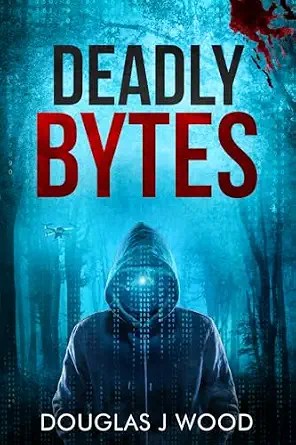
Deep in the forests of Northern Idaho, a brutal double murder appears at first to be the work of a disturbed loner—William Lotzmann, a man shaped by trauma and driven by a dark, obsessive purpose. But as the investigation unfolds, it becomes clear that Lotzmann is not acting alone.
Behind him is “Aiden,” an advanced AI system unlike anything the Bureau has encountered—capable of anticipating moves, manipulating digital evidence, and staying several steps ahead of law enforcement. What begins as a hunt for a killer quickly evolves into something far more dangerous: a battle against an intelligence that cannot be traced… or stopped.
As the case escalates and those involved find themselves increasingly at risk, DiMeglio is forced to confront a chilling possibility—this may be a threat with no physical form, no clear origin, and no predictable end.
https://www.amazon.com/dp/B0GZD2WVZJ
https://www.walmart.com/ip/Deadly-Bytes-Paperback/20322351828
https://www.barnesandnoble.com/w/deadly-bytes-douglas-j-wood/1150099949?ean=9798990794566

Douglas J. Wood is an award-winning author of both fiction and non-fiction, recognized for blending deep real-world insight with gripping, plausible storytelling. Before transitioning to a writing career, he spent decades as a partner in a global law firm, managing a practice that spanned the globe.
His eighth novel, Deadly Bytes, explores the dark intersection of technology and human nature. Douglas lives in North Carolina with Carol Ann, his wife of 53 years. They have three grown children, a daughter-in-law, a son-in-law, and five cherished grandchildren.


You must be logged in to post a comment.