Reading Old Work

For the last few weeks I’ve been thinking about the old mss left unfinished. Some are in my computer. Some of them are on paper, stacked in a closet, shoved into the back where I can’t see them. That’s probably a good thing because if they were visible I’d pull them out and litter my desk with them.

There’s nothing wrong with any one of them, and several came very close to a sale. But there is something not quite right. Every writer knows what I’m talking about—the story we loved and worked on and with a gasp of hope sent off to an editor or an agent. And then it sat there, on someone’s computer or desk, gathering dust of being pushed lower and lower on the list of titles in the TBR file. The question becomes, what do we do with them? Do we reread and rework them? That’s a definite possibility. The more I learn, the more I rethink what I’ve done and recognize where I could have improved the story by changing the setting, developing the villain more, heightening the tension, or removing the extra secondary characters. But I don’t do these things in a novel. I might do some in a short story, but not in a longer work. And I think I know why.

Some years ago I was an avid fan of Margery Allingham’s Albert Campion mysteries. The first one appeared in 1929, The Crime at Black Dudley, and others followed fairly regularly into the 1960s. I don’t know if many people read her work anymore, but she was considered one of the great British mystery writers of her time. After reading through her entire list including a couple of novellas, I came across her first mystery, The White Cottage Mystery, published in 1928. This is only a year before her first Albert Campion story. And I was startled at the difference between the two., and the extent of her growth and development as a writer between her first and her second book. It’s an experience I have always remembered. 

We grow and change as writers. If our work sounds the same year after year, we’re not growing and it’s time to stop and ask why. I don’t want to write the same book year after year. There has to be something different, some sign of a new perspective, a new challenge. I can see this same ambition in some of the writers I read, but not in others. 

When I pulled out some of my old mss and had the passing thought of rewriting and updating them, I was frozen, and here I think I was so for a good reason. Whoever I was back then I am not her now. To bring one of those old mss up to the level I would want to write today would be to dismantle and basically erase it. Each line, each feeling and action would have to be different because I’m different. The story was good for its time and in some instances that’s twenty or more years ago. I was different and the world was different.

I’m in a long phase of decluttering the house I’ve lived in for over forty years, but I doubt I’ll toss out those mss, not just yet. Each one tells me something about writing, finding a voice, developing a voice through time, challenging ideas and creating new ones. I liked some of those stories more than others, and the failure of some weighed on me more than others, but like any other experience that comes to an end, I let those novels go and moved on.

The one important thing I remember is that even though they didn’t sell, they made me the writer I am today, with their lessons and discoveries, their pitfalls and graces. For that alone I will probably keep them for a while longer.
Reframing

Reframing is a well-established psychological tool for tackling problems that may seem intractable, and I found myself appreciating it recently.

For the last three years two other writers and I spend much of the spring and summer working on the annual anthology Best New England Crime Stories published by Crime Spell Books. All three of us read and select the stories, and all three of us edit. All the other duties are split. Ang Pompano sends out the acceptance or rejection emails and works on promotion, developing ads and the like. Leslie Wheeler manages the books, and works on sales opportunities. I get to write jacket copy, and lay out the book for POD. We have a great cover designer, and all three of us weigh in on the art and design. We review each other’s work, offer suggestions, and manage to put out a book we’re proud of every year while also having fun at our launch at Crime Bake in November.

Writing jacket copy is perhaps the least onerous job of a writer with a book going to press. My practice has been to look over the list of stories, arrange them in loose groups, and talk about the kinds of crimes they contain. I wrote the copy this month and sent it around to Ang and Leslie. Both liked it but Leslie had a response I hadn’t expected but found provocative. With all the talk of crime in the news today, depressing for everyone, perhaps we could focus on the characters who are fighting back, challenging the criminals or the system. This immediately appealed to me, and I ditched the first draft and reshuffled my note cards.

Looking at these stories from the perspective of the range of characters caught up in circumstance of crime and its consequences changed the way I viewed them and let me see beyond the cleverness of the plot, the range of characters swirling around incidents, the grounding bit of information, the unexpected twist. Most were ordinary people in extraordinary circumstances finding something within they didn’t realize they had. They were sometimes stymied by their situations, tripped up by bad luck or trapped by betrayal, but they were a match to the challenge, though not all succeeded in bringing about justice.

By reframing I also got closer to a different view of the crime. When a crime is committed it is most often by a person shriveled by life and seeking an unimaginative solution. An ordinary scam inspires a docile matron, and a drug addict discovers how far he has gone on the path to a. new life, and what his world is really like, something most readers will never experience. For others, following clues and solving a crime leads to a painful reckoning. Rewriting the jacket copy turned out, also, to be more challenging than cataloging a variety of crimes. As expected, the protagonists in these twenty-four stories were a varied lot.

With every year, we three editors choose stories that we think are well written, well thought out, and interesting as fiction. Because it’s crime fiction there is an understandable emphasis on the structure, the plot with a crime and its solution. But with a change in perspective, a reframing, I find myself appreciating the range of personalities grappling with life’s body blows. There is a richness not as easily appreciated otherwise. I hope our readers will feel the same way when the book is out in November.

Guest Blogger -Jennifer Giacalone

Working Backwards

When people find out that I write the occasional mystery novel, the most common question I get is “so do you write the ending first and then work backwards?”

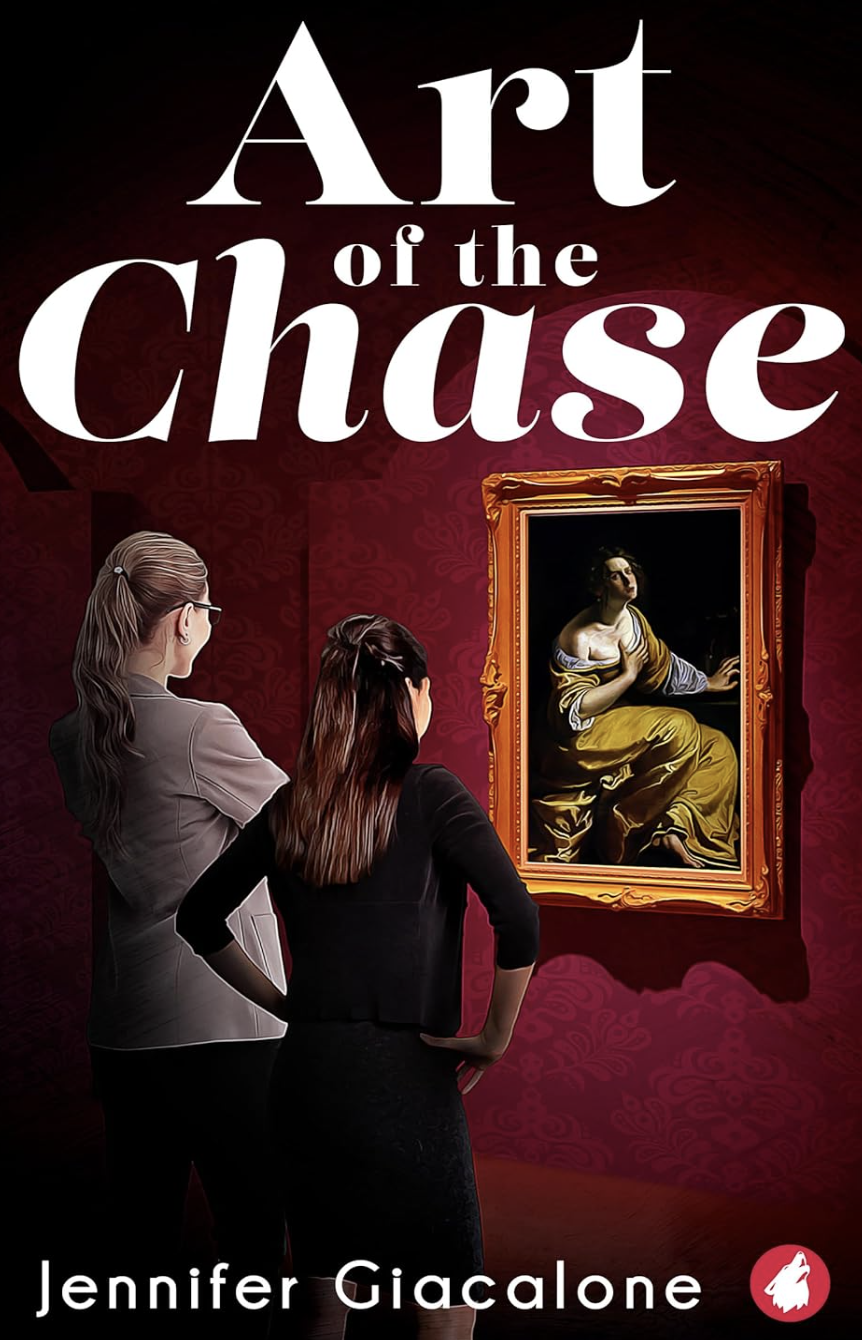
So, for anyone who might be wondering if I did that with “Art of the Chase,” the answer is no. However, I didn’t quite write it from beginning to end either. You could say I did it sideways, from the middle out.

Where Is the Middle Anyway?

For me, a mystery turns less on the beginning or the ending and more on the little bit of information that’s so interesting and surprising that it allows you to see certain things about what comes before it and after it.

For example: I was watching a documentary on the works of Vermeer. They talked a bit about how it was unusual for the time period that he used so much blue in his paintings, because it made them very expensive. Blue paint could only be produced with lapis lazuli stone, which had to be hand-ground and then processed in a very unpleasant, potentially dangerous procedure. You didn’t find many painters of that period using it as wantonly as he did.

The advent of French ultramarine produced chemically, in the 1880s, made it much easier and cheaper to work in blue. And it was this seemingly random fact that ended up being what the story turned on.

Because I started to think: what if you had a detective who specialized in art thefts? Would they know about the rarity of blue in Renaissance and Baroque painting? How would that knowledge come into play if a particular piece was stolen? I was starting in the middle. The middle of a story, the middle of a question, the middle of a period of history in which blue paint was a precious commodity.

Research Is The Fun Part

The process of writing is, for me at least, an opportunity to learn. I learn about myself, always; my biases, my areas of weakness as a writer, my own fascinations. But I also just learn about… well, stuff.

Almost everything I choose to write about requires some amount of research. And it’s always about something of interest to me. There’s nothing I love more than learning a lot about a topic of interest, in this case, art. And in particular, the life and work of Artemisia Gentileschi, the various methods of producing paint colors used by the old masters, and the architectural landscape of Florence. What a delight!

I fell down a rabbit hole, and popped up somewhere late in the third act with bits of fascinating information in my little paws like some sort of literary groundhog. The threads that connect my little prizes are ultimately what hold the story together. Why does this painter matter to this detective? What sort of thief would want to steal a piece of hers? And what does the history of blue paint have to do with any of it?

There is a Connection Here, I Swear

I spread my treasures out and draw lines from one to the next. I figure out why these things matter to each other, and so the story reveals itself. My plotting efforts tend to look less like a traditional bulleted outline, and more like a murder board with photos tacked up alongside post-it notes, connected by a brightly colored thread that runs from the middle out.

And I’m the lunatic cop who can stand back and see how it might all connect; who do I need my thief to be, my heroine, my informant? How do I build them to make these treasures shine and tickle my readers as much as they tickled me?

Ah, there it is. I see it. There’s my story. There’s my heroine. This is how she gets from here, to here, to there. There’s my thief. That’s what he wants, and why.  It’s not a matter of working backwards or forwards. It’s a matter of allowing the story to emerge from the bits and pieces that delight me the most, and letting them surprise the reader as much as they surprised me.

When a notorious art thief surfaces, warring detective exes reunite for the hunt. 

Six years ago, the “Fabulous Gustave” slipped the grasp of Agent Fleur van Beekhof, making off with a priceless artwork…and Fleur’s beautifully ordered life. Suddenly the cool, pragmatic Europol detective lost her detective partner and wife, her rising career, and her control, thanks to the addictive lure of cards.

When a new Italian art theft bears all the markings of Gustave’s flamboyant, taunting style, Fleur is put back in the field, because no one knows him better. She jumps at the chance to correct the mistake that ruined her life. The hitch? She has to work with her fiery ex-wife. 

Where Fleur is a detective who loves art, Renata is an art expert who loves being a detective. Where Fleur is by the book, Renata is reckless and leaps into danger. But they’ll need both of their skills to catch the slipperiest thief Europe has ever seen … even if it shatters what’s left of Fleur’s heart. 

Buy link: https://www.amazon.com/dp/3963248351

Jen Giacalone is a neurodivergent queer nerd who has lived many lives and brings with her a wealth of experience to tell high-octane drama, thriller, and mystery stories across books, film, and TV.

After spending her twenties as a rock and roll frontwoman, and her thirties as a graphic designer in boardrooms of Fortune 500 companies, she’s currently in what she likes to call her “final form” as a writer.

You can usually find her disappearing down rabbit holes of fascinating research on random subjects that will turn up in one of her books. And, of course, she sprinkles a little glitter on everything she touches.

https://www.instagram.com/jengiacalone/

Discovering the Setting

I’m in the middle of the sixth book in the Anita Ray series, which is set in a tourist hotel in a South Indian resort. Over the years the area has grown from a tiny fishing village with a few hotels just up the coast to one of the most popular destinations for Westerners eager for the sun and sand, not to mention the sunsets and the fishing boats bobbing on the horizon at night. I know the area well, having visited it for the first time in 1976 and several times in the 2000s. 

The pathways laid out in the early years are now paved walkways through marsh with little pools covered with lily pads. The paths have been widened in some areas to allow shop owners to hang out rows of brightly colored silk saris and blouses. When I think there’s no more room for another restaurant or shop, I turn a corner and spot five square feet turned into an open-air cafe with the owner stirring a pot on a two-burner cooktop, ready to serve the foreigners sitting on stools before a board table. The food is good, the price is right, and the cook’s son works in one of the high-end hotels. Much of Kovalam has spread on what was once paddy fields that came down to a low berm fronting the beach. All those are gone, and only the rare private home remains, hidden away beneath tall palms.

A reader often tells me they know “exactly where I am” in an Anita Ray story, and that’s because I do too. I have a strong sense of direction in India (and elsewhere), a deep understanding of India (after years of graduate school), and a personal love of the region. All of that informs the Anita Ray stories. What I don’t have is a sense of place in any story if I haven’t been there, walked through a public park, found a typical cafe for the area, and visited a municipal building—perhaps a library or town hall. I can make up a lot of it, but I need to experience the “feel” of the place. 

The Joe Silva series, in seven books, takes place in a small coastal New England town. I know these towns well, having grown up in one. The rocky coast speaks of the “flinty” Yankee, and the harsh winds call to mind the ever-present threat of hurricanes and other storms. Winters may be changing because of climate disruptions, but the birds still come, the land demands careful attention, and life for the fisherman is never easy.

One of the reasons I enjoy reading crime fiction is the other landscapes I get to explore. I’ve been through the Southwest and lived for a brief time in Tucson, so I appreciate any writer who can take me into that world of mountains and deserts, long straight roads, and small adobe houses with gravel yards. The openness of Montana and Wyoming brings out the best in some writers, and I look forward to their stories and landscapes.

Regardless of where we grew up or now live, we are creatures of our environment, and the best fiction uses that sense of place, what is distinctive and unique about one location, to propel the characters and their story. This, for me, is the reward of a reading a novel with a rich, fully developed setting. I come to understand both people and place, and know a part of the world I may never visit a little better.

GOOGLE IT!

Eons ago, when I wrote my first book, I actually had to go to the library to research untraceable poisons, fast acting poisons, skin absorption poisons. Yes, I was poisoning someone and yes, I’m that old!

I loved going to the library, I mean after all it is filled with books! But as a single mom at the time, with two young boys, my opportunities to languish in a palace of books were limited.

Also, during my early writing days, there were no TV shows like Criminal Minds or CSI. Though I have a dark and twisty mind, I didn’t know anything about “behavioral analysis” or “DNA” or “national criminal databases.”

In my next WIP, my villain convinced another inmate to kill himself while posing as the villain. The villain would then assume the dead inmate’s laundry job and smuggle himself out of the prison in a laundry truck. My weapon of choice was a lightbulb gasoline bomb, an idea I stole from “The Longest Yard.” So, I was back in the library researching how to make such a bomb. When I found no such information, I resorted to asking my electrician uncle who said he’d remember not to make me mad.

Then, when I wanted to know what type of firearm an FBI Agent carried, I emailed the FBI. Instead of receiving an email reply, the FBI called me. Evidently, at the time, they kept this information secret, and I was told I’d be placed on a list as an author in case I emailed them again.

A side note about lack of technology when I wrote this book, it was written longhand on countless sheets of a legal pad. Then I would spend hours carefully typing the novel on a non-autocorrect typewriter. Good times!

Imagine my delight when the World Wide Web was created, along with my ability to own a desktop computer! And, of course, my creative brain couldn’t get enough of shows like CSI and Criminal Minds.

By the time I wrote my next novel, it was 2004. My husband and I were finally empty nesters, and I was blessed with the opportunity to work from a home office.

I have an overactive imagination, which isn’t always accurate. Now when I need to verify an action one of my characters might take. Or the consequences for a specific crime if my villain is caught. Maybe I just need to know what the times are for sunrise/sunset in a specific month. Whatever the question, Google is at my fingertips!

I love that I can get instant information from several sources and within minutes to hours, I have my answer. Generally, I copy and paste my newfound knowledge and store the Word file in a folder for my current WIP. Another great tool is the ability to search my Word program for a specific item, but if I failed to save the nugget of info, I can always Google it again!

Googling does have its pitfalls. When I researched how to smuggle drugs in an RV (think gas tank) I received a phone call from Homeland Security. At first, I thought I was being pranked and the following conversation ensued:

“Hello, Mrs. Setzer,” a baritone voice filled my ear, “this is Agent Michaels from Homeland Security. I’m calling regarding your recent research on how to smuggle drugs into the United States from México.”

Okay,” I laughed, “who is this really?”

“Agent Michaels from Homeland Security.”

“How’d you get my cell number?”

“We’re Home Lane Security, ma’am.” Agent Michaels sounded annoyed. “Please answer the question.”

“I’m an author and just doing research for a book.”

“Understood. You will be placed on a list as an author, but you may want to be careful in the future with regard to your Google searches.”

Oh, good, I’m on another list!

Recently, I was struggling to settle on titles for two new WIPs. One book centers around a character’s survival while stranded on a ledge after a fall. The second WIP is about a serial killer who places bodies into a river. These two books will be part of a series that has two-word titles, which are my favorite. As I had my hair cut and colored, my stylist, Larry, and I tried out different word combinations. We landed on “Ravine”, which I really liked, but needed a lead word beginning with R.

You guessed it, we turned to Google! During my two-hour visit, Google sparked our imaginations with words like rescue and remote. We had fun trying different words with “Ravine.” Given a ravine is generally in the woods, our search led us to rattlesnake dens located on rocky ledges. We finally settled on “Rattlesnake Ravine.” Not only do I love the title, but our brainstorming created another threat for my Hero. And if you hate snakes as much as I do, researching and writing about their behavior was creepy!

This series already has “Redneck Ranch”, “Whispering Willows”, and “Willow’s Woods.” And though the titles are perfect for their novels, I really wanted to use a different consonant. So, on another recent visit to Larry, we repeated our title Googling session, finally landing on “Fatal Falls.”

Now, in an era of instant information, I am in awe of the tools available to me. From acquiring specific knowledge to checking facts to looking for inspiration, I can use Google, Bing, Wikipedia, and more.

While I love being able to use technology with my writing projects, I’m not planning to go down the AI rabbit hole. My mind is already dark and twisty without the benefit, or detriment, of Artificial Intelligence.

I very rarely visit a library these days to do research, but I do still write longhand on a legal pad. My favorite writing spot is a noisy bar where I get lost in the cacophony of sound. And when I need a tidbit to round out a character, to verify the average temperature in Oregon in October, or fact check how a rural Sheriff’s Department would handle a crime scene … I just Google it!!!

Happy Googling, Ladies!!!