
The Love Imperative
by Claudia Riess
Love. What state of being—or deprivation of being—requires a more expansive lexicon? What adjective hasn’t been used to describe its properties or intentions? Transformative, destructive, blissful, shattering, blessed, accursed. Love is entangled, in one form or another, in the entire spectrum of human experience.
Besides being the most comprehensive of subjects, isn’t love, at least in its quintessential form, also the most compelling? Admit it, how many times have you read—or watched, in their numerous iterations—the stories of Wuthering Heights, Jane Eyre, Pride and Prejudice, An Affair to Remember? We know the endings, they’re etched in memory, but we’re drawn to reliving—or reviving—them, with the same imperative every time. As if through repetition, we can make the endings, or the ultimate fulfillment of love, or indeed, life itself, never end.
If my take on the subject of love is biased, maybe it’s because I’m an incurable romantic with no wish to be cured. I find it necessary, emotionally and tactically, for the element of romance to be a strong factor in my narratives. However, my focus on love, as both a predisposition and a means to enhance the plot, is not limited to the convolutions of romance. Deep friendship, family loyalty, devotion to a political or humanitarian cause are, among others, forces that drive the narrative forward.
To illustrate, I’ve excerpted a couple of passages from the books in my Art History Mystery series. The protagonists are Erika Shawn, an art magazine editor, and Harrison Wheatley, an art history professor. Book one, Stolen Light, brings them together to solve an academic mystery. The mystery turns deadly; their relationship, stormy. The series takes these initiates to the world of art-crime-solving through a number of multiple-murder, continent-hopping cases. At the same time, it follows their evolving relationship, from roller-coaster romance to passionate partnering to devoted parenting. Having an intimate story arcing alongside one with a more far-reaching effect, adds texture to the narrative as a whole—like musical instruments, which in concert highlight not only their own unique qualities, but in counterpoint, each other’s.
From Stolen Light… In a London hotel, Erika’s protective armor against falling in love begins to crack. This is the prologue to their romance, which changes not only the course of their relationship, but affects the mystery’s narrative:
She didn’t want to be alone though she never minded it, mostly enjoyed it, in fact. Except that in this moment being alone was uneasy solitude, and vaguely threatening. She wanted to snuggle into conversation, hear her voice mingle with another’s…Minutes later she was poised in front of Harrison’s door…
From False Light…By its very nature, Harrison’s playful and caring interaction with a little boy cannot but reflect his empathetic character. It will impact the way he approaches people and situations:
Erika wasn’t sure if Sammy had been heading straight for Harrison or if Harrison had stepped into his trajectory, but within seconds, he was scooping the boy off the floor, legs still pedaling…Sammy, taken by surprise, smiled. He stuck his clenched hand in front of Harrison’s face. Chicken pâté was oozing from between his fingers. “Yech!” he said, teasing a reaction out of Harrison…Erika stopped dead in her tracks as Harrison was opening his mouth to allow Sammy to jam it with a glob of pâté on crushed toast point. “Yummy,” Harrison crooned dreamily, sending Sammy into gales of laughter.
From Knight Light… On his own in Paris, Harrison’s faithfulness is tested by a beautiful colleague. For both Harrison and Erika, loyalty, real and perceived, will figure in the arc of their love story and their progress in the investigation at hand:
It was impossible to miss the twinkle in her eye toying with the bluntness of her invitation. He thought it best to go with the least circuitous response: “That’s kind of you, but I’m married.” Mugging confusion, Raquel looked about, as if for the stalking wife. “And?”
He shrugged. “There’s nothing to add.”
She smiled in disbelief. “How about life is short?”
“Exactly. There’s no time to lose, perfecting a relationship. Call me a pompous prude—”
“You’re a pompous prude.”
“—but that’s how it is.”
From To Kingdom Come… Erika and Harrison, are in London, for the first time away from their toddler, Lucas. They are in the throes of a complex murder mystery pivoting around the looting of African art during the colonial era. At this moment, they are attempting to escape a life-threatening situation, and the power of love is over-riding the primal force of self-preservation:
“Go!” John barked, grabbing Erika’s forearm as she reached out for Harrison with her free hand. “It’s okay, he’s right behind us!”
“Go!” Harrison echoed, wanting her to forget him, beat him to the gate. Clinging to him now would hamper her movement.
But she resisted John’s tugging and both their urgings—even Lucas, calling her from across the ocean, failed to change her mind—and there was nothing Harrison could do but grab onto her hand and slow her down.
From Dying for Monet… Harrison is temporarily confined to a wheelchair after suffering a traumatic injury in London. Erika is helping him handle the use of a commode; putting the inconvenience into broader perspective:
“We’re dealing with bodily functions. News flash. Everybody’s got them.” She’d adopted a tone somewhere between a dental hygienist and a nun.
“I appreciate your stoicism, but I find this humiliating,” he said.
“I love you,” she said, maintaining the firm demeanor. “This is another level of knowing. Think of it as a dry run for old age, when we will be helping each other manage such challenges as hip replacements and incontinence. Think of it as a new facet of devotedness.”
There’s a caveat to keep in mind when writing a mystery with a romantic component: in a bona fide mystery, the mystery should remain the driving force. I have a tendency to get swept into an emotional digression, and it’s only later, when reading through the section where the interlude occurs, that I realize the main thread’s been lost and I’ve got some pruning to do; even a major excision. For love, a small price to pay.
Dying for Monet, Book 5 in the art history mystery series
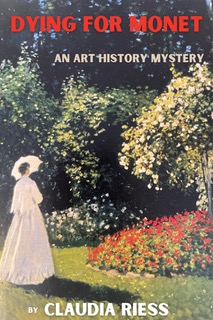
A gala evening auction at Laszlo’s, an upstart auction house in New York City, is in progress. Without notice, a much sought-after Impressionist painting is withdrawn from the block. Moments later, its broker is found dead at the foot of an imposing statue in Laszlo’s courtyard.
Amateur sleuths Erika and Harrison Wheatley are once again drawn into an investigation involving an art-related homicide, this time sharing an unnerving coincidence with violent crimes occurring abroad.
As Harrison searches for clues in the archives at the Ashmolean Museum in Oxford, Erika is on a stakeout in Brooklyn Heights gathering information on the owner of the hijacked still life. After Harrison experiences a disastrous encounter in London, he returns home, where he and Erika, along with a few of their usual cohorts, find themselves ever more deeply at odds with the movers and shakers of the dark side of fine arts commerce.
For links to purchase books in the series, visit www.claudiariessbooks.com.

Claudia Riess has worked in the editorial departments of The New Yorker and Holt, Rinehart and Winston, and has edited several art history monographs. Stolen Light, the first book in her art history mystery series, was chosen by Vassar’s Latin American history professor for distribution to the college’s people-to-people trips to Cuba. To Kingdom Come, the fourth, will be added to the syllabus of a survey course on West and Central African Art at a prominent Midwestern university.


You must be logged in to post a comment.