The Slogging Beginning

I am doing something I haven’t done in some time. I am trying to write a 70k+ book in a month. I want this book off to my critique partners and beta readers by the first of August so I can have it polished and uploaded for release before I leave on a month long vacation the middle of September. Have I put a lot of pressure on myself? Yes! But it will be worth it to be between books while I’m enjoying my vacation.

Most writers know about the saggy middle. It’s where in the middle of the book, sometimes it feels like the pacing has slowed or the story doesn’t feel as fresh and vigorous as it started out. Many have had this happen in a book more than once. But with editing and rewriting it can be given a nice crisp revision.

I’m finding the beginning of this book, not the story, the story is moving along fine. It’s the having to stop and research something that takes time and then takes me off on, ‘What if I did this?’ that turns the story in a different direction. I have had that happen on this particular book four times since beginning the book. I’m a third of the way into the book and I’m finally getting into the rhythm of the story and not having to stop so much and look things up.

So my slogging beginning is the fact, 1) I was at an event and met a person that was so ingrained on my brain after our interaction that I had to put her into this book. Which then changed the direction I had started out on. 2) I decided to make a business I know nothing about as a primary setting to the story. 3) Due to the character I added, I needed to look up mental illnesses. 4) Trying to add information from a short story I put in an anthology required me to reread the short story and figure out how to make it all play into the main plot.

Slogging in this instance is not the writing or the story line, it is the fact I have to keep stopping to research information I hadn’t known would come up with I started the story. Slogging is the hours I’ve spent reading and researching when I wanted to be writing.

However, no matter what you write there is always a need for some research. When I wrote historical western romance I had to research history and how they dressed and lived. In mysteries it’s all about type of wounds, types of crimes, occupations, and yes mental illnesses. Not to mention locations and oh so many things that you would think I wouldn’t need to look up since these are contemporary mysteries. But because of the internet and everyone having access to information, you have to make sure you do even more research so no one can say you don’t know what you’re talking about.

I rarely have a saggy middle and this is the first time I’ve had a slogging beginning. But I can tell you, from here on out this book won’t be sloggy or saggy! I love when I hit the middle of the book and it is like wild downhill ride as I pull all the clues and red herrings together and carry the main character to the revelation of the killer.

Endings are always like a runaway truck!

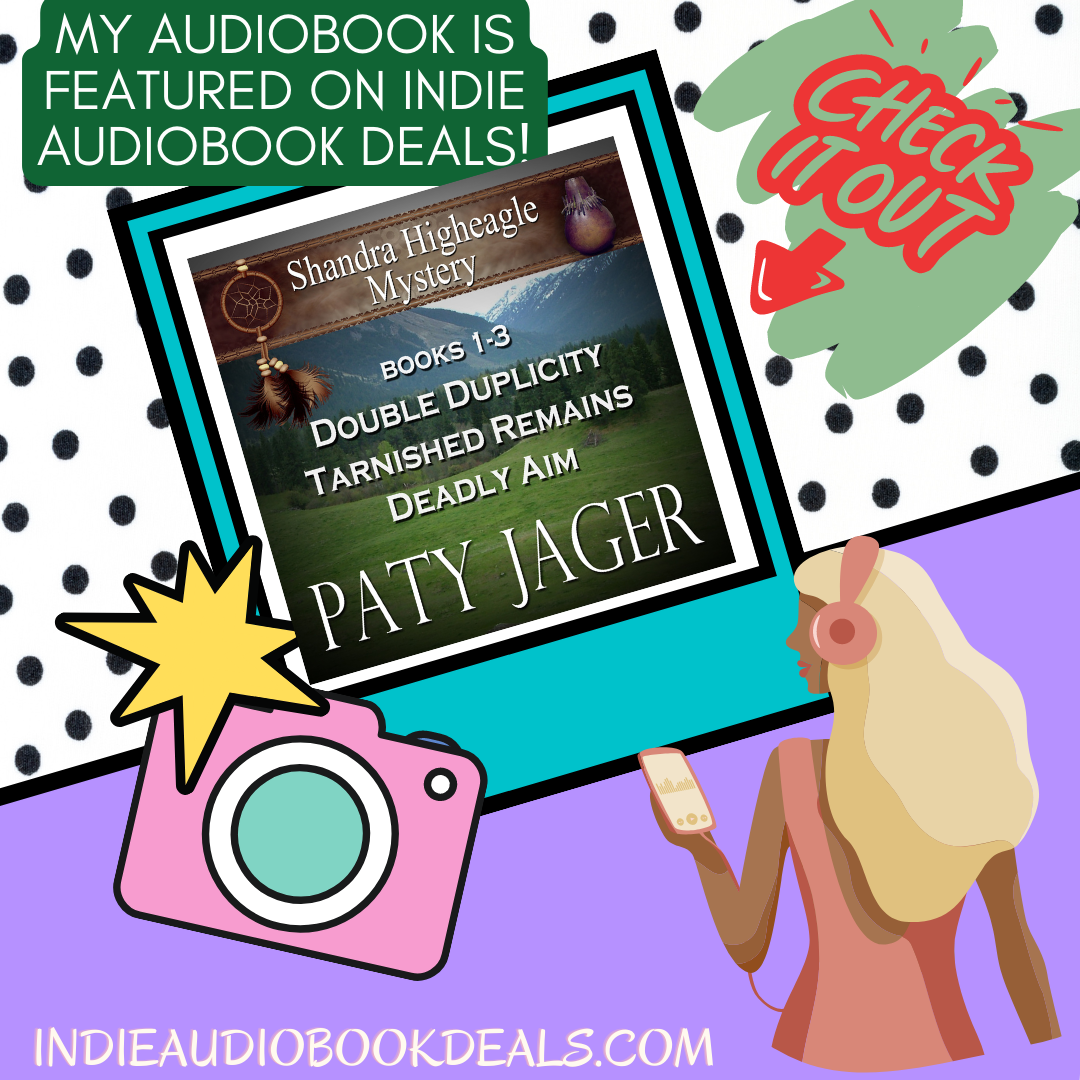
If you are looking for a good deal on an audiobook bundle, the first three books of my Shandra Higheagle mystery series is available for $0.99 at many audiobook vendors until the 10th as part of the Indie Audiobook Deals. https://indieaudiobookdeals.com/

Learning and Sharing

I have always been someone who likes to learn. In school even if I didn’t have homework, I would bring home a book from a subject I liked and read the parts in the book that I was most interested in. It was usually either my history book or my geography book. I loved learning about other cultures and areas of the world.

As an adult, I still am interested in those things and have used my interest in the local Native American tribes to share their customs and beliefs and to show they are still a strong people who continue to learn and keep their heritage alive.

Trips I’ve taken have ended up adding more locales and cultures into my books. I like that I can share what I learn with my readers.

In the Shandra Higheagle mysteries, my main character, Shandra Higheagle, is a potter. She uses clay from the mountain where she lives and purifies it to make a quality clay to make her vases out of. I spent an afternoon, learning about the process from an actual potter. I loved the idea of having a character who is part Native American using clay she digs up, cleans, and transforms into beautiful pieces of art. The process is talked about in a couple of the books.

Because I have Indigenous characters in my three mystery series, I try to put in bits about their culture that shows who they are and how their people came to be strong, but since I’m not Native American, I do my best to show and not tell, since it isn’t my culture. I have readers wanting more of the culture, but I only put in what I fell comfortable revealing.

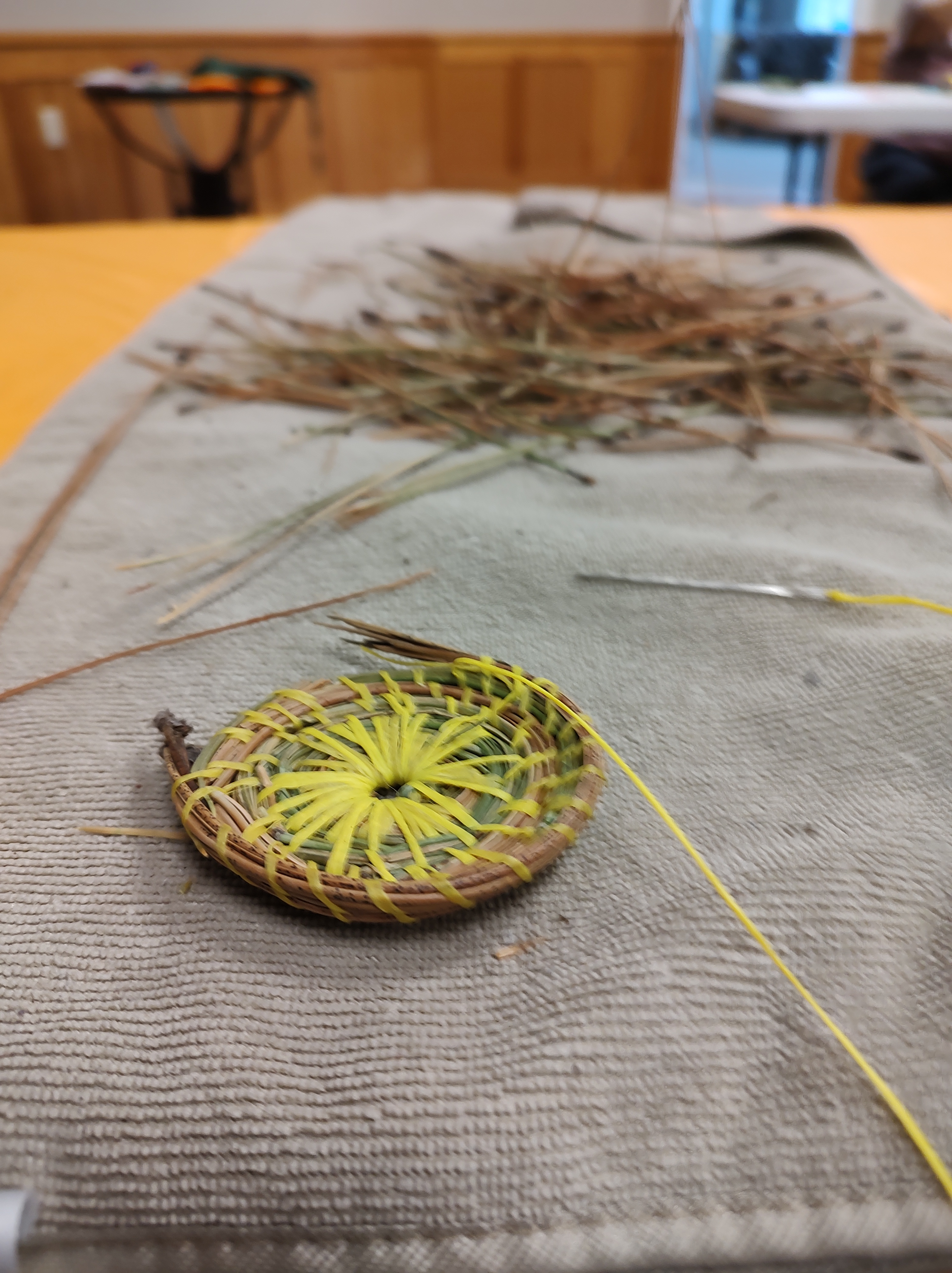
I signed up to learn to make pine needle baskets from a Paiute Elder. Beverly Beers is a fun instructor. She gave us what we needed to know to start and then went around instructing each of us. I started out misinterpreting her instructions and ended up with a larger hole than it was supposed to be. She chuckled and said, “You have made your own pattern.” Which was a kind way of saying I didn’t follow the instructions. 😉

As I sat in the room with the other participants and we all were engrossed in what we were doing a peace came over me that felt good. Stitching each stitch to bind the needles together and adding each new bundle of needles was calming.

I don’t know if it was the tactile closeness to the needles and nature, or the rhythmic stitching, but it felt right and welcome.

Now I’m not saying my hands didn’t start aching from holding the needles tight to put the stitches in, but it was a good ache, if that makes sense. I knew that I was making something interesting and I thought of places I could go to get my own pine needles to try a basket on my own.

I also thought of my character in the Spotted Pony Casino mysteries. She’s a disable veteran who is head of the casino security. She has tragedy in her past and upheaval in her present. She could use a hobby that would perhaps put all her troubles to the back of her mind for short periods of time. As I sat there binding the rows of needles together, I realized this would be a good hobby for Dela. Her friend Rosie, a Umatilla tribal member, could show her how to make pine needle baskets. Dela would enjoy the process, and it would then give her an excuse to go into the Blue Mountains to look for pine needles. While there she could come across an abandoned cabin she’d visited once before and found a journal from the man she believes is her father.

It’s amazing how when your hands are busy and your mind is free your imagination can run amuck and add a secondary plot line to a story. 😉

I will not only share the art of making a pine needle basket, I’ll also move my story along and bring Dela closer to learning the truth about her father. Maybe.

You Just Feel It

I finished book 12 in my Gabriel Hawke series two weeks ago. This is the first book that when I finished, I didn’t have any doubts that I had forgotten something or that it dragged in places or that it wouldn’t sit with some of my readers. I finished this book with a smile on my face feeling as if it was a good book. Not all books feel that way when I finish.

Many writers understand this. There are very few books that when I have it ready to go to my CP and beta readers that I feel I captured everything I wanted and gave all the right clues and nailed the characters. Even the killer. I figure the places that I’m worried about they will see, and I can fix them.

As usual this was what I call my first draft. Over the decades of writing and having published 58 books, not counting the 7 that never made the cut to being published, this was the first time I finished without any doubts about the story. Having been writing this long, I have a system where I what I write the day before is where I start the following day. I begin where I started writing and read through, making changes to scenes, sentences, and words. So by the time I do type the last word in a book, it is the draft I send to my CP and Betas. After they read and send me their thoughts and suggestions, I do what I call the second draft. This one goes to my line editor. Who will also catch any wrong names, duplication of information, and my legal mistakes. From her, I go through it one more time, the 3rd draft, and send that to a proofreader. After I change what she finds, that is the final draft, and it is published.

Now I could be all wet and full of myself on this one, but so far, the beta readers have liked it and found little to comment on. Well, except for my retired police officer. And what he commented on wasn’t anything to do with police procedure. He didn’t like that Hawke kills a rattlesnake. He thought Hawke should have backed out of the cougar’s cave he was crawling into and waited for the snake to leave. I’ve thought about this since his text to me about enjoying the book other than that scene. I’ve bounced around different ways I could change the scene, but they don’t harken to the urgency that Hawke feels about finding more evidence.

My other beta reader liked the whole book. Didn’t see any problems with any of the story. She did catch some typos.

I’m waiting for my CP to get it back to me and see if she mentions the snake scene. I felt Hawke was doing what he needed to do to keep him and Dog safe while they finished their search of the cave. A small area that they couldn’t have avoided being bitten by the snake if they moved around inside upsetting it.

The scene will stay as is. And the book that when I finished felt right and made me smile, is available for pre-order.

This double cold case and current homicide have Oregon State Police Fish and Wildlife Trooper Gabriel Hawke calling in favors… and exploring a childhood he shoved into the deep recesses of his mind. 

While patrolling on the Snake River in Hells Canyon, Gabriel Hawke’s dog digs up a human bone. Hawke is confronted by an aunt he doesn’t remember, and he finds a canister of film when the rest of the remains are excavated. The film shows someone being killed and a rifle pointed at the photographer.

Going through missing person files, Hawke discovers the victims of the
decades-old double homicide. A person connected to the original crime is
murdered, giving Hawke more leads and multiple suspects.

Attending a local Powwow with his family, Hawke discovers more about his childhood and realizes his suspects have been misleading him.

Pre-order: https://books2read.com/u/bQGkXw

My window into other worlds

I don’t know how many of you get giddy when you can visit or see the settings from books you’ve read. But as a reader, I have always enjoyed being taken to settings or worlds I haven’t been and may never be able to see. Books have always been my window into other worlds.

A few weeks ago, my hubby and I made a trip from SE Oregon to Killeen, TX to see his sister and her husband and deliver boxes of belongings to our oldest granddaughter now living in Arkansas. On the way over we drove through the four corners and the towns of Flagstaff, Tuba City, Windowrock, and Gallup. The settings of author Tony Hillerman’s novels.

My husband just shook his head as I said the names of places that I’d read about in those novels. I could envision Leaphorn, Chee, and Bernie Manuelito driving around on the dirt roads I saw from the freeway.  Seeing First Mesa on Hopi land and the hogans on the Navajo land… It stalled my breath to see places and things I’d envisioned as I read or listened to Mr. Hillerman’s books but had used my imagination at what it would look like.

In case you haven’t figured it out already, I have been a huge fan of Tony Hillerman’s books since reading the first one. While he has more Native American life, traditions, and legends in his stories than I have in mine, he was my inspiration to have a Native American character as the main protagonist in my three mystery series. 

He lived on or near the four corners area where the Hopi, Navajo, and Pueblo tribes live. He had many contacts among these tribes to help him show more of the culture than I’ve been able to cultivate living a distance from the reservations and tribes I write about in my Gabriel Hawke novels, Shandra Higheagle Mysteries, and Spotted Pony Casino Mysteries.

I aspire to write as intriguing and thrilling reads even though they aren’t as steeped in the culture and lives of the people.

The next Gabriel Hawke book, I’m having Hawke and Dani, his significant other, attend Tamkaliks. A powwow held every July in Wallowa, Oregon. I attended it this past year for the third time and am now feeling confident I can give my two Nez Perce characters the experience they would undergo having been away from their culture for decades due to their careers and trying to fit into a culture other than their own.

However, with the return of Hawke’s sister to his life, she is showing him how good their culture is for their wellbeing. That will be a subplot in the book to his investigation into a decades-old body he discovers while patrolling the Snake River in the Hells Canyon.

I‘m hoping my contact within the Nez Perce community and the Fish and Wildlife Trooper helping me with the patrol of the river will give my story more realism.

Speaking of realism, I took a trip to the Oregon Coast last Spring to research for my newest release, The Pinch, book 5 in the Spotted Pony Casino Mystery series. In this book Dela Alvaro, head of security for the Spotted Pony Casino is at a tribal-run casino on the Oregon Coast helping them beef up their security. While there a child is kidnapped and she runs into an old friend.

The Pinch

Dela Alvaro, head of security for the Spotted Pony Casino, is asked to do a security check of a casino on the Oregon Coast. She no sooner starts her rounds at the casino and a child of a dubious couple is kidnapped. Special Agent Quinn Pierce of the FBI has been out to get the father for some time.

One of Dela’s best friends from the Army is also at the casino and they catch up. The next morning, Dela finds her friend strangled. As Dela struggles with the violent death of yet another best friend, Tribal Officer Heath Seaver arrives and the two begin untangling the lies, kidnapping, and murder.

As Heath carries the kidnapped child to safety, Dela must face a cunning killer alone.

Pre-order now, releases on February 22nd. https://books2read.com/u/38Y787

I hope you enjoy this latest book and follow my books to learn more about the Nez Perce, Umatilla, and Cayuse tribes as my characters, Hawke and Dela begin to, in Hawke’s case become reacquainted with his roots and Dela is just beginning to learn she may have a Umatilla heritage.

I purchased this seed holder pot from a Pueblo woman in front of a market on the reservation. She told me she was Acoma (Ah-kuh-muh) Pueblo with the Bear Clan. She showed me her name and a bear paw on the bottom of the pot. She then told me the solid black on the pot represents mountains and land, the orange sun, and the thin lines rain. I enjoyed my visit with her.

That is the thing I love most about reading, writing, and traveling. I learn new things and broaden my horizons.  

Guest Blogger ~ Skye Alexander

Mystery Stories and Mystery Schools

What comes to mind when you hear the word “occult”? Evil cults that worship the devil? Weird rituals where animals are sacrificed? Wizards with nefarious aims wielding power behind the scenes? If so, you probably got those impressions from Hollywood or from fear-based religious groups. Let’s pull back the dark curtain that shrouds the occult arts to discover how supernatural elements can contribute to a mystery novel’s plot.

What Does “Occult” Mean?

First of all, the word “occult” simply means hidden, as in hidden knowledge. For centuries, people who practiced the occult arts had to hide what they knew and practiced in order to avoid imprisonment, torture, and murder at the hands of misguided authorities. They formed secret societies sometimes known as Mystery Schools, passed down wisdom through symbols and oral tradition, and wrote in secret code.

Yet occult ideas and practices––witchcraft, divination, spellcasting, incantations, and magic potions––continue to fascinate us to this day. Perhaps the most famous scene in literature comes from Shakespeare’s MacBeth where three witches stir a mysterious brew while they prophesy “toil and trouble” for the Scottish king. The Bard’s plays MacBeth and Hamlet also feature ghosts, and A Midsummer Night’s Dream involves faery spells and shapeshifting. More recently, J.K. Rowling’s popular Harry Potter stories have captured the imaginations of millions of young people worldwide and introduced them to some of the tenets of magic work––and its possibilities.

Using the Occult in Plotting a Story

Occult practices involve working with forces beyond the mundane, tapping into reservoirs of hidden power, and sometimes interacting with supernatural beings. Therefore, they let writers and readers step outside the ordinary limitations of a storyline. Ghosts and spirits can also expand readers’ knowledge into realms beyond the physical. In Alice Sebold’s The Lovely Bones, for example, a murdered girl shares a perspective of the crime from her vantage point on the other side.

Oracles such as the tarot, astrology, or runes can give veiled glimpses into the future. Is someone destined to die when the Death card turns up in a tarot reading? In my mystery novels What the Walls Know and The Goddess of Shipwrecked Sailors, a tarot card reader sees trouble lurking ahead for the protagonist Lizzie Crane, which adds to the stories’ suspense.

Authors can incorporate metaphysical ideas into their novels in various ways. For example:

  • Is a character a seasoned witch or wizard, or a novice dabbling with forces she doesn’t understand, like the Sorcerer’s Apprentice?
  • Does a character pursue a metaphysical path that leads him to a discovery or danger? How does he grow from this experience?
  • If this is a historical novel, what local customs, religious beliefs, and laws affected occultists at that time? Are historical events, such as the Salem Witch Trials of the early 1690s, worthwhile additions to the book?
  • Do nonphysical entities influence a character’s decisions, aid her in solving a problem, or guide her into a realm beyond the physical one?
  • Does a character conjure a spell that works––or goes wrong––and takes the story in an intriguing direction?

Oh, and by the way, writing is a powerful form of magic. When casting a spell, you envision an outcome you want to create. Then you infuse it with color, action, emotion, intention, and passion. You experience it as if you’re living it right now. In your mind’s eye, you see the result as if it already exists––and you’re the Creator who makes it happen. Sounds like writing a novel, doesn’t it?

The Goddess of Shipwrecked Sailors

Salem, Massachusetts, Christmas 1925: When the heir to a shipping fortune hires New York jazz singer Lizzie Crane and her band to perform during the Christmas holidays, she has high hopes that the prestigious event will bring them riches and recognition. But the evening the musicians arrive, police discover a body near a tavern owned by Lizzie’s cousin––a cousin she didn’t even know she had. Soon Lizzie becomes a pawn in a deadly game between her cousin and her employer over a mysterious lady with a dangerous past.


Buy links

Amazon: https://www.amazon.com/Goddess-Shipwrecked-Sailors-Lizzie-Mystery/dp/1685124348

Barnes & Noble: https://www.barnesandnoble.com/w/the-goddess-of-shipwrecked-sailors-skye-alexander/1144045510?ean=9781685124342

Author Bio:

Skye Alexander’s historical mystery novels What the Walls Know and The Goddess of Shipwrecked Sailors, the second and third books in her Lizzie Crane mystery series, use tarot cards and other occult ideas to provide clues. Skye is also a recognized authority in the field of metaphysics and the author of fifteen bestselling nonfiction books on the occult arts including The Modern Guide to Witchcraft, The Modern Witchcraft Book of Tarot, and Magickal Astrology.

Facebook link

https://www.facebook.com/skye.alexander.92

Goodreads link

https://www.goodreads.com/book/show/198671880-the-goddess-of-shipwrecked-sailors

Video trailer

https://drive.google.com/file/d/1IjHJjQYpVe35nvBkMD4sMn-o2zt0skA2/view (if you can’t access it here, it’s also on the first page of my website and on YouTube at https://www.youtube.com/watch?v=kgCT41caKrs