Motivation

I’ve been working on the sixth Anita Ray mystery since July, and now have 44,000 words. That by itself should tell you that I haven’t been well focused on this one, but I’ve had two epiphanies this month. First, I know what the big crisis will be, and it’s coming up in the next 10,000 words. Second, and much more important, I don’t have to know a character’s motive until I get near the end.

This, the second discovery, surprised me. I’ve struggled with finding motivations for my characters’ behaviors beyond their conduct simply being the result of who they are, their past experiences and hopes for the future. That’s always been true of any character, but when it comes to murder or some other form of violence, I need to see something more in this person I’ve created, something that the reader hasn’t already divined by reading about him or her. 

We stitch together our fictional creations from snippets of real life. Riding on the subway or bus or train brings us into contact briefly with the oddities of our world, the woman who wears orange sandals under a plaid lumber jacket on a sunny day, her jacket covering up fabric of such color we’re dying to get a look at it but she’s buckled up tight. Perhaps the only thing about her buckled up. We overhear snatches of conversation. I still wonder about the meaning behind the casual words of two men in a cafe. She’s always been like this; it was no secret. But he married her anyway? He did. And it isn’t medical? Nope. I really want to know what “it” is. And then there was the package that arrived at a neighbor’s, which she sniffed and shook, and apparently rejected because she left it on the front step. I don’t know what happened to it after that, only that it disappeared.

I’m curious about these people’s lives but if I put them in a story as a killer, I need to know what would make them kill. Being odd or different or cryptic isn’t enough, as every writer knows. We look to the great ones in our genre—Agatha Christie in the traditional mystery, Ray Bradbury in science fiction, or James M. Cain for noir—and think about how they developed their characters’ moves and failures. The motives for crime can be limitless, but perhaps the shortest list comes from Christie: greed, lust, envy. Those cover just about every failing in life.

I’ve been thinking about these for weeks now because even though I have a murder, another crime coming up, a diverse cast of miscreants, and a great deal of stupidity, I still don’t have a motive for the inciting incident. At least, I didn’t. That was part of the second epiphany this month. The characters can have all sorts of immediate short-term motives, but the one that’s driving everything has to be larger, tied deeply and inexorably to the character’s identity. I found it this month, and it has delighted me. It was almost obvious, but not quite. 

The surprising thing to me is that I’ve written half the book without knowing why this is all happening and happening in the way it is. We watch people in life, just as in books, wondering what they’re up to. We’re waiting to cross the street when he see a man on the opposite sidewalk stop and stare in a store window; he peers, he moves closer, he looks around to see who else is nearby, and he stares even harder in the window. When he walks on, looking back once or twice, we cross the street and try to guess what he was looking at. It’s an old-fashioned tailor’s shop with the expected clutter in the undusted window—scraps of fabric, a bolt of cloth, a tape measure, a small cardboard box of pins and other notions. In the unlit interior beyond, we see nothing to catch our interest. So what was he looking at? He wasn’t wearing a fine suit, just a short jacket and slacks; and he wasn’t old enough to have known about regular tailors in this little city. But there is something in that window . . .

I stopped worrying about my characters’ motivations in this particular novel while I wrote, figuring each one would either come to me or it wouldn’t. And I have faith in my unconscious to supply the needful. But I’m also flexible, and if a better one pops into my head, I’ll go with that. This is all part of the path I decided to try with this book. I would write it without guideposts, outlines, clear (or vague) ideas of where I was going. If a character or incident popped into my head, I’d add it. I’d just keep going. It’s very liberating but also a little scary. I’m not sure what I have, if anything, but I do have a sense of things coming together. I’ll let you know in another 20,000 words or so where I am.

The Art of Pumpkin Pie

Pumpkin pie is my favorite pie — hands down! Afterall, it is a vegetable and a pie! Like some of my books are thrillers and mysteries.

I come from a long line of ‘damn fine pie makers.’ One aunt has that exact wording etched in her tombstone. The best pumpkin pies begin with a luscious, heavy, ripe pie pumpkin. Thick meaty inside, easy to puree, with a heady pumpkin aroma. A perfect, light crust. Lots of nutmeg, to ease you into the after-turkey hallucination phase, but not too much. And heavy cream whipped by someone standing by with nothing to do but wait for the turkey to crisp.

When I was small, we grew pie pumpkins in a quarter acre truck garden on the family farm. Now we go to market or to a pumpkin patch with the sweet pie pumpkins relegated to the too small to carve but ideal to bake patch. Those who claim to know tell me the Dickinson pumpkin, an heirloom pie pumpkin, is the go-to pumpkin for cooking (Cucuribita moschata). I don’t know that I ever knew the name, just the weight, heavy for its size, not round but a wee tallish, with a little softness at the bud end. You want a pumpkin with firm texture, so the puree is thick. Watery puree mutes the taste of the pie.

The next step is, of course, to steam or bake the pumpkin until the meat is soft and tender and ready for the other ingredients to make it creamy, heady, and luscious. Now a days, you can take the stem out and pop in the microwave, saving untold amounts of time and guessing.

Every family – well, Midwestern family — has a pie recipe handed down from some past grandma. I’d guess most of the recipes use Eagle Brand condensed milk which originated in the mid-1800s and was a staple by the end of the Civil War. While Eagle Brand canned milk is credited with significantly lowering the rate of infant mortality, it is equally famous for fattening us all on pumpkin pie. I don’t know when the ubiquitous pumpkin pie recipe arrived in cookbooks, but I do know that in 1931 Borden’s offered $25 for recipes that used their condensed or evaporated milk and received 80,000 responses.

If you are making your pie from scratch, great grandmas everywhere advise baking the crust first to avoid a soggy bottomed pie. Like pumpkin pies, families passed down crust recipes and techniques from mother to daughter. Or, in my case, grandmother to granddaughter. My mother’s mother made magnificent crusts – pastries, of all sorts, would that I had her skill. Her crusts were truly flaky, firm, and tasty. I can still hear her advising to never overwork the ingredients. And she always had left over dough, taken from edges, or just more dough than pies. She used it to make pig ears. A pig ear is pie dough rolled in butter, cinnamon and sugar then coiled around itself and baked into a wonderful pastry, in case you didn’t have a Swiss grandmother with too much dough.

So, this Thanksgiving, I pause to genuinely appreciate the ladies in my past who baked in the old style, beginning with flour, fresh vegetables, fruits and meat, and the ever-useful measuring spoons on the ends of their wrists. As I write my historical mysteries featuring Cora Countryman and her cohorts, I rely on the lesson I learned in their kitchens to bring the demanding work, the sense of accomplishment, their dedication to my character’s lives.

Perhaps I’ll have Cora bake a pumpkin pie come fall 1877. Cora, of Unbecoming a Lady and A Confluence of Enemies (coming January 15), grows her own pumpkins in the garden on the corner of her boarding house’s lot. Her brother who runs a dairy co-op to the north of Wanee would supply the cream or she might buy a can of Eagle Brand at Layman’s Dry Goods in town. Cora will bake the crust, steam the pumpkin, mash, then whisk the pumpkin meat into puree, and add the cream and spices. The resulting pie would compete with her mother’s famous lemon bars. Her long-time boarder, the newspaper editor, and the new doctor in town would scarf it down, Doc getting whipped cream on the tip of his nose.

Happy Thanksgiving to all!

Cora’s adventures begin in Unbecoming a Lady, https://www.amazon.com/Unbecoming-Lady-D-Z-Church-ebook/dp/B0BTKBSP1B. A Confluence of Enemies, the second book in the Wanee Mystery series, is available January 15, 2024.

Setting the Scene by Karen Shughart

All the books in my Edmund DeCleryk cozy mystery series are set in Lighthouse Cove, NY, a fictional village on the south shore of Lake Ontario, with the crimes occurring in the present but are related to something that happened in the past. In book one, Murder in the Museum, a map dated 1785 discovered in the historical society museum – led by sleuth Ed’s wife, Annie – and a journal dated 1845 found at an archaeological dig in Toronto, Canada, provide clues to why the victim was killed.

In book two, Murder in the Cemetery, a relic at the cemetery where casualties of the War of 1812 are buried; long-lost letters written by the wife of a patriot transported to England as a prisoner of war during that time;  a missing artifact at an exhibit at the Victoria and Albert Museum in London, England; and a diary discovered at an abandoned farmhouse help Ed and Annie solve the case.

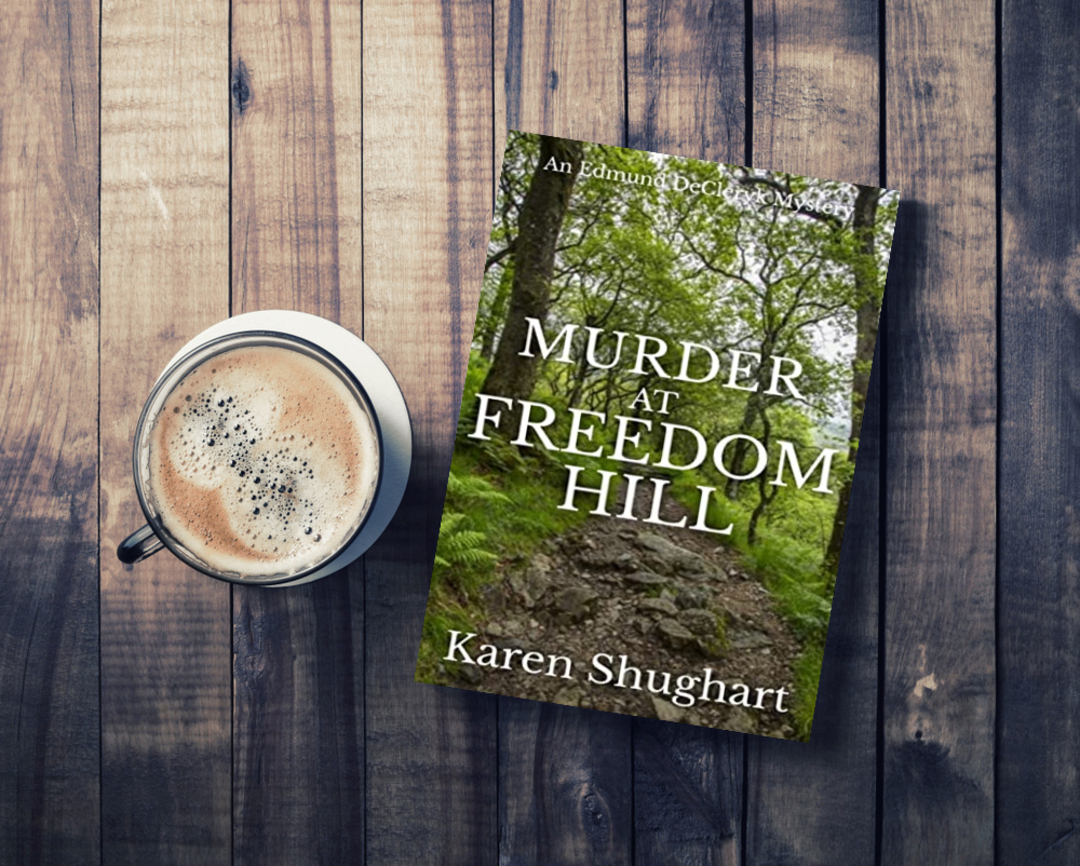
In book three, Murder at Freedom Hill, the crime is thought to be related to the victim’s ancestry, his forebears lived in a settlement where free people of color lived harmoniously with abolitionists who helped transport escaping slaves to Canada across the lake before the Civil War. Another heinous deed, related to that settlement, is revealed during the investigation of the murder.

But what the books also have in common is that I weave into the plot the seasonal setting.  After book one, instead of just one prologue I decided to write two, the first with the historical backstory and the second describing the season.

I continue descriptions of the weather throughout each book, it helps to construct the mood. For example, Murder at Freedom Hill begins in November, before Thanksgiving. In one of the early chapters, Ed discovers that the village mayor has been murdered. A beloved member of the community, the mayor also served on Annie’s board of directors and the two had become close friends. After conferring with Detective Brad Washington at the crime scene, Ed gets into his SUV and drives to the museum to tell Annie about his death. Lots of sunshine and a clear sky start the day, but then the weather changes:

“The brilliant sky at sunrise had made way for clouds the color of brushed pewter that hovered over the roiling silver lake. The day looked like an antique photograph: sepia; gunmetal grey; milky white and black; faded like withered grass. The direction of the wind had changed, picking up speed from the northwest, with fallen leaves swirling around the museum parking lot as Ed pulled into a spot. The temperature had plummeted- winter silently creeping in like a cat about to pounce upon its prey.”

What I enjoy about writing cozy mysteries is the ability to expand description if it fits into the plot, and the weather can either give readers a sense of doom and gloom or provide an interesting juxtaposition to an odious deed.

Karen Shughart’s cozy mysteries are published by Cozy Cat Press. She’s currently working on book four of the series, Murder at Chimney Bluffs.

Guest Blogger ~ Pamela Cowan

I love diving into mystery and suspense thrillers because there’s nothing quite like the satisfaction of seeing an everyday person take on tough challenges and come out on top. It’s like a cathartic rollercoaster ride, and writing thrillers gives me the advantage of being able to control the ride — at least as much as my characters allow.

The inspiration for my latest suspense thriller, “Repoe Man” happened during the early months of Covid. My husband and I had decided to retire so I was living in our vacation home in Southern Oregon while he was 300 miles north, prepping our primary house for sale.

During that time, I got into the habit of nightly chats with an old writing buddy, who used his pen name, Jake. We’d start Facebook threads, and our friends would chime in. One of his friends was Bobby Poe. Their banter was a mix of reminiscing about their rough hometown, and their love for heavy metal and fast cars. I thought their friendship and the way they reminisced was funny and interesting and Bobby’s name was perfect for the character who had started to coalesce in my mind. With their blessing and loads of helpful feedback, I got started on what I affectionately called the “Bobby Poe and Jake book.”

As a person who’d spent most of their career in probation and parole and then in social services, I’d seen the struggles of kids growing up in the foster care system. In fact, my agency was key in helping address one of the more tragic aspects, which is kids who age out of the system and must leave their homes, often with no resources to fall back on. There is no one to help pay for college, or a car, or even offer a place to stay in tough times.

I wondered, what would happen if Jake and Bobby grew up in foster care and were forced to deal with that issue. I decided that without resources or support they might dabble in some sketchy stuff, but since they were basically good and had each other, they would escape real trouble. Bobby would join the military while Jake would discover a marketable talent as a writer.  

That doesn’t fix all their problems though and the novel starts with Jake picking up Bobby, who has just been released from jail. Bobby is ready to make a fresh start, until Jake asks him to help a mutual friend with a problem they can’t take to the police. Bobby agrees and soon finds himself drawn into a dangerous world of crime and criminals.

For this book I did research on burglary, munitions (or how to blow things up), sports gambling, sports memorabilia, cars, motorcycles, sex workers, and law enforcement. I spoke with a drug dealer, a professional thief, a pimp, a retired munitions expert with the Army, a lawyer, and a car mechanic. Each one was fascinating in their own way.

The book was nearly done but I still didn’t have a title. When I told subscribers to my newsletter the problem, I got a flurry of responses. One of them suggested, “Repoe Man.” I thought it was the perfect title for a book about a character who retrieves things for others.

Please note that it is a thriller written in a male voice and contains scenes of erotica and violence. If that doesn’t bother you, I hope you enjoy reading “Repoe Man,” as much as I enjoyed researching and writing it. You can find it here REPOE MAN: A Bobby Poe Novel: Cowan, Pamela: 9781957638966: Amazon.com: Books

Repoe Man

Bobby Poe and his best friend Jake grew up together in foster care, bonding over their rebellious natures, and shared love of fast cars and heavy metal music.

When Jake asks him to help a mutual friend with a problem, Bobby finds himself drawn into a dangerous world of crime and corruption.

Will love, friendship, and the support of a makeshift family be enough to assure his safety and success, or is the damage inflicted by his past too great?

“Suffering from PTSD and a broken heart Bobby Poe still stands up and fights for everyone. A new hero!” ~ Corky Alexander, Simon Says Book Reviews

“Zoey is an idiot.” ~ Haley Lane, Author of The Twilight King

https://www.amazon.com/REPOE-MAN-Bobby-Poe-Novel/dp/1957638966

Pamela Cowan is a Pacific Northwest author most recognized for her psychological thrillers. Her books are known for their dark and gritty themes, exploring the uglier side of human nature. Her short stories have been featured in various magazines, and anthologies, and have been broadcast on public radio.

With an education in communications and organizational psychology, Pamela spent most of her career in social services, honing her understanding of human behavior, which she incorporates into her books. She has two grown children, a supportive husband, and a dog whose life-long goal is to end the tyranny of UPS, USPS, and FedEx drivers. To date, she has not been successful.

Website: https://www.pamelacowan.com/

Facebook: https://www.facebook.com/pamelacowanwriter/

Seasons of Celebration and Frustration

It’s mid-November, and our leaf color display in the Pacific Northwest this year has been nothing short of spectacular. Our drought is finally over, and all the waterfalls along the trails I typically hike are back. I had avoided those areas in the late summer, because it was just too depressing to observe all the dry creek beds. The weather in autumn is typically my favorite, with cool, crisp sunny days.

But I enjoy all the seasons. Spring is always full of anticipation as the hours of sunlight get noticeably longer each day and the blooms and new leaves emerge. Spring, for us along the coastline in the Pacific Northwest It always takes way too long for the snow to melt in the Cascades here, but it’s often fine for spring snowshoeing, so I can conjure up a little patience to wait for the ability to hike on dry trails.

And then there’s summer, the most amazing season of all for high-country hikers, with all the trails melting out and the North Cascades mountain vistas that extend as far as you can see. Mountain goats and bears are around all year long, but are rarely seen in the winter. We are so blessed in this area to have millions of acres of national forests and so many national parks. There are so many trails to explore in Washington State in every direction, I’ll never be able to hike all of them.

So, now it will soon be full-on winter and all the rainbow colors in the trees will be gone. I will, however, still walk the local trails here in the lowlands. I may be one of the few people who actually enjoy seeing the trees in their naked glory. It’s interesting to me to view the branch structures, the differing textures of bark, and the nests that birds and squirrels have built or hollowed out over the seasons. Without leaves, it’s much easier to see the birds that perch on the branches. Owls and hawks are my special favorites.

We still kayak in the winter, but it’s more of a challenge with wind and cold weather and short hours of sunlight. However, it’s always a delight to get out on the salt water. With luck, there will be kingfishers and all kinds of birds along the shorelines, and in the water, seals and harbor porpoises, and the chance to see orcas and whales.

But then there’s snow. I love to drive to the mountains and play in the white stuff there and receive enthusiastic visits from the gray jays that are always ready for a handout. However, I don’t like to see snow here along the coast of the Salish Sea. Snow mucks up the traffic here like you would not believe, because only a few arterial streets get sanded or cleared, so our neighborhoods are left to cope on their own, and many have steep hills to climb or descend. In my area, I often see folks pour out of their houses to help push a stranded vehicle up the street.

I love my independent single life, I truly do. I have lots of friends and all kinds of fun activities that I participate in, such as hiking and kayaking and snowshoeing, and going to movies, plays, and lectures in town. But each year, the holiday season feels to me like it has been uniquely designed to make those of us who don’t have big families feel like total losers.

But now it’s nearly Thanksgiving and the dreaded holidays are fast approaching! While many people look forward to Thanksgiving and Christmas, I detest those holidays, and I guarantee you that many other single, childless people do, too.

I especially dislike Christmas, when everything gets shut down, and so many useless and unwanted items are passed around because of a feeling of obligation. Most Americans have WAY too much “stuff.” It’s awkward to receive a gift that you don’t value. If anyone has to give me a gift, I hope they give me an experience: invite me to dinner or a play, or volunteer to help me fix something around my house.

While I don’t have much in the way of family, many of my friends do, and so they understandably vanish off to spend Thanksgiving and Christmas with their relatives. With luck, I may be able to patch together a potluck with a few single friends or married couples who don’t mind having a single woman at their table. For Christmas, instead of buying token items to the few family members I have, I use that money to make donations to worthy causes who help those who truly need assistance.

So, with more time on my hands in this season, I can finally sit down at my desk to write. I’ve been very slow to work on my next mystery, which will be a crossover novel between my Sam Westin wilderness series and my Neema the Gorilla series. Yes, some days it’s hard for me to imagine that, too. But now that I can focus, I’m sure I can pull it off. Stay tuned.

I plan to call this novel If Only, because the theme is about how we all are born into circumstances that may be lucky or unlucky, and we all make choices that may change our lives for better or worse. Imagine how different our lives would be right now if we had been born in Gaza or in Ukraine or Haiti or Ethiopia. Imagine how we might feel if we had bought a lottery ticket for the first time and won a million dollars, or if we had decided to take the boat out and got caught in a big storm.

That’s how the seasons go in my life. I try to “carpe diem” in all of them. And I hope you do, too.