Who’s In Charge Here?

by Janis Patterson

Once someone asked me to do a workshop on creating characters. He had read several of my books and was impressed with how ‘real’ they all were. Could I, he asked, share my creation process?

I told him I couldn’t do such a workshop, and explained why, but somehow I don’t think he believed me. And I couldn’t blame him, because it’s pretty unbelievable.

You see, I’ve taken all the workshops. I’ve done character sheets and created questionnaires for them, some even to the extent of their favorite flavor of Jello. And every character so created died. Just faded away into cardboard flatness. I have never ‘just created’ a major or even secondary character. Minor characters and walk-ons, yes; but let’s be honest – one doesn’t have to go very deeply into a character who appears just a time or two and has only a couple of lines, if that.

So what do I do to have these apparently wonderfully realistic characters? The basic truth is, I stay out of the way.

You see, my characters come to me. They march into the story and tell me what they’re going to do. If I say the leading man has to have sooty black hair and he says he has a curly red mop, I have to go along. If I don’t, he’ll go sit in the corner with his back to me and not say a word. He won’t speak to me, he won’t do what I tell him to – he just lies there like a lump. Trying to bend him to my will is sort of like trying to make pantyhose out of an oak tree. Sooner or later – if I’m smart – I give in.

It’s the way I’ve worked all my life. I believe in character-driven stories (always have) and therefore by necessity have become a thorough pantser. Though I do have some vague idea of where the story is going, and usually a pretty good idea of where it’s going to end (though not always!) for me writing is simply hanging on for dear life until the characters are satisfied.

On one of my mystery novels I knew from the beginning who the murderer was going to be. There were several villains of one persuasion or another, but the murderer was going to be someone special. I wrote along happily, until about the last third of the book, when I had a sinking sensation in my stomach that the person I had always thought the murderer couldn’t have done it.

Urk.

Okay, I thought for a while and decided that another character just had to be the murderer. Except a chapter later I found he couldn’t have done it either. All in all, I changed the murderer’s identity five times in the last third of the book, and for one reason or another not one of them could have done it.

Double urk.

I was almost to the point of giving up when like a light from above the perfect solution came to me. It was a character I had never associated with the murder and for a reason that had never occurred to me, but everything fit together as if it had been planned from the beginning – means, motive and opportunity in one well-wrapped package. I finished the book with ease. But then – there was the problem of clues. The solution was perfect, but now I quailed at the thought of having to go back through the entire book and plant clues to the murderer. One should always play fair with the reader, after all…

Finally I girded myself for the task and plunged in… where I found to my utter amazement that they were already there. I did add one or two more, just so I’d have some feeling of being in control, but the story would have worked equally as well if I hadn’t. When I think of how many hours I spent worrying and how many scenes I wrote and then trashed…! It would have been so much simpler if I had just sat back and let the characters do the heavy lifting.

That was several years ago and that book is still selling well. It has also won more awards than any other of my books.

My current Work-In-Progress is a straight romance set in the Palo Duro Canyon kindle world of the fantastic Carolyn Brown (who is also a friend, I’m proud to say) and it is ticking along most pleasingly, which means the characters are behaving quite well. Jeri and Doug are total opposites – she’s a sophisticated globe trotting photographer, he’s a tall, strong and handsome rancher – and their mutual attraction is working just fine. I was about 10K into the book when all of a sudden her half-sister who is also her agent (and who I had no idea even existed) started banging about and now she’s worming her way into being a major part of the story… and perhaps the heroine of yet another book that I had never even thought of!

Years ago my late – and adored – mother, a supremely practical woman, listened to me talking about writing with something like despair. “They’re your imagination,” she said half angrily, half condescendingly, “they should do what you say.” Of course, very few living people ever defied my mother… When she tried to write a book on her own, though, she changed her tune. Apparently her characters were a strong-willed as mine. It was a pretty good book, too, but unfortunately she died before it was finished. I’ve been asked why I didn’t finish it for her (like I did her memoir THE LAND OF HEARTS DELIGHT) I can only say that her characters won’t speak to me and I have no idea of where she was going with it. It’s sad.

The Husband has no intention of ever writing anything except a technical report, but when I tried to describe my writing process to him, he thought for a moment, then said “Sounds like possession to me.” He might be right. I just know that I can only pretend to be in control.
Funerals and send-offs

By Sally Carpenter

 I recently read a blog post by a writer in his 70s who said he’s never seen a dead body. He’d never been to a funeral?

It could be the writer was referring to murder victims. But when I lived in the Midwest, viewing the deceased was a way of life.

Commemorating the dead in my rural hometown consisted of three parts: the viewing (called a “wake” in some circles), the funeral service and the graveside committal. The first two parts took place at a funeral home where the funeral director handled all the scheduling and arrangements. Clergy were asked to lead the services, but that was the extent of their participation or input.

 At the viewing, the embalmed body was placed in an open casket, flowers were set out and the public dropped by to sign the guest book, greet the family, and look at the deceased who bore little resemblance to the person in life. I think when I was a kid my mother took me to some viewings of people she know. I thought it was odd to stare at a dead person. Why not visit the person when they were alive and you could talk to them? I also didn’t like how funeral homes looked, too artificial and fussy. Not the place where I’d want to spend my last earthly moments.

At the brief funeral service, an organist played syrupy music and a minister gave a short talk. While the guests were still inside, the funeral home affixed little flags to the hoods of their cars to mark them as part of the processional. With the hearse carrying the casket and the limo with the family members leading the way, a long line of vehicles moved at a snail’s pace to the burial site. Since funeral processions had the right of way, many times I had to sit in traffic while an endless stream of these cars passed through an intersection.

 The committal service was even shorter, since people usually stood by the gravesite (except at my mother’s funeral, we sat in padded folding chairs beneath a canopy). Unlike what you see on TV/movies, the casket was never lowered into the ground and nobody threw dirt or flowers into the grave. The actuall internment took place after friends and family had left. Weeks or months later the gravestone was finally put in place.

 For one of my uncles, the internment consisted of his widow showing up at the family plot on her own, and placing his urn of ashes into a pre-dug hole. Other family members, including myself, happened to be there at the time (must have been around Memorial Day for our annual visit to the graves of mom’s parents).

 At my dad’s funeral service, my brother brought his young children. Even though they were not close to grandpa, they became hysterical when they saw the corpse and their mother took them out of the room for the service. I think their reaction was not grief over the loss but that their young minds had trouble processing a human death.

 Now I live on the West Coast and funerals seem to be done differently here. I’ve never seen a funeral processional, although during the day I’m at my day job. But with the heavy congestion on local streets, a long, slow-paced procession would not be practical.

Religious funerals are now taking place in churches rather than in funeral homes. I’ve attended two funerals at different churches. For me, the services more meaningful and longer and included congregational singing.

 “Home made” memorial services without the body present are replacing the traditional funeral. Family and friends, not processional morticians, plan and lead these informal services set in a home or a favorite bar or restaurant. Acquaintances share stories of the deceased and make toasts in their honor.

 I’ve attended two memorial services set in different community theaters where the deceased was an active participant. One of these funerals screened a video montage of the decease’ stage roles. At the other service, the deceased’s collection of Beanie Babies was set on the stage. Afterwards those present were invited to take a toy home as a memento (the cat I picked sits near my computer). And on my way into the building, I was asked to say a few words during the service. I’m not good at impromptu speaking, but I managed to sound intelligent and even (unintentionally) coax some laughter from the audience.

 How are funerals conducted in your town? What do you think is the best way to “send off” a loved one?


Hidden Tracks

Amber in tree final I have files with titles such as “Accidental Shooting Settlements” and “Art Authentication” as well as “Pricing Art” and “Parrot Questions.” I finally deleted the one on 1989 Aerostar vans. The struggling old van made it through Shaman’s Blues and Snake Face and retired, with no one commenting on how I’d handled its various mechanical problems. That’s how it should be. I want to hide my tracks. Readers usually shouldn’t be paying attention to my research, but since this is a blog about writing, I’m going to go backstage and show the process.

Readers notice all the scholarly articles in The Calling. This book may look as though I worked harder on research compared to the rest, but in fact it was the easiest. I didn’t venture outside my areas of expertise, and I set it in places I knew well.When I lived in Norfolk, I’d visited a number of alternative healers there and several psychics in Virginia Beach—out of pure curiosity, with no idea they would end up as background for a book.  An important character in this story is a professor in health sciences and so am I. To find the material on alternative medicine and research in the field, all I had to do was relocate the right articles. I knew where they’d been published and I remembered the content.

More often, I don’t realize how much I’ll need to know about a subject until I’m into the first draft of a book. I immediately start keeping research lists, things to look up or ask experts about, and I dig into these questions as I go along.

When the character of Jamie showed up in Shaman’s Blues, I read books about current Australian Aboriginal culture in order to understand his roots. I studied Aussie slang and was blessed with an Australian critique partner who could tell if I got it right. And then there’s his van. It’s close to being a character in the next book, Snake Face. I took notes during Car Talk. I looked up timing belts and timing chains, I looked up the last year that these vans were made with carburetors, and I looked at pictures of their engine parts. A musician who had toured with a band read the manuscript to make sure I portrayed life on the road correctly. And I consulted a couple of lawyers about a major plot point. I double-checked some details of the medical treatments and outcomes for a particular injury. And I searched out the name of a Greek drinking dance. This is, I think, typical in the creation of a book, more typical than the ease with which I could pull together the seemingly obscure scholarship in The Calling.

For Soul Loss I reread some books on neo-shamanism to refresh my memory of a strange workshop I once attended as part of a conference, and I researched Tarot cards and Cochiti Pueblo beliefs about the dead. I also had to find out what was involved in setting up a festival. For Ghost Sickness I had to study up on parrots, since several play roles in the story, and also looked into rodeo injuries, and many matters related to art. Even though I’d set the story in familiar places, I revisited the Mescalero Apache reservation and took a careful, observant walk through Truth or Consequences to make doubly sure that certain events could happen as I wrote them. I could go on and on. It’s amazing what I discover that don’t know—or what I’ve forgotten that I thought I knew. But that list with the heading “Look Up” eventually gets crossed off and ideally readers have no idea I had to work so hard on that van. All they need to care about is the character driving it.

August is My Birthday Month

Looking back over the years, some birthdays really stand out for me. Remember, I’m really old and people didn’t do the expensive parties that they do now, nor were there places to buy decorations, party favors and games..

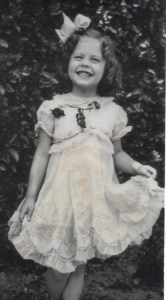
The first one I can remember was when I was about five and my mother planned a fairy princess party. I don’t remember too much about it, except that all the little girls that came got crowns, and I had a big one, plus a wand.  My auntie made all the favors.

Me as a flower girl.
Not the party dress, but that’s about the age I was.

Around the my tenth birthday or so, my mother planned a luncheon party with a Mexican theme. My two girls cousins and my best school friends came to that one.

When I was in junior high, the celebration was held in Chinatown in downtown L.A. and we traveled on the streetcar to get there. There were others, of course, but those are the ones that stand out in my memory.

I’ve had lots and lots of celebrations as an adult because I’ve been around a long time.

This is also the month my first child was born–and I lived 3000 miles away from my family. (Remember this was a long, long time ago.) My husband was in the Navy in Virginia and had the duty the weekend that I gave birth–and I lived in Maryland. Hubby arrived to see his daughter the next day. Looking back, I knew nothing about raising a baby. I had a Good Housekeeping baby book, and did everything it said to do.

This is the month my first child got married too–being a poor Navy family, we made all the bridesmaids’ dresses, daughter made her wedding dress, I did all the flowers using the neighbors’ daisies and a rosebud lapel pin for the groom, a neighbor made the wedding cake and I cooked all the food for the reception. (It all turned out great.)

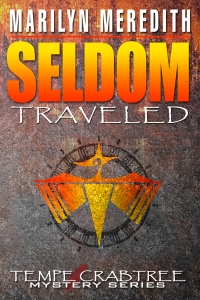
August is also the month that my Deputy Tempe Crabtree mysteries come out–and yes, the new one is now available on Amazon.

SeldomTraveledFrontCover new

The tranquility of the mountain community of Bear Creek is disrupted by a runaway fugitive, a vicious murderer, and a raging forest fire. Deputy Tempe Crabtree is threatened by all three.

https://www.amazon.com/Seldom-Traveled-Tempe-Crabtree-Mystery/dp/1594264333/ref=sr_1_1?s=books&ie=UTF8&qid=1471655178&sr=1-1&keywords=seldom+traveled+by+marilyn+meredith

As you can see August is an important month for me, full of memories and exciting things ahead.

Marilyn


On the Hazards of Seat-of-the-Pants Writing

copyWhat have I been up to since I last posted? Well, as I told you last month, my new book, PSYCHIC DAMAGE, is out. I’ve had a couple of book signings, both at great bookstores, with other writers from Sisters in Crime/Los Angeles. I also moderated a panel at a library in Santa Monica using as our topic “Murder is Where You Find It”. These were all fun, partly because I wasn’t appearing by myself but with other writers. It’s always fun when you have other people to talk to on the podium.

I have also finally (!) unstuck myself in the writing of my latest Florida mystery, as yet untitled. Because I never outline and only start with a vague idea of what’s driving the book and where it’s going, I ALWAYS get stuck somewhere around half way through. I don’t know what’s going to happen next, I’m sorry I ever started, and I wonder what I was thinking when I considered the book a good idea. I wake up thinking about the problems, mulling solutions over in my head, without coming to any brilliant—or even serviceable– solutions. And I find myself depressed, feeling that I’ll be stuck forever.  Maybe I’ll just give up this book and start fresh.

Candy, my writing teacher, tells me I always do this, but since I don’t remember feeling this way before, I think she’s just trying to make me feel better. This time my being stuck lasted longer than usual, and even she began to wonder about me. Then she suggested that, since I had several threads in the book, several ways it could go, that I try following each of them separately from the rest of the book, to see where each of them led me.

Wonder of wonders! I followed one thread to the end and found a logical and conclusive ending. Then I followed another, with a few detours along the way, but I think now I know where I’m going.  I hope I can follow it through to the end.

If you’re a writer, it’s probably a better idea to have some idea where you’re going rather than write the way I do. On the other hand, I’m constantly surprising myself with the paths my books take that I hadn’t planned out at all. And surprising myself is a lot of fun!

In the meantime, my house is still a mess with the kitchen remodeling going on. The walls and cabinets are painted, the lights are in, but the floor hasn’t been done yet and there seems to be a leak in the ceiling.  House remodeling is never fun?