Fingerprinting by Paty Jager

canstockphoto17652788My current work in progress has been interesting and fun. I’ve had numerous conversations with forensic and law enforcement employees about fingerprints.

While the fingerprints on an object doesn’t help find the killer in my book, the illusion they are important draws the reader into a speculation of what-if and hopefully lets an important piece of the puzzle become a throw-away thought.

What I discovered while asking questions about how fingerprints are stored and who might have access to the fingerprints came from a variety of people and, not surprisingly, they all had a bit different take on it all.  Which led me to believe, I could do what I wanted in discovering who had their hands on the weapon. 😉

When I looked up fingerprinting, I discovered there are many jobs where fingerprints are required.  Medical, educational, and of course law enforcement. But also, companies that contract government work.

What I wanted to know dealt with my medical examiner, a local doctor given the honorary title and honor of pronouncing people dead, and a person who came from another country but had gained U.S. citizenship thirty years ago. Would they have fingerprints in “the system”? The answers were varied on the M.E.. Yes, most would have had their prints taken, but they wouldn’t be held in a local police database or AFIS (Automated Fingerprint Identification System). They also said my new citizen would not have had fingerprints taken unless arrested or had a job that required it, and they would only be in the system if arrested.

So millions of people have their prints taken for jobs. What happens to those prints?

According to the law enforcement people I contacted, the employees either send the prints to a local print collection business or they are sent to AFIS. If the prints come up clean, the ten-print cards are then either put in the employees file or trashed. They don’t go into a national system.

So, if you haven’t done a crime and you are fingerprinted, you have nothing to worry about. And your prints shouldn’t wind up in any databases. But what if you had a crooked person running one of the databases, and they did keep your prints to use when committing crimes????

That just may be another book!

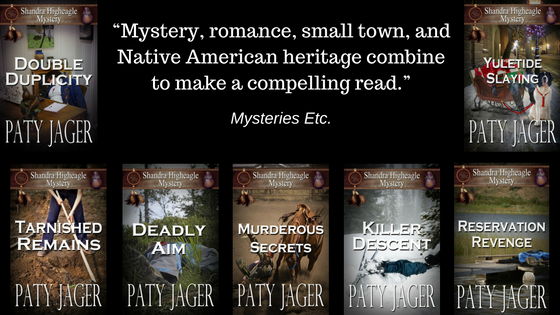
higheagle-book-banner
photo source: © Can Stock Photo / peshkova


When a book festival isn’t so festive

The fact that the Los Angeles Times Festival of Books is America’s largest literary event doesn’t necessarily make it the best.

Each year my Sisters in Crime chapter rents a festival booth where members can sell their books. I hadn’t gone in past years because I don’t drive in L.A.’s notorious bumper-to-bumper freeway traffic, but this year the Friends of the Moorpark Library chartered a bus for anyone wanted to ride to the event. Since I could travel stress-free to the USC campus, the site of the event, I signed up.

The bus dropped us off at the festival entrance, thus sparing us a long hike from the distant (and pricey) parking garages. The “booths” were white tents with the vendor’s name and the booth number professionally printed on the tent flap, making identification easy. Most of the booths were set up along a walkway running the length of the campus from north to south. Other booths branched off along east and west walkways, some easier to find than others. Since the campus lacked a large central grassy area for staging such events, the booths were spread out so much that one needed to walk a lot.

And walk I did, in 90-plus-degree temps and bright, blinding sunlight. My bus arrived at 10 a.m. and by noon I was sweaty and tired and I’d only seen half of the booths. Had the festival been set indoors in air-conditioned comfort, I would have fared better; I don’t function well in heat.

The vendor selection was disappointing. Most of the booths contained self-pub authors with works of dubious quality, gritty/underground niche publishers or local indie bookstores. Other vendors hawked publishing (vanity presses) or editorial services.

Some of the better companies specialized in comics or children’s books—I got a kick out of the reissues of the Little Golden Books for kids. Besides Sisters in Crime, several other organizations were present for horror, romance and mystery writers as well as small presses.

Several booths promoted Islam; New Age groups and Atheists United were present. But in the second largest city in American, not one booth represented Jewish or Christian publishers or bookstores. Go figure.

I wanted to check out the old and antiquarian books, but to do so I had to enter a stifling hot booth and move along aisles only wide enough for one person. Since I was toting a heavy shoulder bag (I didn’t know what I’d need, so I packed everything), squeezing through narrow aisles and dodging other people didn’t seem doable.

At least the Vromans (a large indie bookstore in Pasadena) booth had a fan, which made browsing enjoyable. Barnes & Noble was not present.

Due to the size of the tents, inventory was limited and I found little of interest.

A number of booths had pushy vendors who unloaded a sales pitch on any passer-by. I stopped making eye contact with dealers and avoided getting close to the booths.

The L.A. Times booth had some nice umbrellas that would have been helpful on the hot day. As I approached a woman staffer asked if I had a subscription the Times. When I said I subscribed to the L.A. Daily News, she spouted off on a loud, angry rampage. I walked away without an umbrella or a subscription.

One bright spot was the free health screenings offered by the USC School of Pharmacy. The young students were professional, competent and friendly, with no wait time for services.

My book signing lasted one hour and was uneventful (euphemism for no sales). L.A. is not a cozy mystery town. Many strolled by, but only a handful stopped by the booth and most of those people were friends of the other authors present.

When my time was up, I took my unsold books with me. My suitcase had wheels but it was still heavy and a bother to lug around, especially since I was trying to worm my way through the crowd. Now I know how a salmon feels swimming upstream.

Finding a place for lunch was challenging. I avoided the high-priced campus restaurant with a 30- to 40-minute wait time. After hoofing to the edge of the campus, I found a tiny coffee shop with no salads left and only two choices of sandwiches. Lunch was an $8 turkey pesto pre-made sandwich wrapped in cellophane. At least the building was air conditioned. 

 Later I discovered the campus also had a food court and some food trucks for the day. Where were they? I couldn’t find them on the map or by sight.

As for the restrooms: I could have used the restrooms inside the buildings, if I didn’t mind standing in line for 20 minutes. I settled on the Porta Potties with no wait time. In a pinch I can rough it.

I didn’t go to the panel discussions since I didn’t know the writers and from the titles of the talks, most of the panels seemed to have far-left bias.

 I saw few people carrying or buying books. Apparently most people came to the festival because admission was free and it was a “big event” and “something to do” on a sunny weekend. Or maybe they just came to listen to the outdoor band concerts or shop at the campus store. I didn’t feel much of a literary vibe or maybe I was just too hot and tired to notice.

 Will I go to the LATFOB next year? Probably not. But I did meet some nice people on the bus, and I got a nifty orange festival tote bag for free.


 

The Dunning-Kruger Effect and Writing

You may have heard of this phenomenon, but if you haven’t, here’s the short version: studies by Dunning and Kruger found that competence and confidence don’t always go together. Being a professor, I’ll give an academic example. Students who have the least knowledge of a subject often think they did best on the exam. They lack the foundation from which to question themselves and are amazed when they get Fs. Students who understand more of the material tend to be critical of their performance, in part because they assume others worked as hard as they did. Also, they know enough to know they aren’t perfect. Their sighs of relief when they get As and Bs are sincere. They had doubts. Confidence goes back up when students have real mastery, but not as high as the confidence of the truly ignorant.

What does this have to do with writing? I don’t know about you, but I had no idea how bad the first novel I wrote was at the time I finished it. The theme and the setting still speak to me, and the characters have potential. The writing, however, makes me cringe. I know enough to recognize its faults now and am glad I didn’t inflict it on anyone. Salvaging it would be more work than it’s worth.

Having reached competence but not genius, I’m now in the dip in the confidence curve. I’m stunned that my critique partners haven’t suggested major changes in my work in progress. They noticed places where I could improve it, of course, but I expected they would find problems in the plot, and they didn’t. They said the mystery works. Maybe it flowed well because it started with material I cut from an early draft of the book before it, Ghost Sickness, and because it deals with themes I care about: ethics, spirituality, health and illness, and the exploitation of desperate people.

Nonetheless, before sending it to the next set of readers, I’m going through it to see where it could tighten up further now that I’ve been away from it for a couple of months, drafting the book that follows. So far, I’ve kept myself from acting on the urges of the little demon in my head that’s telling me I should rearrange huge chunks and cut others. I can think of important scenes I almost cut from two other books, scenes which turned out to resonate deeply with readers, so I’m not giving in to the demon, but I wonder if I’ll be relieved or alarmed if the next set of critiques don’t tell me to tear it apart and start over.

Over the Easter weekend, I did my first ever book signing event. After ten years onstage acting and then twenty-odd years as a college professor, I didn’t have jitters about either the reading or the question-and-answer session. It was informal and enjoyable. I sold a few books and got feedback that I should narrate my own audio books, so I trust that my perception of success is not a Dunning-Kruger effect. I plan to try reading the WIP aloud after I complete the current round of revisions and see if it feels alive and ready for an audience. I’ve never done that as part of my self-editing process, but it may be exactly what I need. The actor in me may notice pacing and energy in ways the silent reader doesn’t. If I hear it and cringe as if it were that old first manuscript, I’ll know I have more work to do. If it plays, then it’s ready for the next beta readers, and I’m ready for whatever they tell me. The challenging thing about the Dunning-Kruger effect is that when it applies to us, we can’t tell. One of many reasons I can’t live without my betas.

Writing Can be Painful Sometimes

Many times I’ve written how wonderful it is to be a writer, to be in control of my imaginary world, to find out what is happening in the lives of the characters I’ve come to know and love.

However, there is another side to this whole process–one that can be agonizing. Right now I’m writing my next Deputy Tempe Crabtree mystery. It has some similarities to an Agatha Christie novel in that it is about a group of people confined to a small space. Trying to keep the momentum up, with enough action, and scary developments isn’t easy.

Another painful part of writing is when a book you’ve nurtured along and feel like it’s one of your very best, doesn’t sell as well as you hoped. Then you wonder if maybe it wasn’t as good as you thought, or maybe you fell down on the job when it came to promoting.  There are times when I’ve even wondered why I keep on writing.

Okay, so if I’m not getting famous or rich from spending so much time on writing, why do I continue?

The simple answer is I am compelled to keep on writing. I’ve written my whole life–what would I do if I didn’t write? How could I ignore all those plots that keep popping into my head? The ideas that spring up just as I’m falling asleep.

How about you, fellow writers, do you ever feel the same?

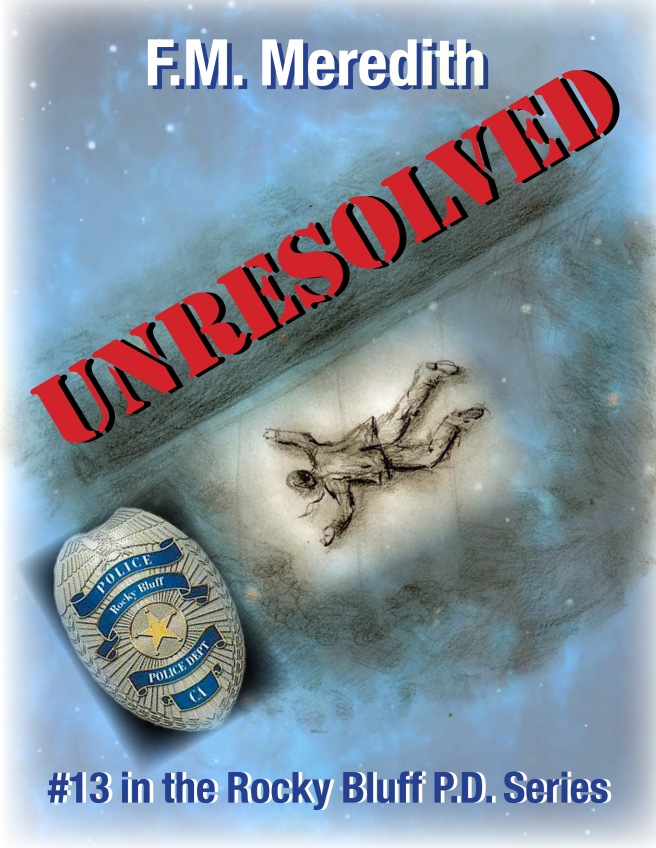
This is my latest Rocky Bluff P.D. mystery, Unresolved, which I wrote as F. M. Meredith. As always, I hope readers will enjoy it.

Blurb:

Rocky Bluff P.D. is underpaid and understaffed and when two dead bodies turn up, the department is stretched to the limit. The mayor is the first body discovered, the second an older woman whose death is caused in a bizarre manner. Because no one liked the mayor, including his estranged wife and the members of the city council, the suspects are many, but each one has an alibi.

https://www.amazon.com/Unresolved-F-M-Meredith/dp/1938436245/

Marilyn

Unresolved

LETTING YOUR CHARACTERS TELL THE STORY

Dialog: it’s the part of the story that makes the characters come alive on the page. When characters speak and how they speak create the atmosphere of the story.  Stories without dialog are told, not shown.

So, you, the writer, have to know your characters well enough so that when they speak, they sound like real people talking the way real people do.

What’s the purpose of dialogue, anyway. Is it to advance the story? Is it to reveal the characters? Is it just to break up the page?

I guess it’s all of those. Dialogue can be used to move the story along. But beware of the dialogue that is used to have one character tell another things that the second character already knows but that the reader doesn’t.

For example:

Smith said to Jones, “I’m glad you’re in on the Alpha Project, Jones. The Alpha Project is definitely the future of communication. You have the skills we need to capture the evil one.  I saw the way you managed that matter with the doctor, and I know you won’t have a problem with the evil one.. Our plan is to use you to scare him into letting himself be caught.”

It would certainly be much more interesting if we saw the way Jones managed the matter with the doctor and why he (or she) isn’t afraid of the evil one. In fact, all of what Smith said could be action, not dialogue. This kind of dialogue makes the reader yawn.

You need to be aware of who your characters are and how they talk. I’m not a fan of dialect and will usually bypass books where the characters obviously talk like people who live in Appalachia or Louisiana. I think the writer can convey the way the characters talk without resorting to dialect.  However, if you’re going to set a story in the deep South, for example, you may have to use some dialect. Just, for my sake, try to minimize it.

But you have to know your characters well enough so that they not only sound like real people but people who are different from one another. I have some difficulty with the male protagonist, Greg Lamont, in my Florida series. He’s a police detective and not a great talker, but I find myself having him talk more than he should.  He sometimes sounds like a woman, and I need to pare down his dialogue.

Andi Battaglia, Greg’s partner, talks more, probably because she’s female. She talks a lot when she’s nervous, kind of a character flaw. I need to keep that in mind when I’m writing.

There are differences of opinion among writers as to whether to use “he said,” or “she said,” to forget them entirely, or to always, or most of the time, indicate some action that identifies the speaker. I know I have read passages from writers, where there is not even a “he said” or “she said,” which means the reader must guess which of the characters said what. Sometimes that’s easy, sometimes it’s not, and sometimes the reader has to go back to check who was last identified as the speaker and count down.

Using something that indicates how the words were spoken or using an action to go with the dialogue is a good way to get the reader to follow. For example, “He said with a forced smile;” “She said as she picked up the cup of tea;” “He said, shifting in his chair.” But you can’t always do that, and sometimes I find myself so carried away with what the characters are saying that I don’t look at them as they’re talking.

You can reveal a lot of information about your characters simply by the way you have them speak.  I’m always learning new ways to use dialogue.  What are your thoughts about dialogue?