What a Difference a Lockdown Makes

I’ve been sheltering in place, more or less, since mid-March, when I got back from Left Coast Crime, which turned out to be about 24 hours long instead of the usual long weekend. I flew to San Diego on Thursday morning and the San Diego County Health Department cancelled the convention that afternoon. After rescheduling my flight to Friday morning, I adjourned to the bar. Me and a lot of other attendees. Prosecco helps!

A few days later, the governor issued the first stay-at-home order for California. Aside from my weekly jaunts to do errands and buy groceries, I’ve been—no surprise—staying at home. I did venture as far as Sonoma County at the start of the summer. From time to time, I get together for lunch with fellow authors Marcia Muller and Margaret Lucke, at a nice restaurant where we sit and talk as we eat delicious food. Not happening in 2020. We brought our own lunches and ate while socially distanced on a sunny back deck.

That’s the farthest I’ve traveled, including that jaunt to Berkeley to see my dentist after his office finally reopened. The good doctor wore a face shield and one of those paper suits. He ruefully informed me this was the “new normal.” Right now, normal is my collection of masks in a container near the front door, ready to grab and wear whenever I leave the house.

The lockdown of 2020, which has now spilled over into 2021, did not propel me into cleaning house or decluttering the closets. You know, those things I said I would do if only I had more time. Well, I had more time, but I can put that stuff off another year or so, just watch me.

More time to write, yes. And I used it. I finally finished a book called The Sacrificial Daughter.

I started the book over five years ago, in 2015. It took me a long time to write it because I was also writing books for Perseverance Press.

During that time, I wrote two books each in the Jeri Howard series (Water Signs and The Devil Close Behind) plus two books in the California Zephyr historical series (The Ghost in Roomette Four and Death Above the Line). I was under contract to finish those books by a certain date, so they took precedence.

Once I finished each book, I went back to The Sacrificial Daughter, reading through what I’d already written to get the creative juices flowing again, making decisions about characters, settings and point of view.

When the lockdown came in mid-March, Death Above the Line was on its way through the publication process. Suddenly I had time. My 2020 calendar, full of dates to go to the theater, the symphony, museums, now had page after page of cross-outs. Not going anywhere. At that point, I was already well into The Sacrificial Daughter, about three-quarters of the way, with a good idea of how it was going to end—and how to get there.

I got there. I finished the first complete draft. Then I read and tweaked and polished my way through revisions, with an assist from several readers.

I plan to publish the book myself, in my role as one-half of a publishing company called Bodie Blue Books. Back in the day, my publisher handled all that stuff. Now it’s me, shepherding my new book through formatting, cover design, and copyright.

Come February, I hope, The Sacrificial Daughter will be published, by me, in my role as publisher for Bodie Blue Books.

So I did get something done during lockdown, even if it wasn’t cleaning out my closet.

REFLECTIONS OF MY 2020 WRITING LIFE

As you may have already guessed, this past year was nothing like I expected—and no surprise to any of you because your lives weren’t anything like you expected either. For this post, I’m going to stick to what happened or didn’t happen as per my writing life.

Before I’d made up my mind whether or not to attend the two big mystery cons, Left Coast Crime and Bouchercon, both to be held nearby, the virus struck and they were both cancelled.

I’d signed up for a local writer’s conference in March, and it wasn’t long before it was canceled too, as well as the wonderful Central Coast Sisters in Crime conference in April.

My favorite conference of all, the Public Safety Writers Association’s, held in July in Vegas. was axed too. Two big book fairs in October disappeared from the calendar.  In November, I was supposed to be the speaker for the Nightwriters in San Luis Obispo—but of course, that was cancelled too. 

The only in-person event that survived was a two-day holiday boutique held in the Porterville Art Gallery, and yes, I had a booth. People wore masks and kept their distance. I sold books and others sold crafts. No one got sick.

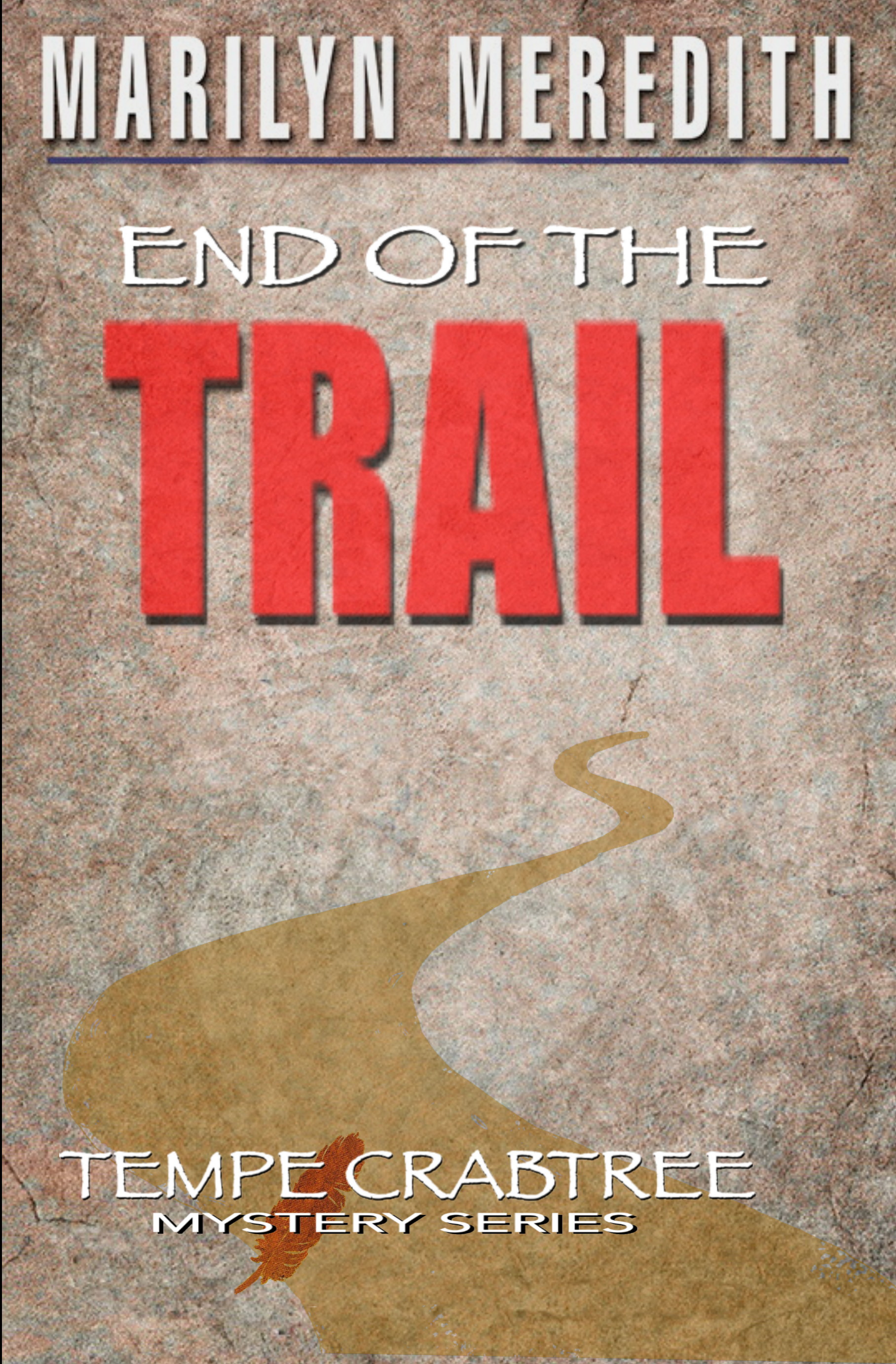
My latest book in the Deputy Tempe Crabtree series came out, End of the Trail, and I really thought it would be the last in the series. However, I’ve changed my mind, because when I made a trip to visit my eldest daughter, I got a great idea for another  mystery in the series.

I also finished Not As We Knew It in the Rocky Bluff P.D. series. I did the forbidden and included the virus because I felt I had to—the series is in real time and to be honest, I had fun writing it.

This is where a problem came along. I’ve always had parties on the occasion of a new book coming out, held in various locations. Of course, this year it couldn’t happen. This meant all my promotion efforts had to be online, and online they were.  I did a free e-book promotion for one of my favorites in the Rocky Bluff P.D. series. It did a fairly good job enticing people to buy some of the other books in the series.

With End of the Trail it was mainly Facebook and Blog Posts. Certainly this was not nearly as profitable as doing in-person events.

What I’ve missed most is my writers’ critique group, being with my writing friends, and sharing out writing.

Lifting my cup of Chai latte, “Here’s to a better 2021 for all of us.”

Marilyn who also writes as F. M. Meredith

Yes, I forgot . . . by Susan Oleksiw

This post is late because, well, I forgot. But I’m in good company. 

My daily newspaper hasn’t arrived for the last four mornings, though one arrived late in the afternoon. This seems to happen every year, right after I send them a check to thank them for their very reliable delivery the rest of the year.

Every year my husband and I pick out a tree about two weeks before Christmas, but this year all the trees were gone by then. Not even a live tree (in a root ball) could be had. So we bought what was meant to be an urn tree, and so we have the smallest tree we’ve ever had. I rather like it—easy to maneuver, easy to decorate, and easy to move back outdoors for the rest of the winter.

Last year we had dinner at a nice restaurant in Salem, MA, but that wasn’t possible this year. Nevertheless, we received an email confirmation for a reservation for Christmas dinner—one year late! 

On dismal weather days, of which we’ve had several, our dog is slow to get moving, which means he wants his morning walk later in the morning, closer to noon. This means that my husband’s midday walk comes earlier. I consider this another category of lateness but my husband considers it an unnecessary disruption to his schedule. In previous years, with a different dog, I had to drag the animal outside. During a snowstorm he would go no farther than the porch. I no longer do that. If a dog wants to go out in bad weather, he can ask.

Every year I make Christmas cookies. This year I burned several—I was late taking them out of the oven—but my husband is too nice to point that out. Besides, they’re still tasty.

My wishes for a Happy New Year are early, which makes a nice change. In 2021 I hope to get in sync with the rest of the world, or perhaps the rest of the world will sort itself out and we’ll all end up on the same page—emerging from isolation grateful to have survived healthy and ready to meet people without fear of infection.  I look forward to being on time in 2021, along with everyone else.

Snow, Snow, Snow!

Every time I watch either A Christmas Story or Prancer on television, I am a kid again in the Mid-West, knee-deep in Christmas snow. And, as everyone knows, a Christmas snow is magic. The stars seem brighter, the possibilities endless, and joy abounds.

In the Mid-West, every hill is a possible sledding hill. The best ones have a stream at the bottom meant to be dodged or jumped. We glided through orchards, through woods, down steep hills fast enough to launch ourselves over that stream and around a corner, laughing the while. We each had your standard flexible flyer, and someone always trailed a toboggan. The type of sled used depended on whether the snow was wet, dry, or icy. The worst part of sledding was dragging your flyer uphill for the next run. And, of course, the occasional crashes.

A certified sledding hill!

Toboggan crashes were the worst, especially when the driver yelled right. Always. Trust me, always, half of the riders leaned right and the other half left.  The toboggan hit the tree dead-center every time, skyrocketing the riders up, out, and head first in the snow. When we were tired beyond standing, bedraggled, and frozen, we lumbered home, sleds and toboggans in our wake.  If we were lucky, a cup of hot chocolate loaded with marshmallows was bubbling on the kitchen stove. If we weren’t, we heated milk and spooned in chocolate powder from a can. It worked.

Back then, we walked to school, the girls in skirts, half-socks, boots (sometimes leggings), coats over the whole, hats and earmuffs and mittens and… The camaraderie of walking, picking up friends at each street corner, teasing, and throwing the odd snowball took our minds off our blue lips and pink legs all the way to our two-story brick school building. Yes, with a flagpole just out front. Cloakrooms were invented for winter. It took us an extra ten minutes to hang up our heavy coats and get our feet out of our dripping boots. Once in class, we spent the day mooning out the classroom window, hoping the snow would stay until the weekend so we could romp and stomp in it until dark, about 4:30 in the afternoon.

A weekend snow was the best. Waking to a sparkling, uninterrupted field of white ripe for snow angels, or a game of fox and goose stomped intricately on the lawn (complete with the berry patch) was heaven on earth. The rules of fox and goose were as loose as the design, sort of a Sorry gameboard but trickier. It was a Dr. Suess version of tag gone mad with safe zones and castle keeps.

I grew up in snow country then joined the Navy and ended up in California. In the second book of the Cooper Vietnam Era Quartet, Head First, Lieutenant Robin Haas, from Michigan, stationed in Monterey, CA, sings my lament.

After five years in California, it still seemed ridiculous…to buy a Christmas tree when it was sixty degrees outside. At least there was some hint of seasons for those on the Monterey Peninsula, though you had to be astute to detect it. Winter was more a chilling down and brightening up than anything. Summers were cold, foggy, and filled with increasing numbers of tourists…  

Robin picked out a six-and-a-half-foot Jackpine from the Christmas trees leaning against the Base Exchange wall. She shook it out to check its shape, ignoring the disapproving Monterey pines that shadowed her in the setting winter sun.

Towhee bathing in a new snow!

A fresh snow still thrills me. Each one holds the promise of fun. I suppose that is why I love to be in our cabin in the Sierras when the flurries begin to fly. The dream of a bright morning sun shining on a field of unbroken snow, waiting for that first footstep, first sled ride, or the first ski run. And is why I dream of buying a little Cape Cod house on a horseshoe-shaped street with the wild toboggan hill (stream at the bottom) just off the next road up but one.

Happy Holidays and Snows to all!

D. Z. Church

Head First is available at: https://www.amazon.com/Head-First-Cooper-Vietnam-Quartet-ebook/dp/B07QG4M97T

A Love Story by Karen Shughart

“He alone is great who turns the voice of the wind into a song made sweeter by his own loving.” Khalil Gibran

In the fall of 2016 my mother suffered a series of strokes and went into a nursing home in Pittsburgh, where she lived. My father had died; I became her power of attorney and had her mail forwarded to me here in New York. That December she received a letter with a return name and address that I vaguely recognized. I opened it.

It was letter from a man named Norge Santin, who was inquiring after my mother, our family, and Leonard, my mother’s brother. Then I remembered that Norge was a childhood friend of theirs when they were growing up in Ohio.

My uncle had died earlier that month; after reading the letter I wrote back, apprising Norge of his passing and my mother’s health issues. He responded quickly, saddened by my news. He knew who I was, he wrote, we’d met when my parents lived in Ohio shortly after I was born.

What ensued was a friendship between us, for a time through letters, then by email and phone. Norge grieved with me when my mother passed three years ago and comforted me when one of my brothers died last summer. Each time we made contact, he ended by offering prayers and blessings for my uncle and mother and sending love to me and my family.

He filled in some blanks. I learned that he and my uncle were not just friends, but best friends, starting in third grade. When the two young men graduated from high school they were drafted, it was World War II, and their college plans were placed on hold. Norge returned from the war, got his degrees, married, and had children.

Leonard was not so lucky. Suffering a breakdown during the war from which he would never recover, he spent his remaining years in and out of VA hospitals and group homes. My siblings and I knew his tragic story; our parents made sure he was always part of our lives. What I hadn’t known was that Norge remained a devoted friend to Leonard throughout his life. During visits when Leonard was withdrawn and unresponsive, he’d sit quietly with him, holding his hand.

Eventually our family moved Leonard to Pittsburgh. Norge, despite living in Ohio, continued visiting my uncle until Leonard decided that he no longer wished to see him. Maybe it was too painful to be with Norge, we’ll never know. Norge respected his wishes and never contacted him again, but his love for his friend never ceased; he contacted my mother to receive updates, up until the time when I opened that letter.

By 2019 Norge’s health had declined, he had trouble reading emails and spoke haltingly over the phone. I wanted to meet this man I’d grown so fond of, so that October my husband and I drove to Ohio to visit Norge and his wife, Therese. We were warmly welcomed and spent a lovely afternoon; all of us feeling as though we’d known one another forever.

Because of Covid there were no return visits, but we talked regularly, most recently just before Thanksgiving when I promised to call again before Christmas. Before we ended that conversation, Norge confided he thought his time was near. I told him I loved him, he said he loved me back.

Two weeks ago, I received a call from one of Norge and Therese’s daughters that broke my heart. This tender, humble, gentle and honorable man had passed and Therese, despite her own grief (they were married for 68 years), wanted to make sure I knew. His death, at 94, occurred almost four years to the day of the death of my uncle.

I’m so glad I decided to open that letter, my life is immeasurably enriched because of it. Therese and I share a strong bond; I’ll keep in touch with her and visit when it’s safe. And I miss Norge already. Rest in peace, dear friend.