Shove Everything To One Side – And Write

That’s what my mother used to say, back in the era when I had a day job. Time to write was limited. So I got up early in the morning and wrote before heading off to the day job.

I also had deadlines. Which would make me crazy. I felt as though I never had enough time to devote to the writing, what with said day job and the day-to-day at home. Vacuuming, decluttering, and other delights of caring for my home, as well as keeping ahead of the weeds in my garden. Exercise, yes, doing that as much as possible. And keeping up with friends and family, the social connectivity that is important in my life.

Back when I was working, I would lament the approaching deadline and the things that crop up demanding time and attention. Mom would say, “Just shove everything to one side and write.”

Okay. I shove. And I write.

That’s why the cat hair is getting thick on the carpet right now and the pile of mail remains unopened. When we went into pandemic lockdown, I swore I was going to clean out the closets and drawers. I still haven’t gotten to that.

Meetings I used to attend in person, of the local chapters of Mystery Writers of America and Sisters in Crime, were replaced by Zoom. Logging into that wasn’t as time-consuming as driving to wherever the meeting was to be held, but it still took time and I got burned out on the online meetings.

I am publishing my own work now, so the deadlines are self-imposed. But they are deadlines nonetheless.

At the end of June, I returned from visiting family in another state. Waiting for me were several commitments. One included providing feedback on several stories I’d agreed to read. Another was sending along a photo, bio, and other information to the host of an upcoming podcast. That done, I focused on the monthly newsletter I do with fellow Ladies of Mystery writer D. Z. Church. And this blog, which goes up on the first Monday of each month.

And the biggest self-imposed deadline of all—the next book.

The day job no longer consumes time and energy. But still, I feel like there is never enough time to write.

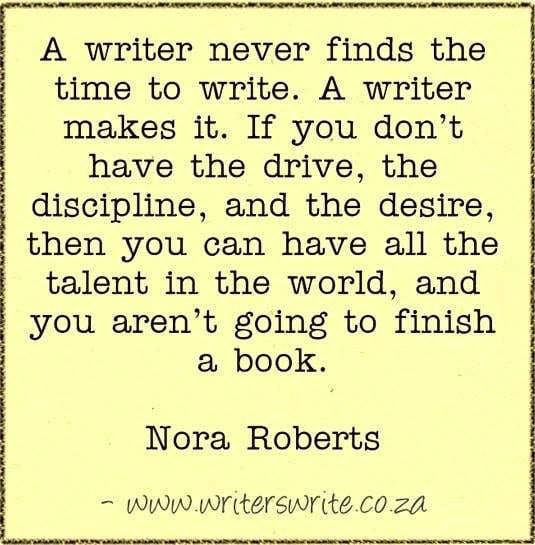
Unless I make it. Here’s what prolific author Nora Roberts says. And I concur.
On Writing by Heather Haven

People often ask me how one goes about writing a book, be it a novel or a memoir. How do you get started? How do you finish? I don’t have a lot of answers but I do know one simple fact: you can’t be a writer if you don’t write. Below are a few things I’ve learned along the way to get me writing. Not foolproof, but helpful, I think. Now and then, I revisit these few rules. I don’t want to make my craft so complicated or get so lost in it I forget the basics.

1 – Give yourself permission to write. Many people think they can’t or shouldn’t write something. Maybe it’s not the time. Maybe other things are more important. Not so! If you want to do it, it’s important. Don’t let family, friends, or circumstances discourage you. If writing is something you want to do then do it! Giving yourself permission is the first step.

2 – Think about what it is you want to write, what you want to say. Fiction or non-fiction? A short story or novel? A memoir, biography, autobiography? It doesn’t have to be big, maybe a couple of pages to start you off. Then put pen to paper, so to speak. Following through is a big part of success in any field.

3 – Find the right set up. You’ll need a quiet place where you can work undisturbed. To be literary for a moment, Virginia Woolf makes this point in A Room of One’s Own. It doesn’t matter if it’s an office with a computer desk or a kitchen table and a tablet. Whatever and wherever you choose, make it your own. Claim it, at least for the span of time you’re writing.

4 – Have the right tools on hand. Notepad, pencils, pens, computer, printer, paper, etc. Be ready for the job of writing. Remember, it’s your job. Approach it that way.

5 – Set up a schedule for yourself and stick to it. Find or make the one time of day when you can concentrate on what you’re doing — writing. Try to choose the same time of day, every day, but if it can’t be that way, go with it. Let everyone around you know this is the time to give you some space. Make it a habit, whether it’s fifteen minutes a day, one hour, or six. Writing is a lot like playing tennis. The more you do it, the better you get. Practice, practice, practice.

6 – Explore the craft of writing. Take classes, read books on subjects that interest you, go to a few lectures. Join a writing group, join a reading group. Make it a living, breathing, attainable craft. Writing can be yours. It can also be a gift for future generations and your family. But most important, it’s what you want to do.

Happy Writing!

What I Like and Dislike About Writing

Writing is something I’m compelled to do. I’ve written in one form or another since I was around four. The first of my telling stories was in a series of pictures about the soap opera my mother listened to on the radio every morning—My Gal Sunday. While mom worked in the kitchen with the radio tuned in, I sat at a little table with a tablet and crayons, depicting what I heard.

During my grammar school days I wrote lots of stories, some were my versions of “Little House on the Prairie,” and an old series of books of my mother’s about the life of Elsie Dinsmore. I also wrote and illustrated a fairy tale my mother sent off to a publisher. She must’ve thought it was good—the publisher sent back a nice rejection letter.

My junior high years I wrote plays for the neighborhood kids to star in and a magazine which I sold to my friends for a nickel. I wrote essays, stories and poems during my high school years. I married young and was kept busy running my household and raising five children. My writing turned to newsletters for PTA and plays for my Camp Fire Girls to perform. I did write two novels during that period of my life and have no idea what happened to them.

My sister labored on our family’s genealogy and when she was done, I used it as a guide for writing two historical family sagas—a huge undertaking requiring lots of research. Both books, after a lot of criticism and work, were published. And I was hooked.

I love the writing process. Because I love to read mysteries, I started writing them. Being inside another place, seeing exciting events through the eyes of imaginary characters became my obsession. Planning the mystery, where it would take place, who would be the detective, deciding who should be a victim and who might want to see that person dead, how the person was killed, all became part of the enjoyment of writing.

I do like the editing part—though I confess to missing mistakes and I’m grateful to my editor for finding plot holes and typos.

Even after all the editing, I don’t like it when a reader lets me know about a mistake she’s found. Oh, I’m glad she pointed it out because it can be fixed, but I’m unhappy because the mistake was missed during the editing process.

Researching is often fun: talking to people in law enforcement, going on ride-alongs, attending mystery and writing conferences, meeting other writers and readers.

What I dislike about the whole business of writing is planning promotional events: making the phone call or going in-person to ask to hold a book signing in a particular place. Though I do enjoy talking to readers, I’m not happy with trying to convince someone to buy a book. If they aren’t interested after I’ve told them about it, I’m not going to push.

I like being on panels at writing or mystery cons, but what I don’t like is when one author tries to hog the whole time period for him/herself.

Though I do like some ways of promotion, I’m not fond of any that takes a lot of time away from writing and costs a lot of money. Anything effective seems to do both.

No matter, when I’m finished with one book, an idea for another is usually rolling around in my brain.

Okay, I’ve had my say. I’d like to hear from my author friends, what do you like best about writing? And what don’t you like about the process?

Marilyn

The Other Reason I Write

This is an exciting time. Crime Spell Books has just announced the list of stories and writers that will appear in its first Best New England Crime Stories anthology. This is the nineteenth such anthology after Level Best Books announced it was discontinuing the series last year.

Last fall two of my colleagues and I agreed that the cessation of the annual anthology by Level Best books was a sad end for a publication we all loved and two of us had worked on. Leslie Wheeler and I had been editors and Ang Pompano had published stories in the anthologies. But I had another reason for being disappointed.

I was one of the original founders of Level Best Books, along with Kate Flora and Skye Alexander. There’s something wonderful in creating something that lives after you—and doesn’t need you to prosper. That was the Level Best Books anthology.

In 2003, when we began, print-on-demand hadn’t yet taken hold and become the easy, accessible (and cheap) process that it is today. As the first editors, we chose paper, dealt with printers and shipping, and hand delivered books to bookstores and events. We advertised and promoted. And that came after reading and selecting stories, editing and proofreading. And back then proofreading meant reading the printed text against the paper manuscript, looking for errors in composition and type setting, not in the writing of the story. The process is so much easier today that any writer can put together a collection of stories and publish it digitally and through POD with or without technical help.

Creating this new anthology satisfied something in me that I don’t usually find elsewhere. I love the process of making something. Yes, I write stories and novels, and have a number of both out circulating with editors. I cannot imagine a life without writing, and indeed I’ve never had one without it since I was a teenager. But the finishing process has its own special appeal—there’s a tactile pleasure in putting together the front matter and back matter, arranging the parts felicitously. I get some of the same pleasure from matting and framing a photograph for the few times I’ve done an exhibit of my work. That form of satisfaction is probably why I do needlepoint and embroidery, and used to sew all the time. Sometimes I arrange tools and equipment in the garage or cellar for their appearance rather than practical reasons. I may end up a sculptor making assemblages or found art pieces. I love using my hands. But I’ll still be writing.

The point of all this, I suppose, is to share with all of you those aspects of my writing self that don’t often come out. I talk so much about writing—how to do this or that—that I sometimes forget that each of us who writes has more going on and other ways of being creative and finding a sense of accomplishment than the one part we talk about on line. The beginning of the resurrected anthology is one of them for me. So while all the writers are celebrating having their stories in the new anthology, which I fully understand, I’m celebrating making another object that will satisfy another part of me.

It’s a Heat Wave

It is 108 degrees outside my front door. That’s hot. But it is a dry heat, shorthand for the moment you walk into an air-conditioned room, you sweat like a stevedore. It also brings on combers of nostalgia for Michigan, feet dangling off a tethered raft in Gull, Gun, or any lake, including Michigan, waves nibbling at my toes, reading summer books that widened my horizons.

July on a raft in a Michigan lake

Edna Ferber was from Kalamazoo, Michigan, once known as the celery capital of the world and a place dear to my heart. I whipped through Cimarron, adored Saratoga Trunk, and still love Giant, one of the ultimate summer books filled with indelible, strong, resilient, tough female characters. I often think of Vashti and wonder what the heck was going on in Luz’s mind. Edna Ferber told big stories about big people, personal growth, and bigotry. That’s a lot to deal with at sixteen years old wearing a bikini on a raft in a lake with boys waterskiing close enough to splash your pages and rock your raft. I also devoured Michener’s Hawaii and Leon Uris’s Exodus and Jessamyn West’s Friendly Persuasion while sashaying about in my favorite madras two-piece.

In between big beach books, I delighted in Dauphine du Maurier. My Cousin Rachel, Rebecca, and Jamaica Inn. Slathered with Coppertone, I adored the dashing Jem Merlyn. I re-read Jamaica Inn recently and wondered at my choice. I suspect it was that Jem was a bad boy, not good, not unredeemable, but a bit sexy and more than a tad sullen. I had the same crazy adoration for ‘Wild Whip’ Hoxworth (Hawaii), Ari Ben Canaan (Exodus), and Jess Birdwell (Friendly Persuasion). What teenage girl wouldn’t love him or them? Or Daphne du Maurier with her brooding houses and equally brooding men, slightly overwhelmed heroines, and crazy housekeepers. She introduced me to a tightly controlled world of threat, romance, and creepy moors.

This brings me to the best read while babysitting during a thunderstorm. The only book I ever threw at a ceiling was Wildfire at Midnight by Mary Stewart. I was babysitting, the kids were all in bed, their parents late, thunder roared, rain rasped against the windows. I kept watch in the living room, shades drawn, listening to the night rumble and whack. I turned the page; the heroine sees a shadow gyrating in front of a burning funeral pyre. A window shade snapped open. The book hit the ceiling at about ten miles an hour. The joy of it is that Mary Stewart’s booksare as fresh as ever with their strong female leads, engaging, slightly sexy male protagonists, and intriguing travelogue plots.

I still have the paperbacks of each of these books, some with water spots on them. My copy of Giant made an appearance on the cover of a magazine, red-checkered tablecloth, paper plates, sunglasses, and Giant open spine up. Most of the books have a price of $.75 or less printed on the cover. Giant, because it was giant, cost $1.25.

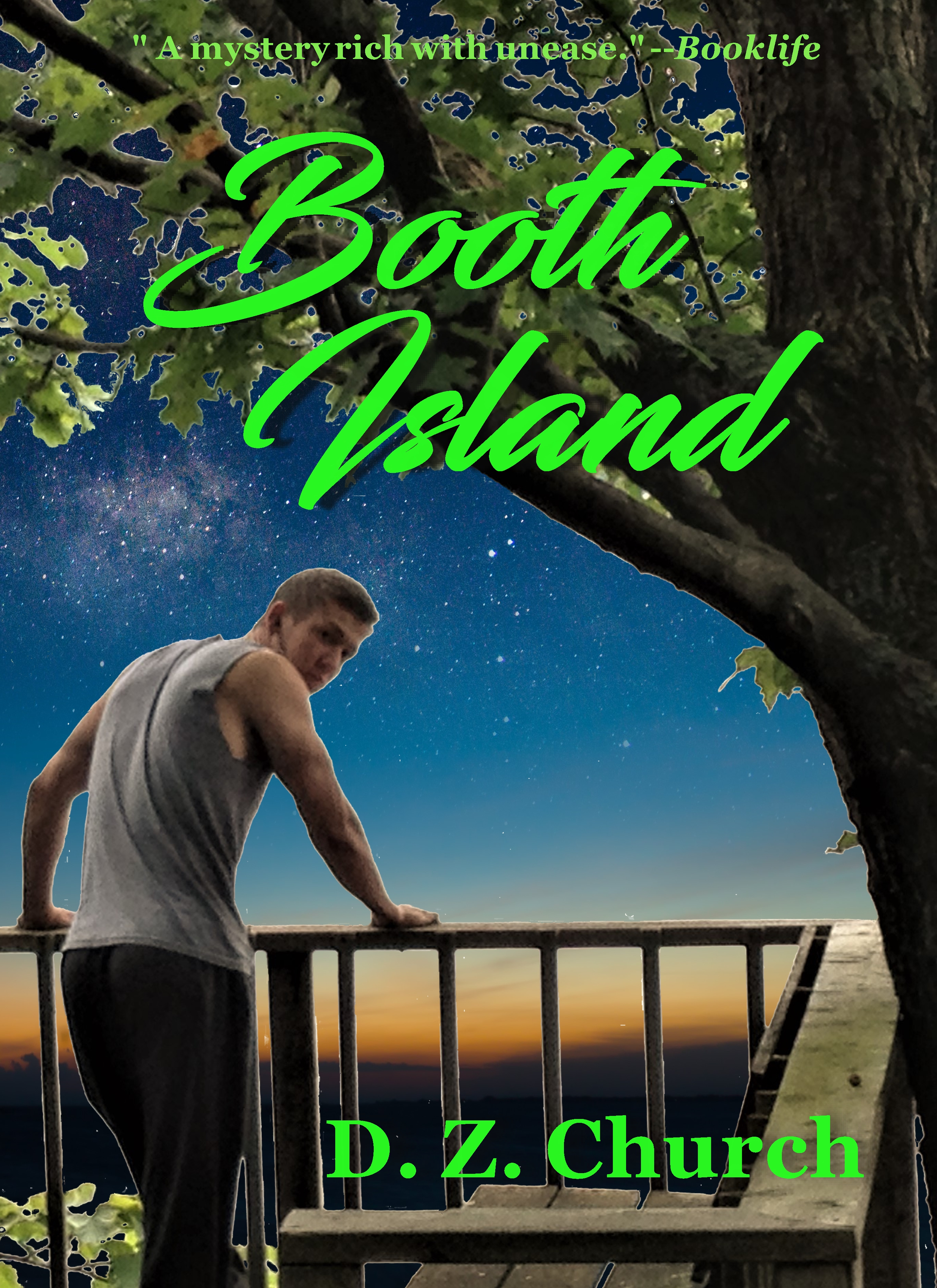
Those hot, humid, muggy Michigan summer days, replete with gigantic mosquitos and buzzing cicada, sit on my shoulder as I write. In particular, my book Booth Island captures the essence of being a teen vacationing on a lake when anything is possible, including love, death, and Tiger Tail ice cream.

For fun, try this summer book quiz. MATCH THE BOOK TITLE with the book’s first line and marvel at the few words used to set the scene. Answers will be in next month’s blog. To get you started, the first one is a gimme:

First Line of Book Title of Book and Author
Last night I dreamed I went to Manderley again.Saratoge Trunk – Edna Ferber
All the Venables sat at Sunday dinner.Madam, Will You Talk? – Mary Stewart
Nothing ever happens to me.My Cousin Rachel – Daphne du Maurier
They were interviewing Clint Maroon.Rebecca – Daphne du Maurier
The whole affair began very quietly.Jamaica Inn – Daphne du Maurier
It was a cold gray day in late November.My Brother Michael – Mary Stewart
They used to hang men at Four Turnings in the old days.Cimmaron – Edna Ferber
HAVE A WONDERFUL SUMMER!