The Art of Getting it Right

Last month I participated in a month-long online workshop/class about law enforcement. It was taught by a veteran policeman who had worked in several places and organizations and enjoys helping writers get it right.

He started the class with an actual case report of a murdered woman. We read it and then asked questions, which he answered very thoroughly. He told us what the police had to do by law at the scene and what they could and coudn’t do while talking to people trying to gather information to help them catch the perpetrator.

We went through processing a crime scene and saw actual photos of the scene. I had a barebones idea of what took place but had left out a few steps when my characters have come across a body. However, I was happy to hear that when a homicide happens the detectives or whoever is working on the case can and do work non-stop the first 48-72 hours. They take short naps and go home to change clothes, but they stay on the evidence because there is that small door of opportunity to gather all the information that could help them apprehend someone. I have had Gabriel Hawke work nonstop on murder cases. I had made it his need to find the truth, but it appears is what a good detective does.

The evidence in the case of the homicide we were “working” pointed to one of the victim’s sons. But several of us, me included, felt it was too easy. Yes, our red herring minds were trying to find ways to make it stick to someone else. Even when all the evidence clearly pointed to the person that was eventually arrested. He even confessed in his own way.

The instructor said that few murder investigations and homicides are as convoluted as writers of TV shows, movies, and books make them out to be. The need to make motives and means hard to figure out are the writer’s way of entertaining the reader. In real life, if the evidence is pointing to one person, it is usually that person. It’s just a matter of the detectives gathering enough to make a solid case and the icing on the case is getting that person to confess.

Something I have had happen to me several times while on jury duty. Once the evidence is all lined out against the accused, they will plea out, sometimes at the last minute, (as when we were waiting for a trial to start and were dismissed because the person plea bargained). The instructor said, that happens the most when the accused has confessed during an interview. The interviews are taped and once a jury sees the person confessing, they are going to be found guilty.

I enjoyed that the instructor was so willing to answer questions for our books and help us with law enforcement questions. I have asked this person questions before on the crime scene email loop I’m on. If you would like to join to ask questions of retired and practicing LEOs, lawyers, forensic pathologists, FBI, DEA there is a person on the loop from just about any entity you might want to ask questions to get your scene or scenario accurate. Crimescenewriter2@groups.io

Besides knowing what I need to about the legal side of things for my mysteries, I also like to go to the area where the story I’m working on is set. I recently watched security guards at an Indian run casino and did a walk around the tribal police station in my Spotted Pony Casino Mystery series. In June I’ll be traveling to Montana to walk through a resort that will be the jumping off spot for the next Gabriel Hawke book and I will be taking a couple trips into a wilderness area near the resort to discover what it is like to better write that story.

What can I say, I like to make sure I not only entertain but I enlighten as well.

Never Too Old

I think back to my childhood every time I find myself digging for more information. I loved school and learning. While math wasn’t a favorite and I struggled to be proficient in it, I understood it was necessary to learn the basics. In the fourth grade every evening while my mom and I washed and dried dishes, she would quiz me on the multiplication table. And today, I can pretty much spout out the correct answer with a few minutes to pull numbers out of my filled brain. 😉

Writing books has been my way of continuing to learn and fulfill my love of research and discovering new things. From the occupations my characters have:

Vase by Olaf

Shandra Higheagle, my Native American potter character, gave me the opportunity to spend time with ceramicist Ted Juve, or Olaf, the name he signs to his work. He taught me the process of extracting pure clay from clay soil that he uses for some of his pieces and the method my character uses for her art pieces.

My character Gabriel Hawke allowed me to spend a day with an Oregon State Trooper with the Fish and Wildlife Division in the county where I have my stories set. That was an eye-opening day with lots of notes taken as we drove around the county. He gave me insights into the job and some incidents that he had been a part of.

My newest character, Dela Alvaro, is taking me into the world of Tribal run casinos and the life of a lower limb amputee. Both new things to me and I’m soaking in all I can learn from many different sources.

This month I am also taking an online workshop from a retired law enforcement officer. He has over forty years law enforcement and what I appreciate the most is he has worked with lots of different law agencies and knows a lot about how different states handle things. And if he doesn’t know, he knows someone who can give us the correct answers.

The workshop started out with him attendees some law enforcement information and then he gave us the first responders view of a murder scene. We are now not only learning the whole business of processing the area and starting the investigation but also being asked along the way who we think might have killed the victim and why. He not only has us using our minds to learn, but to be creative in what we think might have happened or how it would have happened if we wrote this in a book. I like learning two things at once!

This workshop came at a good time for me. I sent out my most recent finished WIP (work in progress) to my retired LEO beta reader. He found fault with three different scenes. Two, I will learn about from this workshop. The third…is harder. It goes to the core of being a policeman for decades. I was being too soft. My character isn’t soft, so I can’t have him acting like I would act. He is tough and knows when his life is in danger he must react as he’s been trained. Another lesson learned. Did I say I like learning new things?

The reasoning my beta reader gave me made sense. It just didn’t work for the scene to come later, so I had to rewrite the scene to keep my character from killing someone they needed to question. I had my LEO wounding the man. But with an AR rifle aimed at him, my character would have “tapped” the suspect three times. (tapped=three quick shots to the torso) Which would end up with a dead, or close to dead, suspect they needed to question. I changed the scenario to the suspect realizing he was shooting at police and surrendering. He wasn’t the bad guy they were after, which the police discover after questioning him. Whew! That scene was rewritten three times before my beta reader gave it a thumbs up.

But he also questioned my character never giving the people he brings in for questioning Miranda Rights. That is why I am taking this workshop. To learn more about that process and how I can incorporate it into the books at the correct time.

There is always a need to learn something. And I love drinking it all up and using it in books.

As a reader do you like to learn while you are entertained?

As a writer do you feel the need to learn and get things right in your books?

My “Little Gray Cells” Are Getting Full

As Hercule Poirot, one of Agatha Christie’s prominent characters, was often to say, his “little grey cells” were working. I have been feeling of late that my “little gray cells” or brain is getting too full to handle much more. LOL

Between the research I’ve been doing for the latest Gabriel Hawke book I’m writing, which is set in the winter in the mountains, to the research for Dela Alvaro, a lower limb amputee, I feel like I finish one book on a subject, only to pick up another book and read about something else I need to know for the book I’m writing or plotting.

While I sound like I’m complaining, it is the research I love the most about writing a book. Well… maybe that’s a second to coming up with an interesting or unique way to kill someone. They are close in what I enjoy most about writing a murder mystery.

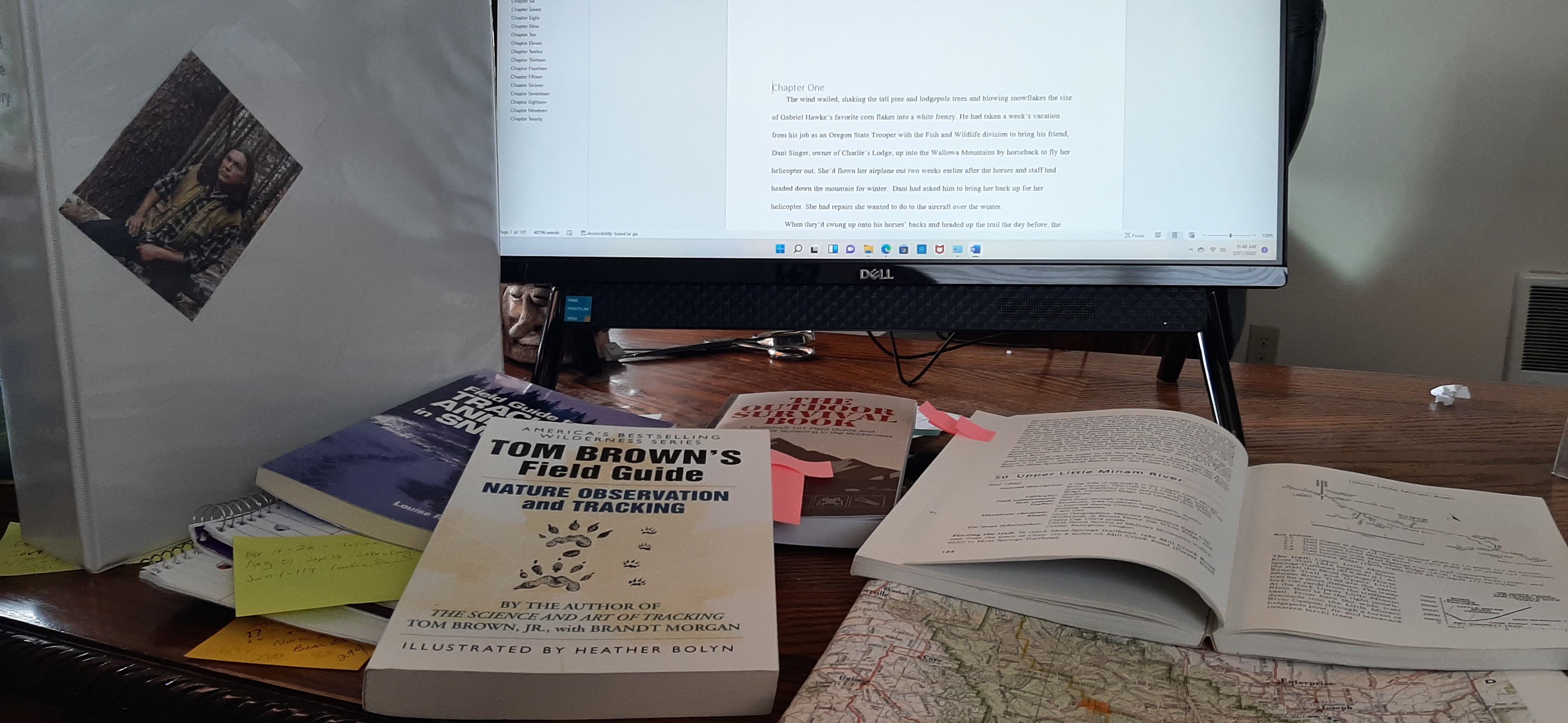
I have been using Tom Brown’s Field Guide to Nature Observation and Tracking, The Outdoor Survival Book, Hiking Oregon’s Eagle Cap Wilderness, Field Guide to Tracking Animals in Snow, and the Oregon Gazetteer, not to mention Google Maps and numerous sites I’ve pulled up on the internet to answer questions. These are all for Owl’s Silent Strike, book 9 in the Gabriel Hawke series.

My character has to take care of a broken leg on his significant other in three feet of snow. Care for another person’s frostbite on their feet and keep all three of them away from men with AR rifles that Hawke believes are after the man he found wandering on the mountain. So you can imagine I had to also research caring for a compound fracture and frostbite.

I also was lucky enough when I started this series to make friends with an aviator who is always willing to help me with aircraft questions as Hawke’s significant other is a pilot. He helped me figure out why she wouldn’t be able to fly the helicopter, they came after, off the mountain.

There are some books, like this one, that I feel like I put in twice as much time with the research as I do actually writing the book. I hope all of this effort pays off in the incidents sounding plausible and realistic.

I have also been filling my head with as much information as I can about a lower limb amputee for my character, Dela Alvaro, in my Spotted Pony Casino Mysteries. I found a book the other day titled AMPossible. It’s written by a lower limb amputee who also counsels other amputees. It has all the nuts-and-bolts information about how a person feels after the amputation, from emotions to physical and what to expect. It has been very helpful for knowing how to portray my character.

All of this and the research I will continue to do for each book as it comes along is why my “little gray cells” are getting full. It’s no wonder I forget the little things. Where’s my phone? What did I do with that letter? What was I supposed to do when I finished writing?

February Sped By–

So much so, I forgot I needed to write a post for this blog. The main reason for my forgetfulness is I attended a board meeting for the Public Safety Writers Association last week. I’ve been a part of this group since its formation, first as the program chair for their annual conference and second as the newsletter editor. I’ve since passed on both jobs to other younger and quite capable members. I’m still a member-at-large on the board.

I must confess though, I mainly wanted to attend because the board members are all good friends and I wanted to see them all again.

PSWA is a group for anyone writing with a connection to public safety, and this included all kinds of law enforcement, fire, EMTs, military, dog handlers, etc. and for anyone writing about any of these including mystery writers.

The conference is my favorite for various reasons: interesting speakers and panels on different aspects of writing and public safety, and a place to ask all those law enforcement and other related questions.  Mystery writers are welcome on appropriate panels and encouraged to bring books for sale in the bookstore.

This is an affordable conference, always in the Orleans hotel and casino in Las Vegas. The night-before reception and delicious lunches are included in the price. A writing workshop before the conference is offered for an extra fee.

Take a look: https://policewriter.com/events/pswa-summer-2022-conference/

And that is my excuse for being late.

Marilyn

Gathering my Thoughts

When a new year comes around and I’m starting a new book, it just feels right. My desk is clean. Something I do the end of every year is make sure my desk is tidy and ready for the coming year. (I also do it between each book/project) It wipes away what I had been working on and makes a clean slate for the next project.

This first project of the year is book 9 in the Gabriel Hawke series. I enjoy writing these books. They are set, mostly, where I grew up and have a unique character who I feel I can tap into better than my female protagonists. I don’t know why, but Hawke flows from me without doubts or self recriminations that the character isn’t this or that.

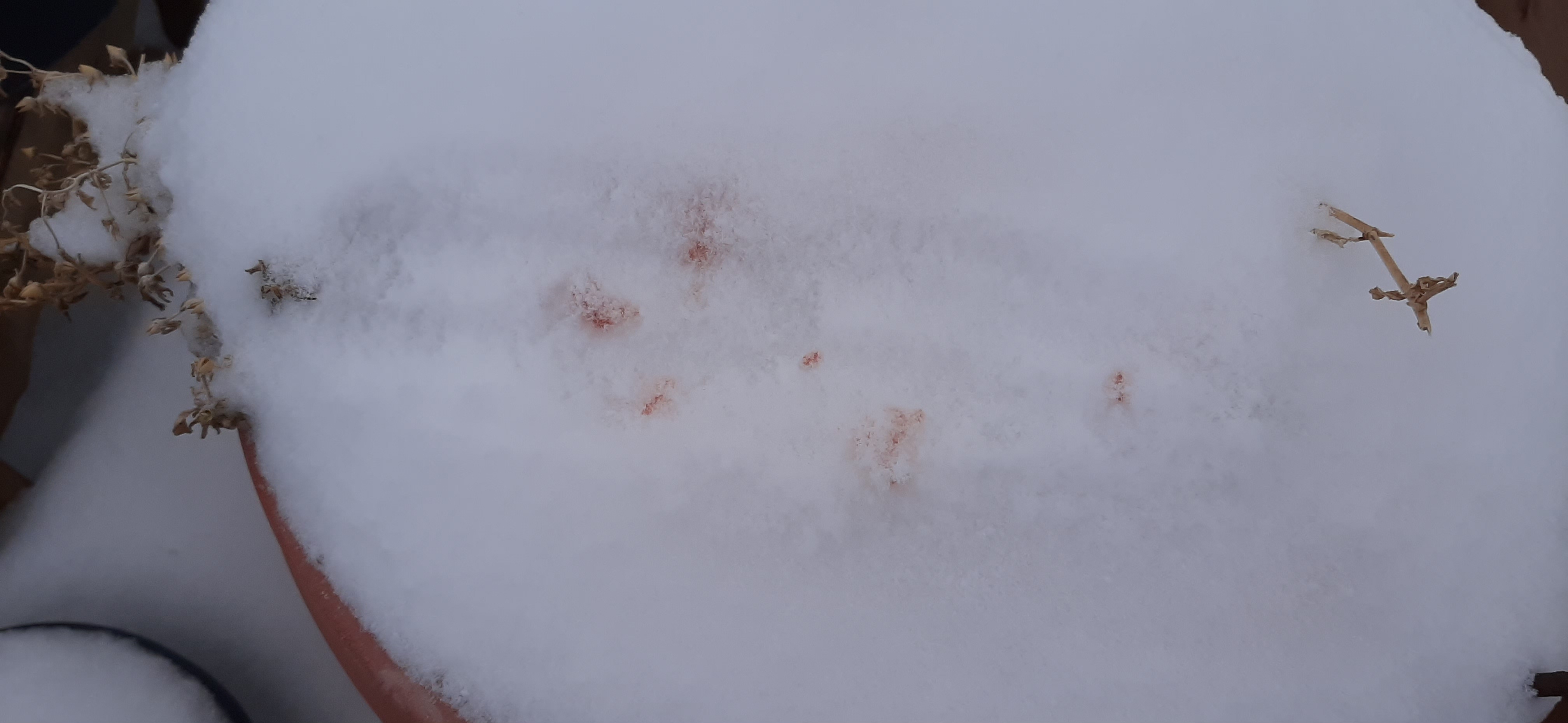
This book will push me and my character. He and his significant other are going to be pushed to their limits trying to help a wounded person and survive a blizzard in the Wallowa Mountains. I have my research books stacked up and have started reading them. I have even ran some tests in our snow to see what blood looks like when it first drips onto the snow. I took photos and studied the spot for about four days, until our snow melted. I know what my character will see or be on the look out for when they follow the sparse drops of blood from the bleeding person who left a dead body behind.

Blood experiment

Several of the scenes have played over in my mind since I came up with the premise of this book. I have sat down and discovered who the person they are following is and who the dead person was. I wrote out the chain of ideas for scenes. Once I do some more research on snow conditions and animals that would be accessible for food or to follow to stay warm, I’ll start writing the book this week.

While some people don’t like to have a “road map” or outline to follow when they write, I’ve found, after the last Spotted Pony Casino Mystery that I “mapped out” that it helped me to know my story better when I started and while I didn’t stick to the road or route I’d mapped, I felt I had a stronger book throughout because I knew a bit more about my characters and who I wanted to highlight as possible suspects.

As yet, I don’t have a title for book #9 in the Hawke books. I’m waiting to see what animal makes sense that is out in the winter and would work for the premise of the book. I’m a writer that either has the titles before I start the book or I come across it as I’m writing. It looks like it will be the latter this time.

If you have any thoughts on a winter animal put it in the comments and I’ll look up its habits to see if it might work.

At the moment I have Churlish Badger being made into an audiobook as well as the Shandra Higheagle Mystery book, Homicide Hideaway. But what you really need to know is through the month of January, if you like audiobooks, Book 1 in the Shandra Higheagle Mystery series, Double Duplicity is $1.99 at Authors Direct.

If you don’t have the app it’s easy to download and free. This audiobook resource gives me and the other authors using it more royalties than the other audiobook vendors. (and my books are priced lower here.)