HAPPY HOLIDAYS

I love the holiday season. Cooler weather and the arrival of fall colors seems to bring people together. Cheering at high school football games. Evenings gathered around a fire pit with a hot toddy. Sharing popcorn in a theatre for the latest fall blockbuster.

And my personal favorite, curled up on the couch in front of a fire with a festive drink and a fabulous book.

I no longer celebrate Halloween, my son Derrick’s favorite holiday. But while doing research for my novel, “Malice in Mazatlán”, I learned about Día de Muertos, a Mexican festival celebrating the dead. This Mexican memorial was a perfect addition to my story. Sarita García’s hotel, Fiesta de Fuego, treated guests to a Día de Muertos celebration every Wednesday night to honor the alleged ghosts from a love triangle rumored to haunt the hotel. Oh, and Sarita might have an affinity for skulls. And I love the idea that maybe a future Stoneybrook Mysteries novel features a haunted house in the Redneck Ranch’s old barn.

Thanksgiving is the holiday that seems to get lost between the ghoulish fun of Halloween and merriment of Christmas. I, however, have an impressive pumpkin collection. Each year, I drag out the orange orbs and decorated my house with fall colors. I love the sentiment of Thanksgiving encouraging us to be thankful for all that we have and blessings still to come. I haven’t found an occasion to put a Thanksgiving celebration in a novel yet but hope to do so soon. It would be fun to see Harley and Wyatt, along with their family and friends gathered around a large table waiting for the turkey to be carved. I’ve spent a couple of Thanksgivings in México, so maybe a scene with my México Mayhem characters planning their version of a Thanksgiving celebration will appear in future books.

And then there’s the Grand Dame of Holidays—Christmas! This is still a hard holiday for me, but I’ve found ways to make Christmas new again. I’ve started collecting ornaments that remind me of my characters, human, animal or insect, for my tree. I have countless dragonfly decoration and beautiful ornaments from México I’ve collected over the years. Last Christmas I added a Día de Muertos collection. This year the tree will showcase Maverick the donkey and a couple of crocodile ornaments. Luckily, last year, I was invited to write a short story for Windtree Press’s “Crime Never Takes a Holiday” anthology. My story, “Five Golden Rings has morphed into the second book in my Stoneybrook Mysteries. Despite my dark and twisty side, Five Golden Rings has a happy ending with a feast being planned at the Redneck Ranch for Christmas Day.

I love all the other holidays we celebrate, too. There’s a Memorial Day dance in “Whispering Willows”, my latest story in Windtree Press’s current anthology, “Whispers”. But as I race the clock to finish editing of the third book in my México Mayhem series, “Vanished in Vallarta” for the holiday buying season, my writer’s brain occasionally wanders.

How fun would it be to see one of my female character’s proposed to on Valentine’s Day? In “Redneck Ranch”, Pastor Jamey hosts Cowboy Church on a beautiful June day, and I can see a future scene with Cowboy Church celebrating Easter. I’m currently working on my next novel, “Willow’s Woods” and am hoping to write my way to a Fourth of July celebration in the town of Stoneybrook.

Probably one of the best gifts my writing has given me are characters I love, places perfect for visiting or putting down roots. And stories to be enjoyed curled up on a couch, with a hot spiced wine, in front of a fire!

Now for my shameless promotion. “Redneck Ranch”, “Five Golden Rings”, and “Whispers” are available on Amazon:


Guest Blogger ~ Ana Diamond

The Body Conscious series was born out of dark humor, in the same vein of light-hearted humorous cozy mysteries. I thought having a murder occur in a funeral home where everyone working there was already used to being among the dead added a quirky element to the mystery.

That being said, even though the story is entirely based in a funeral home, I’ve never worked in or even visited a funeral home. I do work in the medical field, which does help with understanding medical terms and how things are generally run in a medical facility. It probably also contributed to my interest in writing on the subject in the first place.

My main character, Lily Reynolds is a smart, feisty mortician running a family business who ends up falling for the detective on the murder case. In order to figure out how she would feel about working in a funeral home and the tasks she would be doing on daily basis I searched the internet for articles written for people who are curious about the process of embalming and the tools used in the process. I would find interviews of morticians explaining why they enjoy their jobs. I was struck by how compassionate people felt about this profession and the care taken for their clients. I tried to take the morbid association out of the profession and make it seem more accessible to the average person.

For example, in Chapter Two, Detective James Rivers goes to the funeral to ask Lily some questions about the case. Lily is in the middle of a workday and asks if she can work while they talk.  She tells him,

“That’s fine, but I need to finish Mrs. Sherry’s makeup. Can I work while you talk?”

He hesitated for a moment.

The true test of how he really felt about her job, she decided.

In this scene James represents how the most people would react to Lily’s job and I wanted to use it as an opportunity to educate and humanize the role for readers. Through scenes when he’s watching her work she sets the tone for how she treats each client. For example, he says,  

“I’ve never seen anyone put makeup on a body.”

“Mrs. Sherry’s family told me she wore a lot of blush, and my job is to have her look as she did when she was around them. I think that it’s important to the family to have their last moments with their loved one feel like it did when she was alive.”

James’s eyes searched her face as if she’d said the most fascinating thing he’d ever heard.

For some reason, I typically write about topics that might make me somewhat uncomfortable—I write about cults in the second book, Body Snatched. I’m thinking maybe it’s a form of therapy? I’ll let you decide. Body Conscious and Body Snatched are available now at all major retailers from The Wild Rose Press.

Body Conscious

Mortician, Lily Reynolds is used to seeing bodies, but not the type murdered in her own funeral home. As Detective James Rivers zeroes in on her as the town’s number one suspect she must rise above the accusations and rumors to solve the case herself while keeping her attraction to the troubled detective at bay. 

James has a past. The last time he let someone into his life she wound up dead. Vowing never to let that happen again he has sworn off dating for good. Until he meets Lily. In his gut he knows she’s not the murderer but pressure to solve the case puts him on the wrong trail while he struggles to keep Lily off the case.  

Can she solve the case on her own or will their scandalous romance get in the way of proving her innocence?

Buy link:

https://books2read.com/anadiamondauthor

When Ana Diamond isn’t writing about tough gals finding love in unexpected places, she’s at work by day in the medical field. She writes romantic cozy mystery novels with feisty strong women and alluring men who can’t resist them. Her books are fast paced, entertaining and heartfelt all at once.

Ana is a 2020 Tara Contest Finalist for Body Conscious and 2015 Melody of Love contest finalist. She lives in New York with her husband, two children and two needy but wildly entertaining kitty cats.

Social media:

https://twitter.com/AuthorDiamond

https://www.instagram.com/anadiamondauthor/

https://www.tiktok.com/@anadiamondauthor

https://www.anadiamondauthor.com/

Before I Begin Writing

During a recent panel discussion at a nearby bookstore, a member of the audience asked the usual question about how we began our books. The three of us answered in various ways, but all of them were what you might call writerly replies. We began with a character or a scene. I said I began with a situation, a scene that came to me that made me curious about the people in it. My beginning is a little more complicated than that in the case of the Anita Ray mysteries.

I first went to India in 1976, for a year, with thirteen return visits since then, but the last one was in 2014. That seems like a very long time, and it is, even though I stay in touch with friends. Family issues have kept me from returning since then, but I’ve kept writing the Anita Ray series. The fifth in the book has come out in trade paperback and Harlequin will publish the mass market paperback soon. Right now I’m working on the sixth book in the series. So, how do I begin a new mystery set in India after not having visited for so many years? Before I begin with a situation, I look at photographs, to get a feel of the country I love and the area I think I know well. The city of Trivandrum has changed enormously over the years, and I notice large and small changes during every visit. Sitting with images of places I know well—certain shady lanes, small corner temples, old traditional doorways—evoke the ways of living that are so different from how I live here in the States and that may play a role in the story I’m working on.

Many of the photographs suggest story ideas, such as the shop selling as well as exporting homeopathic medicines located on a busy street just at the end of the lane where I lived for a year in the 1980s. Every time I return I walk down Statue Road, and there it is, the homeo shop, near the end, and the elementary school diagonally across the street from it.

One of my favorite photographs is of the laundry hanging among the coconut palms. There is a saying in India. If you’ve only been to a city in North India, you haven’t seen India. If you haven’t been to South India, you haven’t seen India. And if you haven’t been to a village, you haven’t seen India. There is truth in this. The village is the heartbeat of the country, a place encompassing great beauty and unconcealable poverty. Cities of India have on display vast wealth, just like other countries, and unimaginable poverty just around the corner. But in the part of the country I write about, old traditions still live. I learn more about a house and its inhabitants by how the gateway is decorated than I can from any of the nameplates we put on our mailboxes in the States. 

These are some of the details I pull together from some of my photographs to get myself back into the setting of my story. When I write, I want to feel I’m there, and I want the writer to feel she is there with me, so I review my pictures, think about the layout of the city, and imagine my characters walking through a village or resort or the capital of the state. A story I’m working on now is based on a festival held in India in late winter. Pongala has been called the largest gathering of women in the world. Over three million women descend on Trivandrum to make an offering to their deity, to bring good health to the family for the coming year. My photographs of this festival will be on display in the Beverly Public Library in February 2024, while I’m working on the story.

In the fifth book in the series, In Sita’s Shadow, Hotel Delite welcomes a tour from the United States, five guests instead of the six expected. Auntie Meena is soon fussing over them, determined to see them happy while in her hotel though she’s a bit confused by their non-touristy conduct. When the tour leader is found dead in his room, poor Auntie Meena is terrified that his spirit will haunt the hotel, and calls her astrologer at once. Anita calls the police, as is expected, and then begins to worry the death is unnatural. Trying to break the news to the members of the tour proves harder than expected. But one tour member seems uninterested in the death, and rarely uses his room in the hotel. This is not what Auntie Mean expects from a proper guest.

Auntie Meena throws herself into the investigation into the tour leader’s death, to Anita’s dismay, in a determined effort to protect one of her guests from the danger Meena is certain is lurking just around the next corner. Nothing good can come from a young male student sparking a friendship with an older foreign woman. Anita, however, is more concerned about the odd behavior of one of the hotel’s suppliers, a woman who makes airy delicious pastries.

https://www.susanoleksiw.com

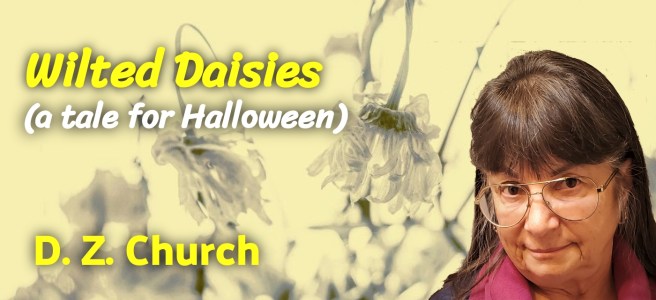
Wilted Daisies

Maybe it’s the darkness of the day, the brown leaves dripping with rain, or Halloween around the corner. Whatever, it conjures stories of visitors from beyond the veil. So, I offer a short-short-short-really short story for your October enjoyment.

No one had used the back parlor of Countryman House since the official government letter arrived twelve years earlier notifying Edith Countryman of her husband’s death at Chickamauga. The letter remained on the small table before the settee, held in place by a crystal vase of long wilted daisies.

As Cora Countryman entered the room, sunlight glissaded through two six-over-six windows, their red brocade drapes tied back to save the cloth, the open sashes allowing the soft clucks of chickens to invade the still of the room. Shelves of books lined the interior wall, some behind glass. When a girl, Cora sat at the carved mahogany reading table by the windows. Her feet dangling off the chair, her tongue between her lips, she drew pictures of sailboats, strange pyramids, and darkly clothed men from stories. Of course, that was when her father lived, before his loss forced her mother to take in boarders.

Twelve years seemed ample time to mourn, especially with her mother as gone as her father, though not as dead, well, not dead at all if the rumors that Edith was gambling on the Mississippi riverboats were true. Cora leaned over, touching the letter’s brittle paper. As she did, the room shook under the thunder of hooves so real she pivoted to face them, horses leaped over a stonewall onto pikes, men shouted as others fell, screamed, lay motionless. She removed her hand from the paper, the room ceased shaking, all before her vanishing.

Cora sat on the settee, staring into the marble fireplace with its walnut mantle, her right hand spread across her chest, her breathing rapid. She lowered her hand to her side, afraid to touch the vase of dead daisies, lecturing herself on her ridiculousness.

Once convinced, she wrapped her fingers around the vase, a withered white petal fell from a long dead stem, floating to the ancient letter. Laughter erupted and swirled around the room. A young woman, a daisy chain wreathing her brow, threw her arms out, twirling until she bobbled into the arms of a dark-haired youth of near her age. They lay together in the tall grass; he brushed a single daisy petal across her lips, until the marching of heavy footfalls brought them to their elbows.

Cora admonished herself, she was a modern woman, this was fantasy, or wishfulness. She lifted the yellowed paper between two fingers, it tore along a long-rotted crease.

“He is not dead, he is not,” a man in a blood-spattered coat insisted, his hands at the wrist of the body set before him. “Take him elsewhere, he belongs with the living.”

A soldier, his blue uniform filthy, positioned the dead man’s arms on his chest and with another lifted the stretcher. The two ducked out the tent flaps into cannon smoke, bullets smacking into trees and through tenting. They dropped the stretcher and ran for cover before men in gray on wild-eyed horses breaching the position.

Cora’s father lay before her, blood coursing from his wounds. A smile eked across his handsome face, a sly one. He opened one eye.

The government letter of notification in Edith Countryman’s right hand, she sank to the settee, placing the letter on the table. When a breeze ruffled the paper’s edges, she situated a vase of daisies on it. “He is not dead, I have seen him, I have seen his smile.”

The vase and letter remained there, twelve years, her mother forbidding all to use the handsome room. Determined to end the nonsense, Cora took the cut crystal vase of dead flowers in one hand and the yellowed notification in the other to the paned-glass section of the bookcase. The moment she set the items on a shelf, it began to vibrate and the glass panes to shimmy. She slammed the rattling doors closed, and holding them tight with her left palm, she locked the haunted souls inside. The key tight in her fist, she leaned, her back against the shelves. A wind howled down the fireplace flue and across the floor, swirling ashes over and about the table.

Her eyes on the fluttering ashes, Cora took a deep, freeing breath. There were eggs to collect.

Cora’s adventures begin in Unbecoming a Lady, available at https://www.amazon.com/Unbecoming-Lady-D-Z-Church-ebook/dp/B0BTKBSP1B. A Confluence of Enemies, the second book in the Wanee Mystery series, is available January 15, 2024.

October by Karen Shughart

October is without a doubt my favorite month, filled with a bounty of richness and color that I embrace before the landscape turns into subtle shades of brown and beige. Here in the northern part of New York state, on the shores of Lake Ontario, there are breathtakingly beautiful days this time of year: cloudless cerulean skies; a Caribbean green lake with meandering white caps, perfumed like the ocean without the brine; a piercing lemon-colored sun that warms the coolness in the air, and crisp nights with a carpet of stars winking and blinking in an ink-stained sky.

By now many leaves have turned bright with shades of yellow, gold, deep rust and red, but until our first frost, the lawns will remain green.  The sea grasses in our backyard, almost as tall as our house, have feathery, burgundy tassels and, when the wind blows in from the northwest, sound like the gentle ebb and flow of waves on the water. Stately pine trees, red-berried evergreens and hollies provide contrast, reminding us that life continues, even in winter.

Burnap’s Farm Market – Sodus, NY

The farmstands, with domes of potted mums for sale in a riot of colors, will remain open for the rest of this month and into the holiday season. Berries, peaches and plums, lettuces, cucumbers, and zucchini, have been replaced with other fruits and vegetables that can be stored for longer periods of time and will warm our bellies on cold nights: local apples of every variety; hearty winter squashes; purple-green kale; cabbages; potatoes, and multi-hued varieties cauliflower.

In October I replace the summer cushions and pillows on the wicker furniture on our front porch with ones more representative of the season. Halloween is big here, so some of the pillows are patterned with pale green, orange, and white pumpkins with deep green and purple leaves and vines. Instead of sitting on our deck for our late afternoon happy hour, my husband and I move to the porch, drinking wine and welcoming friends who stroll by and then stop for a drink and to chat.

November is just around the corner, and there will be plenty to celebrate then, too, but for now I’ll rejoice in this beautiful month of October.

Karen Shughart is the author of the Edmund DeCleryk cozy mystery series, published by Cozy Cat Press. Her third book, Murder at Freedom Hill, recently was awarded first place in the mystery category and third place in fiction in the International Firebird Book Award competition. She is currently working on book four, Murder at Chimney Bluffs.