
The Intersection of History and Fiction

I’ll tell you a story, a once-upon-a-time story, full of passion and loyalty, skullduggery and tragedy. It’s about a prince and princess who travel to a faraway land where they encounter all sorts of dangers. The prince dies and the princess spends the rest of her life shut up in a castle. Sounds like a fairy tale, right? But it’s all true.

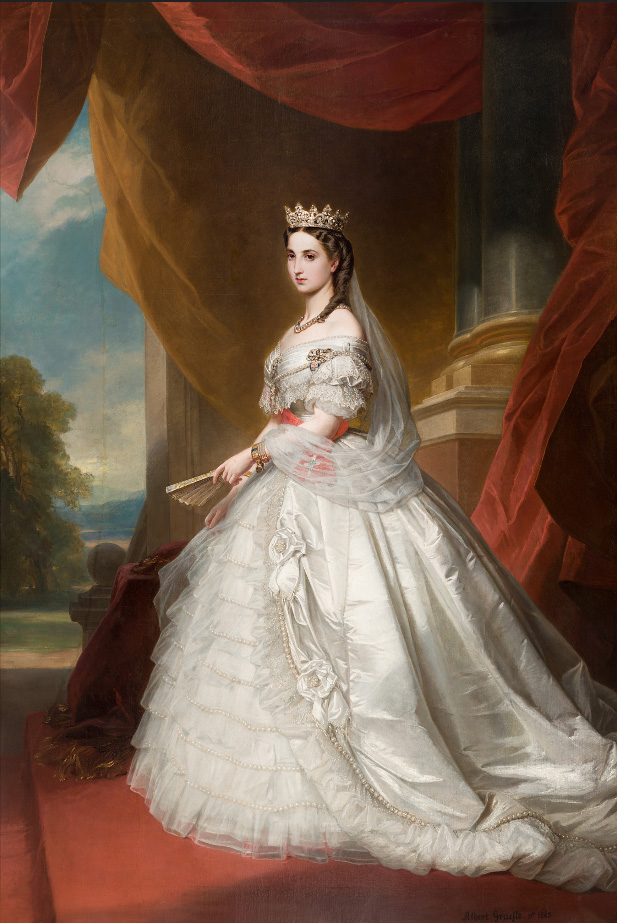
The players are Maximilian, younger brother of the Austrian emperor and his wife Charlotte, a Belgian princess. Together they leave Europe and travel all the way to Mexico, where they are proclaimed emperor and empress by conservative monarchists who are trying to dislodge the republican government headed by President Benito Juarez. These European royals and their empire are propped up by French troops sent by Napoleon III, who wants to expand the influence of the French empire.

All this happens in the 1860s when the United States and its Monroe Doctrine are occupied by that contretemps known as the Civil War. To refresh your memory, the Monroe Doctrine asserts US pre-eminence in the hemisphere and excludes foreign intervention. Despite being focused on dealing with the Confederacy, the US government is not having any truck with the imperial interlopers and continues to recognize Juarez as the legitimate president of Mexico.

When the Civil War ends, the US provides money to the Juarez government. American volunteers, done with one war and ready for the next, pour across the border to join Juarez’s forces. Maximilian has never been popular with the Mexican people, and his tenure as emperor hangs by an increasingly fragile thread.
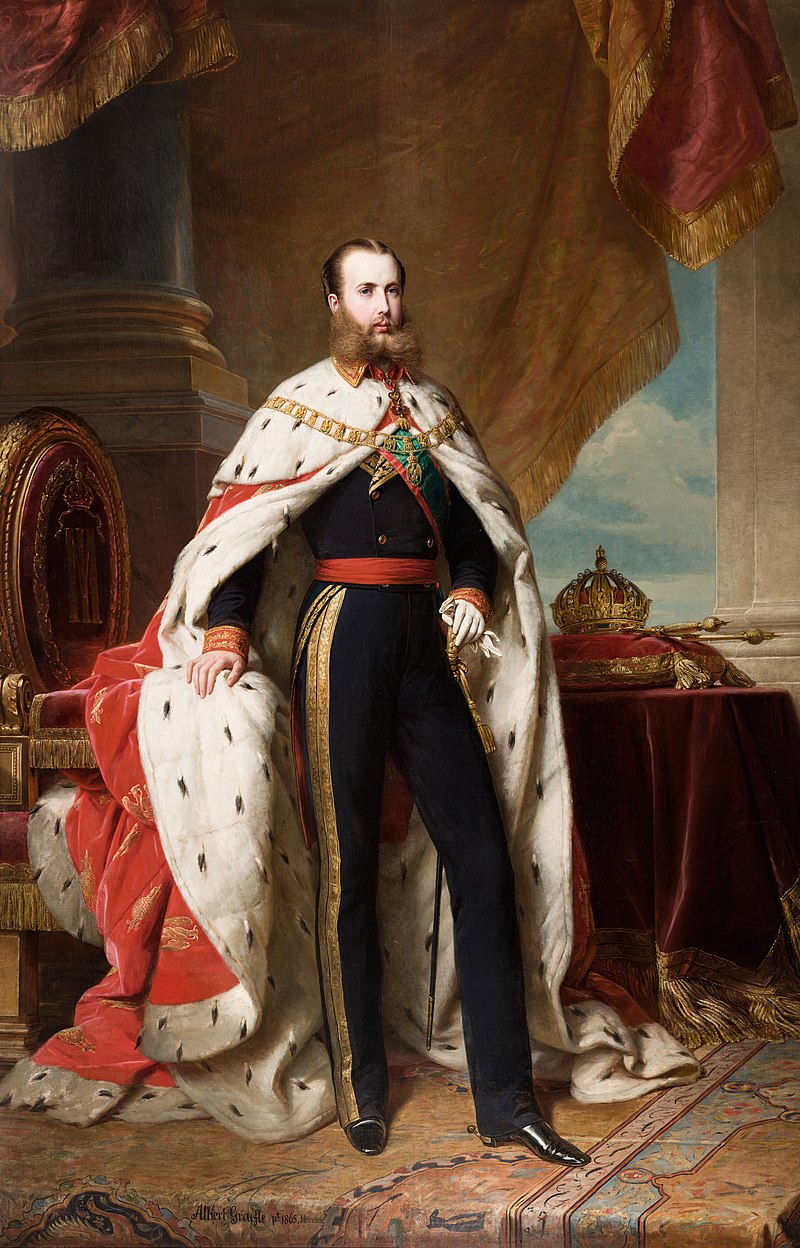
In January 1866, Napoleon III, facing a restive French public that wants no part of this expensive boondoggle, cuts his losses and gets out, withdrawing French troops. Maximilian keeps fighting, eventually losing the battle of Queretero. Captured in May 1867, he is executed by firing squad the following month, his remains eventually returned to Austria.

And what of Princess Charlotte, now the Empress Carlota? Well, that’s the part of the story that really fascinates me. In 1866, Carlota sets sail for Europe, hoping to dissuade Napoleon III from withdrawing his support. Her entreaties go nowhere. Her mental health, suspect even during her time in Mexico, deteriorates. She’s sure that people are out to get her, and maybe they are. She leaves Paris for Rome, seeking the Pope’s help. There she has a breakdown. Carlota spends the rest of her life in Belgium, shut up in a couple of castles. She dies in 1927 at the age of 86, having survived World War I and outlived the players in this bizarre episode.

What a yarn. It’s irresistible. To me, anyway. I’d never heard of Maximilian and Carlota until my first visit to Mexico, over 50 years ago. Looking for something to read, I prowled the paperback rack in a gift shop at a Mazatlan hotel and spied a book on the subject. I bought it, read it, and have since added a number of history books and biographies to my collection, for many writers have been fascinated by Maximilian, Carlota and their Mexican adventure.

The novel I bought in that hotel gift shop is called The Cactus and the Crown, by Catherine Gavin. It uses the emperor and empress as a backdrop for the main plot, which involves a young southern woman, Sally, who leaves the United States with her brother, heading for Mexico with a group of ex-Confederates who plan a new life in a place they call Carlota Colony. And yes, this colony of southern expatriates really did exist, for a short time. Sally and her brother, a doctor, take up residence in Mexico City, where he starts a medical practice and Sally falls in love with a French soldier. And both siblings are drawn into the imperial circle. Just as I was drawn into this improbably but true story.

Stories lie at the intersection of fiction and history. I’m fascinated by what happened to Carlota. Someday, maybe, I’ll write a novel about it. A once-upon-a-time story, about a princess in a castle, shut up with her memories and madness. Because that’s what writers do.


It’s coming soon! The Ladies of Mystery Cavalcade of Books will go live from November 15 through December 31, 2024, featuring books by all of the Ladies. Be sure to check it out! There will be links on the Ladies of Mystery blog site, as well as on my website, at http://www.janetdawson.com.
MARKET MUSINGS

Unless you’re living on an island, sipping margaritas, you know the holiday season is upon us. Only 58 shopping days until Christmas!

I decided to try something new this year and signed up to have a table at the Red Mitten Market, which is held every year at the Canby Grange from October through December. Excited to showcase my books for the first time at this event, I decorated my table with other vendors’ holiday craft items. Currently, I’m displaying Halloween décor.

I’m not required to “man” my table daily, but I love meeting potential readers and talking to people in general. And don’t tell my husband, but I’m not driven by money. However, I enjoy telling shoppers about my writing journey and how my two book series originated.

On my first day at the market, several readers stopped by to visit, and as an added bonus, I sold books and book bundles. Of course, I’m thrilled to have new readers, but I’ve also kept notes about the benefits of participating in the Red Mitten Market.

First, and I know you Ladies already know this, but I’m thankful I’ve taken the time to publish in all formats: Paperbacks, eBooks, and Audible.

The bonus to selling paperbacks is knowing someone is holding my “work of art” in their hands, turning pages, and enjoying the journey from beginning to end. I like to imagine their reaction to learning whether Clara gets justice or revenge against Damian. And did they laugh aloud when Busy asks Sheriff Wyatt Stone, “What’s a girl gotta do to spend the night—” I wonder, too, if they fall asleep with the book open on their chest.

I’m probably most grateful for ensuring my books are available for Kindles and eReaders. The best response to potential readers who say, “I only read on my Kindle.”—is—“Oh, perfect, because all my books are available as eBooks.” Then, I send them off with a handful of bookmarks so they remember to buy the eBooks. As a former “book collector,” I respect the need to downsize and love that I might still get my books in the hands of an electronics-only customer.

It was a difficult journey, but I managed to get the first book in each of my series published as an audiobook. Since I’ve had to return to square one on this project, I’m now struggling with whether to narrate my books or tackle the daunting task of finding a new narrator. In an effort to see the bright side, I enjoy being able to say that I now have these books in audiobook format.

Each time I “man” my table, I’ve had an opportunity to speak with someone who has enriched me beyond monetary compensation. One woman who loved the premise of my Stoneybrook Mystery Series and bought “Redneck Ranch” shared with me that her niece narrates audiobooks. I jotted down the niece’s name, and as an added bonus, she lives near me in Salem, Oregon.

Another woman asked how I liked participating in the Red Mitten Market. I explained it was my first time, but so far, so good. The woman then informed me that she is a six-figure author, so she doesn’t need to have her books at a market. I bristled at her remark but smiled and congratulated her. Did I mention I’m not driven by money? She continued sharing about her success, and I continued to smile and nod. Then she asked if I’d ever heard of Matthew J Holmes and his Facebook Marketing Program. Needless to say, I had not heard of this platform, but I did some research and plan to put Mr. Holmes’s marketing strategy to work next year.

You may recall my blog, “Scritch, Scratch, Feedback,” from a few months ago, which was inspired by my love of country music. I couldn’t let go of a song idea I had, and I finally finished the lyrics. One problem, though, is that I can’t sing or play any music. Undaunted, I considered teaching myself how to play guitar. Because who needs sleep? Today, I had a young lady ask about my books, and after my usual spiel, she said she understood the creative process because she likes to write songs. What?!? After I told her I’d written a song, she said, “Send me the lyrics, and I’ll put music to them.”

As you all know, I lost my son Derrick seven and a half years ago … Being the parent of a deceased child is a difficult burden to bear, and I’m sorry to share that I’ve met many parents who belong to this club. I wanted to make their tragedy more bearable by offering comfort to these moms and dads. When I discovered a pair of white metal wings on an Amazon shopping spree, they brought me a sense of peace. Now, I give these wings to other parents with a poem about not judging a grieving parent.

One of the women who stopped to ask about my books had recently lost her granddaughter to suicide. She said that she was heartbroken and felt her burden doubly because her son was also grieving the loss of his daughter. I shared my story with her, and we plan to have coffee soon so I can give her a set of White Wings and the poem for her son.

As I write this blog post, I’m saddened by the news that my younger sister, Lori, is dying. She has pulmonary fibrosis, and her pulmonologist says she has three to six months. Dying is a messy business, and I’m trying to be there for my sister and distract her from the inevitable. I didn’t know that when I wrote a scene about my villain in “Willow’s Woods,” accepting Jesus Christ as his Savior, I would be helping Lori do the same. We were raised in a Christian family, but she lost her way through the years.

So, participating in the Red Mitten Market for the first time has been a gratifying experience so far. Though I’ve sold books and made some money, the real reward has been the people I’ve interacted with, the real-life stories we’ve shared, and the tidbits I’ve gleaned from these fabulously casual conversations.

Happy Holiday Season, Ladies of Mystery!

The Secret

Many of us in the writing community have a secret, and it’s not exactly the same secret. We write our books, talk about our characters, whom we love, and gnash our teeth over the plot holes, the ever-jiggling middle that refuses to settle down and dash forward, and the ending that leaves us dissatisfied, rewritten three or thirty-three times. You know this because you read us here. None of this is kept secret from anyone who reads a writer’s blog. And then we have to edit the soggy mess, find beta readers, edit it again, and then pop over to our editor, if we have one, or switch hats and become our own publisher.

Somewhere in this scenario is one step that every writer loves. We each have our own. Which one is mine? Those who know me can probably guess.

When I was in college I was the editor of the student humor magazine, which meant handling proofs and working with the printer. I loved working with the printer, seeing those strips of paper with types-set pages on them with little red pencil marks and handing them over to the printer. For some reason I prefer to forget, I always seemed to get him at dinner time. Yes, I love the publishing/printing process. And that brings me to the topic of today—Crime Spell Books.

CSB is the third publishing venture I’ve undertaken with friends or colleagues. What may seem daunting to others has an irresistible pull for me. Two other writers and I began Crime Spell Books after the new editors/owners of Level Best Books, another venture I began with another two friends, dropped the anthology for New England mysteries. They lived in the DC area, so it was understandable. But New England needed its own anthology, so Ang Pompano and Leslie Wheeler and I grabbed the opportunity, and published our first in 2021.

Devil’s Snare: Best New England Crime Stories 2024, now availables is our latest offering, with twenty-four stories, in every sub-genre. We post a call for stories in January, and we read every one that comes in over the next several months (to end of April). We rank the stories 1, 2, or 3 on our own lists, and then we share them to see what we have. It’s always gratifying to see how close we are on most of them. When we decide how many stories we want, we begin discussing the remaining stories that came close, and work for agreement.

Anthologies are among the best works we in the writing community can produce. They show a variety of writers and interests. They require strong collaboration. Each editor loves certain stories and not others, and here we rely on a deep respect for each other’s experience and taste so we can come to agreement. Not every story I love gets into the anthology, and the other two editors probably feel the same. But the result—a list of excellent mysteries and crime stories by known and unknown writers—is something we’re all proud of. And then we come to my special love/hate experience—formatting. I do this because I think there is something wonderful about holding in our hands a finished book that we made, with the chapters and lines of text laid out properly—no unruly paragraphs or rebellious headers or recalcitrant page numbers. Everything is in order and proper and beautiful.

So that’s my favorite part, as much as anyone might question that statement while I’m working on it. The end is worth the frustration, gnashing of teeth, moments of panic, and sheer terror that one wrong punch of a button will send the whole thing to oblivion. And then it’s done. The proof comes in the mail, and then the final copy. And I look up from my desk and there it is. Beautiful. Finished. I can rest of my masses of edited copy and have another cup of tea.

The Company You Keep

Those of us of a certain age were often reminded while growing up, wearing skirts to school, and forced into home economics classes that our reputation was favorably or unfavorably based on the company we kept. If that is the case, then I am one lucky lady.

Recently, I embarked on a project for Ladies of Mystery … its first-ever catalog. The Ladies of Mystery Cavalcade of Books will be online from November 15 to December 31 and feature hand selected offerings from all ten of the Ladies of Mystery bloggers. But that’s not the point. Well, it is, sort of …

In gathering the information for the catalog, I discovered how truly talented the Ladies are. Boy, am I in good company! Did you know there is a Lady in Nova Scotia, one in Texas, and our Lead Lady lives in Oregon? The Ladies live in big cities, in the mountains, and on alfalfa farms. They write about animals, runners, Native Americans, women sleuths, private investigators, families of investigators, small towns, historical fiction and mysteries, romantic suspense and cozies. The gamut of mystery writing – well, not hardcore or noir, but a few that brush the edge.

In her introduction to the Cavalcade, Paty Jager, Lead Lady, writes that she founded the site “to bring mystery writers and readers together to learn about new authors and to get an idea of what it is like to write a mystery book.”

And what a group she lassoed– award winners to newcomers. Am I humbled, yes. Writers tend to be a solitary lot, well, at least, in my case. Yes, we meet at conferences and share our victories and conundrums with each other. Sometimes we do this during online calls, in small groups. We read each other’s books to support our fellow authors, leave reviews, and sharpen our skills.

But, in the end, we sit in a room, at a computer or a typewriter and write, poking our heads out of our holes to take care of the mundanities of life, like bills, food, husbands, cat and dogs, and children.  Not necessarily in that order. Sometimes, we just stare into space or tap our toes at the breakfast table, our brains on the single-minded railroad pulling into Plot-town.

There is always a challenge. Are the clues just so? Are the characters behaving as they should? Are they true to themselves, or have they taken off on some wild bent, dragging the plot behind them like a used tissue? It happens.

So, it was while mulling a rather horrifying historical error in a book I was writing that the idea for the Cavalcade of Books was born. Because, sometimes, the only way out of a hole as deep as the one I dug myself is to redirect your creative energies. Now, I admit, I had no idea how much fun the project would be. And I thank all the other Ladies for their advice, help, and wonderful books chosen for the first-ever Cavalcade of Books.

When the Ladies of Mystery Cavalcade of Books goes live on November 15, you’ll find a bit about each Lady, followed by books categorized by genre. I admit to having fun naming the categories, with able help from another Lady whose fantasy helped me break loose from the humdrum genres. The categories are:

  • The Ladies Save the Day – Mysteries featuring a woman or amateur sleuth
  • Past Perfect (Way back when) – Historical, psychic and ghost-filled mysteries.
  • Cozy by the Fire – For lovers of cozy mysteries
  • Thrills, Chills & Skills – Detectives, private investigators, people caught in webs of lies, deceit and thrills.
  • Made for Each Other (Romance and Mystery) – romantic suspense
  • Written Communications – advice on communications resides here.

The Ladies of Mystery Cavalcade of Books is the perfect opportunity to discover a new favorite author, or new genre, or a new book by an old favorite. As I did. And they are gems.

In the meantime, if you haven’t checked out all the Ladies’ blogs, you should. Talent, diversity, and wonderful tales await you. Like they did me.

Find me at https://dzchurch.com or on Amazon

Justice in New France, 1734


  1. Are lawyers a cornerstone of the justice system in New France?
    Witnesses are a cornerstone of the French judicial system. We do this without lawyers. We do not allow lawyers to practice in New France. We are not English.
  1. Are individuals presumed innocent until proven guilty?
    French law says all accused are presumed guilty. The accused must prove their innocence.
  2. What is the punishment for a capital crime like arson?
    The punishment: death, torture, or banishment. Or some combination of those. Being found guilty will mean an end to the life someone knows regardless of the punishment.
  3. What is the Code Noir?
    The Code Noir explicitly states how slaves are to be treated in New France. It discusses punishment and freedom of movement, or more accurately, lack of movement. The Code also requires that all slaves convert to Catholicism. It is an owner’s responsibility to ensure this happens. Sooner rather than later.
  4. Is there an appeal process?
    Mais oui! The appeal judgment would be rendered by the Conseil Supérieur in Québec. It is the foremost judicial body in New France. Their decision will be final.
  5. Does Montreal have its own prison? Is there a jailer?
    There is a prison, of course. It is attached to the courthouse – and it is where the jailer lives.