More than a Feeling

I have an old, rough, gray woolen blanket that means the world to me. The blanket has been in my family for three generations and can be traced back to a very sad time in my grandfather’s life, during WWII. The wool is harsh. Merciless. As I hold it against my face and feel the roughness, I also feel the history and the love of family.

family-portrait-copy
A portrait of my grandfather, made during the War

Most of us have the privilege of feeling. We have the sense of touch as one of our five senses (or six, perhaps, depending on your point of view). I’ve been watching a TV show recently in which a main character is not able to feel. He has a condition called congenital analgesia. Mostly the show focuses on the fact that he can’t feel pain, a clearly dangerous condition. But it also touches on the fact that he can’t feel good things either — the gentle caress of a warm raindrop, the rough edges of a woolen blanket, the warmth and softness of a kiss.

In my writing I focus, like all other writers, on developing three dimensional characters, on creating a setting that is real and vivid to my readers, and crafting a plot that keeps the reader trying to figure out whodunnit. In the process, I make sure that I catch all the senses: the dryness of an over-cooked steak in a cheap diner, the vibrations of a low bass that you feel as much as hear, the scent of a peat fire burning in the grate.

coffee-1149983_640
Can you smell this?

But I realized that the writers I enjoy the most focus even more on feeling; they allow readers to experience a touch from the character’s point of view. The blanket isn’t just rough, it rubs that sore spot that hasn’t quite healed. The rain isn’t just cold, it seeps deep into the bones and creates an ache in the ankle the character twisted when he was a teenager.

Just as a scent is a sure way to bring back a memory, so, too, is a touch. They’re so closely connected. By feeling something the way the character feels it, the reader is provided a glimpse deep into a character’s mind.

My challenge as a writer is to make sure that my readers experience a feeling — a physical feeling, not an emotional feeling — the way my characters do.

Learn more about books by Jane Gorman at janegorman.com or visiting her Amazon page.

Adam-Kaminski-Mystery-Series


OFF TO BOUCHERCON


copy


Tomorrstock-photo-13496205-path-between-the-rocks-monte-baldo-italyow I’m off to Bouchercon, my second time going to that fan conference. I attended two years ago when it was held in Long Beach, but I didn’t stay at the hotel and drove back and forth. It’s such a huge gathering—Long Beach attracted 2,000 attendees:  fans and mystery writers—that I was overwhelmed.  I attended only a few panels and kept taking refuge at the Sisters in Crime/LA table where at least I had my back to the wall and knew some people.

This time it’s in New Orleans, and I vowed to be braver. I’m not on any panels, which is disappointing, but I will talk to as many people as I can. There will be a lot of Sisters in Crime/Los Angeles members there, so there will be some friendly faces.

This is the part of writing books that I find the most difficult: publicizing myself and my books. Writers generally are a shy and retiring lot, preferring to be home writing and reading than out talking to groups of people and telling them about their writing processes, the way they create, where they get their ideas—well, you get the picture.

Yet, of course, this is the way the writer—me—becomes known, by meeting people and talking to them and giving them cards and bookmarks, telling them about writing and making friends.  I don’t mean to sound as though I don’t like people. Of course I do, and I have lots of friends. It’s the self-publicizing part that I find difficult.

I often wonder——as do many people, especially publishers— what it is that creates mega best sellers, like THE GIRL ON THE TRAIN. It was a first novel, I believe, and it got good reviews, but so do lots of other books, and they don’t stay on the best seller list forever. It must drive publishers nuts trying to predict what book, of the many they publish, is going to be a huge hit. Did Paula  Hawkins know she’d written a best selling novel?

And what about GONE, GIRL? Gilliam Flynn had written and published several books before that one that sold well, but not like GONE, GIRL. If anyone can predict what will sell and what won’t, they’ve got a million dollar gift. Of course they’d have to do a lot of reading!

I know my fellow Ladies of Mystery work hard at promoting their books, going to libraries and bookstores, author fairs and all kinds of other venues They are good at what they do. I am learning, but it’s a slow and somewhat painful process.  But if I don’t work at publicity, no one besides my closest friends and family will even know about my books.

When I read this over, I realize I’m sounding very negative. Probably because I’stock-photo-53147238-climbing-success-happy-woman-in-mountainsm scared about going to Bouchercon, meeting all those writers and fans and trying to make an impression. Wish me luck, guys! I hope I look like this on Sunday.


Mystery and Mysticism by Paty Jager

paty shadow (1)My brother is an artist who creates his own bronze statues and patinas bronze work for other artists. When he told me about a specific piece he’d put the patina on and how it had a unique configuration, he had my attention. His words, “This would make a great murder weapon.”

That sentence stayed with me for several years.

And finally, when I decided to write a murder mystery series, I jumped at the idea of using a 300 lb bronze statue as the weapon. Only I had to come up with a plausible amateur sleuth and give her a profession. That is how Shandra Higheagle, a potter who is half Nez Perce Indian, came to be. I wanted her to have the Native American background to keep with my tag line, “Murder mystery and steamy western romance starring cowboys and Indians.”  And I wanted her to use her heritage to help solve the murders. That is where her Nez Perce grandmother came onto the scene.

Shandra’s Nez Perce father was a rodeo bronc rider who died in a rodeo accident when she was four. Her Caucasian mother and step-father kept her from her father’s family until Shandra rebelled as a teenager and spent a summer with her grandmother.  While Shandra still wasn’t allowed to let people know of her Indian heritage, she kept in touch with her grandmother. The first book opens with Shandra returning from her grandmother’s funeral and seven drum ceremony.

Where is this all going you ask?  When Shandra is suspected of killing a gallery owner and then the county sheriff’s detective turns his interest to her best friend, Shandra’s grandmother comes to Shandra in her dreams, guiding her to the evidence that will help them find the murderer.

Shandra has a hard time believing in these dreams, yet the detective believes. Her dreams cause her conflict with herself and allows her to let someone in after years of keeping herself closed off.

One of the most difficult and rewarding parts of writing these books is to come up with dreams for Shandra to have that reflect what is going on with the mystery without giving anything away.

The first three books of the Shandra Higheagle Mystery series are now in an ebook box set.

Here are the shortened blurbs for the first three books in the Shandra Higheagle Mystery Series.

higheagle-1-3-box-2700px

Double Duplicity

Potter Shandra Higheagle’s Nez Perce grandmother visits her dreams, revealing clues that help Shandra uncover not only one murder but two.

Tarnished Remains

Digging up Crazy Lil’s past takes Shandra Higheagle down a road of greed, miscommunication, and deceit.

Deadly Aim

The dead body of an illicit neighbor and an old necklace sends potter Shandra Higheagle on a chase to find a murderer.

Windtree Press / Amazon / Nook / Apple / Kobo

Paty Jager is an award-winning author of 25+ novels and over a dozen novellas and short stories of murder mystery, western historical romance, and action adventure. She has a RomCon Reader’s Choice Award for her Action Adventure and received the EPPIE Award for Best Contemporary Romance. Her first mystery was a finalist in the Chanticleer Mayhem and Mystery Award and is a finalist in the RONE Award Mystery category.  This is what Mysteries Etc says about her Shandra Higheagle mystery series: “Mystery, romance, small town, and Native American heritage combine to make a compelling read.”

blog / website /  Facebook / Paty’s Posse / Goodreads / Twitter / Pinterest

patyjager logo

Funerals and send-offs

By Sally Carpenter

 I recently read a blog post by a writer in his 70s who said he’s never seen a dead body. He’d never been to a funeral?

It could be the writer was referring to murder victims. But when I lived in the Midwest, viewing the deceased was a way of life.

Commemorating the dead in my rural hometown consisted of three parts: the viewing (called a “wake” in some circles), the funeral service and the graveside committal. The first two parts took place at a funeral home where the funeral director handled all the scheduling and arrangements. Clergy were asked to lead the services, but that was the extent of their participation or input.

 At the viewing, the embalmed body was placed in an open casket, flowers were set out and the public dropped by to sign the guest book, greet the family, and look at the deceased who bore little resemblance to the person in life. I think when I was a kid my mother took me to some viewings of people she know. I thought it was odd to stare at a dead person. Why not visit the person when they were alive and you could talk to them? I also didn’t like how funeral homes looked, too artificial and fussy. Not the place where I’d want to spend my last earthly moments.

At the brief funeral service, an organist played syrupy music and a minister gave a short talk. While the guests were still inside, the funeral home affixed little flags to the hoods of their cars to mark them as part of the processional. With the hearse carrying the casket and the limo with the family members leading the way, a long line of vehicles moved at a snail’s pace to the burial site. Since funeral processions had the right of way, many times I had to sit in traffic while an endless stream of these cars passed through an intersection.

 The committal service was even shorter, since people usually stood by the gravesite (except at my mother’s funeral, we sat in padded folding chairs beneath a canopy). Unlike what you see on TV/movies, the casket was never lowered into the ground and nobody threw dirt or flowers into the grave. The actuall internment took place after friends and family had left. Weeks or months later the gravestone was finally put in place.

 For one of my uncles, the internment consisted of his widow showing up at the family plot on her own, and placing his urn of ashes into a pre-dug hole. Other family members, including myself, happened to be there at the time (must have been around Memorial Day for our annual visit to the graves of mom’s parents).

 At my dad’s funeral service, my brother brought his young children. Even though they were not close to grandpa, they became hysterical when they saw the corpse and their mother took them out of the room for the service. I think their reaction was not grief over the loss but that their young minds had trouble processing a human death.

 Now I live on the West Coast and funerals seem to be done differently here. I’ve never seen a funeral processional, although during the day I’m at my day job. But with the heavy congestion on local streets, a long, slow-paced procession would not be practical.

Religious funerals are now taking place in churches rather than in funeral homes. I’ve attended two funerals at different churches. For me, the services more meaningful and longer and included congregational singing.

 “Home made” memorial services without the body present are replacing the traditional funeral. Family and friends, not processional morticians, plan and lead these informal services set in a home or a favorite bar or restaurant. Acquaintances share stories of the deceased and make toasts in their honor.

 I’ve attended two memorial services set in different community theaters where the deceased was an active participant. One of these funerals screened a video montage of the decease’ stage roles. At the other service, the deceased’s collection of Beanie Babies was set on the stage. Afterwards those present were invited to take a toy home as a memento (the cat I picked sits near my computer). And on my way into the building, I was asked to say a few words during the service. I’m not good at impromptu speaking, but I managed to sound intelligent and even (unintentionally) coax some laughter from the audience.

 How are funerals conducted in your town? What do you think is the best way to “send off” a loved one?

 

August is My Birthday Month

Looking back over the years, some birthdays really stand out for me. Remember, I’m really old and people didn’t do the expensive parties that they do now, nor were there places to buy decorations, party favors and games..

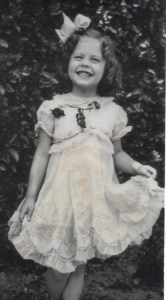
The first one I can remember was when I was about five and my mother planned a fairy princess party. I don’t remember too much about it, except that all the little girls that came got crowns, and I had a big one, plus a wand.  My auntie made all the favors.

Me as a flower girl.
Not the party dress, but that’s about the age I was.

Around the my tenth birthday or so, my mother planned a luncheon party with a Mexican theme. My two girls cousins and my best school friends came to that one.

When I was in junior high, the celebration was held in Chinatown in downtown L.A. and we traveled on the streetcar to get there. There were others, of course, but those are the ones that stand out in my memory.

I’ve had lots and lots of celebrations as an adult because I’ve been around a long time.

This is also the month my first child was born–and I lived 3000 miles away from my family. (Remember this was a long, long time ago.) My husband was in the Navy in Virginia and had the duty the weekend that I gave birth–and I lived in Maryland. Hubby arrived to see his daughter the next day. Looking back, I knew nothing about raising a baby. I had a Good Housekeeping baby book, and did everything it said to do.

This is the month my first child got married too–being a poor Navy family, we made all the bridesmaids’ dresses, daughter made her wedding dress, I did all the flowers using the neighbors’ daisies and a rosebud lapel pin for the groom, a neighbor made the wedding cake and I cooked all the food for the reception. (It all turned out great.)

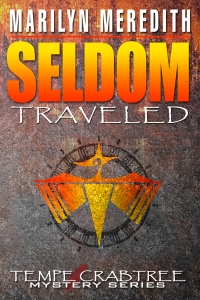
August is also the month that my Deputy Tempe Crabtree mysteries come out–and yes, the new one is now available on Amazon.

SeldomTraveledFrontCover new

The tranquility of the mountain community of Bear Creek is disrupted by a runaway fugitive, a vicious murderer, and a raging forest fire. Deputy Tempe Crabtree is threatened by all three.

https://www.amazon.com/Seldom-Traveled-Tempe-Crabtree-Mystery/dp/1594264333/ref=sr_1_1?s=books&ie=UTF8&qid=1471655178&sr=1-1&keywords=seldom+traveled+by+marilyn+meredith

As you can see August is an important month for me, full of memories and exciting things ahead.

Marilyn