Meeting Peter Graves

by Sally Carpenter

Over the years I’ve met celebrities at book signings, concerts and appearances. Some stars have been quite charming; others apparently wanted me to go away. One particular appearance comes in mind regarding my WIP set in 1967.

In 1967 the entertainment world was spy crazy. Imitating the success of the new James Bond films came the spy parodies “Our Man Flint,” “In Like Flint,” “The Silencers” and “Murderer’s Row.” Television was chock-a-block spies with “The Man From UNCLE,” “The Girl From UNCLE,” “Get Smart,” “The Avengers” “The Wild, Wild West” (secret agents in the Old West) and “Mission: Impossible.”

As a kid I didn’t understand “MI” when it first aired, although I had a crush on Peter Graves. Years later when watching the shows in syndication I became a devout fan. In fact, my WIP works the “MI” show into the story as homage.

On a Friday in 2009, I glanced through the weekend entertainment section of the newspaper and saw that the next day Peter Graves was scheduled to receive an award at the Ojai Film Festival. The event would start with a screening of the film “Airplane!” with Graves in a hilarious comic performance, followed by comments from Graves and an audience Q&A.

Ojai was about an hour or so drive from my town and the festival was open to the public. Why not go, I thought. I thought up an interesting question for the Q&A and pulled out my book “The Mission: Impossible Dossier,” about the making of the TV show, for him to autograph.

Ojai is one of those places you can’t get there from here. To go by freeway meant dealing with heavy traffic, so I opted for the back roads route. What looked like an easy path on the map became navigating up and down steep hills with winding streets and hairpin turns. I was too busy watching the road to enjoy the rural scenery.

Ojai has basically one main street, so finding the location wasn’t difficult. The event would take place inside a drab school auditorium. Hardly the sort of dazzling venue fit for a star of Graves’ caliber. I stood in the long line, waiting for the doors to open. Some people were talking to the man ahead of me. I didn’t pay any attention to him.

Inside the auditorium I took a front row seat on the right hand side on the old-fashioned wooden bleacher-type chairs. The emcee said the festival’s custom was to ask the honoree to select their favorite piece of work to screen. Graves had picked “Airplane!” An interesting choice.

After the movie, Graves came out front along with Robert Hayes, another “Airplane!” star. Also joining them was the man who stood in line in front of me—Rossie Harris, who played Joey in the movie (the kid in the cockpit) and now all grown up. Now I wish I’d gotten his autograph.

Unfortunately, Graves was no longer the handsome leading man. He looked ill, was quite thin and used a cane for walking/standing. His voice quavered a little and at one point he seemed to forget what he was saying. But for the most part his mind was still sharp and his speech lucid.

When the Q&A started, I raised my hand. I mentioned that Peter smoked a lot of “MI.” Was that just for the character or did he smoke in real life? (Martin Landau, Barbara Bain and Greg Morris also smoked on the show).

Graves replied in a strong voice, quote, “I smoked for forty years and enjoyed every puff!” He went on to say he was forced to quit smoking after a skiing accident that resulted in his jaws being wired shut for several weeks. The doctor gave him a set of wire cutters so he could remove the wires in case he needed to throw up (TMI).

The program ended and the audience was leaving. Graves and his entourage headed for the exit. I was sitting between him and the door. I ran up to him and said, “May I have your autograph?”

He said, “I came empty handed,” meaning he had nothing to sign for me.

I held out the book and a pen. He seemed surprise. “Oh, you have the book!” I set the book on the stage (we were on the ground floor) so he’d had a firm surface for writing. He took the pen and signed the page I had opened. I thanked him and he left the building. I don’t know if he was annoyed at me—I was the only one in the crowd that had accosted him—but I was over the moon.

Graves died six months later.

What I’ve learned from meeting celebrities is to always be gracious to a fan. As a published author I haven’t had many opportunities to meet readers, and I’ll never be as famous as Graves, but when I’m “on stage” I strive to be pleasant and accommodating. Once at a writers convention a reader interrupted me while I was eating to sign my book. I was so thrilled that someone actually wanted my autograph that I didn’t mind at all.

But don’t bother me in the ladies’ room.



Holiday Reads or Not? by Paty Jager

paty shadow (1)I’m not one of those people who has to buy every romance or mystery book that deals with a holiday. In fact, over the 50+ years that I’ve been a reader,  I’ve had one Nora Roberts set of romance books that were Christmas books that I read every year in December, but I didn’t read any other Christmas books. Then a friend wrote a Thanksgiving novella. I pull that out and read it in November. But that’s about it for reading holiday themed books.
And yet, I seem to write a lot of holiday themed books. In my romance books I’ve written three Christmas Stories, a 4th of July, New Year’s, Halloween, and Valentine story.

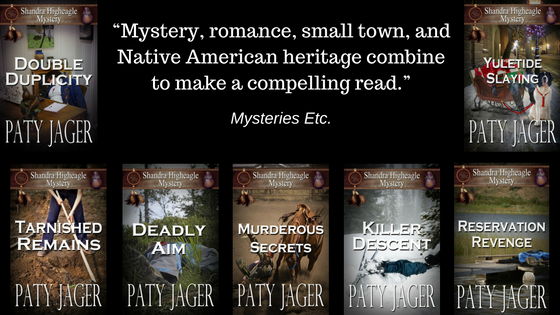
In my mysteries, I’ve now written a Christmas and a Halloween story. Last November I put out Yuletide Slaying with Sheba the pony-sized mutt as the character who discovered the dead body.

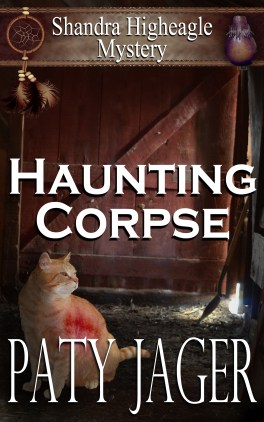
And this month, going with the theme of an animal finding the body in the holiday stories, Lewis, Crazy Lil’s orange cat, finds the body in Haunting Corpse, book 9 of my Shandra Higheagle Mystery series.

I found while planning this book, I didn’t really think about the holiday. My mind was focused on the murder and who could have done it. The Halloween party was merely used as a means to gather information for Shandra and Ryan and the reader. But I had fun writing the party, the costumes, and the conversations.

Do you find as a reader that you like to read between the lines of the conversation and character’s actions, to try and discover the murderer? Or do you just let yourself go with the flow of the story and be surprised at the end?  Writer’s do you try to make your characters’ conversations relevant to giving clues or do you just write what comes to mind and drop a hint here or there?

Here is the blurb and cover of my newest Shandra Higheagle Mystery.

Haunting Corpse 5x8Desertion…Wrath…Murder

A runaway bride, murder, and arson has Shandra Higheagle sleuthing again. Sorting through the debris of her best friend’s childhood, Shandra believes she must solve the murder before her friend becomes the next victim.

Stumbling upon a dead body, Detective Ryan Greer is determined to bring the killer to justice before Shandra becomes too entangled in her friend’s dysfunctional past. He hopes he’s not too late. Her deceased grandmother has already visited her dreams, putting Shandra in the middle of his investigation and danger.

Universal Link – https://www.books2read.com/u/3J0ZWX


higheagle-book-banner


Retro-dressing my characters

By Sally Carpenter

One of the challenges of writers of historical mysteries is clothing their characters. As fashions change continually, authors must carefully research their time period for accuracy.

My new cozy is set in 1967, a period that should be easy to clothe, right? When I was growing up in the ‘60s I wasn’t interested in fashion. My mother sewed all my clothes and I didn’t buy my own clothing until college. My memory of what people wore at the time is vague and limited.

So I consulted books and learned about Mary Quant and the groovy, hip styles. However, my book is set in the rural Midwest—similar to where I grew up—and the hot fashions of the New York runway never made it west. Growing up, I didn’t see anyone on the streets wearing love beads or Nehru jackets or batik prints or even miniskirts. The ordinary Jane Doe didn’t dress like Emma Peel.

What to do? I found a terrific book titled “Fashionable Clothing from the Sears Catalogs mid 1960s.” That’s right, the book contains full-color illustrations of the merchandise sold in the mail-order catalogs. It’s a wealth of information of what the common person wore as they shopped at Sears, not high-end boutiques.

Women’s clothes of the ‘60s were less restrictive than the ‘50s. Gone were the girdles and mounds of petticoats holding up poodle skirts. Pantyhose replaced nylon stockings for a practical reason. Individual stockings required garter belts to hold them up, but the stocking clips could be seen under miniskirts. Pantyhose provided a seamless visual line as well as some modesty if the skirt flipped up.

But some ‘50s holdovers remained into the ‘60s. The catalogue book has several pages of women’s hats, and when ladies put on a hat, they wore gloves as well. Jackie Kennedy made the pillbox hat a must-have at the time. So I will occasionally put my 26-year-old heroine in a hat because it looks far out and while she’s tough, she isn’t a total tomboy.

The Sears book has no miniskirts! The dresses and skirts hit the knee or just below. A black “dance” dress is shorter, with the hem only about two inches above the knee “to allow movement.” Miniskirts were not practical for everyday women working in offices, stores or schoolrooms.

The book also has far more dresses than pants for women. Women in white- and pink-collar jobs generally wore dresses and seldom  pantsuits on a night out. I had to rethink my character’s wardrobe. I’m putting her in more dresses than I anticipated, but that’s OK. She looks groovy in skirts. And she’s in pants for the “action” scenes that require running and climbing.

I found no women’s jeans in the catalog book, although I did spot a denim jacket and skirt outfit. Women’s dungarees (jeans) had been around in the ‘50s, but only for casual wear or factory/farm work. In the ‘50s and early ‘60s jeans were associated with biker gangs, hoods and rowdy rock bands. Only by mid ‘60s did jeans gain popularity. In fact, faded and patched jeans were stylish.

The few shoes in the book are mostly flats, a surprise as I thought most women in dresses wore heels. Flat heels permit more movement and are less painful for the feet. However, the pencil skirts of the time prevented women from taking long strides and forced them to move their hips more when walking.

Watching TV shows and movies of the era is a another great way to do research. One can see not only what women wore but also how they moved in the slim skirts and short hems. One of my heroine’s dresses is based on an outfit Barbara Feldon wore in “Get Smart.”

In the ‘60s, not everyone jumped on the fashion bandwagon. The older generation, i.e., my parents, continued to wear older styles. Few women in my hometown wore pants in public. My mother only put on pants once in her adult life and I thought they looked weird on her.

I’m writing from my experience. No doubt many older women of the ‘60s embraced pants and other hip styles—just not in my neighborhood.

Of course my cozy has hippies. They dressed differently from the “square” townsfolk to express their individually and distain for the “establishment.” The Sears book didn’t have hippie clothes–no surprise there–but I found examples in other books. Surprisingly, hippies shopped at war surplus stores. This seems odd considering their opposition to the war, but perhaps the reason was that the merchandise sold cheap.

Men’s fashions haven’t changed much over the years. The suit-and-tie has remained standard wear forever, although the ‘70s put a spin on that with the huge lapels, wild pastel colors and paisley shirts. The men in my book mostly wear regular shirts and pants except for the occasional denim overalls (this is farm country after all) and suspenders. And maybe a couple of bellbottoms.

In looking through the Sears book, I was struck at the beauty of the clothes. The models look feminine but not girlish, pretty yet confident, stylish but not too dated. Modern women’s clothing has a drab “unisex” look that I dislike. I’d love to wear some of the fashions in the Sears book. Let’s go retro!


Off and Running


Well, maybe not running–but I have certainly begun the promotion for my latest book, A Cold Death, with as much spirit and energy as possible.

Me at Branches and Books

This is my first book signing for the new book at Branches Books and Gifts in Oakhurst. Long  drive but one of my favorite towns. Lots of pluses, got to lunch and visit with an old friend, then after the signing, went to dinner with grandson, his wife and great grandson. Though I didn’t sell a ton of books, did sell some to people who like mystery series.

AColdDeath-lg

I’m also in the middle of a blog tour–it hasn’t gone smoothly, hosts forgot to put my post up–not sure why they wait until the day and don’t schedule it–but I’ve had many great comments and the book is beginning to receive reviews.

My next event is planned at Stafford’s Chocolates, yes, it’s a store that sells handmade delicious chocolates, only 17 miles from home. I’ll let you know how that goes, but if all else fails, I can eat chocolate. The store is excited to be hosting me–so that’s a plus.

Also attending a the Great Valley Bookfest on October 14th in Manteca–also a long drive, but well worth it. The people come to it planning to buy books.

While all this has been going on, I’ve also taken the rights back for some of my books and new editions have appeared on Amazon.

This is a book truly from my heart-not exactly a mystery, though there are some mysterious elements–but it is based on something that happened in our family.

The Astral Gift latest

This one is a mystery–the first one I wrote and published. It has been re-edited–it is about child abuse, astral projection, murder, and a touch of romance.

https://www.amazon.com/Astral-Gift-Marilyn-Meredith-ebook/dp/B075M7B7PW/ref=sr_1_1?s=digital-text&ie=UTF8&qid=1506264448&sr=1-1&keywords=the+astral+gift+by+marilyn+meredith

So you can see, though I’m not really running, I feel like I have been. I’ve also been learning new things along the way.

What new places have any of you tried for book signings? Anyone else experiencing new challenges along the way?

Being an author is certainly not for sissies!

Marilyn

WHODUNIT?

I’ve been reading a lot of mysteries lately, perhaps to unstick myself from where I am stuck in my own book. I read to find the solutions other writers have come up with in their books. When the soluton is revealed and I find out who the murderer is or why the murderer did what he or she did, is it satisfactory? Does it leave me with a feeling that although I was mystified, I am now satisfied by the answer. Those mysteries are a pleasure.

Sometimes, though, I think that the writer doesn’t play fair or comes up with a solution that doesn’t make sense. The solution may be a great surprise, but it leaves the reader feeling cheated.

Sometimes writers do the “Hercule Poirot” ending where the detective or amateur sleuth gathers all the suspects together and accuses each character in turn of committing the murder, lays out the reasons why they did so, and then exonerates each one until he gets to the real murderer. That was good for Agatha Christie, who may have been the first to use it, but it get tedious when it continues to be used. Perhaps everyone has a reason to kill the victim, but not everyone is capable of murder or has a reason serious enough to kill.

That’s an other thing: the reason to kill must be serious. The killer must not only be capable of murder but must also have a really good reason to do so. Revenge for a terrible injury or protecting an important secret or shielding a loved one,. yes. Revenge for a social slight or insult, no. Revenge must be for something really serious.

I like an ending where the sleuth suddenly realizes who the murderer must be and pursues him or her to a satisfying climax, preferably with a chase or confrontation scene. That’s only my preference, of course. Obviously, not all mysteries should be alike. I’ve read many satisfactory mysteries where the murderer is known by the reader from the start, but the story is about the pursuit of the murderer by the sleuth or the sleuth’s realization of who the murderer must be. Or even, although this isn’t my favorite, a story told from the murder’s point of view as he or she escapes from the detective. In that kind of mystery, I find myself rooting for the murderer, and that’s kind of uncomfortable.

Anyway, the sticking point in the novel I am currently writing, the problem which is driving me to read one mystery after another in an attempt to forget my problem or, with luck, solve it, is the discovery early on of a safe deposit full of very expensive jewelry. The novel is the third in my Burgess Beach, Florida, series, featuring detective Andi Battaglia and her partner, Greg Lamont. It’s called REASONS TO DISAPPEAR, and the story concerns their captain, the man who ran the Burgess Beach Police Department, a real stickler for rules and regulations, who has disappeared, taking with him a lot of the city”s money and leaving behind the safety deposit full of jewelry. Is it solen? If so, from whom? By whom? How did the captain get hold of it? Why didn’t he take it with him when he left? What, if anything, does it mean?

I am inclined to trust my writing subconscious, which often causes me to put something in as I’m writing that I’m not sure I know the meaning of. This safe deposit box full of jewelry may be one of those things. Who does it belong to? Was it stolen? How did it get to the Captain’;s safe deposit box? Why is the Las Vegas mob interested in the jewelry? I hope my subconscious knows the answer and will reveal it to me soon.