How Mysteries Found Me . . . and Elude Me

Ever since I was a fourth grade nothing–and despite my disdain in book report writing during grammar school–my goal was to break into news reporting. Specifically, feature writing, soft-news reporting, or 1st POV investigative journalism. Thank the current events segment of school lessons, two National Geographic and Time magazine issues, and falling asleep to the opening 10 O’Clock news segments–after the announcer’s ask if parents knew where their children were?–of the usual Middle Eastern countries fighting. I’d be amiss if I didn’t give a nod of gratitude to the inimitable Paul Harvey for enriching my love of journalism until his still-missed narrative on said news. The dream became reality in features reporting for two college newsrags, an online site when the Interwebs was young, a stint with a New Orleans Pennysaver, a church tabloid, and scattered articles in First Draft, and in a Brooklyn, a Queens, and a small-town Texas outlets. But even with present-day current events growing scarier, stranger, and noticeably darker with each passing hour as news outlets are also noticeably more crowded and pointy-elbow competitive, I still follow them steadfast.

Much as I love words and what REM sleep-dreams surprise me with, it never occurred I’d write one book, let alone be earlobes-deep into projects spanning three separate series, this platform, newsletter-planning, and shoehorning in working flash fiction pieces and haikus. The universe and the Designer behind it had adventures in mind not involving conventional journalism. As one not believing in coincidences, I’m body-surfing this space-time wave unapologetically.

My now-deceased mother devoured anything medicine-related for a career in nursing, but my joyous arrival detoured those plans. My being born with albinism likely pushed her into the genetics end of biology of medicine, from the sneaks I saw of her Queensborough College class notes, and with her help during high school biology and organic chemistry, I aced the classes; to this day, I still remember most of the components. On her days off from working as a phlebotomist lab tech since early childhood, she watched every medical or crime mystery on TV. Perry Mason. Quincy, M.D. Nancy Drew/Hardy Boys Mysteries. Hart to Hart. Ironside. Alfred Hitchcock Presents. I Spy. The Saint. Mannix. Barnaby Jones. Kojak. Nero Wolff. More often than not, she cracked the case before the show’s penultimate commercial block. She also read Sidney Sheldon, Michael Crichton–The Andromeda Strain stands out alongside Robin Cook’s Coma and another title with “Ophelia” in it, but I’m unsure which this is–Jackie Collins, and back copies of Ellery Queen. She’d offer these when I read everything in our area library or at home, but I did so lacklusterly (yes, I made up a word! 🙂 )–no kids were in it. Leastwise, no cute guys I could imagine as my book boyfriends. Sherlock Holmes was easier to listen to than to read, but even then, that story captured me as long as a rainbow lasts; ADHD much? Same with Nancy Drews (what WAS it with every 👏🏻 story 👏🏻ending 👏🏻 with 👏🏻 an 👏🏻 ice 👏🏻 cream 👏🏻 sundae 👏🏻 celebration?!? Who can even eat that much ice cream–NOT looking at you, Joey Chestnut! 🙂 Yikes!). The Hardy Boys were more fun than Nancy, as were a handful of classic Scooby-Doo episodes, but not for lack of trying. Aside from the aforementioned, there wasn’t much for kids to believably play in, and case-crack, good whodunnits. Sci-fi, sure. Judy Blume, Richard Peck, Heidi, Charlotte’s Web, Peter and the Wolf, Beverly Cleary, and Paula Danziger ruled the kid-lit scene as Harry Potter, Wimpy Kid, The Dork Diaries, and the Percy Jackson reads do today, but the After-School Specials in book form tackled fitting in, boy-meets-girl, boy-loves-girl, boy-loses-girl or boy-claims-girl-again, bravery and honesty in friendships, humility, and standing up for oneself Cleary handled. Danziger and Blume took on heavier topics like divorce, drugs, puberty, sexuality, dysfunctional families, or weight struggles. So who’d believe a kid crime-fighter or a pint-sized spy in the same playing field genre as Sherlock, Nero, Bond, or Mike Hammer, let alone one grown-ups would take seriously? Heck, even teenagers Frank, Joe, and Nancy were grown-up technically, but they probably still did kid-stuff like ball games, pillow fights, sock-hops, and pajama parties offstage!

Aghast and disgusted with American journalism’s willful descent into madness during college, post graduation and zero job prospects, I pondered what I’d next write, where I’d next go. Diary-keeping–meh. Blogging wasn’t a thing. I loved emailing, but didn’t know a soul I couldn’t easily talk to in person or on the phone. And most family members had passed away or weren’t on speaking terms with me to engage in letter-writing. My imagination? Then, like now, is too friggin’ big to contain in a short story if I tried. Still reading though–Harry Potter, in this case–while cleaning my kids’ bedroom one afternoon, a teenage boy on his bed in his messy room, looseleaf open on his knees as he dozed, flashed to mind like C.S. Lewis’s lit lamppost in a snowstorm-shrouded forest popped in his. This fully formed Wyoming high school sophomore, oldest of three siblings and sans girlfriend, was Jay Vincent. Upon hearing stock car racers Tony and Cruz Pedregon’s surnames later that evening, I stole this to tag as J.V.’s. Add in Keenan Alexander, the name Keenan influenced by the Wayans brothers on a youngish FOX network, and Casper McGuinness from another false-start novel, I had my central cast in need of a story. A few turns of the imaginative Phillips head, Keenan became Casper’s street-smart, smart-ass, and lady-killer cousin Logan.

2005 was pivotal for news and personal events. New York State Governor Eliot Spitzer made headlines in regular trysts with a prostitute and for it, shamed out of office. Not long after, New Jersey Governor Jim McGreevey lost his post for hiring a PI to track his gay boyfriend’s affair at taxpayers’ expense. Iconic comedian Richard Pryor, and R & B artists Luther Vandross and Rick “Superfreak” James died, but Pryor made ink with his birth allegations the result of a hooker-john union. In that year, I happened into a long-forgotten neighbor around the corner from my then-residence who remembered my being a non-conformist curiosity preschooler, and a ball of near nonstop energy. A ten minute exchange of hellos and are you so-and-so’s daughter turned into a year of visits, teas, desserts and hushed conversations I deserved to know, including confirmations behind our 1980 cross-country move, how my maternal grandmother had been an alleycat, and my dad’s acidic bigotry to Caucasians were explained.

Even with my questions and suspicions acknowledged, a deeper why thickened the current events and history soup I mentally and emotionally digested: What if two high school kids learn they’re sons of prostitutes, set to be slain to keep them from discovering why they are? From that, I the composer to sleuth-to-be Jay Vincent Pedregon and cousins Casper and Logan McGuinness, the players of the music in pouring out my heart in anger, shock, astonishment, rage, and sadness in my experiences-backstory-explained on paper, mixed with current events in the novel’s plot, found a story home. In the storm and its cleansing, JERSEY DOGS was born.

Was that to shamelessly plug my inaugural mystery? Nope. It’s to illustrate why I’m an author in the first place, and how my ancestry’s sordid and unapologetic past drop-kicked me here. My mother’s love for this genre, and learning she used to write before her vocation in peripheral medicine? Partly. But it’s broader and more intense than having messy creative fun in streaking watercolors to blend word forms, characters, scenes, plots, and settings. If I’m gonna be ugly-crying honest with myself and with you, I need to be constantly okay with my father’s homicide in 1991, that I may never uncover why that now Pluto-cold case ever happened, or that his putrid ethnic views might’ve factored in his death. I’m also good with not knowing my mother’s deepest fears in having daughters with albinism, or her fright behind her uprooting my 14yo self and its bustling, never-sleepy Metropolis life to a podunk northern Arizona town with one traffic light and one post office. Forensically, though, albeit fictionally, my curiosity Qs and As are a little more sated with each story crafted, crime solved or gotten away with, and growth steps my characters take. That, too, is okay. If there isn’t enough time to read all the books I’d like to, then in a world where the 5Ws and an H are often plain, aspects of how my author life came to pass is a sweet enough mystery for me.
Transitions

Right now I’m making the transition from writing a series to writing a stand-alone. There are similarities between the two forms, of course. Setting is still all important, for example. We need to know where the story takes place and how this affects the characters. Is the story set in a city? If yes, then at least some characters will travel by public transportation–the subway or bus or zip car or Uber/Lyft or bicycle. If the setting is a small town or even a farm community, the bus will be a once a day opportunity, and most people will drive everywhere.

The variety of characters around the protagonist will remain important, but here some less obvious differences start to emerge. In any mystery the reader expects a diversity in age, occupation, gender, and race. That’s a given. The list of characters should reflect the makeup of the setting in all its variety and richness. Even in the most traditional stories from the Golden Age, the characters, especially the suspects, had a sense of individuality and diversity within the given bounds of the time. The Anita Ray series is set in a tourist resort in South India, which gives me unlimited possibilities for characters.

In a mystery novel that is part of a series, the suspects orbited around the protagonist and her or his circle of friends and relatives, the recurring personae of the series. We enjoy seeing some of our favorite fictional friends fall in and out of trouble, knowing that in the end, the real culprit will be found out. Our literary friends, of course, will be fine. I was glad of this because I grew very fond of some of Felicity O’Brien’s relatives in Below the Tree Line, my newest series.

In a stand-alone, every single character is equally suspect. There is no protected circle of recurring characters, and there is no single character who cannot be the culprit, not even the narrator in a first person tale. Perhaps I should say, especially not the protagonist now that there are so many stories with unreliable narrators.

As I tackle my first stand-alone, writing every character as though he or she is the villain changes some fundamental aspects of the story. The narrator in a first person story really has no one she can rely on as a trustworthy confidante. We have to suspect everyone. Never can we say, Oh, that’s just Aunt Ida. She’s always like that, right from Book One. In a stand-alone, Aunt Ida, as flaky as she may be, remains a viable candidate for the role of murderer. If the narrator is confiding in her about her suspicions, Aunt Ida could be gathering information that will enable her to foist the guilt onto someone else. Or Aunt Ida could be discerning an important detail that would allow her to blackmail the real villain. Or the narrator could be planting ideas in Aunt Ida’s mind to propel her to act in a certain way. Poor Aunt Ida. She’s landed in the wrong script, and there’s no getting out of it.

The other change that seems most notable to me should be obvious in the preceding paragraph. No matter how dire the situation, I tend to see things through a particular lens, and it shows up in my wry humor. Aunt Ida can’t become a comedic character that undermines the tension of the story.

I’m working on all of this, and when I finally finish this ms I hope I’ll have mastered what is for me partly a new form. Stay tuned as we used to say. More to come.

Do You Ever Use Real People in Your Mysteries?

Do You Ever Use Real People in your Mysteries?

The reason I’m asking, I’m contemplating doing exactly that in my next Deputy Tempe Crabtree mystery.

Oh, I’ve based characters on people I know or have known and made enough changes the person would never recognize him or herself.

I’ve used real crimes I’ve read about in the newspapers or someone has told me about, and changed the people and the situations enough that no one ever said they knew where my plot came from.

Once, at the request of a friend, I put her into one of my mysteries, described her as she is, and included her dogs and cat. The only thing I changed was her name. She loved it, and her friends all recognized her.  I even included her in another book because she asked.

As the result of contests, I’ve used the names of real people, but the descriptions and personalities came out of my imagination to fit the book I was writing.

In the next Rocky Bluff P.D. mystery, (which I just sent off to the publisher) I used two real situations I knew about in the plot, but changed both radically.

Recently, I met the strangest group of people in an even stranger situation. I don’t want to say any more because I truly want to use them in the next book I’m planning. In order to make it not obvious what I’m doing, of course the names and descriptions will be much different than they are, as will be the setting.

I’m not sure I can pull this off—but the big thing I have going for me is I know none of them read my books.

I’m eager to hear what my fellow authors have to share. And readers,  have you ever recognized a real person or situation in a mystery you were reading?

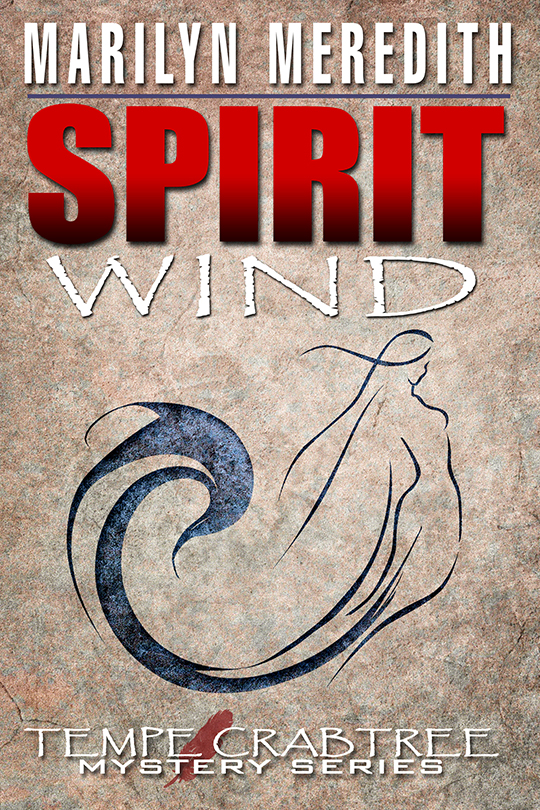
Marilyn, whose latest Deputy Tempe Crabtree mystery is Spirit Wind.

Spirit Wind cover

Blurb for Spirit Wind: A call from a ghost hunter changes Deputy Tempe Crabtree’s vacation plans. Instead of going to the coast, she and her husband are headed to Tehachapi to investigate a haunted house and are confronted by voices on the wind, a murder, and someone out to get them.

Buy link: https://www.amazon.com/Spirit-Wind-Tempe-Crabtree-Mysteries/dp/1092112081/ref=sr_1_fkmrnull_1?keywords=Spirit+Wind+by+Marilyn+Meredith&qid=1556631664&s=books&sr=1-1-fkmrnull


Guest Blogger: Jeri Westerson

History and the Religious Thriller

By Jeri Westerson

When you write about the medieval period, religion looms large. Of course, I’m talking the Catholic Church when it truly was a universal (catholic) church, where everyone who was Christian was Catholic and any reformists were to be condemned. In the time period that I write—late fourteenth England—being a reformist was dangerous but not necessarily life-threatening. That was later, in the fifteenth century (after all, no one expects the Spanish Inquisition).

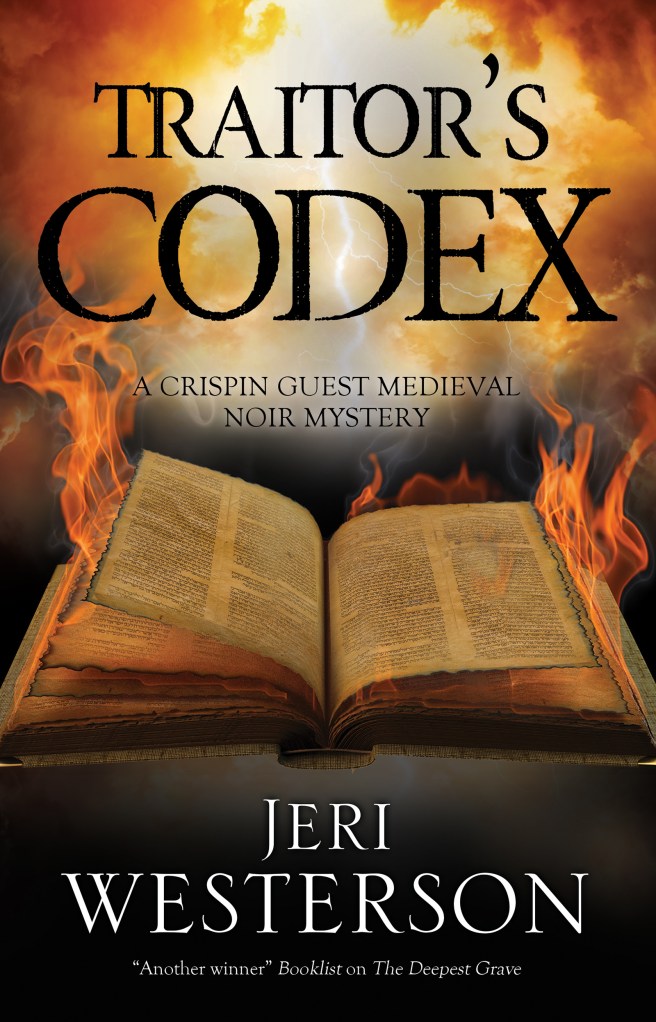
I’m always looking for something interesting for my disgraced-knight-turned-detective Crispin Guest to deal with, besides murder. And I remembered reading about the Judas Gospel a few years ago. It’s only one of several “apocryphal” gospels, meaning “hidden”, or those that weren’t accepted at the time when the early Church fathers were deciding what to include in the New Testament, like the Gospel of Thomas and the Gospel of Mary Magdalene. But the Gospel of Judas would be sufficiently intriguing and dangerous enough for my detective to discover and try to fend off forces beyond his control. Judas is the “traitor” in TRAITOR’S CODEX, but the “traitor” is also Crispin, whose treason got him disgraced and banished from court in the first place.

By delving into its strange history, the religious reformers of the day (called Lollards), and getting him mixed up in murders and a mysterious agent of the Church out to get this book to destroy it, Crispin has his hands full doing his detecting.

The Judas Gospel, as did many of the apocryphal gospels, had a different voice from the four chosen gospels we know of today. It follows a very spiritually eastern path with its emphasis on one’s inner divinity, and that Judas was the favored Apostle not John, the one to whom Jesus entrusted this distinctly different philosophy. It’s presence certainly made Crispin think about what it means to be a faithful Christian, when the most auspicious decision one could make in the day was whether to follow the orthodoxy of the Church, or follow Lollard tenets. Lollards did not believe, for instance, that baptism and confession were necessary for salvation. They believed in the laity reading scripture in their own language and they considered asking intercession of saints and statues a form of idolatry—essentially, the beliefs that would eventually come to fruition in Henry VIII’s reformation in the sixteenth century.

When I started writing my series, I was interested in the medieval setting, with its mores and society so very different from our own. The challenge was to world-build just enough so that readers not wholly familiar with the fourteenth century and the court of Richard II, would be able to relate to my characters. Authenticity sometimes wars with accuracy (I give you the taste of the language, for instance, instead of writing it in Middle English), but history is never sacrificed for plot. Sometimes it’s tight-rope walking that fine line, but it’s never dull.

Disgraced knight turned detective Crispin Guest is caught in a deadly conspiracy within the Church to suppress what they consider a dangerous relic from falling into the hands of the reformist Lollards. But murder and betrayal are the coin of the realm amid the turmoil stirred up by a mysterious nemesis. Crispin struggles to find a killer and might have to bring a painful truth to light while avoiding falling into the lethal hands of a shadow organization within the Church.
Buy links: Amazon https://www.amazon.com/Traitors-Codex-Crispin-Guest-Mystery/dp/0727888757/ref=sr_1_1?crid=2BH7SKBABH45&keywords=traitors+codex&qid=1561419959&s=gateway&sprefix=traitors+codex%2Caps%2C248&sr=8-1Barnes & Noble https://www.barnesandnoble.com/w/the-traitors-codex-jeri-westerson/1130151313?ean=9780727888754#/Indiebound  https://www.indiebound.org/book/9780727888754Google Play https://play.google.com/store/books/details/Jeri_Westerson_Traitor_s_Codex?id=7MeDDwAAQBAJKobo https://www.kobo.com/us/en/ebook/traitor-s-codex

Los Angeles native JERI WESTERSON is the author of twelve Crispin Guest Medieval Noir Mystery novels, a series nominated for thirteen national awards from the Agatha to the Shamus. Jeri also writes the urban fantasy series, BOOKE OF THE HIDDEN. She has served two terms as president of the Southern California Chapter of Mystery Writers of America, twice president of the Orange County Chapter of Sisters in Crime, and as vice president and California Crime Writers Conference co-chair for the Los Angeles Chapter of Sisters in Crime. See more about Jeri at JeriWesterson.com or visit BOOKEoftheHIDDEN.com

Social Media:Facebook https://www.facebook.com/author.westerson Instagram  https://www.instagram.com/jeriwestersonauthor/
Pinterest  https://www.pinterest.com/jeriwesterson/

Inspired by Solitaire

There are two immutables that drivSolitaireShote my writing life. One is that I am the ADHD poster child. This means that focus is not my strong suit and that I am fidgety as all get-out. The other is that I am an audial writer. I have to hear it in my head before I can write it. So, sitting still while mulling over my next line can be a bit of a problem.
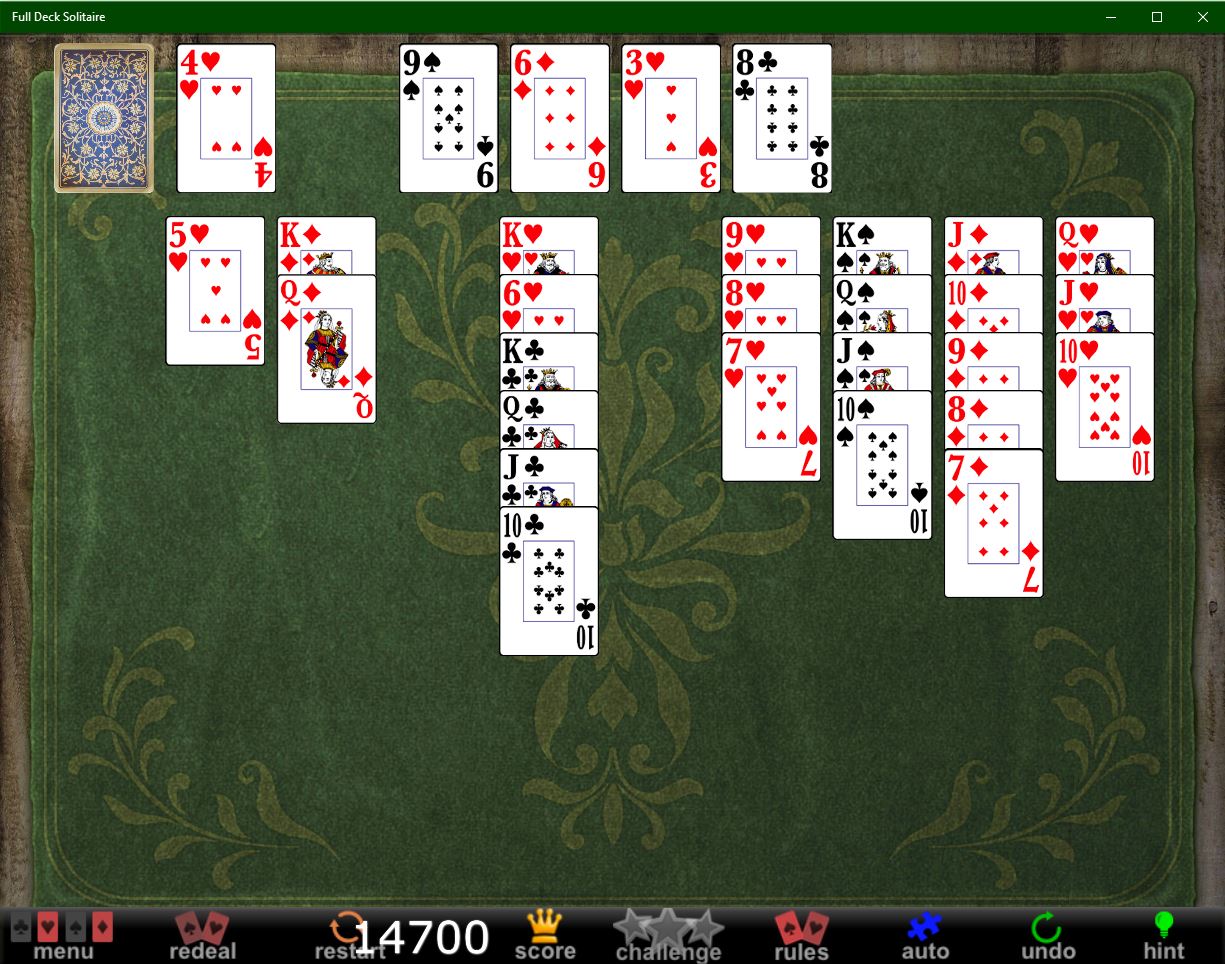
Thank God for solitaire. Okay, I also like Bubble Witch (although that’s getting a little too tough for mindless clicking) and I have a slot machine game (completely mindless clicking), plus the mahjong matching game and blackjack training. But when it’s time to write, inevitably, I’ve got the solitaire app open.

It’s one of those that has dozens of games, most of which I don’t play. But I have my ten or so favorites, and of those, there’s the game I play most often – Thirty Thieves. It’s not an easy game to win, but not as impossible as its cousin Forty Thieves. I win about half the time I play – and I know that from my stats. It’s not completely mindless, in that I do have to decide where and how to play my cards. But it’s pretty close. (Drat, just lost another hand). In short, it keeps my mind and my hands just busy enough that I can focus on what to write next.

The idea behind Thirty Thieves is that you try to move cards in number and suit order Solitaire2up to the foundation from where they’ve been dealt. The catch is that you can only move one card at a time (okay, need to undo that last move) and you can only go through the stack once. But you can put cards in any empty spot, once you’ve emptied it. (Let’s see, if I put that seven here, I can put the eight and the nine there and there, then put the eight on the nine and the seven on the eight, and that’s a new empty spot.)

I try not to think how many games I go through while working on something. I think I’ve played at least 12 since I started this piece (won that last one – yay). And sometimes, I have to get away from desktop so that I’m not playing endless rounds of solitaire. But there is something about that mindless clicking that joggles the thoughts loose like nothing else. (Okay, 14 games).

So, what helps you joggle the thoughts loose?