Ol’ Man Janus Ain’wah He Use-ta Be

by Missye K. Clarke

I’m at my new tripod desk as I work on this month’s longish post, so I please ask your pardon for the inconvenience. Truthfully–and warring winter allergies with pet dander while half-zonked on antihistamines meds–I’m half-winging this, uncertain how to open or grab your attention on a writing topic not done past use, but I suppose this works. I wasn’t about to offer another post of life post-couvid, or kvetch to y’all when do I get my former life back, how I’m adjusting without this or that. Although nothing wrong with those subjects in/of themselves, for one usually a big mouth on issues . . . couvid silenced me another way: The shock of how fast humanity changed past the point of know return, the shock itself, and how this event’s deepoend me despite not wanting to go that crazy depth. Like in almost every writing reference around insisting the main character must adjust to his or her new normal in their worlds, I’ve been forced again to follow suit. Guess my cast is having a good belly laugh at my expense, because in their words: this constant compass-adjusting just fuckin’ sucks. They’re not wrong.

Still . . . I’m notorious for delayed shock, unfortunately exposed to this at an early age. Knocked out cold by a thrown rock when I was nine, I had my first of several out of body experiences, being knocked silly to start with, subsuquent recovery from the OBE, and the shock itself until many weeks later. 9/11/2001, another stunner, now much bigger and deeper with the emergence of a more likely storyline behind that event I’m still unpacking. Still sweaty from kidhood at twenty whem my forty-year-young mom lost her cancer fight; and four years hence, more shock during what should’ve been a joyous time receiving my firstborn the same year my father violently died. As you can imagine, also released that year, Mike + The Mechanics’ “The Living Years” will always hold a certain poignance, the last verse especially useful when I need a good cry to wash my eyes out before allergy meds kick in.

But even couvid and a rigged election’s aftermath still being written before our eyes isn’t my biggest shock, despite the resonance these events still hold. For the longest time, I’ve struggled to put my thoughts and feelings into digestable bites for readers and contributors of this platform to understand, cogitate, and maybe help me change–and on another level, maybe even relate a little to me–without coming off bitchy, arguing too much, or generally be that unlikeable narrator. This subject’s been on my heart since I could remember, only recently instigated by open mockery, hot disdain, and the flat-out exile from groups, orgs., and other socials of daring to hold a dissenting point of view. What was once done in pockets of academia–being a target from both sides while finishing college, you learn a few things–the veneer of impartiality and evenhandedness in the open marketplace of ideas is gone, if it existed to begin with. In its place is a scary, filthy leviathan of a share-our-view-or-else slant now so mainstream you’d have to be living on Pluto most of your life not to see how bad times have become. Don’t misunderstand–this isn’t a political post, nor will such ever be shared here. But I’m speaking–pleading, if I’m being honest–strictly from the standpoint of an author making a modest living on a basic tenet: to speak his or her mind freely no matter how appalling, offensive, or dangerous it may come across. I do not sanction violence. But the right to be as you are, say what you like, how, where, when, or which you like–just being heard, damn it!–is being persecuted in unprecedented ways. I hope to help quelch this, not only in picking up the reins where the fantastic, late, great Nat Hentoff dropped off, but holding to that late Sixties drumbeat I was taught in school: DIFFERENCES ARE GOOD! As I opine this, I’ve tears in my eyes where free speech, free thought, and free expression will go–the helpful, beneficial, positive, uplifting, and inspiring kinds that call on pulling together differences in every one of us we’re the same to and in at the end of the day despite the awful-icky speech we’ve dealt with. Solomon of Proverbs was spot on when he said the tongue is more powerful than the strongest sword or the heftiest ship’s rudder. Hoo-boy, isn’t it ever.

In the guise of “wokeism,” I found myself in #1stAHasAVoice jail from certain platforms within the past year. One was with two scribe orgs. I’m happily no longer assosicated with; Twitter, where I called out several NYT bestselling authors for treating their readers like they’d been asked to enjoy a roten fish smoothie for lunch; and the third was a monthly box I’d gushed over several months back (This last, I owe you a deep apology for–not that you’ll like what I do, but I should’ve vetted this company more thoroughly for my tastes.) I could’ve been a little more diplomatic, suave, evenhanded in my responses. But I suppose holding my feelings and thoughts of what’s moral and just in the name of professionalism was what got even one of us here to begin with is problamatic. Done with being nice, I gave my own exit interviews to those outlets like a wrecking ball discovering demolition sex, having nothing else, in my eyes, to professionally lose. Banned from the blue bird (Sidenote: why are some to most beta males disgusting to strong women they secretly want? What, SWINOs–strong women in name only–need only apply?)–no real loss, since it’s permitting child porn and okaying snitching on your friends/followers/following, euphamistically labeled “Birdwatching” if you haven’t heard, with zero discernment. The tea has it through other socials membership is continuing to decline in my former orgs, including those rethinking their membership in wake of my treatment on principle, and take their wallets where viewpoint alienation isn’t a menu regular. As the quasi-tired expression goes, some are finally seeing the true light in the contrived darkness. I’m happy for this. Being that casuality, or witnessing one, isn’t a picnic, nor is going outside my comfort zone defending the attacked, or letting them stay persecuted (i.e.: capitulation by proxy) hoping in that skein, maybe I won’t be. Un/Fortunately, we’re not in polite times or polite society anymore. Positions will be taken, rooted deeper into, right POV or no. Whichever yours are, hold fast boldly, go all in, bake until done. Lukewarm, wimpy, or milquetoasts anything is unacceptable–in the writing life and your right to speak in it!–and that’s how it is.

As my box-drop is funniest in a you-hadda-be-there kind of way, I’ll expound. Comedians like Seinfeld, Ray Romano, Fred Rubino, identical twins Kevin & Keith Hodge, Larry the Cable Guy, Jeff Foxworthy, Tim Allen, and a slew of others lamented they can’t visit American college and university campuses anymore for stand-up routines. Why? Co-eds are so indoctrinated with unevidenced fear and anger over jokes being offensive to anyone, when it’s that means making dark times more bearable. The kids are right in one sense–even through we ladies might find gallows humor appalling, laughter makes those intense moments less so; I can only imagine the sick jokes during and after Christ’s execution or the rotten timing of satire from some in Titanic’s lifeboats as they waited for the Carpethia. But psychological studies of this phenom back this to be legitimate: dangerous vocations like First Responders or high-rise window cleaners have, or one in a horrific life-changing event, often crack morbid, greusome, or gory jokes to help themselves deal with nightmarish tasks they’d like to forget forever. In the place of some NYPD detectives having to handle recent affairs of child sex trafficking–those terrifying images involved they had to see, they’d damn better joke, joke, joke all the way home. #TooSoon isn’t applicable here.

But an author serving a spoof at couvid’s or its country of origin’s espense? No! Go! Scared me so! Get out, get out, GET!!!! OUT!!!! Not hyperbole, either–it happened all that way. Even this platform came under recent fire for contributors not towing the censorship line others wished they’d do. I defended my fellow authors in both cases that tasteless, crass speech is free to be expressed, as it’s on the reader/listener/viewer to discriminate if they’ll be in audience. Sadly, with many millennials freefalling into the dangers of okaying piecemeal’ed to extreme censorship–and not a few boomers declaring themselves God to push such impositions on–they complained to the CEO and group owners about the emerging author’s share and complained about those who supported her right to express herself. No avail. We were permanantly excused. Just as well–I can’t justify monthly writing tchotchkes on a lean budget, but more imporantly, I won’t patron a business hellbent on quelling voices or views they find objectionable because it challenges their hegemony or stances. Sharing my argument to the CEO that I expected to go unanswered (it did), later that week I received a snarkily-comedic worded exit email, feigning sadness in its “Dear John” seeing me go. Tough sh*t, I’m staying ghost. I won’t give anything of me to anyone, anything, or any cause showing its ass, even more so since my position’s been thoroughly belittled, dismissed, scorned, or openly made fun of. All in the name of tolerance, of course.

Although a tired expression, it’s one worth sharing again: Where He closes a door, He opens a window. Opportunities abound for a warrior. During times of great upheaval, they always, always do.

So. That was my January. The bearded god looking in our past sees . . . what? Wreckage of a broken everything, if we’re being raw honest. The god’s other bearded face looking into our sunrise of what’s to come . . . sees what, exactly? Wreckage illuminated? The glow to rebuild, the light to guide?

The resplendwency to constntly keep in plain sight what never to revisit in history ever again?

That dude’s role sure ain’t what it use-ta be.

Then again, ain’t none of us are.

Stay strong in the fight for the pursuit of life, liberty, and that ever elusive bitch of happiness, my friends and scribe warriors. We’ve only just gotten started.

ps: Almost forgot: Happy Valentines’ Day. May you all be showered in flowers today and always.

.
A Newsletter: To Have Or Have Not by Heather Haven

The decision to have a newsletter was not an easy one for me. I didn’t come to it naturally. At first, I resented spending the time and moola sending out something I wasn’t sure anyone was going to open, let alone read. My webmistress really pushed me to do it, saying any writer worth his or her salt had one. I like salt, so I relented.

Three years ago, she began to build one. And it was an immediate disaster. The first model used SSL, I believe. If I don’t have the right name for this, it’s because I’ve blocked it out. The bad taste of it stays with me. The newsletter, itself, wasn’t actually written by me, but used info pulled from blogs I was steadily writing at the time. It was supposed to be effortless, even going out to a designated email list at a pre-designated time.

It didn’t work. Sometimes it would go out but without any information attached. Just a banner with an image of me and Tugger the Cat would show up in their emails. Other times, it would go out containing bits and pieces of Gobbledygook, not one straight word. But most of the time, it didn’t go out at all. Meanwhile, I was paying for all of this through the schnozzola.

After three months of this nonsense, I started writing them in real time. Then I was in real trouble. I had no idea what to say. Just buy my books sounded a little too blatant. And for whatever reason, I couldn’t be amusing or witty in these newsletters I was writing to a bunch of strangers. Neither informative nor entertaining, the newsletters laid there like a lump. My readership dropped off significantly. It wasn’t unusual for me to lose five to ten people a month. I was desperate.

I was ready to abandon the whole idea of a newsletter and save myself 35 bucks a month in the deal. I happened to mention my decision to Julie Smith, who not only is my publicist, but a fantastic writer, herself. She was totally against the idea of not doing a newsletter, claiming this was the only way to reach out and truly get to know your readers. Hmmmm. You mean, a newsletter is something more than just buy my books?

I should also mention, in the meantime I had been reading other newsletters, from writers like Camille Minichino and Cindy Brown. These are authors whose work I not only admire, but who have newsletters I found myself reading from top to bottom. I discovered something amazing. They not only engaged the reader but wrote about stuff they were interested in. And it had an intimacy about it, like writing to a penpal.

Armed with the idea of getting to know my readers, I became more chatty in my newsletter and even asked questions. I started receiving emails back from them filled with tidbits about their own lives. I came to know many as more than names. I learned some of their stories. They became not just readers but friends. Not only did the email list stop declining, more names were added.

And they are all really neat people. I like them. I’m happy to write to them, to share something from my life, a joke, an anecdote, or even a book I recently discovered they might be interested in reading. Sometimes I mention my own books, but not often. I also found out, incidentally, most of them do buy my books, but not because I hawk them about it, but because my style fits into their reading pleasure.

This writing a newsletter is so win-win.

Revising the Landscape

Real places. For the most part, that’s where I set my novels. When I began writing the first Jeri Howard book, Kindred Crimes, I used Oakland, Alameda, and San Leandro as settings. I’ve lived in the Bay Area of California for decades, and at various times have called those cities home. In that book, Jeri travels to the town of Cibola in the Mother Lode, the old gold mining area along Highway 49. Cibola is fictional but it’s modeled on the towns I encountered there when I took a vacation in that area.

I also write about real places in the California Zephyr books, the places my protagonist Jill McLeod goes when she steps off the train. Alameda, of course, since Jill lives there with her parents. Also San Francisco and Oakland. In the most recent book, Death Above the Line, Jill is Niles, which was at that time (1953) a separate township soon to merge with four other townships to form the city of Fremont.

Downtown Niles

Writing about real places means I pay attention to the landscape as it exists and make every effort to portray it accurately. Although I will exercise the writer’s prerogative. That means if I want to put a café on that corner, I will.

I take field trips from time to time. Most recently, that involved going to the Niles District and walking around to check out what various fictional characters could see from real sidewalks and corners.

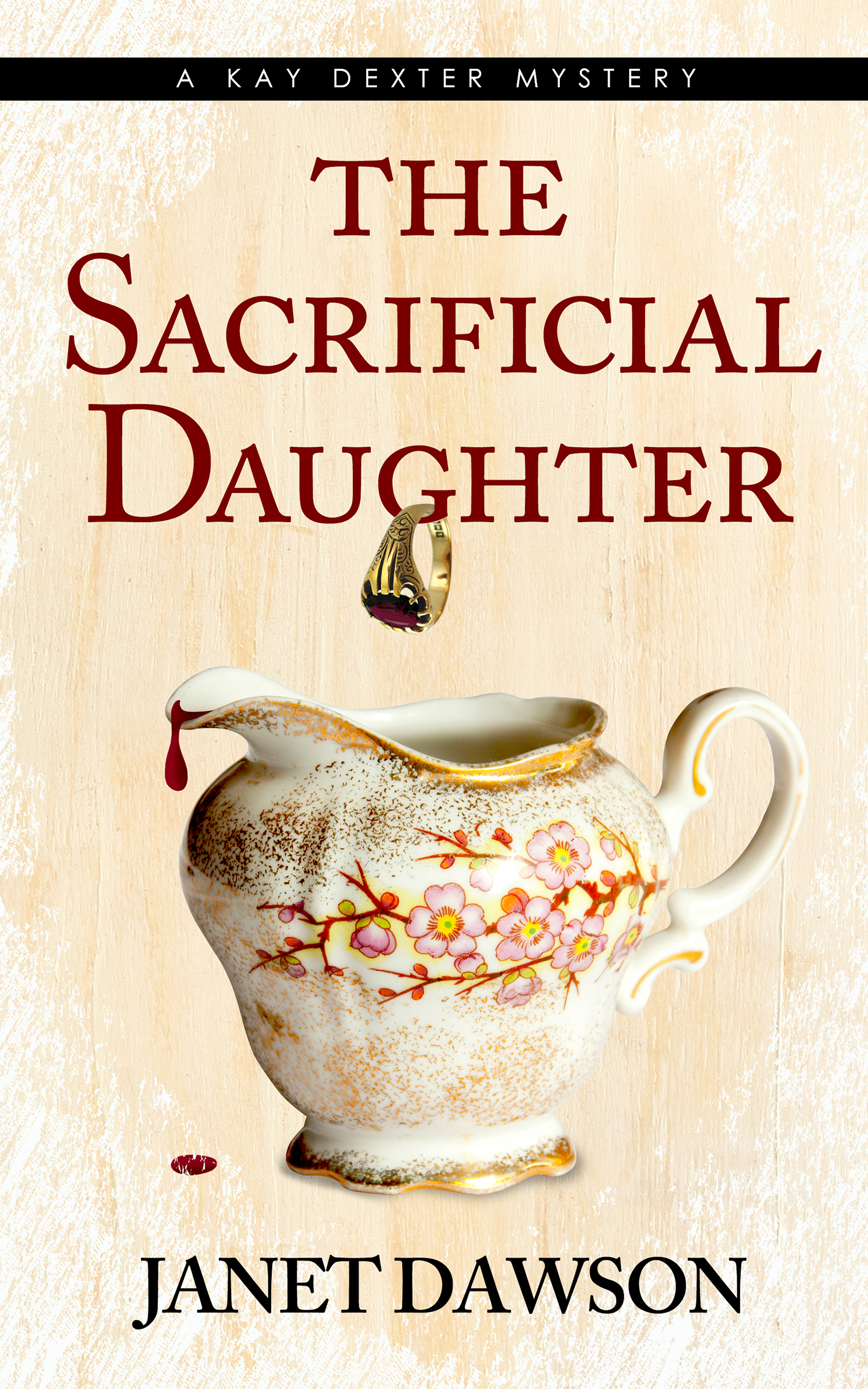
The Sacrificial Daughter will be published in mid-February. Protagonist Kay Dexter, a geriatric care manager, is an advocate for elderly clients and their families. The book is set in Rocoso, a city in a county also called Rocoso, located in the Northern Sierra Nevada. It’s the county seat and has a four-year college where Kay’s significant other, Sam, teaches history. There’s a historic narrow gauge railroad that goes up a scenic river canyon to an old mining town called Jermyn. The river itself is known for its Class Five rapids and is popular with rafting enthusiasts. At a midway point are the abandoned ruins of a resort hotel where people still go to soak in the hot springs along Lost Woman Creek.

None of these places exist, except in my imagination. And now, in the pages of my book.

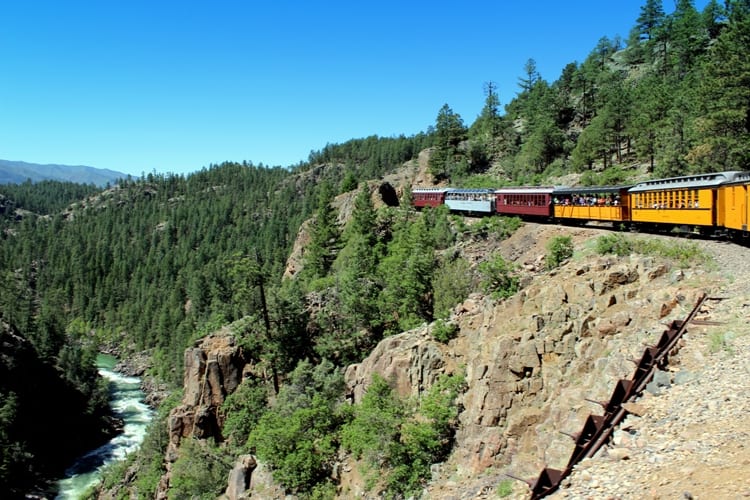
To be sure, anyone who has ever been to Durango, in southwest Colorado, or who has ridden the Durango & Silverton Railroad will recognize their counterparts in Rocoso and the Rocoso & Jermyn Railroad. The landscape and hot springs at Princeton in the Colorado Rockies might strike a familiar chord. The river could be the American or Yuba in Northern California, the Animas or Arkansas in Colorado, or any rugged river where rafters challenge the rapids.

Train above Animas River

The advantage of creating a fictional setting is that I can arrange the streets to suit me, as well as the topography. And most important of all, the history and culture of the place. Kay’s office is located in the former stables behind Rocoso’s historical society and museum, a building that once housed a bordello. That derelict hot springs resort at Los Woman Creek plays a role in the plot. So does the river and the rapids.

That’s what writers do. We revise the landscape to suit our needs, whether it’s putting a nonexistent café on a corner in a real town, or making up a whole county full of towns and populating them with characters.

Calypso Swale Is Smarter than Me and I Created Her!

The wind hit at about three in the afternoon. A stiff breeze that turned into a raging blast. At a hundred miles an hour, it tossed trees, tore off shingles, smashed roofs, and tangled wires into a massive mess that Pacific Gas & Electric took six days to unsnarl. In the meantime, a refrigerator full of food sat unused, the propane furnace was useless without electricity to the thermostat, matches were required to light the range, and no water without the water pump, no washing, no showers, or toilets flushing. So, there we were roughing it at the edges of civilization. In a normal year, let’s say without a pandemic, one would make reservations at the nearest hotel.

That may not have worked anyway because every PG&E employee plus ten was housed in the local hotels. So, we set about making the best of it. We drove down the hill to the local drive-through for breakfast and bought sandwiches at a grocery store, which we then ate sitting in our car in various parking lots, listening to the news, and charging our phones. We weren’t the only ones.

The wind tore chunks of shingles off our roof and deposited limbs with abandon. Our realtor recommended a roofer, he didn’t do repairs anymore. But at the mention of her name, he recommended someone who did and said to use his name with specific instructions on how to reach said roofer. That is why we are the only people in our area with our roof restored and not blue tarp dangling where trees bisected the house.

Now we have snow, eight inches of it, effectively snowing us in. Electricity is still up, our internet provider is not, but we have hotspots on our phones and a jetpack, and we can charge them without the car, so we aren’t without. No Netflix, or Amazon Prime, or… Thankfully we have a handful of prized DVDs.

What have I learned? That it would have been nice if our new fireplace had been delivered and installed before the wind hit. That we should have a generator and maybe a whole house generator like our neighbors. Listening to theirs humming away caused waves of jealousy. That Calypso Swale, of my thriller Saving Calypso, was savvy enough to have a peddle-charger to light her cabin at night. Having done the research for that book that takes place just northwest of where we are snowed in, you’d think I would have learned something about living off the grid. Because, when the power is out, you are really, really off the grid.

I did learn that if your freezer is stuffed enough, and your refrigerator door lined with cold wine bottles, and you don’t open either, you might make it six days without any loss of food. We’ll find out when we eat the jambalaya I made just before the power went out.

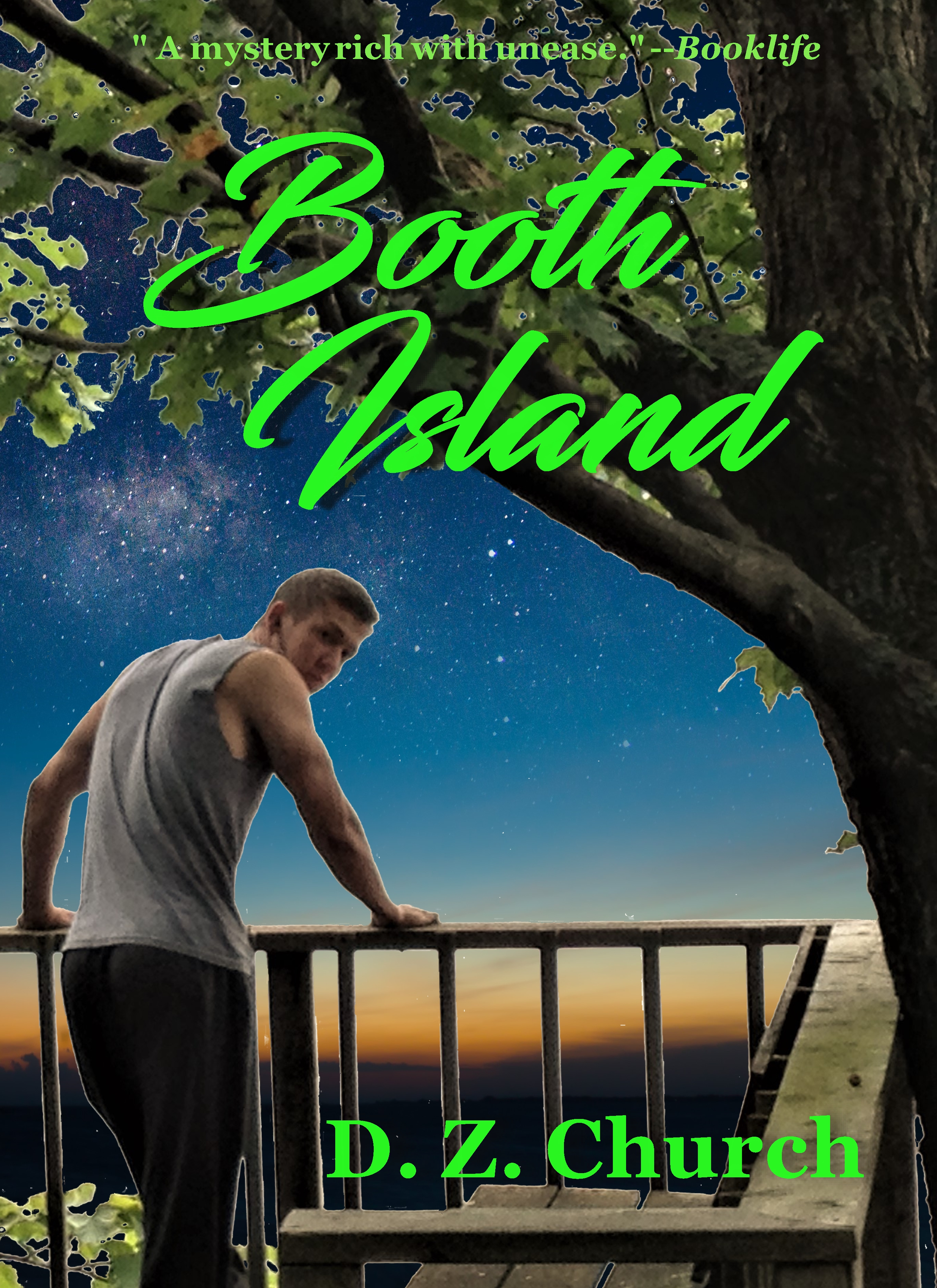
I’m not a stranger to camping or staying on an island without power or using an outhouse. In fact, I relied on that experience in writing my soon to be released book Booth Island. But losing power, when you have it, is a weird thing. First, you assume that the power will magically come on in the morning, then it doesn’t, so you think it will by 6:00 pm because it always has. Then you get into the bringing in buckets of rainwater to flush mode and doing anything to ease through the day. Should I have been writing? Yes, but my computer was on when the power went out, and my battery was dead. Dead. Dead. Dead.

With a book coming out, losing six days is a big deal. I’m behind on everything, including promotions, ads, and, well, everything. But here’s a preview of Booth Island:

My clothed body bumps off granite rocks as it descends into the frigid depths of a Canadian lake. A swirl of red drifts on the bubbles escaping my lips. I watch each pocket of air grow smaller as it ascends toward the surface. A concussion rams my hip against a cement post. I glance to my left. Another body bobs next to mine. Recognizing it, I reach out…

I woke with a jolt knowing I was out of my depth again. I chose to believe that was the message of the dream. The nightmare, really, had haunted me at random intervals since my brother, Roy, drowned at the age of seventeen. I was fifteen at the time. We had been a team.

Winter here, wind calm, jetpack working. All is good. Twelve inches of snow predicted for tonight.

An Unusual Month

Not  sure how I feel about the first month of 2021 starting off with some strange happenings. I’m hoping it isn’t a forecast of things to come.

My latest book, Not As We Knew It, made its debut. My sister ordered a book immediately, read it, and reported a couple of typos. Told my editor/publisher and she fixed them. Then my daughter read the book and found more typos and other errors. (Both said they really liked the book despite the problems.) I also heard from other who said they loved the book and ignored the typos. All has been fixed and the new version available on Amazon.

Others have bought copies, and of course, I purchased copies to sell. My editor/publisher is sending me some of the fixed copies to replace the ones with errors. I’ve offered to replace the books of others who bought from the first batch. Only a few have taken me up on the offer.

I’ve been complaining about being unable to participate in any in-person events—and in this case, a good thing, until my new books arrive. However, I was invited to give a presentation on writing at the local Art Gallery, and told to bring some books. Once a month, different artist demonstrate new techniques, and this time it was me to talk about writing. A huge article was in the paper about my appearance along with a warning that everyone had to wear a mask and social distancing would be in place.

Frankly, I doubted many, if any, would come. To my surprise the room already had about a dozen people in it when I arrived; more sat in the next room to listen. (One of the members of the art association said 20 in all attended.) All wore their masks. Among those there were a teenage boy who wants to write mysteries, a young man who is writing a book set in World War II, two older men writing their autobiographies and another writing non-fiction. None of the women spoke up about what they were writing or wanted to write, but may have been there just to support me. However, they were the main book buyers. I also gave away copies of the book with the typos and errors to everyone’s delight.

I spoke for two hours mainly about writing in general and answered lots of questions. I had a great time, and I think those who came did too. Hope I can do it again somewhere in the not too far future.

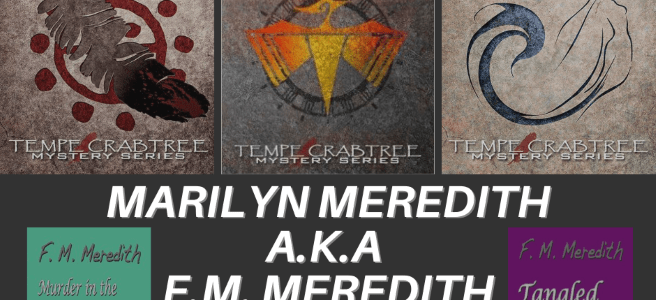
And if anyone is interested in the re-edited Not As We Knew It, it is available on Amazon for Kindle and in paper. (I write this series as F. M. Meredith.)

One more thing, from February 1-5, I’m offering Kindle copies of Seldom Traveled for .99 cents.

Marilyn